Ab Psych Chapter 7: Mood Disorders - Bipolar Disorder
- Bipolar Disorders: formerly called manic-depressive illness or manic depression
- Characterized by unusual shifts in mood, energy, activity levels, and concentration
- Moods span the extremes of “up” and “down”
- Manic episodes (up) = elated, irritable, energized
- Depressive episodes (down) = sad, indifferent, hopeless
- Hypomanic episodes = less sever mania
- 3 types: Bipolar I, Bipolar II, & Cyclothymic disorder.
- Bipolar I: Manic episodes that last at least 7 days, or manic symptoms that are so severe the person requires emergent care. Depressive episodes that last approximately 2 weeks
- Very sever manic episodes
- Bipolar II: Pattern of depressive and hypomanic episodes, but not full blown manic episodes as seen in Bipolar I
- Episodes are not as severe as manic in Bipolar I. No manic episodes seen, only hypomanic.
- Cyclothymic Disorder: Periods of hypomanic & depressive symptoms lasting a period of 2 years, that do not been criteria for a hypomanic or depressive episode
- DSM-5 Criteria for a Depressive Episode: same as criteria for depressive episode in context of MDD
- 5 or more of the following symptoms must be present during the same 2-week period and represent a change in previous functioning. At least 1 of the symptoms is either (1) depressed mood or (2) loss of interest or pleasure:
- Depressed mood
- Loss of interest or pleasure in almost all activities
- Unintentional weight gain/loss or decrease/increase in appetite
- Sleep disturbance
- Psychomotor changes (agitation/retardation)
- Tiredness, fatigue, low energy
- Sense of worthlessness, excessive, inappropriate, or delusional guilt.
- Impaired ability to think, concentrate, make decisions
- Recurrent thoughts of death
- Manic Episode criteria: A distinct period of abnormally and persistently elevated, expansive, or irritable mood, abnormally and persistently increased activity or energy lasting at least 1 week, and present most of the day, nearly every day.
- During this period of increased mood and energy, 3 or more are present:
1. Inflated self-esteem or grandiosity 2. Decreased need for sleep 3. More talkative than usual or pressure to keep talking 4. Flight of ideas, racing thoughts 5. Distractibility 6. Increase in goal-directed activity 7. Excessive involvement in risky situations
- The mood disturbance is sufficiently severe to cause marked impairment in social or occupational functioning or to necessitate hospitalization to prevent harm to self or others, or there are psychotic features.
- The episode is not attributable to the physiological effects of a substance (e.g., a drug of abuse, a medication, other treatment) or to another medical condition.
- Manic Episodes vs Hypomanic:
- Mania lasts at least one week, causes sever impairment and may have psychotic symptoms
- Hypomania is a less severe version of the mania, it lasts at least 4 days, and psychosis (psychotic symptoms) are not present
- Bipolar I vs Bipolar II:
- Bipolar I is when there is at least 1 manic episode experienced in the past. And there may or may not have been a major depressive episode experienced in the past. People with Bipolar I do return to a baseline of functioning between such episodes
- Bipolar II has at least 1 hypomanic episode in the past. And at least 1 major depressive episode in the past. And there will be no history of a manic episode (if manic episode occurred in the past, then it’s Bipolar I, not II)
- Specifier - specific terms and conditions in the DSM that can be used to further identify a specific type of disorder within a general disorder.
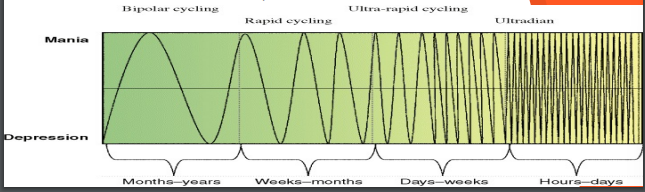
- Specifier #1: Rapid Cycling -
- 4 or more full cycles of mania and depression within a year without any intervening normal periods
- Relatively uncommon
- Linked to poorer outcomes
- Greater risk for suicide attempts
- Specifier #2: With Mixed Features -
- Applies when symptoms of mania and depression occur within the same episode, there are no swings between the two
- Mood shifts between mania and depression
- Almost every day for at least a week
- Someone with MDD could get this specifier (not enough symptoms to meet criteria for a bipolar disorder)
- Less common
- Bipolar with psychotic features
- Going in between depressive and manic episodes is very overwhelming.
- Women who give birth are more likely to have depressive episodes due to hormonal changes, alone with manic episodes, which would be an onset of bipolar disorder.
- Cyclothymic Disorder: milder form of bipolar disorder. For at least 2 years, periods of mild mood swings (hypomanic and dysthymic moods)
- Few periods of normal mood that lasts for more than 1-2 months
- Usually begins in late adolescence
- Prevalence: 0.4% to 1.0%
- 1 in 3 people with cyclothymic disorder eventually go on to develop bipolar disorder
- Risk factors for Bipolar Disorder:
- Biological Contributors: Depression runs in families, Heritable genetic predisposition
- Psychological Contributors: Personality style, Ways of thinking and problem solving
- Environmental Contributors: Early childhood trauma, Major life events
- Sociocultural Contributors: Female (vs. male), Sexual identity, Racial/ethnic differences
- Theories of Bipolar Disorder 1: structural brain abnormalities may serve as biological risk factors.
- Abnormalities in: volume of the striatum, left hemispheric white matter, thalamus, anterior cingulate, ventricles, hippocampus, or subgenual prefrontal cortex.
- Areas of the brain related to language look different for those with bipolar disorder.
- Various chromosomal regions and genes are related to susceptibility to bipolar disorder: Serotonin transporter (5-HTT, SERT), Dopamine transporter (DAT), Brain-derived neurotrophic factor (BDNF), Mitochondrial DNA mutations, Glutamate receptors, Mitochondria-related genes, Chaperone genes, Oligodendrocyte genes, GABAergic neurons
- Twin and adoption studies indicate a genetic link.
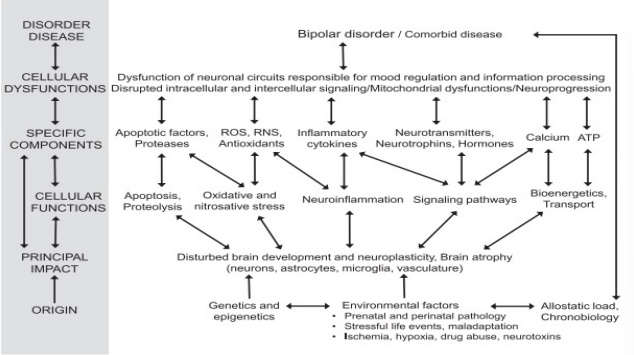
- A mix of a ton of different factors that will put you at risk for bipolar disorder.
- Stressful Life Events: stressful life events can trigger mood episodes in people with bipolar disorder
- Negative events (like job loss, marital conflicts) may trigger depressive episodes
- Both negative and positive life events (like getting a new job) may precede a hypomanic or manic episode.
- In relation to the diathesis-stress model: stressful life changes and underlying biological influences may interact with a genetic predisposition to increase a person’s vulnerability to bipolar disorder
- Protective Factors: social support from family and friends can buffer against negative impact of stress. → Helps speed recovery and reduces likelihood of recurrent episodes.
- Treatment for Bipolar Disorder: Psychotherapy alone is not sufficient for bipolar disorder - medication often necessary to stabilize mood
- Psychoeducation: information about bipolar disorder, its causes and treatments, with primary goal of medication adherence → provide people with insight on their disease, gives patients autonomy and control of their disorder a little bit.
- Psychotherapy: psychoeducation and focus on identifying and challenging overly negative thoughts and overly positive thoughts present in mania
- Additional focus on promoting regular sleep and balanced lifestyle.
- Family Focused Therapy: psychoed + family involvement; communication skills
- Based on evidence that overly negative family interactions can trigger relapse.
- Interpersonal and Social Rhythm Therapy: modification of IPT. Focuses on resolution of current interpersonal problems (like unresolved grief, interpersonal disputes, role transitions, and isolation). Also regularity of daily routines and schedules.
- Medications for Bipolar Disorder:
- Lithium: Helps moderate mood swings by regulating glutamate in brain.
- Too much glutamate = mania; too little = depression
- Indefinite treatment (like insulin for diabetes)
- Adherence is crucial but many stop because of side effects: Headache, nausea, dry mouth, hair loss. And Lithium toxicity
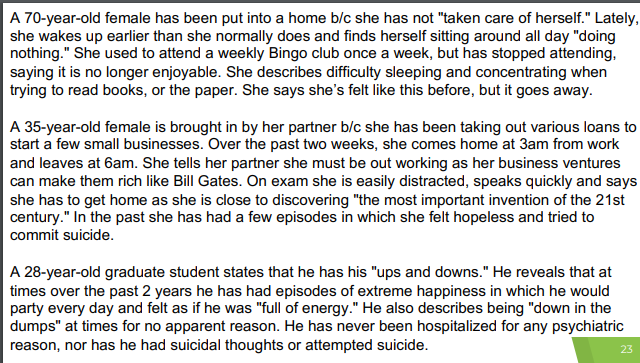
- 1: loss of interest, can’t concentrate, no manic episode so not Bipolar disorder, so MDD
- 2: Experiencing manic episodes, episodes where she felt hopeless and suicidal. So it’s Bipolar I
- 3: Cyclothymic disorder, Milder mood swings and symptoms, been going on for an extended period of time.