L1: Ductile vs brittle behaviour
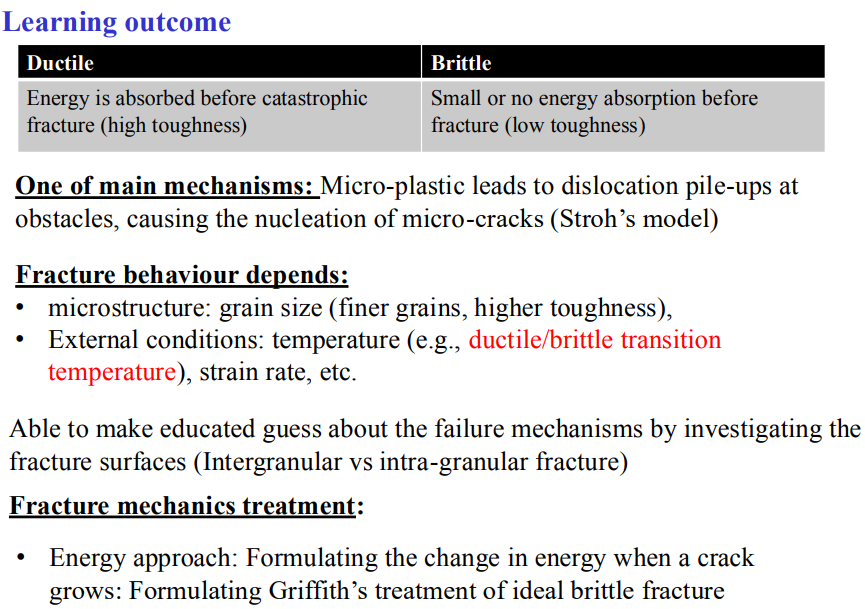
Key Mechanisms
A. Crack Nucleation (Stroh Model)
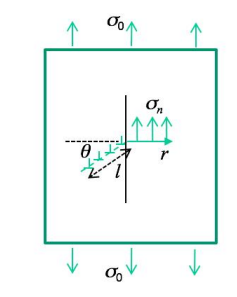
Dislocations pile up at obstacles (e.g., grain boundaries).
Shear stress builds up → nucleates microcrack.
Shear stress:
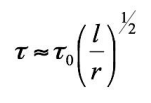
(l = slip band length, r = distance ahead of pile-up)
B. Griffith Theory (Brittle Fracture)
Crack grows when:
Strain energy released ≥ Energy to create new surfaces
Critical crack size (ac) and fracture stress (σf):
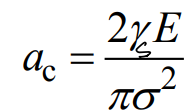
(γs = surface energy, E = Young's/elastic modulus)
3. Factors Affecting Fracture
Factor | Effect on Fracture |
|---|---|
Grain Size | Finer grains → higher toughness, ↓ DBTT |
Temperature | Low temps → brittle (↑ DBTT) |
Strain Rate | Higher rates → brittle behaviour |
Stress Triaxiality | Hydrostatic stress → brittleness |
4. Fractography Clues
Ductile: Dimples (cup-and-cone morphology).
Brittle:
Cleavage: Flat facets, river lines.
Intergranular: Crack along grain boundaries.
Transgranular: Crack through grains.
5. Practical Implications
Charpy Impact Test: Measures energy absorbed to determine DBTT.
Design Tips:
Reduce grain size (↑ strength + toughness).
Avoid stress concentrators (e.g., sharp notches).