HISTORY 1809G UWO — International History 1880s-1990s: Together and Apart
History 1809G
Intro:
Newspaper assignment – 5% for finding your topic.
Second assignment – pay attention to how historians in coursework define internationalism
Research – what impact is it having, relate it to big themes, was it divisive or unifying how did it circulate and what impact did it have on people
5% a day penalty
Pay attention to images in the course !! there was a question on the previous exam about pictures in the slides…. “Explain why it is an emblem of internationalism”
Week 2: People on the Move
Migration – British and French settler colonies
Nation building strategy – ‘Last Best West’, opportunity
Repopulation after settler colonialism, through prejudiced immigration practises.
So… or so what? What does this mean for internationality?
Tourism
People began to move for pleasure initially .. or out of curiosity (the idea of an elitist class due to restricted access to education and wealth)
Travel:
Technology and transportation made tourism more accessible
– steamships and trains .. transportation revolution
Orient Express began operating between London and Constantinople in 1883
Isabella bird (Hawaii 1870s)
Cook’s Ticket and his belief that tourism and exposure to other cultures would make the world more peaceful – u capitalist and opportunist FUCK AWFFFF
Luxury, Mass, Individual and War tourism
Passport Regime
Wartime measure – security issues – rise of passports after WWI
They would expire in 1 yr or 6 months sometimes.
Govts. wanted passports because they wants to assign a national identity to citizens
^ gives us the right to travel but it really does restrict one's identity
Facilitating mobility and restricting it as well. Juxtaposing idea
Establishment of National Identity
League of Nations – very preoccupied with refugees
Nansen passport for refugees and stateless people .. but did not grant you citizenship
Hierarchy and ethnic nationalism.. Govt control on who could come in and on what terms.
Great concerns about ethnic and racial mixing, sense of fear (Aus, US, CA, GB, SA) about businesses and international projects on one's own nation and how it could potentially sabotage western Success
Survival or Death – Social Darwinism
The idea of an approaching demise of the European
Foreign labour = economy yay
Economy good = fuck off u can't come into my country
Things okay = leave this job u cunt it's mine
Controlling migration due to prejudiced opinions on nationalism
Ideological purity and restrictions based on
Transportation
Case Studies
Migrants
Labour movement defines this period
Consequences of migration –
Displacement
Imperialism.. Facilitates migration but can also
Race and racism – rise of ethnic rationality … legitimised to achieve certain objectives.
Week 3: International Movements:
People were moving around – and relatively freely
Trade unions and govts felt threatened… migrants may threaten jobs in home country
Regulation and exclusion
Ethnic nationalism etc.
Qwok She – wife of Chew Hoy Quong
Restrictions Case Study:
Targeted to specific groups of people
Restriction of Asian migrations – journey had to be continuous
Head tax was one migrant per 50 tons of cargo
British empire allowed its colonial constituents to travel throughout the empire – Britain was not happy about Canada's attitude to this
Du Bois again – ‘problem of the 20th century is the problem of the colour line’
Discrimination barriers and hierarchies
Steady increase in NGOs
World esperanto association — common second language, amalgamation of different languages
Olympics Committee
International Socialist Bureau
Internationalism:
Exclusion is an important aspect – focus on who's being brought together, but also on who is being pushed to the sidelines.
Ideas about reforming into a better world – may be problematic
Upholding of Western Ideals
Reinforced global divisions between North/West and South
Upholding nations and nationalism
Trade Unions Movement
MARX AND ENGELS POOKIES
Conditions of the English Working Class (1845) , Capital: A critique of political economy (1867-1883)
(i) accepted risk and cost of the industrial revolution, Engels talks about child labour, health concerns, critic of workers and their, more of a human direction
(ii) Marx focused on the value of labour – smth fundamentally so wrong that strips the value of people. And instead of asserting value upon material goods and production, institutional theoreticians – labour should be valued.
Early Unions in US and UK Etc.:
Trades union Congress, National Labour Union, Knights of Labor, Free associations of Trade Unions
National movements of labour !!! National unions – skilled labour was unionised
Class as a form of organisation internationally
International cooperation but going back to one's own country
Overlap & Tensions between Trade Unions and International Socialism
Working class is exploited, fundamental injustice to be addressed
Offshoots of marxist thinking
Radical thinking about the functioning of states – border free? Transcending the nation state?
Abolishing state gradual reforms and world citizenship
Trade Unions however, were more focused on realist solutions:
8 hr workday; right to strike; limiting migration
May not be a critic of capitalism.. Just wishing for reforms
Proto-Communism
Socialism and Trade unionism had tensions cause of difference on issues like War
Trade unions could be patriotic
Nationalism – socialism has a bone to pick w it
Workers are exploited and have common cause – WW1 makes nationalism seem more important than peace and workers rights.
Working Class - Start of WWI
Jean Jaures – French Socialist Leader:
Socialists and trade unions should be against war.. Working class being enscripted would gain the cost of being involved with conflict – blood on our hands at the expense of the elite
History is messy – doesn't mean it's everything and confusing
People can hold completely contradictory ideas and it's fine.
Canon Foddering - treatment of soldiers as expendable forces
Social justice and rights are integral to the idea of Peace –
Creation of ILO
Peace conference — international secretariat lobby
Trespassing on national sovereignty and how ILO cant enforce too many peaceful regulations cuz it violates ???? bruh stupid ass shit
Unions and Anti-Colonialism
Early unions in colonies were restricted to European and white workers – building railways
Restrictive unions only applied to british workers etc.
Railway workers and government employs first to unionise for African workers
Not much labour solidarity
Strikes for European workers often did not includeAfrican workers – they often broken strikes by African unions
Labour movement linked to fight against capitalist exploitation
Trade Unions Peace Movement & Arbitration
William Randal Cremer
Frederic Passy - French MP
Promoted disarmament and arbitration – utopian mindset that economic conditions would improve
Peace Congresses: The Hague 1899 & 1907
TSAR NICHOLAS
Arbitration cause it would cost less
Peace negotiated by Roosevelt
Peace was utopian – who was entitled to peace? Those that were civilised
Nobel Peace Prize – White elites receiving prize
PPC & Treaty of Versailles 1919
Peace treaty with Germany
Size of army - tanks armoured
Territorial losses - Fines
Rhineland demilitarised and occupied
Saar: occupied and annexed
Article 231 - war guilt clause
Proposed by an American Lawyer – terms of the treaty presented to Germany, they refused to sign until they couldn't refuse any more.
Course of war created opportunity for peace
Elites being involved in Peacemaking – groups like RIA, CIIA
Paris Peace Conference Again
Elite older women having access to power
Fractured movement – zeitgeist of the war
1920s Flappers
Issues were right to work and control over their bodies
Shocking to social norms and values
Smoking, drinking, intercourse, Birth control
Next generation of feminist movement goes on to be called 2nd gen movement
Autonomy over body was not part of earlier women's movement
Class racial and generational divisions that informed these women
Western elite experience was a source of wisdom and guidance throughout the world
Issues are divorced from a cultural context when talked about in Western European context.. Accepting internationalism of Women's movement and its eurocentrism/western centrism
Progressive imperialism – white feminism
Week 4: Global Economy
Recap:
technology 🤝 internationalism
Big forces and pressure – but individuals matter. They themselves were impacted by international pressures
Nationalism and Internationalism – competing ideologies
Internationalism could be eclipsed by nationalism — race class and gender as influences on shaping international ideology
Universally true and relevant ideas presented… whereas they are deeply exclusionary ideals
Global Economy
Not supply and demand curves but the power and force of it to cause destruction and upheaval — how it affects conditions of life everywhere for everyone
Economy is pervasive and defining force for the political scope of the world
People and ideas move around — but the focus of the economy is how money and stuff moved around
Trade unions and remittances – Suez Canal
Countries achieving objectives through the economy — reinforced divisions and hierarchies
Broad Characterization
Periodization: global recession 1870s-1890s
Boom to 1913; shaky recovery
1920s; global Depression
1930s; World War Two ended the Depression
Second Industrial Revolution: chemists, oil, raw materials
Attitudes towards the global economy
Integration – free trade! Trade n everyone's better off
Protectionism– backlash, hijacking national resources and supporting the interests of other states
Welcoming cooperation vs. being empirical of, its path not being conducive to how others want it
Large and Multinational Companies
Large multinationals being established – monopolies
Centres of trade – countries attempting to access the markets – US and UK became big
Great Britain
Exported ¼ of production 1870-1914
Exported industrial goods, textiles, coal, steel
Imported food and raw materials
Raised 50% of global capital circa 1913
Centre of global trade & finance (leader of global economy)
They owed more money that they were bringing in with their exports –
Opium wars – to get people addicted and create a closed economic cycle
Opium was one of the commodities that allowed G.B to overcome their debt… nah bro
Moral implications of the economic actions
Was britain successful because it achieved through war, imperialism and addiction of because they were simply at the centre of a western
If you industrial first… others may more ahead
History of Rubber
Colonial production of Rubber:l
British in Malaya, Dutch in Indonesia, French in Indochina, Americans in Liberia
Congo under belgian imperial control — King Leopold
Rubber as a booming commodity was produced to be put up as a plantation in Congo
Coercion of labour
Labourers in Congo were killed if they didn't meet the expectations of their overseers — 2-15 Million people dead
Rubber became an imperial endeavour
USA rubber and car industry – principal market for rubber
Fordlandia – rubber for ford company - utopian society
American Internationalism – as soon as the american experience was desirable and universally relevant
Transplanting America and making everyone super productive – feeding them hamburgers to make them happy… completely absurd and idealistic
Monopolising commodities – ride or die kinda thing
Sedgewick: ‘What does it mean to be connected to faraway people and places through everyday things?’ (Coffeeland, p. 13)
History of Rice
Small scale production
Domestic market — export was usually to the same country that was producing it – Vietnam to China
No major technological changes
Terrain important: irrigation essential
Geography – supply and demand.
Increase yields by cultivating more land
Most rice consumed domestically
Asian rice economy – internal small-scale forces
Main exporters: Burma, Vietnam, Thailand, Taiwan and Korea
Prices less volatile
China as a stabilizer of the rice market
Resistance & Alternatives to Racism of the G.E
Contested World Economy, Helleneiner
Capitalist contributors don’t get their equal benefits.
Pan Africanism:
Global Economy as White Western World above all
Marcus Garvey – state that unified Africa
Working closely with Black Diaspora
Who benefits from the global economy? (Racist dimension)
Economic power leading to true emancipation
Racist hierarchies – tool for exploitation
Great depression
Massive unemployment
Govts were not in part of the Global economy, but they began to
We can not separate Economics from politics and the geopolitical scope of the world.
Integrated world economy – massive shock in the U.S – depression spread
World and the global economy
National Experiences
U.S.A
Largely about unemployment
Massive loans to Europe
Banks failed
Govt. would intervene to create jobs — United
Turn in and focus on itself – rejection of internationalist thinking
Smoot-Hawley Tariffs
Britain
Trading nation
Closed off market – no competitors pls, keep our own people i
Shutting off markets to keep civilians generating revenue
Unemployment at 25% of workforce
Export trade collapsed
Declining competitiveness
Utilising Imperial commonwealth system – tariff system
Expensive food - social unrest PLEASE FEED THE PPL WE CANNOT AFFORD THAT
Canada
Agricultural story
Industrial product slowed
Unemployment about 30%
Social protest – govt having to offer relief
Germany
Finance and trade – not fully recovered from WWI
German economy depended on loans from American banks
Banking system ent into crisis
Unemployment 44%
Ppl @ the govt. Can u move or sth — Hitler screaming in the corner
Getting out of the depression by militarising economy
Economic thinking under nazi – coercive economic participation of other countries
Expansionist militaristic logic
Japan
Relied on imports for industrial production
Nations less affected
USSR
Five year plans
Economy during the depression
Little economic contact
Largely agricultural – burgeoning economic leader in region
Not interdependent
China
Indigo plants – textiles
19th CE, synthetic dye was made – coffee came to El Salavador late 1920s, almost all of it is export
Oligarchs – but at the end of the day ppl in el salvador were better off bc of it
Just because Oligarchs owned most of the land doesn't make it truly terrible
People not having capital to work with because they now have to Own the land as well, they were better off
Week 4: IR & Global Politics I
Recap:
Freedom of Press. Journalistic autonomy and independence… risk of being arrested once writing about. Surveillance and censorship.
Steven Topik:
The history of the global economy is one of two things. Either that of Free rights, competition and liberalism. OR Imperial conquest, government intervention and exploitation.
The global economy was a key factor in the establishment of power dynamics and hierarchies globally, that stratified society and placed people into groups that perpetuate and maintain the dominance of Western nations.
Politics before League of Nations
Nations – component of international politics
Capitalism creating an order – and placing people in hierarchies
Shared political purposes
International Conferences:
Intl. Sanitary conference
1851 - 1938
Disease does not stop at borders
Economic motives behind cooperation: how to keep borders open and goods flowing
Disagreements on spreading of diseases
Promised to standardised quarantine —
Berlin West Africa Conferences
Before the partition of africa took off — 1880s merging competition between European states to control what happened in Africa
Turned their attention to Africa after beating each other black and blue…. Freaks
Didn't want colonial projects to interfere with each other – norms of colonialism.
Disputes in claiming colonies:
Missionaries would be protected — administrative presence – treaties with leaders and police, free trade – integrated economic system – claimed the colony, tell everyone else, so that you were overstepping someone else's territories.
“Civilised and non-civilised” – civilising, preserving and improving their moral and material well being
First Intl. Conference of the American States 1889 - 1890
Hague Peace Conference, 1899
Minimization of violence
Disarmament — concerns of Russian Tzar
Arbitration and conduction of war – outlawed chemical weapons
Politicians conforming to
Woodrow Wilson c. Lenin
Contemptuous european diplomacy
New kind of intl policy
February & the Democratic Movement ☭ !
Years leading up to WWI —
Russian empire – national liberation secret societies
Pan-Slavism:
Mushing all slavic nationalities under Russia
Serbia and Austria Hungary’s relationships
When Russia went to war, they promised Poland a state if they joined them in the war.
Country was not stable – war destabilised further
Political radicalism — anarchism and communism, and concerns of Russia international prestige
Does not have factory and industrial
National rights
Uninational military units
Conducting business in their own languages
Bolsheviks and Mensheviks
Mensha – smaller man
Not the time for a communist revolution – middle class then to socialist revolution
Bolsheviks:
based on Leninist and later Marxist–Leninist principles, are known as Bolshevism
Great War – imperialist war.
Withdrawing from WWI
Proletarian solidarity — reaching out to the working class and communists abroad. Extensive networks
Right for national self-determination ← global affair and threatening
Contrasts with Woodrow Wilson
Stalin who had a Minor nationality — chosen for Bolshevik representation
October Revolution
Seizure of power
Removal of provisional govt.
Communists took over
Execution of Imperial power – counter threat to revolution
Civil war
Pacifism – germans and austro-hungarians for them to pull out – territory issues
Militant nationalism within former Imperial territories
Baltic states, Poland, Finland, Central asia (1916), Ukraine
Foreign support for Finland and Poland (three diff national armies)
Military forces deployed to secure assets lent to the former govt.
Carrying degrees of support provided to White Forces.
The Revolution had so many diff nationalities.
Outside concerns from war effort – increasing issues with Red Scare
Communist Internationalism
Bolsheviks as a international group
Foreign communist – alex Budich serbia
Setbacks for trade
Canada example: Trade unions seized control – infrastructure etc – armed troops were sent in.
Socialist revolt in Germany and short socialist regime in Hungary
Civil war in russia lead to increasing independence of Poland
COMINTERN
Modernization – branching out to other groups.
Infiltration into internationalist groups
“Socialism in one country”
Anti - imperial world don't necessarily communism
Paris treaty
League of Nations
Treaty of Versailles – embedded League of Nations
Sure that it would be ensured that it would come into power
An international organisation to resolve disputes and reduce arms – so you don't have to go to war.
Japan racial equality clause – western nations not keep on it, dismantling immigration restrictions
League of Nations was NOT A DEMOCRATIC institution
Many delegations were contrasting in proposals etc.
Woodrow Wilson – vetoed because you have to have consensus
Resolving Conflict
Mussolini – LoN have no authority
Greece pay italy and Italians retreat
Kellogg Briand Pact
American international authors etc. – some war are legitimate this is bad
Undermining of intl thinking
Renunciation of war except for self-defence
65 nations signed
Everything fell apart in 1930s
Episodes of aggression on sovereign identities
Invasion of manchuria – japan withdrew from LofN
And Italian invasion of Ethiopian
Hoare laval pact
Failure of sanctions
Haile Selassie, emperor of ethiopia appealed to LofN
League tried to refuse him in Audience
Us today and you tomorrow
Idealised wilsonian vision of internationalism
International that seemed inclusive — indigenous peoples as sovereign peoples
LofN — International Health organisation
Long part of LofN
Poorly funded
Worked on epidemic diseases – ig issue at the time
Considered a high point for the LofN
With LofN’s increasingly limited in extrajudicial powers — ILO’s impact grew
Precursor to WHO
LofN Ideas About International Politics
Refused to uphold sovereignty of Indigenous peoples
Had their own ideas about legitimate participants in intl. Politics
Canada
Regulate things and restore order
Enfranchising Indigenous peoples at the expense of their indigenous identity and status
Forms of International things then, can be exclusionary – and not incorporate different forms of internationalist thinking
Week 5: Dark Internationalisms
What is internationalism?
It is an ideology – how people understand the world or how they think the world should be.
– seeing things that one does not like ; something that needs to be fixed
– injustice and inequality central to its purpose
– fragmented internationalism — not consistent across variations (eg. pacifists)
– idea that it means ‘good’ or progression
– perpetuation of hierarchies – element of reformation but they can also do harm and be exclusionary
– internationalism is not the antithesis of nationalism since they are entangled
–
Transnationalism (transcends boundaries of nations and sees their idea as fundamentally )
vs.
Internationalism (contact between nations)
Polarising and exclusionary ideas and — internationalisms that were coercive and violent and viewing ‘the other’ as fundamental to logic and objectives of their international
Nationalism
Ethnic nationalism – one group and their history
vs.
Civic nationalism – respect and encourage different cultural and ethnic background with a shared purpose
Inside vs. Outside group
Embedded in ideas about imperialism, fascism and communism
Imagined community
Transatlantic imperialism
Collaborative project
Late 19th Century in Europe –
Intense period of making claims 1880s to 1900s
Civilized – legitimately sovereign and Uncivilised – thus do not have sovereign status
Sustaining an imperial order
Hierarchical, unequal and global: Racialized logic
Violence was fundamental to asserting power and legitimised in the name of violence
Rejection of sovereignty when it comes to other groups because all sovereign groups are equal
Communism
Marx and Engels pookies
Anti imperial and anti capitalist
Comintern:
Attack patriotism
Attack socialist pacifism
Fight colonialism
Not participating in electoral processes
Focal point – global communist movement
Infiltration of other labour union
Trade unions became a contesting space
Intersection: Communism and Anti-Imperialism
Mandate: deter imperialist governments from oppressing weak nations
Brussels 1927
Senghor (Senegal) end of imperialism will bring slavery to an end
Hadj (Algeria) – independence may be realised
Fascism
Manifesto – 1919:
Universal suffrage, 8 hr workday, abolish senate, pacifist oregon policy… didn't really manifest itself that way
Elements:
Anti Communist
Reactionary – movement/violence: order will prevail but thru repression
Nation state is superior
Greatness and figures of greatness – cult of leadership: Mussolini
Ultra-nationalist
Nazism
Overshadowed Italian Fascism
Borrowed from Italy
Mein Kampf
Hitler - cult of leadership
Racial hierarchy and racial purity as core tenets
Struggle between nations and peoples
National greatness or extinction
Anti-communist and anti-semitic ; Social darwinism
Spanish Civil War 1936 - 1939
Clash of ideologies
International attention and intervention
Span in 1930sL changing fragmenting, contested
Week 6: IR & Global Politics II
Recovery & Reconstruction
Domestic circumstances specific to Spain leading to upheaval
Appeals to British did not work – great Depression
Britain and France – non-aligned states
Communist – across state boundaries → Spanish civil as clash of Ideologies
USSR etc. sent support to Spain
Wartime Devastation:
1937 – 1945
Statistics incomplete and there are gaps
Homelessness, WWII ended with atomic bombs, unimaginable scale
Planning Post War Order (UN):
Equality and prosperity of all, management of conflicts that create a better world.. Internationalist ideology woven into the origins of the UN
Rules Hierarchies and Control that ensured that the UN was more Western Nationalism centric and sustained the legacy of imperialism.
Centralised Control that aspires to Cohesion of nations through coercive strategies?
Nationalism and Nations embedded as the main actors
Inertia and Paralysis – empty Figureheads of authority
Four Policemen and Four Freedoms:
William Beveridge: Welfare State !! transformation of British society.
Right moment to be revolutionary
Great Powers: US, UK Soviet Union, China
Distinct ideas about postwar world
Rhetoric of equality of state however there is disproportionate power
Churchill — Empires must persist, Britain as a leading power, they mustn't be questioned
Roosevelt — did not make a strong stand against imperialism (didn't want an intl. Organisation anyway cuz america's national sovereignty would be compromised)
Stalin — main concerns were that USSR shouldn't be attacked again → security, no threats pls YESS UN, armed power of UN
^ alliance of convenience (liberal democracies wanted Spaniards to die cuz communism gay) non ideological alliance pwease I beg said Stalin
Chiang Kai-Shek — weak form war, internal struggles, imperial claims – was very anti imperialist, also anti communist.. Fuck u Mao. YOU ARE ALSO OPPRESSORS AS U CALL FASCISTS OPPRESSORS
Ref. Fourteen
Freedom of Speech, Worship, From Want(necessities), From Fear
Far reaching ambitious idea about postwar world order.
Other Intl. Visions
Gandhi – Quit India Movement – end of empires
Latin American States: Chapultepec Conference
Here's what the UN is gonna look like: take it or leave it.
Small States: Australia and New Zealand Canberra Pact 1944
Civil Society and International Organization
Ely Culbertson – amplifying Internationalist ideologies, we gotta stop being racist y’all
Ideals:
Non-nationalistic education
Common language
Cross cultural understanding
Social justice, rights for women, fair wages, job security etc
Moral bankruptcy –
National Security & Peoples Peace
San Francisco 1945
Security Council: opposition to the P5 Veto
General Assembly: townhall of world (we will put up with Veto decision if GA is a thing)
Trusteeship Council: Colonial states from WWI, imperial centres were offered to hand over responsibility of colonies to them… no one did it surprise surprise
Articles 73 & 74 of UNC ‘Non Self Governing Territories’ – imperialism as a sacred trust wtf man.. Euphemism for colonies
Imperialism persists
Transcending national boundaries… We are made up of nation-states who are the primary
Unless nations wished for the UN to be successful, it wouldn't be.’
Institutions to deliver Peoples Peace
Food & Agriculture Organisation FAO
John Boyd Orr
Race as having a biological
UNESCO
Attlee ‘Do not wars begin in the minds of men?’
Education is the solution, pedagogical internationalism
Setting aside nationalistic and conflict favouring ideologies
Week 7: IR & Global Politics III
Cold War, Non-Alignment & Decolonization / Development, Inequality and Geopolitical Faultiness
Cold War
– Defining aspect of international politics for a range of 40 years
– One aspect of Intl. Politics
– Interference in other
– Militarised diplomacy – communist internationalism vs. Liberal internationalism
– Strain on UN to navigate around political forces or engage meaningfully with them, froze UN
– No direct war, there for holding up both powers - unspoken intimidation through nuclear weapons and arms race
– Acceptance of intl. Superpowers in order to balance intl. Politics
Beginning:
1917/18? ; WWII
1947 key:
Western Bloc: Marshall Plan and Truman Doctrine
We will give you money to support you for fighting against communism.
Eastern Bloc: Szklarskz Poreba and Cominform
Poland – no more diplomatic contact with the West
Formation of two Blocs:
Division of Germany
Bizone and Trizone: US, UK and France join together
NATO est’d 1949
Coup in Czechoslovakia 1948
Comecon 1949
Warsaw Pact 1955
Cold War in Asia: People’s Republic of China 1949
Military conflict:
Korean War 1950
Actual conflict
Division into North and South
China’s assistance for NK - Soviet Union wary
Stalemate
Thawing:
Khruschev denounces Stalin 1956
Death of Stalin in 53,
Peaceful co-existnce
Solidifying of permanence of this mode of politics
Vaccine Diplomacy:
US + USSR govts. Cooperation to development of polio vaccine
50s Global polio epidemic
Strains in the Blocs:
Suez Crisis 1956 .
Post-colonial politics
Nasser leader of Egypt
Nationalised Suez Canal
British-French-Israeli plot to overthrow Nasser and take control of canal to colonise again
American govt. Denounced Britain France
Western bloc was completed disorganised amidst the Suez Crisis
Hungarian Revolution .
PM Nagy: political and economic reforms and withdraw
Cuban Missile Crisis 1962 .
Cuba - long standing US involvement
Cuban revolution and Fidel Castro
American spy planes – soviet nuclear weapons and bases in Cuba
High alert – if yall try to install nuclear weapons in Cuba we are gonna do something OKAY.
Naval Blockade
The 1980s:
Reagan in 1980 denouncing USSR as an Evil Empire
Initiated Strategic Defence Initiative - Star Wars
Gorbachev comes to Power 1985:
USSR has problems – economic and educational reforms
Perestroika & Glasnost
No military intervention pls
End of Cold War 1989 - 1991
Fall of Berlin Wall
Importance of parity: Soviet Union could not keep up with SDI and technological leap
Soviet Bloc:
Collapse began in Poland – 1980s labour movement
Solidarity → workers party led by Lech Walesa
Every Solidarity candidate won and formed govt. → non communist elements in Poland
East Germany Czechoslovakia and Hungary snowball effect
Collapsing Soviet Union:
Critics of Gorbachev → Borid Yeltsin
Attempted Coup
Stepping down – 25 December 1991
Nationalities declared independence of Ukraine Lithuania Estonia etc.
Non-Aligned Movement
Bandung Conference 1955
Alternative internationalism
States from Africa and Asia – Resistance of Cold war and Imperialism – promotion of peace and social justice
Intl. politics did not just happen in Washington and Moscow
Belgrade 1961
Peace can only be achieved with the end of colonialism
Great power rivalry is a threat to peace and war is a crime against humanity
Rejection of inevitability of all wars even cold war
Self determination and disarmament
Redress economic inequality that is a product of colonialism – UN reform
PRC as legitimate representative of China
Week 8: The Global Economy III
Decolonization is taking place
Cold wars new wave of imperialism –s structures that seemed to uphold colonialism seemed to prevail
Concern around colonial powers and capitalist subjugation – big aspect of intl. Politics
End of WW2
freedom , liberty against fascism and for human rights
You would think that for UN establishment, colonialism would be incompatible and must be dismantled
Embedded and Upheld the imperial order: consistent with the interests of colonial powers
In UN charter - non-self governing territories
Decolonization
First major movement of intl anti colonial revolt was in India
Philippines and US
1956 Indonesia
Sudan, Mali, Senegal, Congo on and on.
46 to 68 was the bigger scene of decolonization
Cumulative pressures and forces
Empires – resistance in opposition:
Legitimacy was being questioned
People were going to war for their independence
Not because imperial centres had a change of heart
India
Gandhi – Quit India movement
This colony is what really made the British Empire so great.
After the war the UK pledged to free them. by 1948
Wanted India to become a Commonwealth - couldn't
Britain tried to retain colonies elsewhere through economic incentives, political concessions and violent suppression
1960 touring in SA, Prime Minister Harold Macmillan ‘Winds of Change Speech’
Forces of nationalism are evident and powerful in Africa and cannot be resisted anymore
‘…the processes which gave birth to the nation states of Europe have been repeated all over the world...Today the same thing is happening in Africa, and the most striking of all the impressions I have formed…is of the strength of this African national consciousness.’
‘The wind of change is blowing through this continent, and whether we like it or not, this growth of national consciousness is a political fact. We must all accept it as a fact, and our national policies must take account of it.’
‘As I see it, the great issue in this second half of the twentieth century is whether the uncommitted peoples of Asia and Africa will swing to the East or to the West.’
Indochina
WW2 destabilised French in SE Asia
Ho Chi Minh declared provisional government for DRoV 1945; cited American Declaration of Independence
Using ideals of the West in order to a. Win support, and b. Show universality
Was a nationalist and a communist
French resisted - backed by the US ( suppress communist threat by supporting imperial power)
Battle of Dien Bien Phu 1954: French were defeated and withdrew
Provided temporary end of war
Divided at 17th parallel ; US forces left in 1975
Algeria
France saw them as a province
National Liberation Front: only independence would suffice
400,000 troops sent to ALgeria
Intl. opinion turned against France
Collapse of the Fourth Republic in 1958
De Gaulle was made president again (national hero refused to accept defeat from Germany)
War will not have good consequences in Algeria it would leave France collapsed
Independence in 1962
Let's join the UN party ..!!
UN is like damn guys we lowkey fucked up lets vote for a Resolution
Resolution 1514: UN Declaration
‘All peoples have the right to self-determination; by virtue of that right, they freely determine their political status and freely pursue their economic, social and cultural development.’
Inadequate economic, social, political or educational preparation cannot delay independence: rejection of UN charter
Sponsored by Soviet Union but drafted in collaboration with Bandung participants
The G77
Global economy created new forms of oppression
Global Economy since 1945
Transformation
Increasing Integration:
Globalisation movement of labour and integration of supply chain
Fixation on Growth:
Boom in Economic growth and fixation on the rightness of everyone as long as everything keeps growing
Inequality:
Income inequality - growth and transformation on of certain communities, increasing marginalisation
Two Narratives - Global North/West and Global South:
Large blocks of the main actors
Internationalism:
Capitalism vs. Post colonialism
Economy is Political
Every economic action taken serves larger political
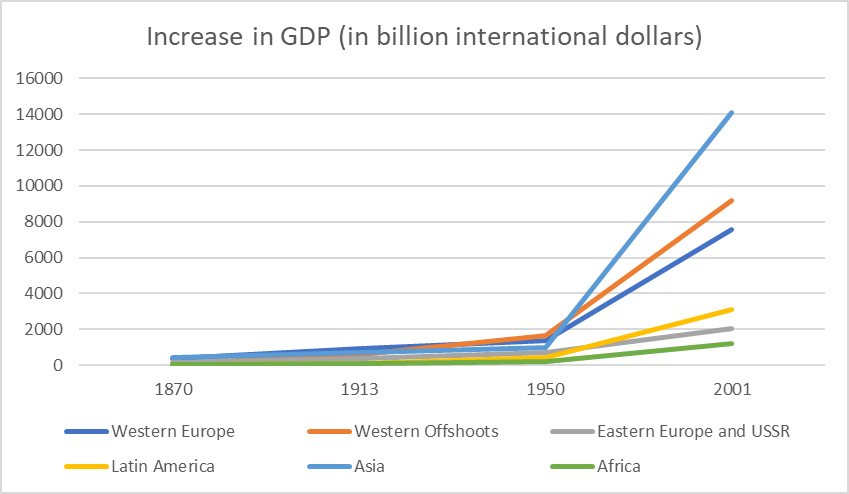
Uneven Growth:
Rates →
1950-1973:
Wn Erp 4.08%; Wn Offshoots 2.44; Japan 8.05%; Latin Am 2.52%; Africa 2.07% En Erp 3.49%
1973-1998:
Wn Erp 1.78; Wn Offshoots 1.94; Japan 2.34; Latin Am 0.99%; Africa 0.01%; En Erp -1.10%
Development & The Global South
Goals of development: raise standards of living (end poverty); create modern and industrial economies
World Bank: finance development
Technocratic approach to development; same path for all
Little understanding of local conditions
Did not address structural causes of unequal development and inequality
Has not worked very well because of unequal economic growth and unequal world order.. And because supporting developing nations is a political decision
UN and the First Development Decade
5% target growth for developing countries – translating the Western experience in
Raúl Prebisch: Secretary General of UNCTAD; trade gap and importance of industrialization
You can either perpetuate poverty or promote growth
American suspicion of UNCTAD
1969 Pearson report: 0.7% ODA target
1970s: Economic Slowdown and Shocks
Stagflation: inflation increased, growth flattened
Inflation affected household items: shortages, stockpiling
Reduced demand; consumption dropped
Rising unemployment
Less disposable income
Oil Crises, 1973 and 1979
OPEC: Organization of Petroleum Exporting Countries
Iran, Iraq, Saudi Arabia, Kuwait and Venezuela
controlled 80% of global oil exports
goal: increase price of crude oil
political motivation: Middle East politics; retaliation for American preference for oil from Canada and Venezuela
1973: price jumped from $3 to $15/barrel
1979: price increased to $35/barrel
Oil – geopolitical
New Intl. Economic Order
1970s: time of shocks, volatility, uncertainty, threats and promise
Came out of UNCTAD, G77 etc
Algiers Charter 1967: redistribution of wealth
Economic liberalism – if we grow we will solve everything 🙂
Developed countries must take responsibility and must support redistribution of wealth!!!!!!
Houari Boumediene, President of Algeria made case for NIEO, 1974
Change & backlash
New centres of economic power: Japan, Western Europe, SK, SIngapore, Taiwan, Hong Kong
Economic Protectionism: If your own economic was shit youd wanna keep competitors out, open markets global supply chains bring about economic destruction/change, unemployment
Restricted access to markets
Encouraged domestic production and consumption
Fears of trade war
Regionalism: Economic cooperation est’d on basis of geography, compatible economies, history
Did regional economic agreements perpetuate uneven relationships?
Would regional trade blocs spark conflict?
Canada US FTA 1988
Globalisation and its Discontents
Intersectional and worldwide spread or dissemination of an idea or practise
Promotes Consumerism, discourages boundaries
Diminishes practises beliefs and culture – synthesised culture or cultural imperialism
Recession in
Week 8: Intl. Movements II:
Anti-war, Anti-Nukes, Student Unrest, Women’s Rights, LGBT Rights
Global 1960s and Counterculture
Jeremy – counterculture
Existential crises
Anti-Nuclear Weapons Protests
First protestors were Japanese
Hibakusha – survivors of the bombs
Post-Hiroshima: fear of nuclear weapons and nuclear war
Scientists against Nukes & War
Russel and Einstein – we are all human beings: produced manifesto in 1955
Feeling compromised because they participated in the development of nuclear weapons
Warned against universal death
Great states should renounce war
Pugwash Conferences on Science and World affairs
Campaign for Nuclear Disarmament (CND)
Est. 1958 England
Wide-ranging support – Quakers, scientists academics peace advocates and labour
Walking a fine line – civil disobedience their tactics were mass marches at nuclear sites
Peace symbol was devloped by Gerard something.. Symbol of sadness and dispair
Scientists and the Cold War
Took up human rights violations related ot scientists
Andrei Sakharov in the soviet union
Sakharov was a nuclear weapons scientist who called for disarmament and human rights
Preventing spread of nuclear weapons their top priority
Movement and Disarmamaent
Limited Test Ban Treaty 1963
Nuclear Non-Proliferation Treaty 1968
Anti-ballistic missile agreement 1972
Strategic Arms Limitations Treaty 1972
Movement revived in 1980s because of development of new weapons like Cruise Missiles
Growing fear of a Nuclear Winter – Nuclear weapons would make Earth uninhabitable
Popularization of science – karl sagan
Anti-Vietnam Protests
Protests in USA
Ealry oppositio: Quakers set up info centres about the war
Students central to protests ; learned from civil rights activism
Opposition to racism
Intersection with anti-racist movements .
Mohammad Ali refused to enlist in the US army and refused to be a draft dodger, 1967
‘My conscience won’t let me go shoot my brother, or some poor hungry people…for big powerful America.’
‘It has been said that I have two alternatives. Either go to jail or go to the army. But I would like to say there is another alternative. And that alternative…is justice. And if justice prevails, I will neither go to the army, nor will I go to jail.’
Protests died down as US started to withdraw troops; war ended for US in 1975
Intl. protests – Globalisation and Internalization .
Australia: Vietnam Action Committee – marched on US consulate, smashed windows and took down US flag
West Germany: International Vietnam Conference, Berlin 1968
Britain: British Council for Peace in Vietnam: sits in, teach ins
Japan: Citizens Federation for Peace in Vietnam: took over Tokyo University auditorium
Soviet Union: Russian hippies protested in Moscow; arrested
Situation in Vietnam resonated with other peoples fighting oppression or for independence, eg Quebeckers and Northern Irish
Exclusionary protests within scientist
LGBT Rights Movement
Central challenge: upholding human rights in a way that would uphold the interests of the Allied nations.
Persecution of community regarding sexual identity due to post WWII rights being exclusionary of sexuality and sexual identity.
Pracitising homoseuxals are a national threat.
Postwar repression and criminalization of homosexuality (Belmonte)
Sexologists from the US, widespread range of sexual practise that denounce heterosexuality as the norm
National homophile organizations:
COC established in the Netherlands
Intl. Congress for Sexual Equality 1951 →
Petitioned UN for equal rights for sexual minorities.
Shift to Gay Liberation
1968 Meeting of North American Homophile Association
Motto: Gay is Good
5 point Homosexual Bill of Rights
Stonewall Riots 1969: flashpoint
1970s international organizations created, like International Gay and Lesbian Association
Organized transnationally
Lobbied WHO to stop classifying homosexuality as an illness
Lobbied UN to be an observer
Gay Liberation Front (US); Front Homosexuel d’Action Revolutionnaire (France); Frente de Liberacìon Homosexuel de México
First Gay Pride March, NYC 1970
Refferred gay rights to huamn rights
2011 UN finally recognized gay rights
Secretary General UN asked UNCHR to consider gay rights
1973 US Psychiatrists removed homosexuality from list of illnesses
UN Human Rights Commission passed resolution endorsing gay rights in 2011
Women Rights
Pass laws – continuation of Apartheid
Women were involved in anti-nuclear, anti-Vietnam war and gay rights movements – but were marginalised due to sexism
Intersectional approach
Emerging form WWII, womens rights were recognized more.
ECOSOC created UN Commission of the Status of Women
Drafting of UDHR 1948:
Language being gender netural
acknowledged women specifically re marriage and motherhood
rights inclusive and presented as gender neutral: everyone, all human beings
proactive work of women from Latin America, Australia, Indian China
Socially conversative – hetersexual unit with man aas head of the family and having the main share of income – very western-cetnric
AMerican and Candaian women thoughts they were equal – elitist women being satisfied with the current oppressive system of the patriarchy
Week 9: People on The Move II:
Policing who comes in and who goes out – national sovereignity
Borders become more pronounced and prominent – more continuity than change
Age of the Airplane
Becomes easier to travel – transportation becomes intense,
Commerical airlines/flights (KLM) increased after 1940
Archaic Technology – possibilities of travel were limited back then
Migrants
Economic opportunities, family reunification, unrest, environmental disasters
UN: A person who lives outide their country of birth for one year
internal/international ; voluntary/forced; temporary/permanent
Not a labor migration story
Periodization
World War II and Postwar Years
Exceptional circumstances
30 Million displaced people in Europe Alone, those in China start walking home
People who have been forced to move
Governments expelling people, disregard for DPs
War brides, japanese women werent allowed into america regardless of whether they were married to Americans
Poles were encouraged to go home – if you can go back, go back.
Cold War – deterrance of people retruning home, some need to come back
China’s Civil War: people fleeing to Hong Kong, Taiwan, Macao, Burma, Laos
Num of people born outside of the country they are residing in declined:
15% in 1910 to 4.7% in 1970
60% migrants went to western offshoots + Persian gulf states
Why Move?
Labour –
Migration helps with the extension of diasporas
Regulating Migration since 1970
Work permits - temporary with restrictions
Visas for skilled workers
Economic Capacity
Explicit racialized restrictions end in Canada, Australia, New Zealand and USA
White Australian policy 1970
Family reunification for refugees
UNHCR and 1951 Refugee Convention
Laura Reading
Postwar refugees
Following WWI there is no outburst of humanitarian aid,
Definition 1951: a person with a well-founded fear of being persecuted for reasons of race, religion, nationality, membership of a particular social group
Very restricted definition
You shouldnt be forced to be repatriated,
Case Studies
Hungary 1956 revolution
Vietnam end of war in 1975
1 million fled .. boat peopple.. Turning away from nearby countries
Algeria after war of independance 1962
200000 fleeing to Morocco and Tunisia.. 1 million french algerians returning to France
Western Sahara 1975 - 76
130000 fled to Alergia.. Sahwari permanent camp
Morocco mined the area around the camp.
Rwanda 1960s to 1990s
Tourism and Tourists
Massive infrastructures to extend tourism
Borders more porous for tourists
Accessibility and affordability of travel
Longer air routes – 1945 Sri Landa to Aus
Tourism generated 10% of Global GDP pre-2022
Environmental consequence – skewing of local economy
International students
Internationalism – make world more peaceful by understanding and respecting other people’s cultures
UNESCO fulbright program