Mediation
Path models
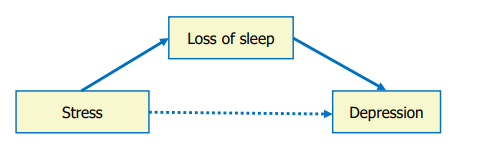
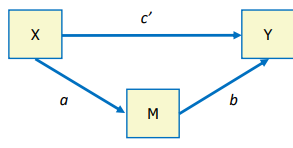
Mediation = the effect of IV on DV is explained by a 3rd intermediate variable
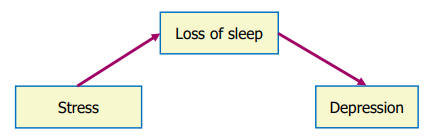
Complete mediation = there is no indirect effect; the rel. bet. X and Y is then fully explained by mediator
Partial mediation = there is both a direct and indirect effect; the rel. bet. X and Y is partially explained by mediator
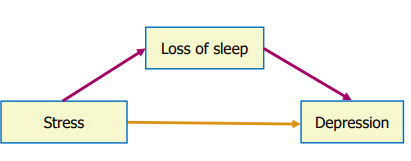
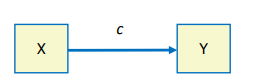
Regression: c = total effect of X on Y
Mediation: c’ = direct effect of X on Y // a×b = indirect effect of X on Y through M
Bootstrapping
provides confidence intervals for indirect effect
JASP draws multiple samples from the data proxy (resampling) → stats are conputed on each sampled dataset
(+) simple, versatile, offers SE and CI for complex parameters (e.g.procentile points, odds ratio, correlation coef)
Assumption: sample needs to be random
Significance: look at 95% bootstrap CI → if 0 is included in interval, accept H0, ab is not significantly different from 0 (there is no indirect effect)
Back to mediation
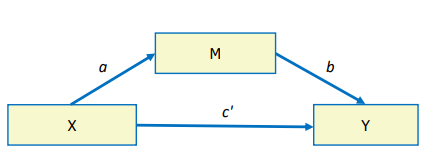
c = total effect of X on Y = c’ + ab
c’ = direct effect of X on Y
a = direct effect of X on M
b = direct effect of M on Y
ab = indirect effect of X on Y
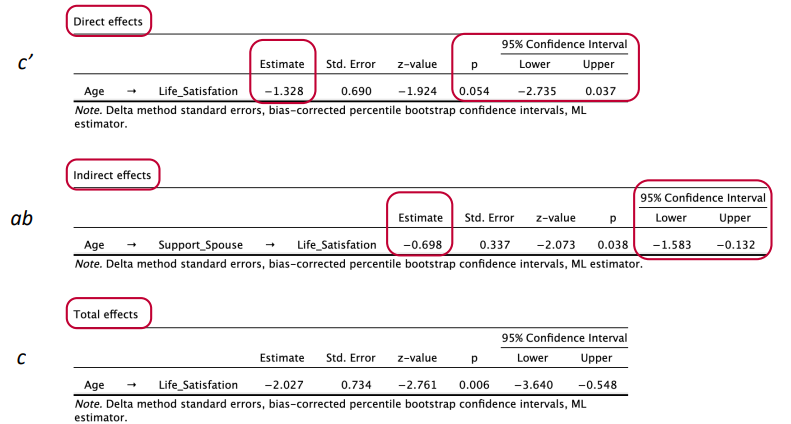
Complete mediation: ab in significant & c’ is not significant
Partial mediation: ab is significant & c’ is significant
No mediation: ab not significant
Report:
b (estimate, z- value (3 digits), p-value (3 digits)
indirect effect is not normally distributed so needs Confidence interval
APA: The mediation analysis was conducted in JASP, using bias-corrected percentile bootstrapping with 1000 resamples to obtain a 95% CI for the indirect effect.
The indirect effect of A on B via C was/ was not significant (b = …, 95% CI […, ….]), whereas the direct effect of A on B was/ was not significant (b = …, z = …, p = …), indicating that C fully/ partially mediated the rel. bet. A and B.
Effect size: R2
Effect size indirect effect: k2