ideology & science
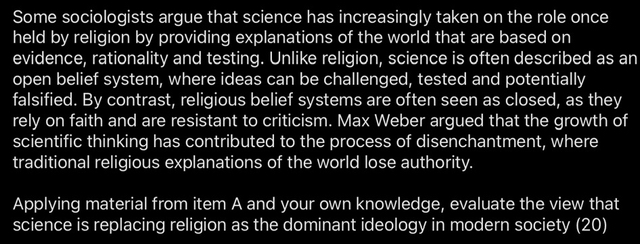
Intro: ideologies are ideas that make knowledge claims about the world that should be taken as the truth, science & religion are examples of ideologies. Many believe science is taking over the functions religion plays in modern day society because of its openness and reliability.
P1. One reason why science is replacing religion as the dominant ideology in modern society is that science is an open belief system, where knowledge can grow, change, and adapt based on criticism or new discoveries. Popper argues that science is based on falsification, which is the practice of proving a theory wrong. This makes science more reliable and means that it has the ability to overturn old ideas with new ones, for example the idea that the earth was flat was replaced with evidence of a spherical earth. People trust science because it’s based on empirical evidence that can be observed, tested, & replicated, meaning findings are more reliable. Whereas, religion is rooted in faith & sacred texts that don’t require empirical validation, making religious teachings less trustworthy. However, Thomas Kuhn argues science is actually a closed belief system that only accepts ideas that fit their paradigm, for example in 1967 Cambridge researchers were studying pulsing stars and labelled them little green man 1, 2 and so on, due to its childish label their theory was dismissed. This highlights how science isn’t always open to new ideas and can be over critical, meaning many might be put off from its harsh nature.
P2. Another reason why science is replacing religion is that religion is a closed belief system, with a viewpoint that is unchangeable and dismisses any criticism. Horton suggests this is because religion claims to offer absolute truth, it cannot be overturned by evidence or tested, and any contradictory evidence is reinterpreted or dismissed. For example, some Christian’s are willing to accept the Big Bang occurred but believe it derived from gods work. This points out the fact that religious institutions will bend their beliefs instead of accepting criticism or new discoveries, because of this individuals may view religion as unreliable and feel as though their their genuine questions about existence can’t be addressed. Science on the other hand, provides hard evidence and answers, meaning individuals may feel more comfortable putting their faith into it. However, religion isn’t entirely closed, changes in attitudes towards women & sexuality in the church through the acceptance and incorporation of legislation such as the Divorce Reform Act 1969 and the legalisation of same-see marriage shows that religion is open to change and new ideas.
P3. A final reason why science is replacing religion is disenchantment, we no longer explain events through the work of unpredictable supernatural beings, we now have a more rational & predictable understanding of the world, meaning ‘religious explanations of the world lose authority’. Weber argues that science has been replacing religion gradually throughout history in 3 stages. Firstly, the theological stage, where Christianity was the dominant belief system, life & phenomena were explained through supernatural beings. Secondly, the metaphysical stage, where Calvinism was the dominant belief system, life and phenomena were explained through more natural forces like the power of nature. Thirdly, the scientific stage, where religion was abandoned, the previous stages were displaced by rational scientific explanations based on evidence derived from experimentation & reasoning. Weber’s theory highlights how science has become more important and widely accepted, therefore replacing religion. However, Weber assumes that science removes the need for religion, Davie & Giddens argue that science can increase uncertainty, which creates a need for comfort and leads to fundamentalism.
Conclusion - overall, the view that science is replacing religion as the dominant ideology in modern society is complex. While science offers reliable ideas that are proven and open to criticism, religion offers meaning and a sense of belonging in a fragmented world. Both ideologies are heavily supported and one may not be more dominant than the other.
Intro - ideology definition: ideas that make knowledge claims about the world that should be taken as the truth, e.g. science & religion
P1. Science is an open belief system, definition: knowledge can grow, change, and adapt based on criticism or new discoveries
Popper - falsification definition: the practice of proving a theory wrong
Makes science more reliable, able to overturn old ideas with new ones, e.g. flat earth
People trust science because: based on empirical evidence that can be observed, tested, replicated - more reliable ideas
People don’t trust religion because: its rooted in faith & sacred texts that don’t require empirical validation
Evaluation - Thomas Kuhn, paradigms - science is a closed belief system
E.g. Cambridge researchers 1967 - little green men
P2. Religion is a closed belief system, definition: viewpoint is unchangeable & dismisses any criticism
Horton - claims to offer absolute truth, cannot be overturned by evidence or tested, any contradictory evidence is reinterpreted or dismissed
E.g. Big Bang
People don’t trust religion because: RI’s will bend their beliefs instead of accepting criticism or new discoveries - individuals view religion as unreliable & feel as though their genuine questions about existence cannot be addressed
People trust science because: provides hard evidence & answers - people feel more comfortable putting their faith into it
Evaluation - religion isn’t closed - acceptance & incorporation of divorce reform act, legalisation of same sex marriage - open to change & new ideas
P3. Disenchantment, Weber
Theological stage, Christianity - life & phenomena were explained through supernatural beings
Metaphysical stage, Calvinism - life & phenomena were explained through more natural forces, power of nature
Scientific stage, religion has been abandoned - previous stages were displaced by rational scientific explanations based on evidence derived from experimentation & reasoning
Evaluation - Davie & Lyon - still a need for religion, science can increase uncertainty → fundamentalism