7.1 INTRO TO INDUSTRIALIZATION
Cottage Industry → A type of industry in which the production of goods and services is based in homes, not factories.
Industrial Revolution → A social and economic shift caused by the dramatic increase of manufacturing productivity.
What factors contributed to the start of the Industrial Revolution?
Abundance of natural resources
Availability of human capital
Internal political stability
Stable trade relationships
High demand for goods
New technologies
How did the Industrial Revolution diffuse?
Originated in Britain in 1700’s and spread outwards through Europe
By early 1900s, reached all of Europe, Japan, parts of China & South America
Vast majority of world is industrialized today
What were some important new technologies of the Industrial Revolution?
Steam engine
Electricity
Steel
Cotton gin
Spinning Jenny
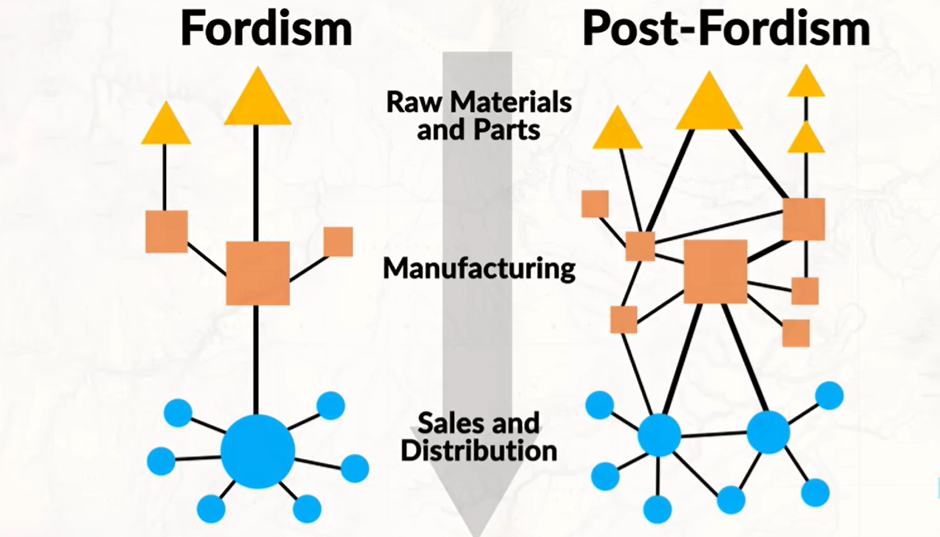
Fordism → A means of mass production based on the assembly line method.
Impacts of the Industrial Revolution |
Impact | Description |
Alteration of landscape | Factories first built near power sources (rivers, coal deposits, etc.) and transportation routes Later, development of electricity, construction of new roads & harbors allowed factories to be built in diverse locations
|
Evolution of agriculture | |
Impact | Description |
Population growth | |
Urbanization | Workers moved to cities to work in factories since they were no longer needed in agriculture Low standard of living (overcrowding, lack of sanitation) Growth of buildings & infrastructure
|
Environmental harm | Air pollution due to burning of coal to heat homes and run factories Water pollution due to lack of sanitation, chemical runoff, etc. Habitat destruction due to growth of cities & infrastructure
|
Social structure | |
New ideas | Advancement of science & medicine More interconnected world (new technologies) Expansion of education Emergence of socialism (discontent among workers who did not benefit as much from capitalism)
|
Imperialism | |
Distribution of wealth | Wealthy countries became wealthier, leading to a great divide between advanced, industrialized states and underdeveloped, non- industrialized states
|
Post-Fordism → A production system in which companies have replaced workers with machines to allow for faster and varied production.
With use of computers and increased automation, every product coming off an assembly line can be customized (ex. cars of different colors)
Although expensive to install, machines often save a company money in the long run (can work 24/7 without breaks or vacations, produce consistent, high quality work)
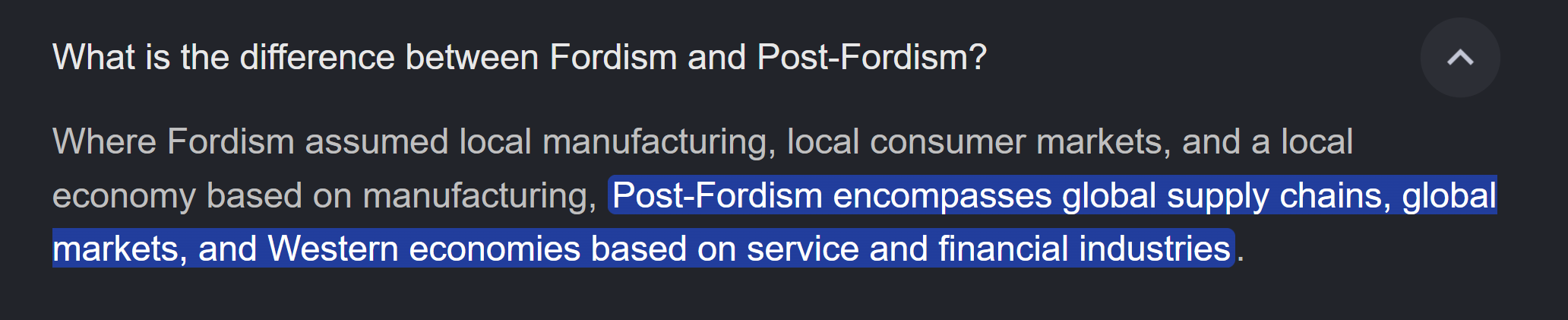
Deindustrialization → A reduction in the size of the manufacturing industry and industrial capacity of a place.
7.2 FACTORS OF INDUSTRIAL LOCATION
jLeast Cost Theory → Developed 1909 by German economist Alfred Weber Theory that attempts to predict the location of manufacturing relative to the location of necessary raw materials and the market industries locate to minimize costs, prioritizing transportation, labor, and agglomeration (the clustering of firms, workers, and economic activity in a geographic area, producing mutual benefits from proximity.) Explains the geographic distribution of economic industrial activities
|
Assumptions: The area is an isotropic plane (flat, featureless, quality and price of all land is the same) The population is homogeneous (culture, needs, skills, etc.) Labor is immobile and unlimited Markets have unlimited demand and perfect competition Products are shipped to a single market Transportation costs are determined by weight of the items and distance they will be shipped Companies produce only one type of product
Owners need to balance three factors when deciding where to open a factory: Transporation : Raw materials get transported to the factory and finished goods get transported to the market Bulk-Reducing Industry → AKA Weight-losing industry, raw material-oriented industry, raw material-dependent industry Raw materials are heavier than the final product so companies should try to locate manufacturing near the source of the raw materials
Bulk-Reducing Industry: Steel Iron ore mined from earth Impurities removed from the iron by melting and oxygenating it, making it lighter and stronger
Bulk-Gaining Industry → AKA weight-gaining industry, market-oriented industry, market-dependent industry The final product is heavier than the inputs so companies should locate factories near the market
Bulk-Gaining Industry: Soft Drink Bottling Soda companies make syrups for their drinks Syrups are shipped to bottlers Bottlers combine water (heavy) with syrups to make soft drinks
Draw and explain the locational triangle. The market is found at one location and the resources to make the product are obtained at two others. The three points make up the locational triangle. Where the factory is located within the triangle depends on the weight of the materials
 If neither raw material loses weight during processing, the company has no advantage in locating near either If one material loses weight when processed, the company can save money by placing factory closer to the other (heavier) resource If both materials lose weight during processing, the factory can be located between the two sources
Agglomeration → The spatial grouping of businesses in order to share costs. Can assist each other through shared talent pool of workers, services, and facilities Ex. When several factories share the cost of building an access road to connect them with a highway
Weber argued companies should minimize transportation and labor costs and maximize agglomeration. Sometimes, cost savings from cheaper labor or agglomeration can be greater than savings from locating at the cheapest spot relative to transportation costs. In these cases, owners should choose to locate where the cheaper labor or benefits from the agglomeration economies exist.
Criticisms: Weber’s Assumption | Reality | The area is an isotropic plain | Isotropic plains rarely ever exist; mountains, rivers, urban areas, etc. can impact location decisions | Labor is fixed and unlimited | Labor is relatively mobile; labor is not unlimited (especially skilled labor) | Populations are homogenous (culture, training, needs, etc.) | Populations are heterogeneous, with different needs (demands) and different levels of training and education |
Weber’s Assumption | Reality | One product is produced for a single market | Companies often sell multiple products and to more than one market | Markets have unlimited demand, perfect competition | Perfect competition conditions rarely exist; demand is not unlimited, especially if there is lots of competition | Raw materials are found only in certain locations | Raw materials are often available in many locations. |
Weber’s Assumption | Reality | Transportation costs are determined by the distance of travel and weight of items | Cost per mile may decrease as the distance increases; space-time compression can reduce overall cost of transportation | Location of factories is based on economic consider\ations only | Emotional factors (history, tradition), personal preference of owners (convenient commute, etc.) can influence location of factory |
|
|
Further Considerations of Industrial Location |
Factor | Description |
Energy Source | Power sources needed to produce goods can dictate where factories are located Early mills located on rivers (immobile water power) First manufacturing plants located near coal fields ( bulky/ expensive to transport, lots needed on constant basis) Development of electricity made power more mobile and thus the location of energy sources less important Growing reliance on renewable energy sources that are somewhat location-dependent
|
Transportation |
Break of Bulk Point → A location where goods are transferred from one means of transportation to another. Ex. ports, airports, depots, etc. Break of bulk points are often centers of industry as they allow businesses to save on transportation costs
|
Interdependence | Locational Interdependence → The location decision for a factory being dependent upon the location of other factories |
Flexibility | Footloose Business → A business that can pack up and leave for a new location quickly and easily. Low demand for raw materials, don’t need large spaces Fixed costs no matter where they establish themselves Typically tech-centric businesses (call centers, online companies, etc.)
|
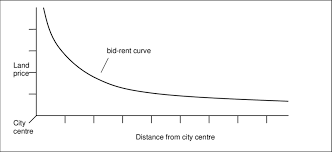
Cost of Land | Bid-Rent Theory → The price and demand for real estate increases the nearer it is to the Central Business District.
Transnational Companies → Large international companies with locations in more than one country. |
Prestige & Cost Savings | Front Offices → Offices for an executive branch of workers, usually located in somewhere highly visible and important (expensive). Back Offices → Cheaper office spaces typically for non-executive employees, linked to the front office via technology so they don’t have to be nearby. Offshoring → When companies locate their back offices in other countries due to a lower cost of operation. |
Labor Force |
Labor-Oriented Industries → Industries that locate close to major training institutions
Outsourcing → Contracting work out to non-company employees or other companies. |
Government Incentives | At international level - trade agreements At national/regional level - different legal/economic/ business procedures in different countries At local level - communities provide incentives such as tax breaks and low-interest loans to attract investment
|
7.3 TRADE & WORLD ECONOMY
Globalization → Growing interdependence of the world’s economies, cultures, and population due to trade, investment, and transportation & communications technologies. |
Benefits | Drawbacks |
More of/greater variety of goods and ideas Cheaper production and consumer costs Businesses have access to new markets Increased cooperation between countries Increased economic development
| Uneven development (poor vs rich countries) Exploitation of poor workers and countries Helps more powerful countries exert influence Negative impact on environment and resources Threat to local cultures and traditions
|
What is interdependence and how does it apply to the global economy?
Interdependence = The dependence of two or more people or things on each other.
Interdependence of global economies demonstrated by financial crises, international lending agencies (i.e. IMF), and strategies of development (microfinance, etc.)
2008 crisis : Collapse of housing market in the US led to a global economic crisis
Decline in international trade and increase in global debt
By 2009, economic activity declined in more than half of all countries
Complementarity →Trade that occurs when parties have goods or services that the other wants.
Can exist due to differing environmental conditions, diversity of natural resources, internal division of labor, etc.
Ex. Country A has an abundance of wood but wants bananas. Country B has a surplus of bananas but needs wood. Both countries have something the other wants, so Country A and Country B have a complementary trade relationship.
Comparative Advantage → The idea that a country should specialize in producing products for export that they hold an advantage in producing (i.e. can produce at a lower cost).
If a country does not have an advantage when producing a product, they should import it
Ex. China has a comparative advantage over the US when it comes to electronics since they can produce them more quickly and cheaply due to their labor force, so it makes sense for China to produce electronics and for the US to import them
Neoliberalism → An economic strategy that calls for free markets, free trade, and minimal government intervention in the economy.
Government intervention seen as inefficient
Makes trade easier between countries by reducing tariffs and political trade barriers
Such policies have led to creation of trade agreements and supranational organizations
neoliberal policies prioritize the needs of wealthier cooperation and states over developing regions which creates economic inequality
deregulation of different markets can lead to less accountability and government oversight which may increase in unethical behavior by different institutions
Trading Blocs → Groups of countries that consent to a common set of trade agreements.
Ex. EU, MERCOSUR, WTO, OPEC, etc.
Agreements encourage trade by easing regulations within blocs but makes trade with countries outside bloc expensive
Can lead to lower prices, stronger economic growth, greater competition
Transnational Corporations → Companies that operate in more than one country.
Newly Industrialized Country → A term used to describe a country whose level of economic development ranks it somewhere between developing and highly developed countries.
Emerging economies
Moving from labor- to technology-intensive industries
Increased personal freedom, greater social mobility
What countries are Newly Industrialized Countries?
Mexico
Brazil
South Africa
Turkey
China
India
Malaysia
Thailand
Philippines
Outsourcing → Contracting work out to non-company employees or other companies.
Offshoring → When companies locate their production in other countries due to a lower cost of operation.
Why do MDCs shift their manufacturing to LDCs?
Manufacturing jobs shifted away from highly developed to less developed countries to increase profits
New International Division of Labor → A system of employment in the various economic sectors spread throughout the world.
High income countries have rapidly increasing quaternary sectors that emphasize research and development
Middle income countries manufacture goods sold in high and low income countries
Low income countries have large primary sectors and export minerals and resources used in the production process
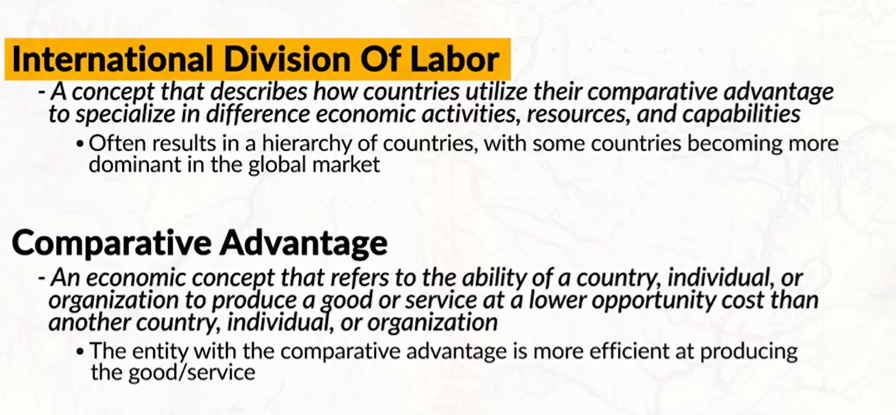
How does the New International Division of Labor impact LDCs?
Impacts on LDCs
Job creation (low paid)
Increased pollution
Increased urbanization
Widening wealth gap
Uneven development
Increased child labor
Work for women
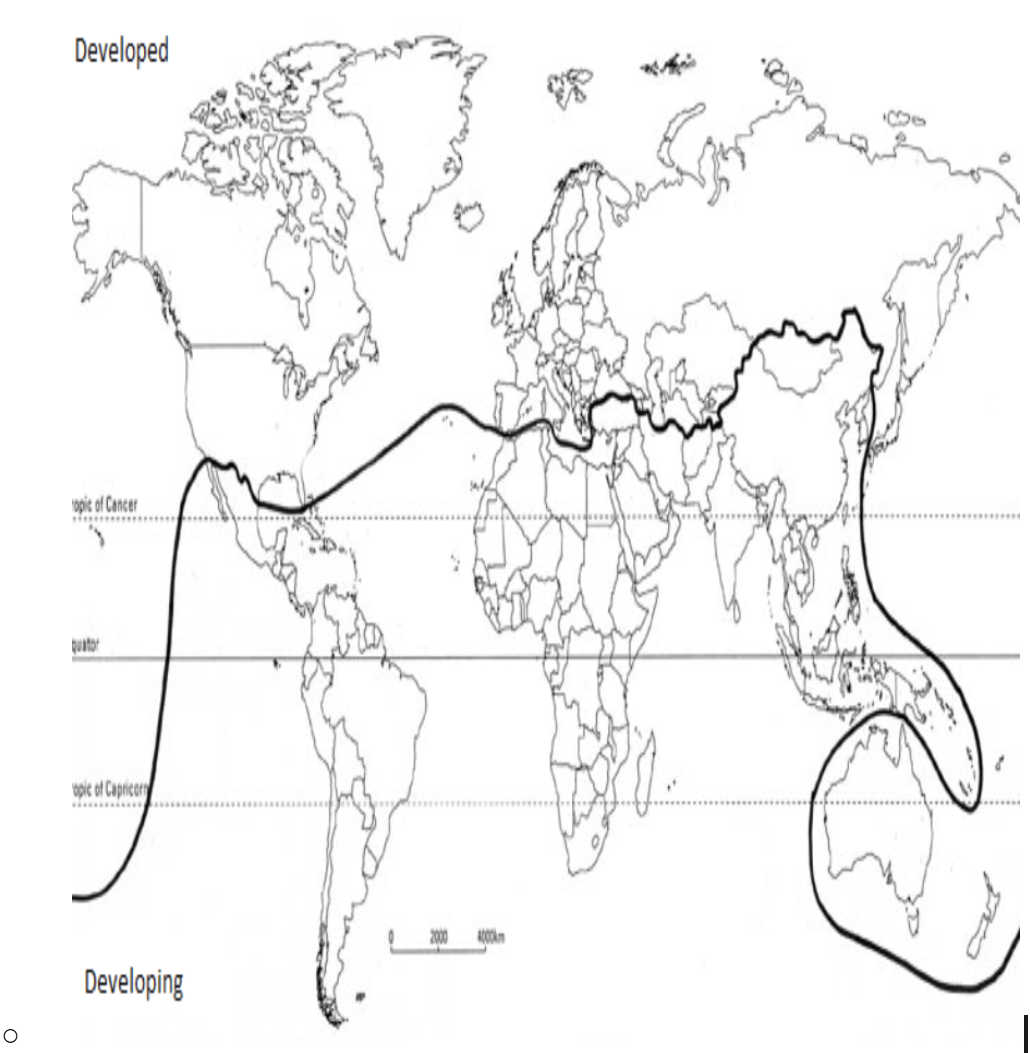
Describe the placement of the Brandt Line and what it illustrates.
Special Economic Zones SEZ → Areas in which business/trade laws are different from other parts of the country.
Free trade zones FTZ → A region within a country where imported goods can be stored and processed without being subject to tariffs or trade barriers
Export Processing Zones → designated areas within a country that offer special incentives to attract foreign investment, primarily in manufacturing for export |
Benefits | Drawbacks |
Creates jobs (especially for women) Increases foreign direct investment Introduces new technology/ideas to LDCs Cheaper prices for consumers
| Low paying jobs Potentially unsafe and exploitative working conditions Goods not sold in and do not benefit the local community Lax environmental regulations
|
Multiplier Effects → When a change in spending or investment causes a larger change in output.
Ex. a crayon factory opens in a community, providing people with jobs. The workers then take their salaries and spend money at local businesses, then those business owners spend their profits elsewhere (ripple effect of wealth).
Economy of Scale → The cost advantage experienced by a company when it increases its level of output.
With better/more access to resources, markets and technology due to globalization, companies can increase their efficiency (output)
More efficient production leads to more profit for the company and lower prices for the consumer
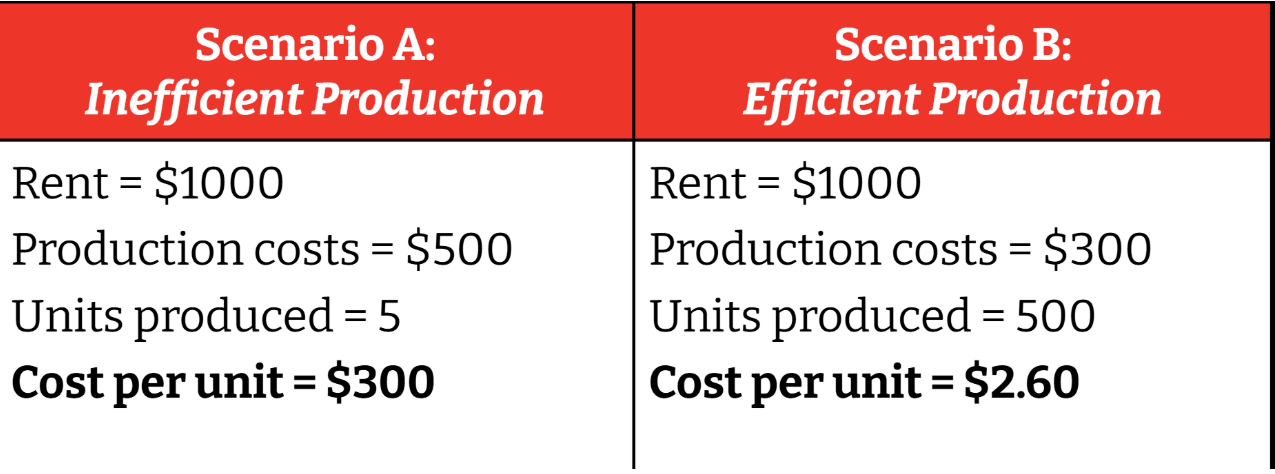
Agglomeration → The spatial grouping of businesses in order to share costs.
Can provide assistance to each other through shared talent pool, customers, resources, services, infrastructure, and facilities
Ex. When several factories share the cost of building an access road to connect them with a highway
Just-in-Time Delivery → A method of manufacturing where materials are sent to a factory moments before they are needed.
Deindustrialization → A reduction in the size of the manufacturing industry and industrial capacity of a place.
Typical in more developed countries
Production outsourced to less developed countries
Manufacturing replaced by growth of service sectors and high tech industries
Brownfields → Sites of abandoned factories that have the potential to become a hazardous waste or pollutant.
Rust Belt → The US region hit hardest by deindustrialization, located in the Northeast around the Great Lakes.
Growth Poles → Concentration of technically advanced industries that stimulate economic development in the businesses that are connected to those industries.
Backwash Effects → Possible downsides of growth poles.
Loss of highly educated young people from distant communities (brain drain, depopulation, loss of tax revenue), etc.
Some very large companies create their own business parks where they are only tenant (Google, Apple, Samsung, Meta, etc.)
7.4 MEASURING DEVELOPMENT
Development → A process of change in society as it seeks to meet the needs of its people.
Improving the material conditions of people via diffusion of knowledge and technology
Implies progress, but cultures view progress differently
Describing Development |
System | Low Development | Middle Development | High Development |
Economic Level | Low income | Middle income | High income |
Industrialization | Non-industrialized | Newly Industrialized | Post-Industrial |
Human Development Index | Low HDI | Medium HDI | High/Very High HDI |
World Systems Theory | Periphery Country | Semi Periphery Country | Core Country |
Stages of Economic Growth | Stages 1 + 2 | Stage 3 | Stages 4 + 5 |
What are some barriers to development?
Lack of social welfare
Low life expectancy
High dependency rate
Lack of healthcare
Low levels of education
Poor sanitation
Gender inequality
Poor infrastructure
Social conflict
Political instability
Violence & war
Coups
Corruption
Lack of funds
Economic Indicators | Social/Demographic Indicators |
Economic output (Gross National Product, Gross Domestic Product, Gross National Income) Sectoral distribution of workforce Income distribution Energy use and production
| Birth/death rate Fertility rate Life expectancy Gender inequality Literacy rate Access to healthcare
|
Factors of economic development: resource availability, population, colonial status, location, climate, etc.
Economic Sectors |
Sector | Description | Examples |
Primary | Extraction of natural resources | Farming, mining, fishing, etc. |
Secondary | Processing resources into products | Manufacturing, construction |
Tertiary | Selling and transporting products | Marketing, retail, design, etc. |
Quaternary (sub) | Research and transfer of knowledge | Education, IT, banking, etc. |
Quinary (sub) | Highest level of decision making | CEOs, judges, politicians, etc. |
In less developed countries, greater percentage of labor force is employed in primary sector
In middle income countries, secondary sector accounts for most economic activity
In more developed countries, a greater percentage of labor force works in tertiary or quaternary/ quinary sectors
Measures of Development |
Measure | Definition | Description of Distribution |
Gross Domestic Product | GDP → The total value of goods and services produced within a country’s borders in a year. | |
Gross National Product | The total value of goods and services produced by the citizens and corporations of a country in a given year, regardless of their location. | |
Gross National Income | Measure of the worth of what is produced within a country plus income received from investments outside the country in a year. | |
Gini Coefficient | A measurement of the distribution of income within a population. | |
Energy Use & Production | | SOCIAL MEASURES OF DEVELOPMENT : Generally, in highly developed countries, people enjoy a high standard of living and in less developed countries, people have lower standards of living
Factors associated with standard of living: poverty rate, class disparity, quality of housing, working conditions, access to healthcare, quality of education, political stability, safety, environmental preservation |
Fertility Rate | | Factors affecting fertility rates: educational opportunities for women, access to family planning methods, government policies, gender equality, etc.
|
Life Expectancy | | |
Gender Inequality | | |
Access to Healthcare | Generally, people in more developed countries have more access to healthcare and enjoy better quality healthcare than those in less developed countries Barriers to effective healthcare: cost, limited number of doctors, lack of infrastructure, inadequate supplies and equipment, etc.
| |
Literacy Rate | Generally, developed countries have very high literacy rates and less developed countries have lower literacy rates. Barriers to education: cost, lack of government funding, lack of teachers, poor quality of teacher training, lack of infrastructure, exclusion based on gender/ ethnicity/ability, political instability, etc.
| |
Human Development Index | A measure of development that combines one economic measure (GNI per capita) with several social measures, such as high life expectancy and average education level. Created by the UN Rankings of countries by HDI and income often similar
| Countries that invest in things like education or medicine sometimes rank higher in HDI than income (i.e. Cuba) Some countries have high incomes but don’t perform well in terms of social measures (i.e. Qatar)
|
What is the general pattern of development based on the different measures indicated above?
Latin America, Southwest & Southeast Asia, Central Asia, South Asia, Sub-Saharan Africa
7.5 THEORIES OF DEVELOPMENT
Rostow’s Stages of Economic Growth → Stages of Economic Growth Model → A development model proposed by economist Walt Rostow in 1960 that describes the shift from traditional to modern forms of society. Assumed all countries wanted to and would modernize, albeit at different speeds Saw economic development as linear progression to modernity through five stages of development Different conditions/levels of investment required for a country to move from one stage to the next
| Drawing: 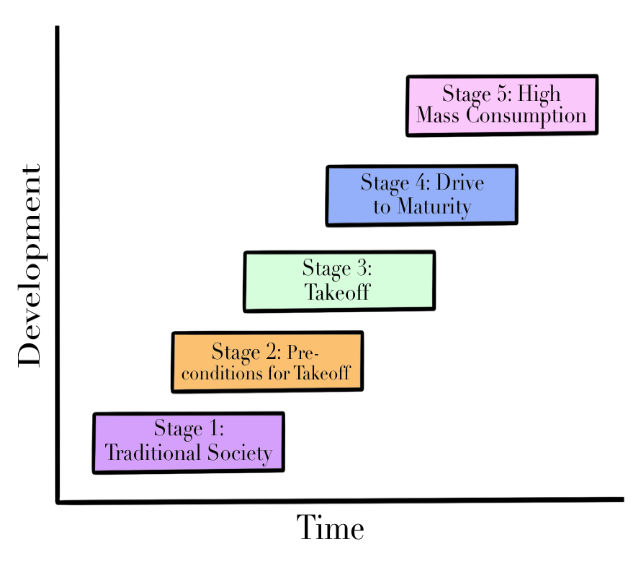 |
| Economy | Technology | Trade | Society |
Stage 1: Traditional Society | Dependent on primary sector activities for subsistence | Limited technology (labor-intensive agriculture) | Limited trade (local/regional) based on the barter system | Lack of class or individual mobility; tradition |
Stage 2: Pre - Condition for Takeoff | Shift to commercial agriculture | Increasing spread of technology & advances in existing technology (irrigation, canals, etc.) | Increasing specialization generates agricultural surplus for trading; expanded trade due to expanded infrastructure | Start of individual social mobility |
Stage 3: Takeoff | Industrialization increases, workers shift from agriculture to manufacturing | Technological breakthroughs tied to industrialization; openness to innovation | International trade expands | Beginning of urbanization; evolution of new political and social institutions to support industrialization; further class stratification |
Stage 4: Drive to Maturity | Economy diversifies; existing industries expand and new ones established quickly | Improved energy, transportation, communication systems; innovation provides diverse range of investment opportunities | Economy producing wide range of goods and services and less reliance needed on imports | Large-scale investment in social infrastructure (schools, universities, hospitals, etc.) enables increased social mobility |
Stage 5: High Mass Consumpt-ion | Service sector becomes increasingly dominant; economy geared towards mass consumption | Advanced communication and transportation technologies | Reliant on countries in earlier stages for raw materials; dominance of trade hierarchy | Desire to create egalitarian society; consumers have disposable income to spend on luxury goods |
How do countries move from one stage to the next?
Development requires investment of capital & stable conditions (provision of financial services, strong internationally traded currency)
Once a country moves from one stage to the next, they cannot move back
Criticisms |
Development not always linear Does not account for differences that could hinder development (size, population, resources, location, etc.) Model based on western countries - doesn’t work for non-capitalist or undemocratic states Assumes everyone could eventually lead life of high consumption but does not account for sustainability Fails to acknowledge that most countries in stage 5 got there through exploitation and those not there yet don’t have the same opportunities
|
Wallerstein’s World Systems Theory → An alternative view to Rostow’s model proposed by historian Immanuel Wallerstein in the 1970s that included political and economic elements and proposed that countries do not exist in isolation, but are part of an interdependent system.
Argued that international trade led to creation of capitalist world economy in which a system based on wealth and power extends beyond individual states. fails to account for Non Governmental Organizations that offer microfinance for those in developing countries fails to consider other programs such as microloans that seek support to those in semi periphery and periphery allowing them to be interdependent and self reliant
Countries of the world are all part of an interconnected economic system
| Drawing: 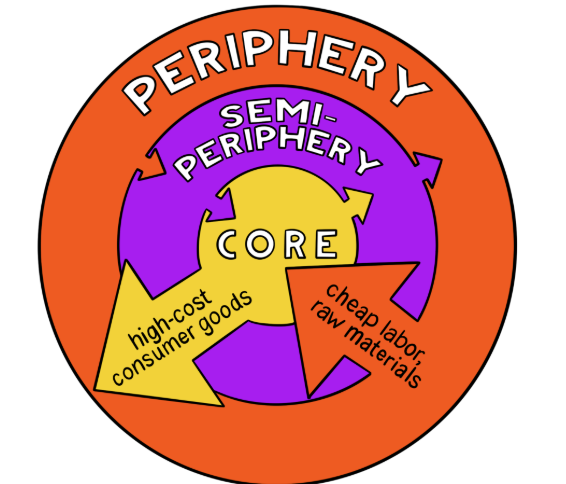 |
| Core | Semi-Periphery | Periphery |
Description | The most economically and politically dominant countries that receive goods and raw materials from the periphery and semi-periphery.
Benefit from and hold power over periphery and semi-periphery Dominate the tertiary sector Became dominant through colonialism and stay dominant through neocolonialism
| Middle-income countries that receive raw materials from the periphery and provide the core with goods and services it used to provide for itself.
Mix of characteristics of the core and the periphery Dominates the secondary sector Exploits the periphery and is exploited by the core
| Least-developed countries that provide the core and semi-periphery with inexpensive raw materials, labor, and agricultural production.
Most jobs in primary sector Receives jobs but little profit from manufacturing Are typically former colonies
|
Examples | Ex. US, UK, Japan, Germany, etc.
| Ex. India, Mexico, Brazil, China, Russia, South Africa, etc.
| |
Dependency Theory → Resources flow from the periphery to the core, enriching the core at the expense of the periphery.
Criticisms |
Somewhat outdated - based on industrial production but many countries are postindustrial Limited practical use - suggests that countries can change their position but doesn’t say how Fails to recognize role of NGOs, private charitable groups or foreign investment in development Doesn’t acknowledge that trade is asymmetrical - periphery is dependent on few trade relationships but core can source materials from many countries
|
7.6 SUSTAINABLE DEVELOPMENT
Sustainable Development →Any economic development that meets the current needs of people without making it harder for people in the future to live well.
UN Millenium Development Goals →
A set of 8 goals developed by the United Nations in 2000 that aimed to eliminate barriers to development and improve the lives of people in the least developed countries
Accomplishments
Most successful anti-poverty program in history, lifting 1 billion out of poverty
Reduced hunger, child deaths, maternal mortality
Increased number of girls in school, access to safe drinking water
Saved millions of people via investment in fighting malaria, AIDS, tuberculosis
UN Sustainable Development Goals →
A set of 17 goals devised by the UN in 2015 to build on and go beyond the Millenium Development Goals and build a better, and more sustainable future for everyone.
Goal | Key Indicators |
No poverty | Eradicate extreme poverty (living on less than $1.25/day) for all people everywhere Implement social protection systems Ensure equal access to economic resources and
|
Zero hunger | Ensure all people have sufficient nutritious food Increase agricultural productivity and income of small farmers Increase investment in rural infrastructure, agricultural research
|
Good health & well-being | Reduce maternal & infant mortality, death from pollution & road accidents End AIDS, tuberculosis and malaria Ensure access to health services, including sexual and reproductive health information and programs for all
|
Quality education | Ensure all children complete secondary school and that all adults have access to postsecondary education and vocational training Eliminate gender disparities in education Upgrade educational facilities and increase number of teachers
|
Gender equality | End all forms of discrimination against women and girls Eliminate violence against and exploitation of women and girls, including trafficking, child marriage, and genital mutilation Ensure equal opportunities for women to participate in the economy and all levels of leadership
|
Clean water and sanitation | Ensure universal and equitable access to safe drinking water Ensure adequate sanitation and end open defecation Reduce water pollution Ensure sustainable use of freshwater
|
Affordable and clean energy | Ensure universal access to affordable, modern energy services Increase share of renewable energy Enhance investment in clean energy research and technology
|
Decent work and economic growth | Promote policies that support job creation and entrepreneurship Ensure equal pay for work of equal value Reduce youth unemployment Protect labor rights and eradicate forced labor and modern slavery
|
Industry, innovation and infastructure | Develop reliable, sustainable, and resilient infrastructure Upgrade infrastructure and industries to make them sustainable Provide least developed countries with support to develop infrastructure
|
Reduced inequalities | Ensure income growth at a higher grate for the poorest in society Eliminate discriminatory laws, policies, and practices Encourage foreign investment where it is needed most
|
Sustainable cities and communities | Ensure access to safe, affordable housing and transportation Enhance sustainable urbanization Provide increased access to green spaces
|
Responsible consumption and production | Achieve sustainable and efficient use of natural resources Reduce global waste, especially food waste Spread awareness about sustainability Phase out harmful fossil fuel subsidies
|
Climate action | Strengthen resilience to climate-related natural disasters Improve education about climate action Integrate climate change measures into policies and planning
|
Life below water | Prevent and reduce marine pollution of all kinds Minimize and address impact of ocean acidification Prevent overfishing and illegal, unregulated fishing Protect oceans and their resources under international law
|
Life on land | Ensure conservation and sustainable use of land Reduce deforestation and desertification End poaching and trafficking of plants and animals Prevent invasive species and protect biodiversity
|
Peace, justice and strong institutions | Significantly reduce all forms of violence, exploitation and abuse Promote equal access to justice for all Reduce organized crime, corruption, and bribery Promote and enforce non-discriminatory laws and policies
|
Partnerships for the goal | Promote foreign investment in the least developed countries Share technology and knowledge Promote an open, non-discriminatory trade system
|
What are some obstacles to achieving the SDGs?
COVID-19 severely impacted the progress of the SDGs
119-124 million pushed back into extreme poverty
70-161 million people experiencing hunger
Reversed progress in health and shortened life expectancy
Violence against women intensified
Increased child exploitation, including early marriage
Loss of 255 million full time jobs and 7% of manufacturing
Worsened conditions in slums
Foreign direct investment declined by 40%
What is the correlation between the status of women and development?
The status of women directly correlates to the level of development of a country
As women gain employment, the economy of country improves
Increased financial participation gives women more influence in their communities and health decisions, leading to decreased birth rates and a better quality of life for children
How are women impacted by employment in the informal economy?
Many women are employed in the informal economy (domestic work, subsistence agriculture, etc.), especially in South Asia, Latin America
Lower wages, potentially unsafe conditions, vulnerability to harassment and violence, no benefits or insurance
Why have women become increasingly involved in the formal workforce?
Number of women in formal workforce has increased greatly over last 30 years
Due to presence of transnational companies, increased education opportunities, and from necessity (declining populations)
HOWEVER, the pay gap and “glass ceiling” still exists.
How pervasive is the gender pay gap?
Women often perform the worst work, earn less than men, and do more unpaid work
Worldwide, women earn 23% less than men for same work
How can gender equality be encouraged?
Remove discriminatory laws
Collect and monitor data about gender equality issues
Encourage female leadership at all levels
Educate to prevent gender-based violence and strengthen legal protections for victims
Take legal action to ensure pay parity and inclusive hiring practices.
Microfinance programs →
Programs that provide small loans to entrepreneurs who would not normally qualify for credit from traditional sources.
Who benefits the most from microloans?
Particularly active in South America, South Asia
Vast majority of people taking advantage are poor women
Repayment rate is 98%
Traditional tourism can be beneficial in some ways, but it poses many disadvantages to less developed countries:
Most profits benefit international companies (hotel chains, tour companies) instead of locals
Foreign companies may bring their own workers for skilled jobs, leaving only lowest paying work for locals
Housing prices increase as foreigners buy property
Activities often entertain rather than educate tourists about local culture and history
Creates increased pollution, disruption to wildlife
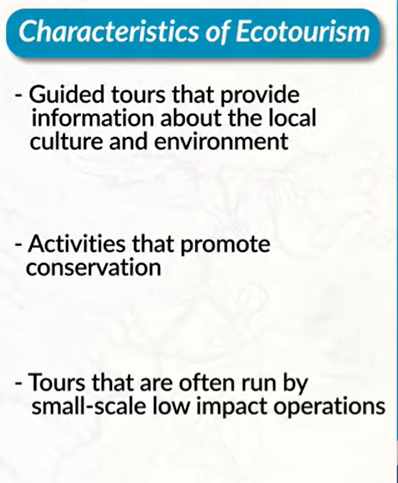
Ecotourism →
Tourism involves responsible travel to natural areas, conserving the environment, and supporting the local population.
Generates $77 billion every year, mostly in developing countries
Aims: protect environment for future use, respect people/culture of the area, provide long term economic benefits to locals
What are the impacts of ecotourism?
Protects local species and ecosystems
Promotes environmental awareness
Creates jobs and promotes local entrepreneurship
Upgrades local infrastructure
Drives development of related industries
Promotes education and awareness of local culture and history