Chapter 3A Human Physiology
Eukaryotic Cell Overview
- Organelles: membrane-bound structures that perform specific functions
- Cytoplasm: everything inside cell membrane except the nucleus
- Cytosol: fluid inside the cell membrane but outside of the organelles
Plasma Membrane
- Plasma membranes act as a selective barrier
- Selective barrier: The function of the plasma membrane as it is surrounding whole cell, organelles, nucleus
- Helps with compartmentalization
- Movement of molecules between compartments
- Selectivity
- Regulation
- The plasma membrane also senses chemical messengers and helps with cell signaling
- The plasma membrane functions as cellular support
- Cellular Support: The plasma membrane function that anchors the cells to adjacent cells and the extracellular matrix (ECM)
- Glycoproteins in ECM bind to proteins in plasma membrane
- Provide sites for transmission of forces
- The plasma membrane also acts as a double layer of phospholipids
- Few chemical bonds link the phospholipids
- Helps with fluid structure
- Cholesterol adds stability to the cell membrane
Proteins in the Cell Membrane
- Integral proteins: Proteins imbedded within the cell membrane
- Integral proteins are amphipathic
- Transmembrane proteins: A subunit of integral proteins that form channels, transmitting cell signals from the extracellular fluids to the intracellular fluids
- Peripheral Proteins: Proteins attached to inside or outside the cell membrane, but do not transverse the whole membrane; helps with enzyme activity and cell shape
- Glycocalyx: This is a layer made of glycoproteins & carbohydrates used for cell recognition,
Cell Membrane Junctions
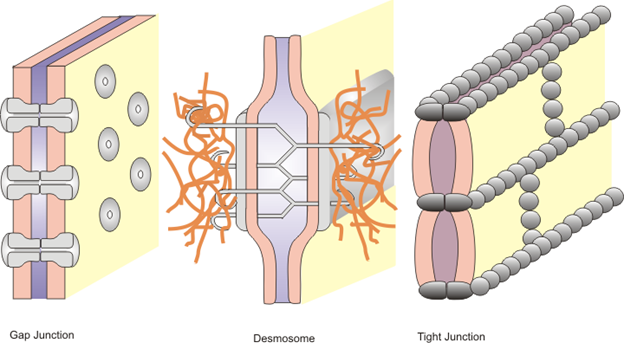
- Cell Membrane Junctions: Physical connections between cells
- Desmosomes: Membranes of adjacent cells linked by strong fibers in isolated spots
- Important in areas subjected to stretch
- Holds cells firmly together, structural support
- Tight Junctions: Membranes joined with no space between them, connections go all the way around the cell; restricts molecular diffusion between cells
- Paracellular Pathways: A passive transport process that results in the transport of substances across an epithelium by passing through the intercellular spaces in between epithelial cells.
- Transcellular Pathways: A carrier-mediated, energy-dependent, active transport mechanism,
- Gap Junctions: Protein channels that link the cytosol of adjacent cells; allows small molecules & ions to pass between cells & rapid cell communication
Cellular Organelles
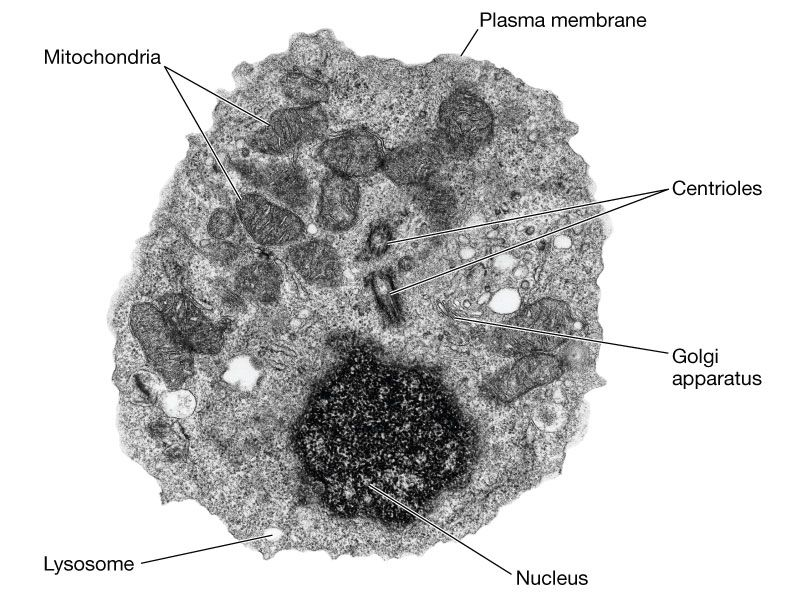
- Cellular Organelles: Plasma membrane-bound structures that perform specific cellular functions
- Nucleus: Largest cellular organelle, stores DNA
- Cells without a nucleus include skeletal muscle and red blood cells
- A nucleus stores genetic information in the from of DNA, the blueprints of protein synthesis
- Nucleolus: Part of the nucleus, site of ribosomal RNA synthesis
- Chromatin: Part of the nucleus, is the DNA
- Nuclear evelope: Encases the nucleus and allows mRNA to pass into cytoplasm, also called pores
- Ribosomes: An organelle that builds proteins by connecting amino acids; many of these in a cell
- Free ribosomes: Ribosomes that release proteins into cytosol
- Bound ribosomes: Ribosomes that are attached to the ER and release proteins into the ribosome
- Endoplasmic Reticulum: A large continuous space encoled my membranes, has a rough and a smooth type
- Rough ER: Contains ribosomes, involved in packaging of proteins
- Smooth ER: Responsible for protein synthesis, Ca2+ handling
- Golgi Apparatus: A series of flat membraned sacs that deal with protein modification & packages proteins into vesicles
- Vesicle: A small sac that moves stuff into and out of a cell
- Intracellular transport
- Secretory vesicles: Vesicles that fuse with the cell membrane and release contents (proteins) to the extracellular fluid
- Mitochondria: Produces the cell’s energy (ATP) and has inner & outer membranes and a matrix
- The mitochondria consumes oxygen and produces CO2, heat, and water
- Lysosomes: Contain acidic fluid and digestive enzymes used to break down bacteria, damaged \n cells, and cellular debris
- Peroxisomes: Contains enzymes that oxidize organic molecules like lipids and alcohol
- Cytoskeleton: Generally made of proteins, this is NOT a membrane-closed organelle but helps maintain and change cell shrape
- Cytosol is the fluid in a cell, but the cytoplasm is all of the cell contents