Unit 4; GDP and the Production Function
Unit 4 Learning Objectives
Knowledge of the production function and how factors of production determine total output.
Articulate the meaning of constant returns to scale.
Understand the definitions and implications of marginal product of labor (MPL) and marginal product of capital (MPK).
Understand diminishing marginal product for both labor and capital.
Explain how much each factor of production (labor and capital) is paid and why.
The Production Function and Factors of Production
Total Output (): In economics, the variable is utilized to indicate the total output of goods and services produced in an economy.
Factors of Production: These are the inputs required to produce output. They are divided into two main categories:
- Capital (): The set of tools workers use to produce goods.
- Examples include an accountant's computer, a carpenter's hammer, or a professor's projector.
- Labor (): The actual time people spend working.
Production Function Definition: The factors of production ( and ) are combined in a mathematical function to determine how much output () the economy produces.
- The production function acts as a recipe that dictates how to combine capital and labor to generate output.
- The mathematical representation is: , where represents the available technology.
The Role of Technology in Production
Technological Improvement: Improving technology allows for the production of more output with the same amount of inputs.
Historical Case Study: Uses of Tin:
- The Bronze Age (3000 BCE to 600 BCE): Named for the alloy created by mixing tin and copper, used for weapons, armor, and household items like plates and cups.
- 1 CE: Tin was combined with copper, lead, and antimony to create pewter, which was used for flatware until the 20th century.
- Early 19th Century: Discovery that steel-plated tin could create airtight food containers (tin cans).
- Recent Discovery: Tin mixed with indium results in a solid solution that is both transparent and electrically conductive, currently used in smartphone screens.
Tin is an example of how technological progress allows societies to get more valuable output from the same input. As people discovered new ways to combine tin with other materials, tin became useful for bronze tools, pewter goods, food cans, and smartphone screens. This illustrates the role of technology in the production function because technology improves the “recipe” for turning capital and labor into output.
What happens if we add more capital or labor?
A production function has constant returns to scale if an increase of an all-equal percentage factors of production, causes an increase in output of the same percentage.
Constant Returns to Scale
Definition: A production function EXHIBITS constant returns to scale if an increase of an equal percentage in all factors (both input and output doubles) of production, results in an increase in output by that same percentage.
For constant returns to scale, you must increase all factors of production together.
Example: If you only add workers but do not add more machines, output may not double.
If you only add machines but do not add workers, output may not double.
Constant returns to scale means doubling all inputs doubles output.
Mathematical Rule: for any positive number .
What does z mean?
z is just a scaling number.
It tells you how much you are increasing or decreasing both capital and labor.
For example:
If z = 2, you double capital and labor.
If z = 3, you triple capital and labor.
If z = 0.5z, you cut capital and labor in half.
Economic Assumption: Economists typically assume production functions exhibit constant returns to scale.
- For instance, if you double both inputs ( and ), you will double the resulting output ( ).
What happens if we increase only labor or capital?
If you increase only labor or only capital, output usually increases. But the key question here is by how much does output increase?
That by “how much” is the marginal product.
Marginal Product of Labor (MPL)
Definition: The extra amount of output a firm receives from one additional unit of labor while holding the amount of capital fixed.
Capital fixed means the firm is not adding more machines, tools, space, ovens computers, etc. It is only adding more workers.
Formula:
Marginal product of labor (MPL) = change in output divided by, change in labor.
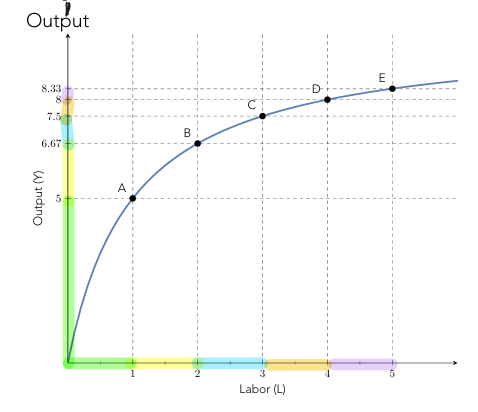

Each additional worker produces less output than the one before it.
The first worker produces 5 units of output.
The second worker produces 1.6
The third worker produces 0.83 units of output.
The fourth worker produces 0.5 units of output.
The fifth worker produces 0.33 units of output.
Diminishing Marginal Product of Labor: As more labor is added (holding capital fixed), each additional worker produces less output than the worker before them.
This usually happens because workers begin sharing limited resources, such as:
machines
workspace
tools
equipment
So eventually workers get in each other’s way or have less to work with so they become less productive.
MPL Data Table Analysis:
Labor () | Output () | Marginal Product of Labor () |
|---|---|---|
1 | 5 | 5 |
2 | 6.67 | 1.67 |
3 | 7.5 | 0.83 |
4 | 8 | 0.5 |
5 | 8.33 | 0.33 |
Marginal Product of Capital (MPK)
Definition: The extra output produced when a business adds one more unit of capital, while keeping everything else the same.
So the marginal product of capital measures how much additional production comes from adding another machine or piece of equipment.

Formula:
MPK Data Table Analysis:
Capital () | Output () | Marginal Product of Capital () |
|---|---|---|
1 | 10 | 10 |
2 | 13.33 | 3.33 |
3 | 15 | 1.67 |
4 | 16 | 1 |
5 | 16.67 | 0.67 |
Diminishing Marginal Product of Capital:
The idea that as more units of capital are added while other resources stay fixed, each additional unit of capital eventually produces a smaller increase in output than the previous one.
For example, if a factory keeps adding machines but does not hire more workers, the new machines will eventually become less useful because there are not enough workers to operate them efficiently.
Firm Profit Maximization and Factor Demand
What is the goal of every firm? To maximize profits.
Therefore, firms hire labor, capital and such so that their profits are maximized.
Assumptions of the Model:
- The firm sells (Y) units of output at a price of (). per unit
- Total Revenue = .
- The firm hires () workers at a market wage () wage per worker.
- Total Labor Costs = .
- The firm hires capital () units of capital at a rental rate of () per unit.
- Total Capital Costs = .
Example:
Suppose a firm uses:
10 machines (K = 10)
Each machine costs $500 per month (this would be the rental rate) to use (r = $500)
Then:
Total Capital Cost =10 × 500 = 5,000
So, the firm's total capital cost is $5,000 per month.
The Firms’ total profits:
Total Revenue - Total Cost
Profit Equation:
Suppose the firm is considering if it should change the number of workers it hires, how does it make its decision?
First, how much does their revenue change?
Changing the number of workers by one (either up or down) will change production by MPL (either up or down)
The firm’s revenue will change by P x MPL
How much do their cost change?
Changing the labor force by one worker, will change the firms cost by W (either up or down)
What should the firm do?
If P x MPL > W: Hire one more worker
If P x MPL < W: Hire one less worker
If P x MPL = W: Profits are maximized
Firm Decision-Making for Hiring Labor
Marginal Decision: Firms consider if hiring one more worker increases profit.
MPL: Marginal product of labor, the extra amount of output a firm receives from one additional unit of labor while holding the amount of capital fixed.
- Change in Revenue: Hiring one additional worker changes production by the . The revenue changes by .
- Change in Cost: Hiring one additional worker increases costs by the wage ().
Hiring Rules:
- If : The firm should hire more labor (the worker adds more revenue than cost).- If : The firm should hire less labor (the worker costs more than the revenue they generate).
- If : Profits are maximized.
Labor Hiring Example: Practical Application
Scenario: Market wage () is .
Step 1: Firm has 0 workers. Should it hire its first worker? - The first worker adds in revenue () and costs . - Decision: Hire. Profits increase.
Step 2: Firm has 1 worker. Should it hire a second? - The second worker adds in revenue () and costs . - Decision: Hire. This is the point of profit maximization. - Conceptual Logic: Time is divisible. For roughly 7 hours, 59 minutes, and 59 seconds of an 8-hour day, this worker is adding profit. On the final second, costs and revenue equate. Therefore, hiring a second worker is regarded as adding profit overall.
Step 3: Firm has 2 workers. Should it hire a third? - The third worker adds in revenue () and costs . - Decision: Do not hire (or fire). This worker decreases profits.
Equilibrium and Factor Payments
Equilibrium Condition: Profits are maximized when .
The Real Wage: This can be rewritten as . - Definition: The real wage is the amount of goods and services a household can buy with their nominal wage () relative to the price level (). - Rule: In equilibrium, labor is paid its marginal product (). - Implication: To receive higher pay, a worker must increase their productivity.
Capital Payments: The same logic applies to capital. The real rental price of capital is its marginal product. - Formula: