Stationary Waves
A stationary wave can be formed by the superposition of two progressive waves of the same frequency, travelling in opposite directions. This is usually achieved by:
two progressive waves
same frequency
opposite direction
Superposing a reflected wave with its incident wave.
A stationary wave is formed at certain frequencies, by the superposition of the incident wave from the vibrating pin, and the reflected wave from the pulley. The reflected wave is in anti-phase with the incident wave, so there is always a cancellation (destructive interference).
Properties of stationary waves:
No net transfer from one point to another.
Amplitude varies (from nodes to antinodes)
All particles oscillate at the same frequency.
Wavelength is equal to twice the distance between adjacent nodes.
Between nodes all particles are at the same phase. Any other two particles have a phase difference equal to m¶, where m is the number of nodes between particles.
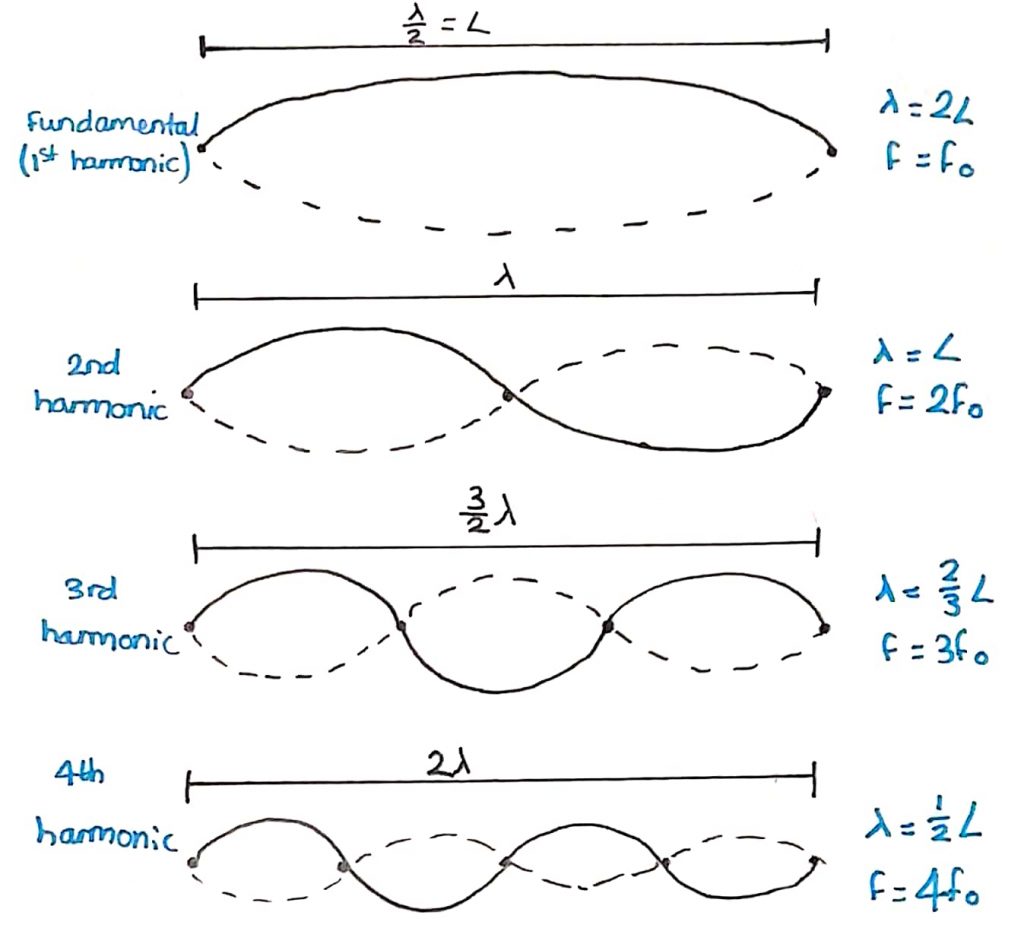
Secondary Waves on Strings:
Fundamental mode: Fº
This is the lowest frequency that can produce a stationary wave. (Also known as the first harmonic).
The length of the loop L is equal to half a wavelength, λ.
So λ=2L,
Fº = C/λ = C/2L.
First overtone: 2Fº
This is the second lowest frequency that can produce a stationary wave.
The length of two loops is equal to one wavelength.
So λ=L
2Fº = C/L