• Jeffry A. Frieden, David A. Lake, and Kenneth A. Schultz, World Politics:Monteary Interests, Interactions, Institutions, 4th ed., pages pp. 386-401
The source provides a comprehensive analytical overview of international monetary relations, focusing on the interests, interactions, and institutions that shape global currency policy. It defines exchange rates as the price of one currency relative to another and explains concepts like appreciation and depreciation, illustrating how these affect international trade, tourism, and purchasing power. The text details how currency values are determined by factors such as supply and demand and interest rates, positioning national monetary policy, implemented by central banks, as a powerful economic tool. Furthermore, the discussion explores the political and economic trade-offs between fixed and floating exchange rate systems, highlighting domestic conflicts of interest among governments, businesses, and consumers. Finally, the source addresses the controversial practice of currency manipulation, particularly in the context of China, and the resulting conflicts with trading partners
Briefing Document: The Politics of International Monetary Relations
Executive Summary
International monetary policy is a critical and contentious area of world politics, characterized by significant conflicts of interest both within and between nations. The management of national currencies, particularly their value relative to others (the exchange rate), has profound consequences for international trade, investment, and domestic economic conditions.
Governments face a fundamental choice between adopting a fixed exchange rate, which provides stability and predictability for international transactions at the cost of sacrificing independent monetary policy, and a floating exchange rate, which grants policy autonomy to address domestic economic issues but can introduce volatility that impedes cross-border exchange. Historical systems like the gold standard and the Bretton Woods agreement sought to manage these trade-offs, but contemporary major currencies largely operate on a floating basis.
Within each nation, exchange rate policy creates distinct winners and losers. A strong currency benefits consumers by increasing their purchasing power for foreign goods but harms domestic producers who face tougher competition from cheaper imports and find it harder to export. Conversely, a weak currency boosts exports and aids domestic producers but reduces consumer purchasing power. These competing interests make currency policy a subject of intense domestic political debate.
Internationally, these dynamics can lead to significant friction, particularly regarding currency manipulation. When a country, such as China, systematically keeps its currency artificially weak to promote exports, it generates benefits for its producers and foreign consumers but creates economic pressure on producers in trading partner nations. This practice is often condemned as unfair competition and can become a major source of international economic and political conflict.
--------------------------------------------------------------------------------
I. The Fundamentals of Exchange Rates
A. Defining Exchange Rates and Their Impact
The exchange rate is the price at which one national currency is exchanged for another. The value of a currency can change in two primary directions:
Appreciation (Strengthening): An increase in value relative to other currencies. When the U.S. dollar appreciates against the euro, one dollar can buy more euros.
Depreciation (Weakening) / Devaluation: A decrease in value relative to other currencies. When the dollar depreciates, it can buy fewer euros.
Exchange rates are a crucial component of a country's international economic relations because they directly affect the prices of goods, services, and investments across borders.
Impact on Goods and Services: An appreciating currency makes a country's exports more expensive for foreigners and makes imports cheaper for domestic consumers. A depreciating currency has the opposite effect, making exports cheaper and imports more expensive.
Example: In March 2017, a €100 Italian hotel room cost an American tourist about $105 (when €1 = $1.05). A year later, after the dollar had depreciated by 18% against the euro, the same €100 room cost $124 (when €1 = $1.24). This principle applies equally to internationally traded goods, such as Italian shoes exported to the United States.
B. Determinants of Currency Value
Like other prices, exchange rates are determined by supply and demand. A key factor influencing supply and demand for a currency is relative interest rates.
Higher Interest Rates: When a country's interest rates are higher, investments in that country become more attractive to foreigners. To invest, foreigners must buy the country's currency, increasing demand and causing the currency to appreciate.
Lower Interest Rates: Lower interest rates can make investment less attractive, reducing demand for the currency and leading to its depreciation.
General Investment: Any factor that makes a country attractive for foreign investment will increase demand for its currency and lead to appreciation.
II. National Monetary Policy and Exchange Rate Regimes
A. The Role of Central Banks
National governments use monetary policy as a primary tool to influence macroeconomic conditions like unemployment, inflation, and economic growth. This policy is typically implemented by a central bank, such as the Federal Reserve in the United States.
To Stimulate the Economy: A central bank lowers interest rates, making it cheaper for individuals and companies to borrow, thus encouraging expansion.
To Restrain the Economy: A central bank raises interest rates to combat inflation, making borrowing more expensive and restraining demand.
Because interest rates directly affect exchange rates, a government's domestic monetary policy has a powerful impact on its currency's international value. A government can deliberately lower interest rates to cause currency depreciation, thereby stimulating exports and reducing imports.
B. The Core Choice: Fixed vs. Floating Exchange Rates
The most important decision a government makes regarding its currency is whether to adopt a fixed or floating exchange rate regime.
Regime Type | Description | Key Characteristics & Examples |
Fixed Exchange Rate | The government commits to keeping its currency at or around a specific value relative to another currency or a commodity, such as gold. | Pros: Provides stability and predictability, facilitating international trade and investment. Acts as a monetary anchor to keep prices stable. <br> Cons:Reduces or eliminates a government's ability to use independent monetary policy to address domestic economic problems (e.g., a recession). <br> Examples: The classical gold standard (1870-1914), the Bretton Woods system (1945-1973). |
Floating Exchange Rate | The government permits its currency to be traded on the open market without direct government control, allowing its value to be driven by market forces. | Pros: Gives the government freedom to pursue its own monetary policies. <br> Cons: Currency values can be volatile, which can impose costs on and impede international trade and investment. <br> Examples: Current regimes for the U.S. dollar, Japanese yen, and the euro. |
Intermediate Regimes | Systems that blend elements of both fixed and floating regimes, such as allowing the currency to vary within a specific band. | The Bretton Woods system's "adjustable peg" is an example. Currencies were fixed to the dollar but governments were permitted to adjust the rate periodically. |
C. Analysis of Historical Fixed-Rate Regimes
The Classical Gold Standard (1870-1914): Governments promised to exchange their currency for gold at an established rate. This created a global system where exchange rates were fixed, as most major currencies were effectively interchangeable with gold. The stability is estimated to have increased trade between two countries on the gold standard by 30-70 percent.
The Bretton Woods System (1945-1973): This system was a compromise designed after World War II. The U.S. dollar was fixed to gold at $35 per ounce. Other member currencies were then fixed to the U.S. dollar under an "adjustable peg" system, allowing for infrequent devaluations (typically every five to seven years) if economic conditions warranted. It aimed to provide the stability of the gold standard while allowing more flexibility than its predecessor.
III. The Political Economy of Exchange Rates
Decisions about exchange rate policy affect domestic groups differently, leading to conflicts of interest.
A. Domestic Conflicts of Interest: Fixed vs. Floating
Support for Fixed Rates: Actors whose economic activities are international (involving trade, investment, finance) have a strong interest in the stability and predictability of a fixed rate. Smaller economies that are highly open to international trade (e.g., the Netherlands, Belgium, Austria) have historically been strong supporters of fixed systems, such as the euro.
Support for Floating Rates: Actors whose economic activities are entirely domestic tend to favor a floating rate. They are less concerned with currency fluctuations but want the government to retain the ability to use monetary policy to manage the national economy. Larger, more self-sufficient economies (e.g., Mexico, Brazil) have typically allowed their currencies to float.
The constraints of a fixed rate become especially clear during economic crises.
Argentina (2001): With its peso fixed to the U.S. dollar, the government was unable to devalue its currency or lower interest rates to combat a severe recession, contributing to economic and political paralysis.
Eurozone Crisis (post-2008): Countries like Greece, Spain, and Portugal, which used the euro, could not devalue their currencies to make their exports more competitive and stimulate their economies. Monetary policy was set for the entire eurozone by the European Central Bank (ECB), removing a critical policy tool from national governments.
B. Domestic Conflicts of Interest: Strong vs. Weak Currency
Currency Strength | Beneficiaries | Those Harmed |
Strong Currency | Consumers: Their purchasing power increases, allowing them to buy more foreign goods and services cheaply. <br> Tourists traveling abroad. | Domestic Producers (Manufacturers & Farmers): They face increased competition from cheaper imports and find it more difficult to sell their goods abroad because their exports are more expensive. |
Weak Currency | Domestic Producers (Manufacturers & Farmers):Their goods become cheaper and more competitive in global markets, boosting exports. They are also shielded from foreign competition as imports become more expensive. | Consumers: Their purchasing power is reduced. Foreign goods and travel become more expensive. This can contribute to domestic inflation. |
Case Study: The Strong U.S. Dollar (1981-1985): The dollar appreciated by over 50%, leading to a surge in American consumer purchasing power. However, it created serious problems for U.S. manufacturers, who faced a flood of cheaper imports and found it hard to export. An estimated 1.5 million manufacturing jobs were lost, and the president of Caterpillar Tractor called the strong dollar "the single most important trade issue facing the U.S." This pressure led to a unanimous Senate resolution in 1985 calling for the dollar to be depreciated.
IV. Currency Manipulation and International Conflict
A. The Strategy of Maintaining a Weak Currency
Some governments, particularly those in developing countries pursuing export-led growth, deliberately keep their currencies weak over long periods. This policy boosts national producers and makes the country's exports highly competitive on world markets.
Case Study: China's Renminbi Policy: After 1979, China organized its development strategy around promoting exports of manufactured goods. A key component was keeping its currency, the renminbi, artificially weak.
Methods: The government controlled capital flows, managed the domestic market for foreign currency, and held vast reserves of U.S. dollars overseas to prevent them from being converted into renminbi, which would have caused appreciation.
Domestic Consequences: The policy acted as a tax on Chinese consumers, whose purchasing power was artificially suppressed. This led to complaints that the benefits of China's growth went disproportionately to export producers.
International Consequences: Trading partners, especially the United States, frequently complained that the weak renminbi was an unfair trading practice, creating political friction and threatening to escalate into open trade conflict.
B. The International Controversy Over Currency Manipulation
Currency manipulation occurs when a government intervenes in currency markets to weaken its exchange rate and give its producers a competitive advantage. This practice is a major source of international economic conflict.
Clash of Interests: Manipulation helps exporters in the manipulating country and consumers in trading partner nations (who get cheaper goods). It harms producers in trading partner nations and consumers in the manipulating country.
Institutional Rules: The International Monetary Fund (IMF) and the World Trade Organization (WTO) have rules against currency manipulation, but their enforcement power is limited. These issues are often handled through bilateral pressure.
The U.S. and China: During his 2016 campaign, Donald Trump promised to label China a currency manipulator, which would have allowed for punitive sanctions under U.S. law. He ultimately did not follow through for two main reasons:
By 2017, most analyses indicated China was no longer trying to weaken its currency and was, in fact, working to prevent it from depreciating further.
The administration sought China's diplomatic cooperation in addressing North Korea's nuclear program and did not want to jeopardize that relationship.
The debate remains over whether manipulation should be punished. Proponents of punishment argue it is an unfair practice that harms producers and risks provoking protectionist retaliation. Opponents argue that weak currencies are a legitimate tool for poor countries to stimulate growth and that consumers in wealthy countries benefit from the resulting cheap goods.
Study Guide: International Monetary Relations
Quiz: Short Answer Questions
Instructions: Please answer the following questions in two to three sentences, based on the provided source material.
What is an exchange rate, and why is it considered a crucial part of a country's international economic relations?
Explain the difference between currency appreciation and depreciation using the example of the U.S. dollar and the Mexican peso.
How does a country's national interest rate influence the value of its currency?
Describe the primary function of a central bank and the main tools it uses to implement monetary policy.
What are the key differences between a fixed exchange rate and a floating exchange rate?
Briefly describe the Bretton Woods monetary system that was in place from 1945 to 1973.
What is the main advantage of a fixed exchange rate, and what is the primary cost or trade-off for a government that adopts one?
Identify which domestic groups generally benefit from a strong currency versus a weak currency.
What is currency manipulation, and what is the primary motivation for a government to engage in this practice?
According to the text, what were the two main reasons the Trump administration chose not to label China a currency manipulator in 2017?
--------------------------------------------------------------------------------
Answer Key
An exchange rate is the price at which one national currency is exchanged for another. It is crucial because it affects the prices of goods, services, and investments bought and sold across borders, thereby influencing a country's attractiveness to foreign trade and investment.
When a currency appreciates, its value increases relative to other currencies, meaning a dollar can buy more pesos. Conversely, when a currency depreciates, its value decreases, meaning a dollar can buy fewer pesos.
Higher interest rates in a country make investments there more attractive to foreigners, which increases the demand for that country's currency. This increased demand leads to an appreciation in the currency's value. Conversely, lower interest rates can lead to depreciation.
A central bank is the institution that regulates monetary conditions in an economy to influence macroeconomic conditions like unemployment and inflation. It primarily implements monetary policy by raising or lowering national interest rates to either restrain or stimulate the economy.
Under a fixed exchange rate, a government commits to keeping its currency at a specific value relative to another currency or commodity, such as gold. Under a floating exchange rate, the government permits the currency's value to be determined by the open market without direct control.
The Bretton Woods system was a monetary order based on the U.S. dollar being tied to gold at a fixed rate of $35 per ounce. Other currencies were fixed to the dollar but were permitted to adjust their exchange rates from time to time, creating a system of "fixed but adjustable rates" known as an adjustable peg.
The main advantage of a fixed rate is the stability and predictability it provides, which facilitates international trade and investment. The primary cost is that it eliminates a government's ability to have an independent monetary policy, as interest rates must be used to maintain the currency's fixed value rather than address domestic economic conditions like a recession.
A strong currency benefits consumers and tourists, as it increases their purchasing power for foreign goods and services. A weak currency benefits national producers, such as manufacturers and farmers, because it makes their exports cheaper for foreigners and makes imports more expensive, reducing foreign competition.
Currency manipulation occurs when a government intervenes in currency markets to alter its currency's value, typically by selling its own currency to weaken its exchange rate. The motivation is to give its domestic producers a competitive advantage in international markets by making their exports cheaper for foreigners.
The Trump administration did not follow through for two reasons. First, most economic analyses indicated that China was no longer trying to weaken its currency and was, in fact, trying to prevent it from weakening. Second, the administration sought China's cooperation in dealing with North Korea's nuclear weapons program and felt that labeling it a manipulator would interfere with diplomatic efforts.
Glossary of Key Terms
Term | Definition |
Adjustable peg | A monetary system of fixed but adjustable rates. Governments are expected to keep their currencies fixed for extended periods but are permitted to adjust the exchange rate from time to time as economic conditions change. |
Appreciate | In terms of a currency, to increase in value relative to other currencies. |
Bretton Woods monetary system | The monetary order negotiated among the World War II Allies in 1944, which lasted until the 1970s and which was based on a U.S. dollar tied to gold. Other currencies were fixed to the dollar but were permitted to adjust their exchange rates. |
Central bank | The institution that regulates monetary conditions in an economy, typically by affecting interest rates and the quantity of money in circulation. |
Currency manipulation | The practice of a government intervening in currency markets to alter its currency's value, often by selling its own currency to weaken its exchange rate and give its producers a competitive advantage. |
Depreciate | In terms of a currency, to decrease in value relative to other currencies. |
Devalue | To reduce the value of one currency relative to other currencies. |
Exchange rate | The price at which one currency is exchanged for another. |
Fixed exchange rate | An exchange-rate policy under which a government commits itself to keep its currency at or around a specific value relative to another currency or a commodity, such as gold. |
Floating exchange rate | An exchange-rate policy under which a government permits its currency to be traded on the open market without direct government control or intervention. |
Gold standard | The monetary system that prevailed between about 1870 and 1914, in which countries tied their currencies to gold at a legally fixed price. |
Monetary policy | An important tool of national governments to influence broad macroeconomic conditions such as unemployment, inflation, and economic growth. Typically, governments alter their monetary policies by changing national interest rates or exchange rates. |
Strong currency | A currency that has appreciated in value. It increases a nation's purchasing power but makes its goods more expensive to foreigners, hurting exporters and producers who compete with imports. |
Weak currency | A currency that has depreciated in value. It reduces a nation's purchasing power but gives a boost to national producers by making exports cheaper and imports more expensive. |
video notes=
vacations how currency impacts ur wallet= vacation suddenly cost more 1yr after planning teh trip
hotel in italy 1000 euros american =105, 1 yr now costs 124 for americans went up 20%= exchange rate=price of currency can go up or down base don who wants to buy/sell it = euros price went up for ppl trying to buy it with american dollars
could gov try to control or flow with price changes
fixed =gold standard(1870s-1914) Britian allow pound to. be exchanged with 130 grams of pure gold —> each country same exchange rate with gold —> pay currency to gold stable fixed exchange rate = our curency is worth x, pro stability for trade(free trade) first globalization. 2/3 impossible=fixed and free capital flow (less capital control across borders) in britian can move capital investment over borders= Britian can buy u.s Treasuries/ did. not have freedom to choose monetary policy implication recession os coming cannot reduce interest rate
floating rate= U.s set up open market, pro independent policy. flexibility
stability comes with trade off= monetary policy=lower interest rates when economy is down get ppl to spend can make recession worse if fixed rate
strong currency= good for consumers bad for company that sells over seas more expensive for foreigners
weak= good for exporters local manufacturers not good for consumers
1980s U.s dolalr strong apperieaned more than 50% american tourists couls spend alot bad for american companies threat to comapnies survival —> 1.5 million manufactoring jobs disapeared more cheap imports human cost
tension btw diff groups explodes onto global stage =controversy to chinas currency
China’s plan= 1. keep currency weak 2. boost exports 3. stop appericiation stop currency from gettung stronger on own
web of winners and losers no t.s vs chian = china exports+consumers win / china consumers+american manufactures =losers
cause tension u.s point finger accuse of currency manipulation keep currency weak
no single perfect value evry choice has a impact
lecture notes=
how does exchange rates get determined = interest rate can make more money sell dollars to buy yen to investw here interest rate high, how many ppl want certain currency, determine interest rate = central bank try to lower interest rate —> weak dollar investors ahve less incentive to invest in country, increase interst rate more investors invest in country buy buying dollar and investing those dollars
influencial tool nation states can adapt= lower interest rate in bad economy = hosueholds borrow more influence ppl to spend more better economy/ infastructure
economic boom= central bank higher interests rates try to prevent overinflation demand above supply = mitigate business cycles
impossible trinity= one country eco choice/policy choice desirable
fixed=free trade =stability/ if currency goes down investors profits could disappear w/o it
free capital= promote globalization. competition
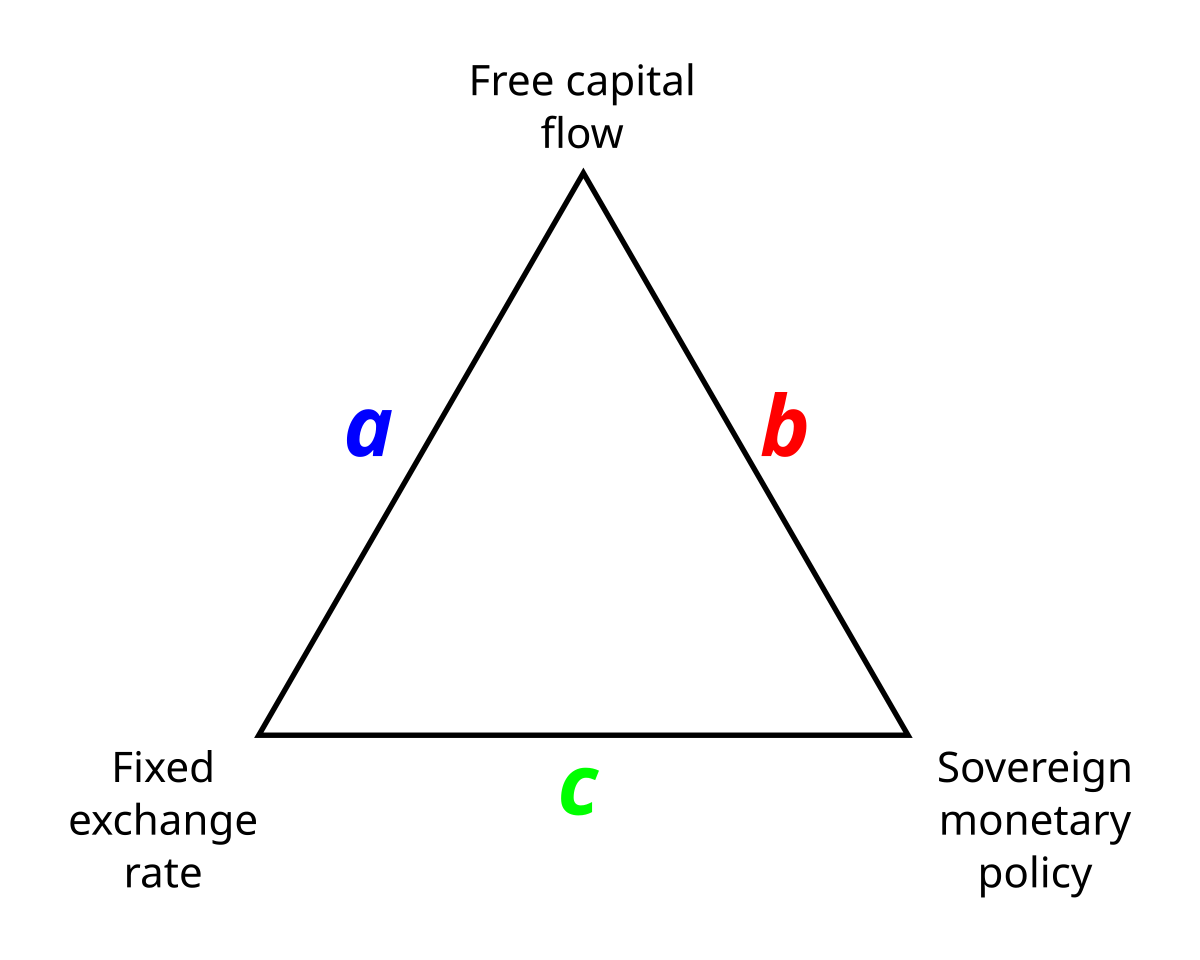
impossible trinity
modern day golden standard=certain european counntries in european union does same does not have freedom to manipulate interests rate /central bank in frankford only has freedom to /coutries that adapt euro/ countries like Portugal can buy stocks in ireland
currency dollar to gold fixed exchange rate Bretton Woods system(post 1945-1971?)= historically was the most profitable system according to danny rodrick= U.S taken advantage of by developed countries (Japan+Germany) overvalued dollar allow allies to have weaker currency rate to let them grow cooperation during cold war —. nixon declare to stop dolar to gold system
dollar primary currency even today lead into next class
dollar gold standard middle of 20th century=chose soverign policy and fixed exchange abandon free capital= spread of democracy vote=monetary policy important foreign policy = face recession central bank can stimulate economy =labor suffer if eco recession happens = less jobs after war= decide free capital flow only help ppl. who have capital ($) and gain influence through interest rate vs labor with less influence =democracy —> workers can vote post 1945=pressure from owkers to take care of interests= impose forms of capital control difficult for investors to move capital over border —> imposed tax/ quota on foreign currency you can buy $10,000 per person limit =china has combination of it —> china grow exponetially
interest rate lower exchange rate of country stable investors cannot sell money to buy foreign currency
current system= chose free capital flow and soverign monetary policy without fixed exchange rate nixon end dollar to gold
1981-85 Reagan dollar overvalued fight inflation since oil shocks of 1970s = central bank increase interest rates —> foreign investor= u.s dollar appreciated=overvalued $ overmind u.s economy reduce u.s exports/ lost jobs floating exchange rate = flexibile but still has negative
free capital mobility cons + floating exchange rate=cause financial crisis after liberalization 1980s-90s= brazil→argentina
matters if you are a developed floating exchange vs developing fixed exchange rate what is best/ time period=different strokes for different folks/ diff =latin america fixed exchanged at expense of free capital flow = develop itself instead of importing
china today =soverign + sort of fixed exchange rate=impose capital controls trade surplus cannot go back to china to be converted = currency would go up export advantage go away