15.7 the loop of henle
the loop of henle
u-shaped tubule in kidney nephron, extends from renal cortex into medulla
two sections:
Descending limb: first section filtrate travels, narrow, permeable to water, impermeable to ions.
Ascending limb: second section, wider, impermeable to water, permeable to ions.
loop facilitates exchange of water + solutes between tubule + surrounding interstitial fluid, lets kidney produce concentrated urine
how loop of henle concentrates urine
function: decrease water pot in medulla via active transport of ions out of filtrate → tissues of medulla that surround loop of Henle (interstitial space)
this establishes water pot gradient that lets water be reabsorbed → blood from filtrate in collecting duct
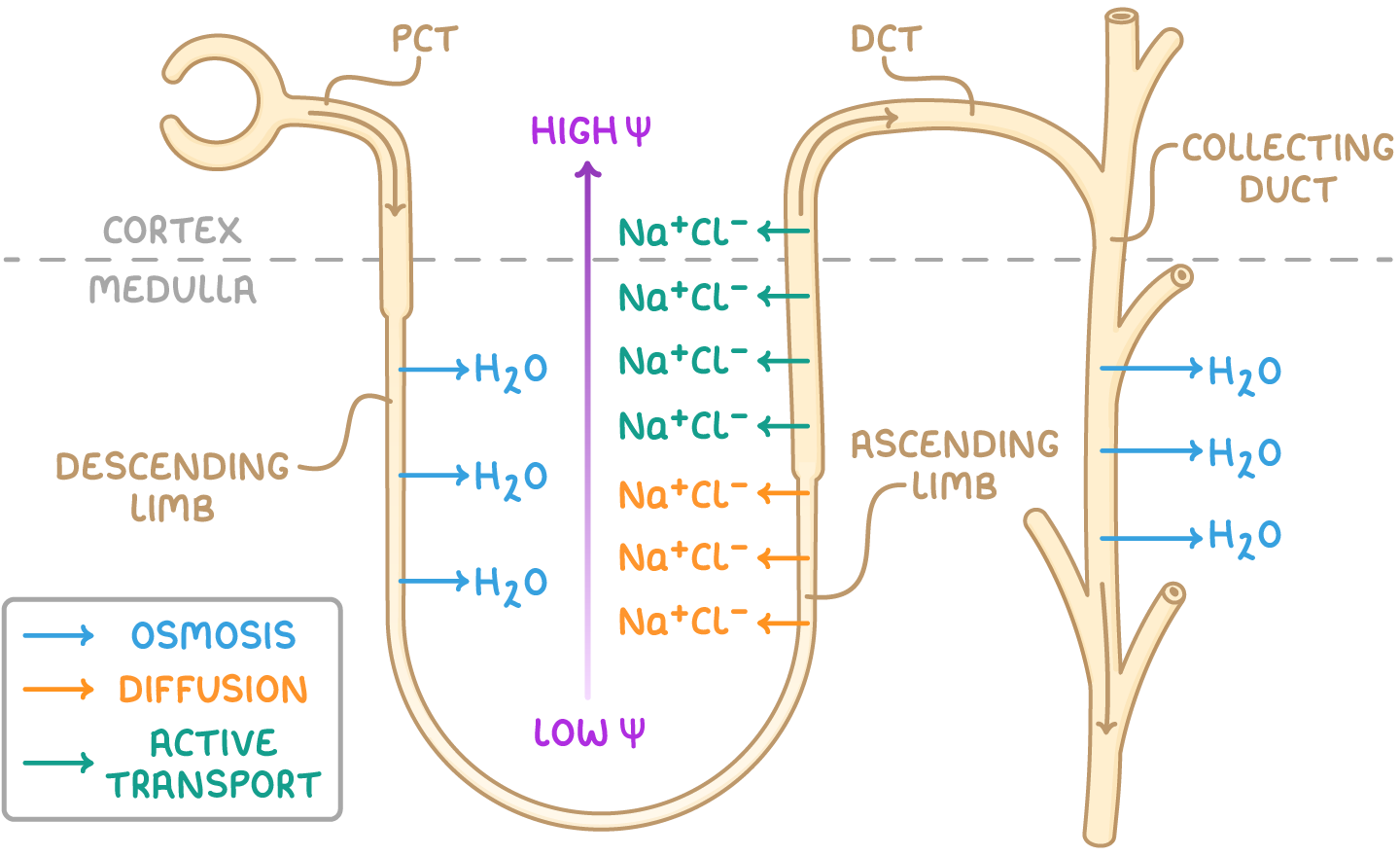
Water reabsorption in the loop of Henle:
The descending limb's walls are permeable to water, so water leaves the filtrate via osmosis into the interstitial space.
Filtrate loses water as it moves down the descending limb, reaching its lowest water potential at the tip in the medulla.
Water that is lost is reabsorbed into blood in the surrounding capillaries by osmosis and is carried away.
The ascending limb is impermeable to water, but is permeable to sodium (Na+) and chloride (Cl-) ions.
Na+ and Cl- diffuse out of the filtrate into the interstitial space at the bottom of the ascending limb, due to the low water potential of the filtrate.
This concentrates ions in the interstitial space in the medulla, making its water potential very low.
Na+ and Cl- need to be actively transported out of the top of the ascending limb, because their concentration in filtrate decreases as it ascends (the water potential increases).
Overall, this creates a water potential gradient in the interstitial space, with the highest water potential in the cortex and an increasingly lower water potential deeper into the medulla.
Then, when filtrate enters the collecting duct:
Water moves from the filtrate in the collecting duct into the interstitial space, and then into surrounding capillaries, by osmosis to be carried away.
Water continues to exit the filtrate as it moves through the collecting duct, even deep in the medulla when most water has already been lost, because of the low water potential established by the loop of Henle in the surrounding interstitial space.
Urine leaving the collecting duct has a very low water potential, as most water has been reabsorbed into the blood.
countercurrent multiplier system
Countercurrent multiplier intensifies salt gradient in medulla.
how countercurrent multiplier set up:
As filtrate moves down collecting duct, loses water, decreasing water potential
However, due to pumping of ions out of ascending limb of loop of Henle, especially deeper in medulla, water pot of surrounding tissues in medulla is even lower than in collecting duct.
This allows water to continue to move out of filtrate down whole length of collecting duct
so, concentrates urine + ensures always water pot gradient drawing water out collecting duct. if flows were parallel, less water reabsorption would occur.