chapter 11
Forms of Price: You pay tuition for your education, rent for an apartment, interest on a bank credit card, and a premium for car insurance. Your dentist or physician charges you a fee, a professional or social organization charges dues, and airlines charge a fare. In business, an executive is given a salary, a salesperson receives a commission, and a worker is paid a wage. And what you pay for clothes or a haircut is termed a price.
price (P): The money or other considerations (including other products and services) exchanged for the ownership or use of a product or service.
Barter: The practice of exchanging products and services for other products and services rather than for money.
Value: The ratio of perceived benefits to price; or Value = (Perceived benefits ÷ Price).
value pricing: The practice of simultaneously increasing product and service benefits while maintaining or decreasing price.
profit equation: Profit = Total revenue − Total cost; or Profit = (Unit price × Quantity sold) − (Fixed cost + Variable cost).
Demand-oriented approach: weigh factors underlying expected customer tastes and preferences more heavily than cost, profit, and competition factors when selecting a price level.
skimming pricing: Setting the highest initial price that customers really desiring the product are willing to pay when introducing a new or innovative product.
penetration pricing: Setting a low initial price on a new product to appeal immediately to the mass market.
prestige pricing: Setting a high price so that quality- or status-conscious consumers will be attracted to the product and buy it.
odd-even pricing: Setting prices a few dollars or cents under an even number.
bundle pricing: The marketing of two or more products in a single package price.
cost-oriented approach: a price setter stresses the cost side of the pricing problem, not the demand side. Price is set by looking at the production and marketing costs and then adding enough to cover direct expenses, overhead, and profit.
standard markup pricing: Adding a fixed percentage to the cost of all items in a specific product class.
cost-plus pricing: Summing the total unit cost of providing a product or service and adding a specific amount to the cost to arrive at a price.
Profit-Oriented Pricing approach: A price setter may choose to balance both revenues and costs to set price using profit-oriented approaches. These might either involve setting a target of a specific dollar volume of profit or expressing this target profit as a percentage of sales or investment.
target profit pricing: Setting an annual target of a specific dollar volume of profit.
target return-on-sales pricing: Setting a price to achieve a profit that is a specified percentage of the sales volume.
target return-on-investment pricing: Setting a price to achieve an annual target return on investment (ROI).
competition-oriented approaches: Rather than emphasize demand, cost, or profit factors, a price setter can stress what “the market” is doing
customary pricing: Setting a price that is dictated by tradition, a standardized channel of distribution, or other competitive factors.
above-, at-, or below-market pricing: Setting a market price for a product or product class based on a subjective feel for the competitors’ price or market price as the benchmark.
loss-leader pricing: Deliberately selling a product below its customary price, not to increase sales, but to attract customers’ attention to it in hopes that they will buy other products with large markups as well.
demand curve: A graph that relates the quantity sold and price, showing the maximum number of units that will be sold at a given price.
Demand Factors: consumer tastes, price and availability of similar products, and consumer income.
Consumer tastes: depend on many forces such as demographics, culture, and technology. Because consumer tastes can change quickly, up-to-date marketing research is essential to estimate demand. For example, if research by nutritionists concludes that some pizzas are healthier (because they are now gluten-free or vegetarian), demand for them will probably increase.
Price and availability of similar products: If the price of a competitor’s pizza that is a substitute for yours—like Tombstone® pizza—falls, more people will buy it; its demand will rise and the demand for yours will fall. Other low-priced dinners are also substitutes for pizza.
Consumer income: In general, as real consumers’ incomes increase (allowing for inflation), demand for a product will also increase. So, if you get a scholarship and have extra cash for discretionary spending, you might eat more Red Baron frozen cheese pizzas and fewer peanut butter and jelly sandwiches to satisfy your appetite.
price elasticity of demand: The percentage change in quantity demanded relative to a percentage change in price.
Elastic demand exists: when a 1 percent decrease in price produces more than a 1 percent increase in quantity demanded, thereby actually increasing total revenue. This results in a price elasticity that is greater than 1 with elastic demand. In other words, a product with elastic demand is one in which a slight decrease in price results in a relatively large increase in demand or units sold. The reverse is also true; with elastic demand, a slight increase in price results in a relatively large decrease in demand. So marketers may cut price to increase consumer demand, the units sold, and total revenue for a product with elastic demand, depending on what competitors’ prices are.
Inelastic demand: exists when a 1 percent decrease in price produces less than a 1 percent increase in quantity demanded, thereby actually decreasing total revenue. This results in a price elasticity that is less than 1 with inelastic demand. So a product with inelastic demand means that slight increases or decreases in price will not significantly affect the demand, or units sold, for the product. The concern for marketers is that while lowering price will increase the quantity sold, total revenue will actually fall.
total revenue (TR): The total money received from the sale of a product.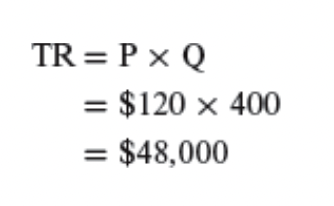
total cost (TC): The total expense incurred by a firm in producing and marketing a product. Total cost is the sum of fixed cost and variable cost.
break-even analysis: A technique that analyzes the relationship between total revenue and total cost to determine profitability at various levels of output.
pricing objectives: Specifying the role of price in an organization’s marketing and strategic plans.
Profit: Three different objectives relate to a firm’s profit, which is often measured in terms of return on investment (ROI) or return on assets (ROA). One objective is managing for long-run profits, in which companies—such as many South Korean HDTV manufacturers—forgo immediate profit by developing quality products to penetrate competitive markets over the long term. Products are priced relatively low compared to their cost to develop, but the firm expects to make greater profits later because of its high market share. A maximizing current profit objective, such as for a quarter or year, is common in many firms because the targets can be set and performance measured quickly. A target return objective occurs when a firm sets a profit goal (such as 20 percent for pretax ROI), usually determined by its board of directors.
Sales Revenue: Given that a firm’s profit is high enough for it to remain in business, an objective may be to increase sales revenue, which can lead to increases in market share and profit. Objectives related to dollar sales revenue or unit sales have the advantage of being translated easily into meaningful targets for marketing managers responsible for a product line or brand. However, although cutting the price of one product in a firm’s line may increase its sales revenue, it may also reduce the sales revenue of related products.
Market share: is the ratio of the firm’s sales revenues or unit sales to those of the industry (competitors plus the firm itself). Companies often pursue a market share objective when industry sales are relatively flat or declining.
unit volume: the quantity produced or sold, as a pricing objective. These firms often sell multiple products at very different prices and need to match the unit volume demanded by customers with price and production capacity. Using unit volume as an objective can be counterproductive if a volume objective is achieved, say, by drastic price cutting that drives down profit.
Survival: profits, sales, market share, and unit volume are less important objectives of the firm than mere survival. For example, many well-known retailers have faced survival problems in recent years because they couldn’t compete with the prices promoted by competitors and online retailers. These companies enacted price-matching programs and advertised large discounts on their merchandise to raise cash to avoid bankruptcy and closing locations.
Social Responsibility: A firm may forgo higher profit on sales and follow a pricing objective that recognizes its obligations to customers and society in general. For example, Gerber supplies a specially formulated product free of charge to children who cannot tolerate foods containing cow’s milk.
pricing constraints: Factors that limit the range of prices a firm may set.
Demand for the Product Class, Product, and Brand: The number of potential buyers for a product class (cars), product (sports cars), and brand (Bugatti Chiron) clearly affects the price a seller can charge. Generally, the greater the demand for a product, or brand, the higher the price that can be set. For example, the New York Mets set different ticket prices for their games based on the appeal of their opponent—prices are higher when they play the New York Yankees and lower when they play the Pittsburgh Pirates.
Newness of the Product: Stage in the Product Life Cycle: The newer a product and the earlier it is in its life cycle, the higher is the price that can usually be charged
Cost of Producing and Marketing the Product: Another profit consideration for marketers is to ensure that firms in their channels of distribution make an adequate profit. Without profits for channel members, a marketer is cut off from its customers. Of the $200 a customer spends for a pair of designer denim jeans, 50 percent of each dollar spent by a customer goes to a specialty retailer to cover its costs and profit. The other 50 percent goes to the marketer (34 percent) and manufacturers and suppliers (16 percent).
Competitors’ Prices: When Apple introduced its iPad, it was not only unique and in the introductory stage of its product life cycle but also the first commercially successful tablet device sold. As a result, Apple had great latitude in setting a price. Now, with a wide range of competition in tablets from Samsung’s Galaxy Note, Lenovo’s ThinkPad, and others, Apple’s pricing latitude is less broad.
Legal and Ethical Considerations Setting a final price is clearly a complex process. The task is further complicated by legal and ethical issues. Price fixing, price discrimination, deceptive pricing, predatory pricing
Price fixing: A conspiracy among firms to set prices for a product. is illegal under the Sherman Act. When two or more competitors collude to explicitly or implicitly set prices, this practice is called horizontal price fixing.Vertical price fixing involves controlling agreements between independent buyers and sellers (a manufacturer and a retailer) whereby sellers are required to not sell products below a minimum retail price.
Price discrimination: The Clayton Act as amended by the Robinson-Patman Act prohibits the practice of charging different prices to different buyers for goods of like grade and quality. However, not all price differences are illegal; only those that substantially lessen competition or create a monopoly are deemed unlawful.
Deceptive pricing: Price deals that mislead consumers is outlawed by the Federal Trade Commission. Bait and switch is an example. This occurs when a firm offers a very low price on a product (the bait) to attract customers to a store. Once in the store, the customer is persuaded to purchase a higher-priced item (the switch) using a variety of tricks, including (1) degrading the promoted item and (2) not having the promised item in stock or refusing to take orders for it.
Predatory pricing: is the practice of charging a very low price for a product with the intent of driving competitors out of business. Once competitors have been driven out, the firm raises its prices. Proving the presence of this practice has been difficult and expensive because it must be shown that the predator explicitly attempted to destroy a competitor and the predatory price was below the defendant’s average cost.
one-price policy: also called fixed pricing, is setting one price for all buyers of a product or service.
flexible-price policy: involves setting different prices for products and services depending on individual buyers and purchase situations in light of demand, cost, and competitive factors. Dell Technologies uses dynamic pricing as it continually adjusts prices in response to changes in its own costs, competitive pressures, and demand from its various personal computer segments (home, small business, corporate, etc.).
Discounts: are reductions from list price that a seller gives a buyer as a reward for some activity of the buyer that is favorable to the seller. Four kinds are especially important in marketing strategy: (1) quantity, (2) seasonal, (3) trade (functional), and (4) cash.
Quantity discounts: To encourage customers to buy larger quantities of a product, firms at all levels in the channel of distribution offer quantity discounts, which are reductions in unit costs for a larger order.
Seasonal discounts: To encourage buyers to stock inventory earlier than their normal demand would require, manufacturers often use seasonal discounts.
Trade (functional) discounts: To reward wholesalers and retailers for marketing functions they will perform in the future, a manufacturer often gives trade, or functional, discounts. These reductions off the list or base price are offered to resellers in the channel of distribution on the basis of (1) where they are in the channel and (2) the marketing activities they are expected to perform in the future.
Cash discounts: To encourage retailers to pay their bills quickly, manufacturers offer them cash discounts. are typically expressed as a percentage off the list price.
Allowances: like discounts—are reductions from list or quoted prices to buyers for performing some activity.
trade-in allowance: is a price reduction given when a used product is part of the payment on a new product. an effective way to lower the price a buyer has to pay without formally reducing the list price.
Promotional allowances: Sellers in the channel of distribution can qualify for them for undertaking certain advertising or selling activities to promote a product. Various types of allowances include an actual cash payment or an extra amount of “free goods”. Frequently, a portion of these savings is passed on to the consumer by retailers.
Everyday low pricing (EDLP): is the practice of replacing promotional allowances with lower manufacturer list prices. promises to reduce the average price to consumers while minimizing promotional allowances that cost manufacturers billions of dollars every year.