3.3.1 Transcription
DNA replication
Allows cells to divide to make replicates. Unzipped using helicase
Protein synthesis
Process where genes are exposed to make a protein
RNA polymerase unzips DNA
Genetic code to protein
Genetic code is a sequence of bases which provide the instructions for making specific polypeptides
Process in which genetic code is made into polypeptides is transcription and translation
Transcription
The genetic code, found in nucleus, provides instructions for protein synthesis.
However protein synthesis occurs in ribosomes outside the nucleus
There needs to be a 'messenger' that transfers code outside of the nucleus. This is an RNA molecule, mRNA
Transcription is the process by which the information in a strand of DNA is copied into a new molecule of mRNA
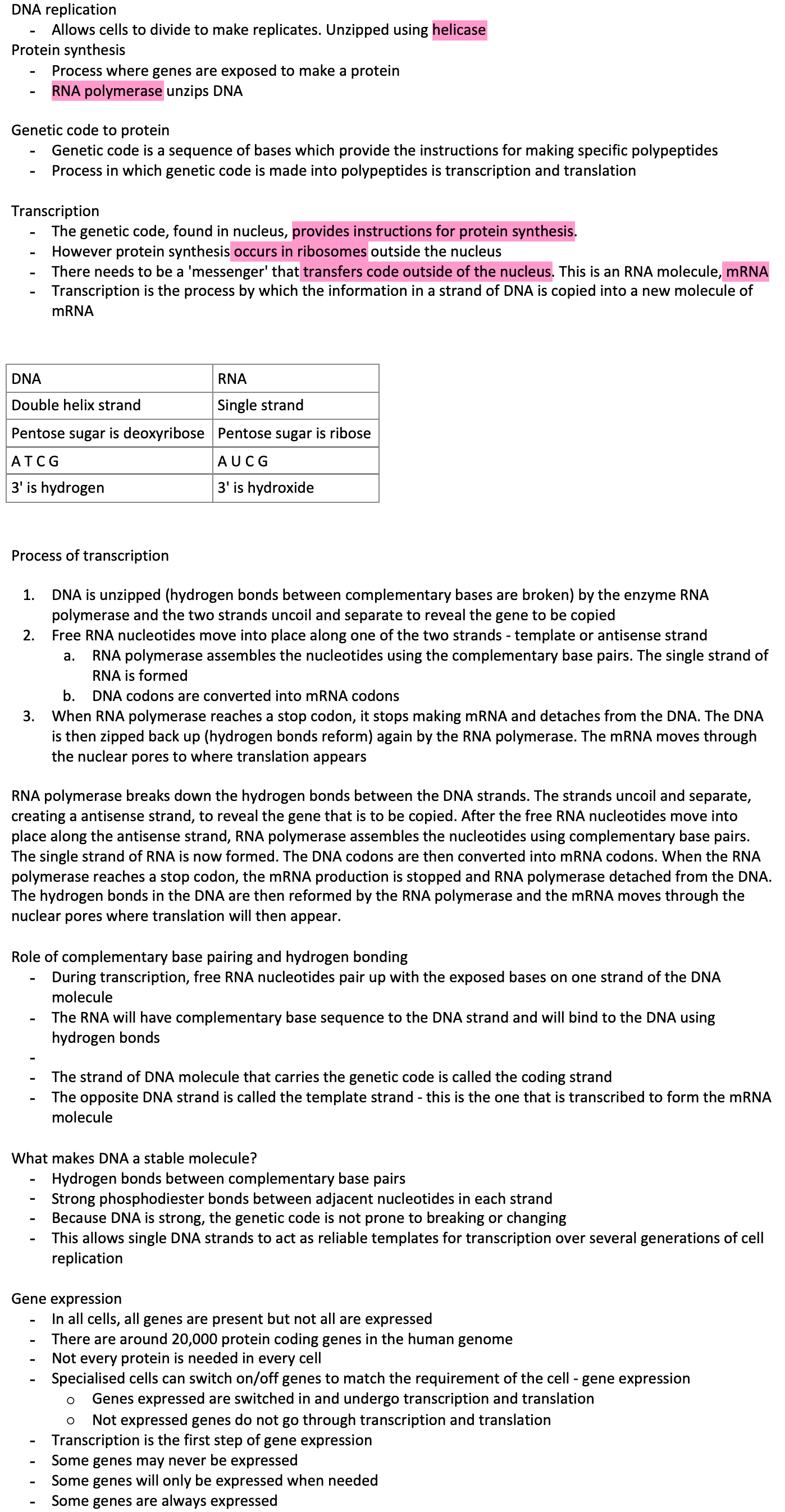
DNA | RNA |
Double helix strand | Single strand |
Pentose sugar is deoxyribose | Pentose sugar is ribose |
A T C G | A U C G |
3' is hydrogen | 3' is hydroxide |
Process of transcription
DNA is unzipped (hydrogen bonds between complementary bases are broken) by the enzyme RNA polymerase and the two strands uncoil and separate to reveal the gene to be copied
Free RNA nucleotides move into place along one of the two strands - template or antisense strand
RNA polymerase assembles the nucleotides using the complementary base pairs. The single strand of RNA is formed
DNA codons are converted into mRNA codons
When RNA polymerase reaches a stop codon, it stops making mRNA and detaches from the DNA. The DNA is then zipped back up (hydrogen bonds reform) again by the RNA polymerase. The mRNA moves through the nuclear pores to where translation appears
RNA polymerase breaks down the hydrogen bonds between the DNA strands. The strands uncoil and separate, creating a antisense strand, to reveal the gene that is to be copied. After the free RNA nucleotides move into place along the antisense strand, RNA polymerase assembles the nucleotides using complementary base pairs. The single strand of RNA is now formed. The DNA codons are then converted into mRNA codons. When the RNA polymerase reaches a stop codon, the mRNA production is stopped and RNA polymerase detached from the DNA. The hydrogen bonds in the DNA are then reformed by the RNA polymerase and the mRNA moves through the nuclear pores where translation will then appear.
Role of complementary base pairing and hydrogen bonding
During transcription, free RNA nucleotides pair up with the exposed bases on one strand of the DNA molecule
The RNA will have complementary base sequence to the DNA strand and will bind to the DNA using hydrogen bonds
The strand of DNA molecule that carries the genetic code is called the coding strand
The opposite DNA strand is called the template strand - this is the one that is transcribed to form the mRNA molecule
What makes DNA a stable molecule?
Hydrogen bonds between complementary base pairs
Strong phosphodiester bonds between adjacent nucleotides in each strand
Because DNA is strong, the genetic code is not prone to breaking or changing
This allows single DNA strands to act as reliable templates for transcription over several generations of cell replication
Gene expression
In all cells, all genes are present but not all are expressed
There are around 20,000 protein coding genes in the human genome
Not every protein is needed in every cell
Specialised cells can switch on/off genes to match the requirement of the cell - gene expression
Genes expressed are switched in and undergo transcription and translation
Not expressed genes do not go through transcription and translation
Transcription is the first step of gene expression
Some genes may never be expressed
Some genes will only be expressed when needed
Some genes are always expressed