Wk 3 Reflection Types
Reflection Types in Ultrasound
Types of Reflection
Specular Reflection
Diffuse Reflection
Scattering
Wave Interference
Rayleigh Scattering
Specular Reflection
Definition: Mirror-like reflections from large, smooth, and flat structures.
Characteristics:
Produces bright echoes, especially at perpendicular incidence
Frequency independent
Highly angle dependent
Examples of Specular Reflectors:
Capsules of organs
Sheaths around tendons
Diaphragm
Bone
Vessel walls
Anterior margin of the trachea
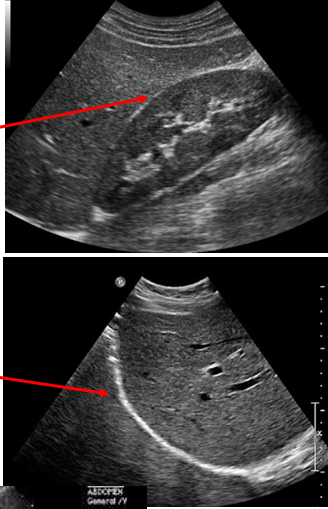
Diffuse Reflection
Characteristics:
Occurs from rough surfaces
Reflects sound in many directions
Typically has a low echo amplitude
Comparison with Specular Reflection:
Specular: one direction, strong echoes
Diffuse: many directions, weaker echoes
Scattering
Definition: Occurs when the surface of a reflector is rough and similar or smaller in comparison to the sound wavelength.
Characteristics:
Angle independent
Produces low echo amplitude
Contributes to the echotexture of organs
More common than specular reflections
Frequency dependent
Creates a speckle pattern referred to as "tissue texture"
Speckle
Nature: Form of acoustic noise resulting from interference of echoes.
Types of Interference:
Constructive Interference:
Occurs when two similar waves arrive nearly simultaneously, resulting in a higher amplitude echo.
Destructive Interference:
Two similar echoes with different arrival times cancel each other, resulting in a lower or nearly zero amplitude echo.
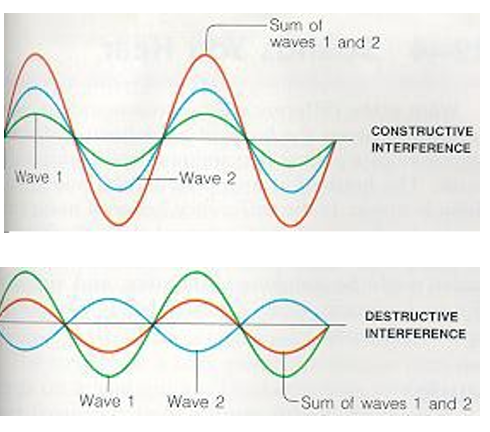
Effects on Images: Speckles contribute to image texture and noise in ultrasound imaging.
Speckle Reduction Techniques:
Frequency compounding
Spatial compounding
Post filtering
Rayleigh Scattering
Definition: Refers to scattering that occurs when reflecting structures are very small relative to the wavelength.
Characteristics:
Often occurs with red blood cells (RBCs) because the diameter of RBCs are small in comparison to the wavelength of diagnostic ultrasound
Scatter is more significant with higher frequencies (degree of Rayleigh scattering α f4 )
Angle independent but frequency dependent
Visibility of Blood Flow
Rouleaux = clumping of RBCs occurs at slow speeds
Clumps producer stronger reflections compared to individual RBCs
Reflection Strength Factors
Echo strength varies based on:
Change in acoustic impedance ()
Size of the reflector
Smoothness of the reflector
Interference type
Summary of Reflectors
Specular Reflectors:
Smooth surface, larger than incident wavelength, angle dependent, high echo amplitude, frequency independent.
Nonspecular Reflectors:
Rough surface, smaller than incident wavelength, not angle dependent, lower echo strength.
Rayleigh Scatterers:
Very small, angle independent, very low echo amplitude, scattering degree is frequency dependent.
Conclusion
Understanding the different types of reflection and their characteristics is crucial for effective ultrasound imaging and interpretation.
Speckle reduction strategies can enhance image quality by reducing noise and improving tissue texture visibility.