Ch. 4 Max Weber
Weber's Sociology: Verstehen, Action, and Ideal Types
Weber defines sociology as "a science which attempts the interpretive understanding of social action in order thereby to arrive at a causal explanation of its course and effects" (Weber 1947:88).
Its central objective is interpretive understanding (Verstehen), as opposed to seeking universal laws. This contrasts with Durkheim, who focused on objective social facts, while Weber emphasized subjective meanings.
Social action (Weber's key unit) is behavior that considers others' actions due to the subjective meaning attached to it by the actor. It can be observable or internal, involving intervention, abstention, or acquiescence (Weber 1947:88).
Sociology's task: understand meanings actors assign to contexts and their effects on conduct and the social world.
Weber identified four types of social action (ideal types):
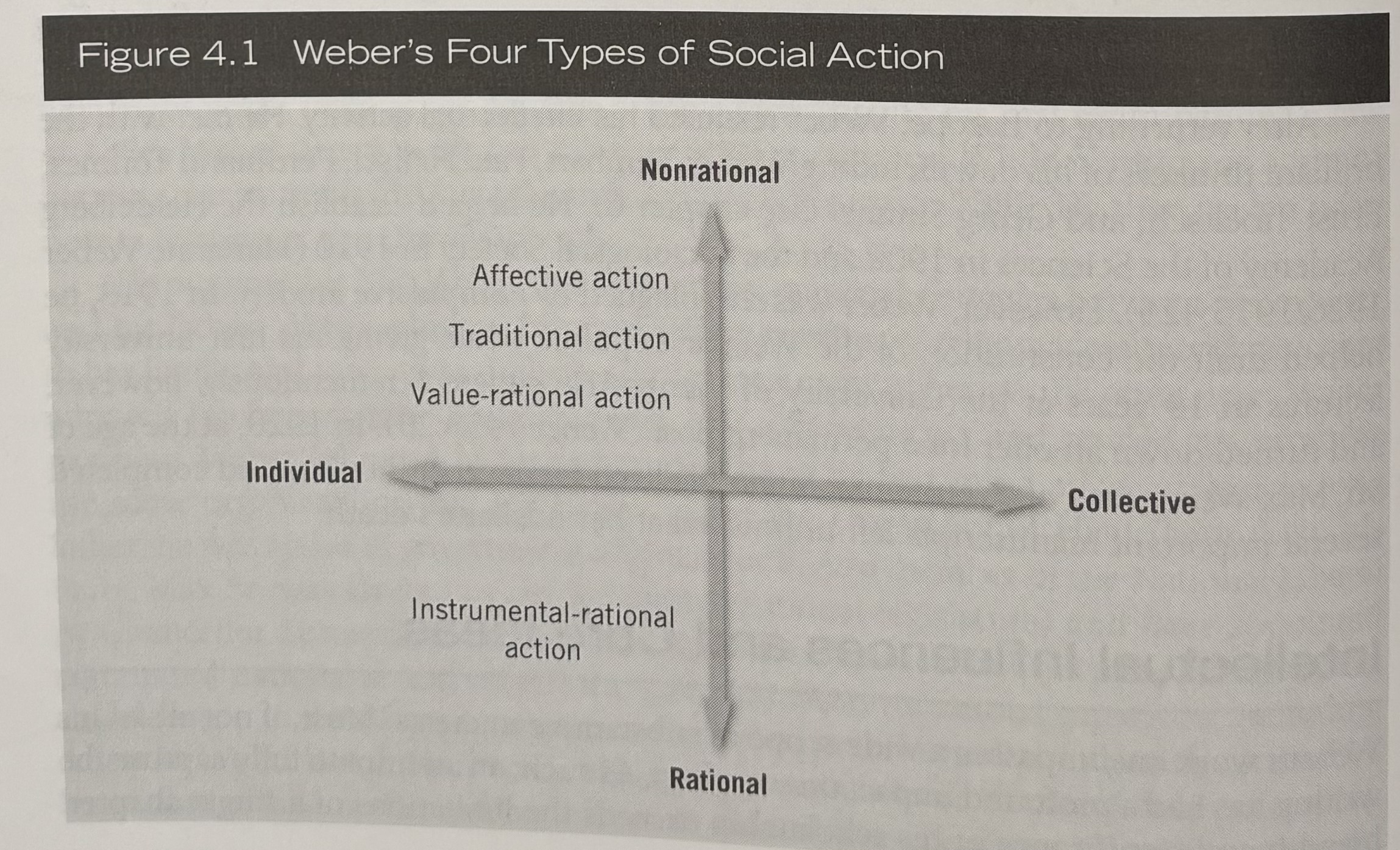
Instrumental-rational (means-ends rationality): pursuing goals with calculated advantages/disadvantages (e.g., wage calculations, union strikes).
Value-rational: action as an end in itself, guided by values or moral commitments (e.g., risking arrest for a cause, donating time to charity).
Traditional: action based on habit or custom (e.g., religious rites, national anthem).
Affective: action driven by emotions or impulses (e.g., spontaneous help, reacting to an umpire's call).
Mnemonic for Four Types of Social Action (IVTA): "I Value True Art."
Everyday behavior often combines these types (e.g., social work for pay (instrumental) and helping others (value-rational)).
Ideal types are analytical tools, not pure real-world cases; they serve as yardsticks for comparison (Weber, ideal types).
They are not normative judgments but analytical emphases on specific life aspects (e.g., Weber's bureaucracy essay uses an ideal type).
Foundations of Classical Sociological Theory: Dilthey, Rickert, and the Epistemic Divide
Weber positions sociology within debates on natural vs. social sciences and their methodologies.
Kantian roots: emphasized the mind/spirit vs. external world, suggesting human behavior is not fully predictable.
Dilthey (1833–1911): advocated for historical studies to understand particular events contextually, focusing on subjective meanings.
Rickert (1863–1936): argued differences between natural and social sciences lie in inquiry methods, not subject matter; natural sciences seek universal laws deductively, while social sciences pursue inductive, historically specific descriptions.
Mnemonic for Dilthey and Rickert:
Dilthey for Descriptive/contextual understanding.
Rickert for Rules/methods in inquiry.
Weber's contribution: established a middle ground using ideal types for generalizable insights while respecting context.
Causality in Weber: probabilistic and context-dependent, not invariant. It seeks sets of factors with "elective affinity" to outcomes; ideal types help frame general arguments about probable relationships.
Key outcome: for Weber, science can offer generalizable insights without denying the historically contingent, meaning-grounded nature of social action.
Nietzsche and Marx in Weber's Thought
Rationalization is a central theme linking Nietzsche and Marx in Weber's work.
Nietzsche and the disenchantment of the world: Weber shared concerns about rationalization and instrumental reasoning replacing traditional meanings, leading to a loss of meaning in a secular order.
The Enlightenment project and nihilism: Weber echoed Nietzsche's worry that science and instrumental reason could undermine ultimate meanings.
Weber’s open-ended future: unlike Marx, Weber saw no single historical end-state; modernity's future is open, characterized by an 'iron cage' of rationalization.
Charismatic leadership: linked to Nietzschean ideas of overcoming norms. Charisma can transform social orders but is unstable, often requiring routinization into traditional or rational-legal forms.
Marx vs. Weber on causality and mechanisms:
Marx focused on economic base and class struggle; Weber posited multiple causal mechanisms (economic, ideas, institutions).
Weber argued ideas can independently shape actions, and material and ideal interests jointly govern conduct, not merely reflecting production relations.
Three key points of Weber–Marx divergence: 1) No predetermined end to history for Weber; capitalism and rationalization may continue. 2) Complex interplay of economic, political, and cultural factors; no single primary mechanism. 3) Ideas and beliefs are not mere reflections of material conditions; they actively shape action.
Mnemonic for Weber-Marx Divergence (HER): "History (no pre-determined end), Economic (complex interplay), Reflections (ideas are not mere reflections)."
Significant Others in Weber's Worldview
Robert Michels (1876–1936): The Iron Law of Oligarchy
Argued all large organizations tend toward oligarchy, with leadership concentrated in an elite, even in democratically founded groups.
Mechanisms include organization, representation, bureaucratization, staff expertise, and organizational self-preservation.
Core claim: democracy requires organization, but organization itself centralizes power.
Mnemonic for Iron Law of Oligarchy:
IRON represents the inescapable tendency.
Oligarchy is Obligatory in Organizations.
Weber's synthesis: acknowledged the power of interests (economic, political, status) while emphasizing the central role of ideas and institutions.
Weber's Theoretical Orientation: Multidimensionality and Religion as a Social Force
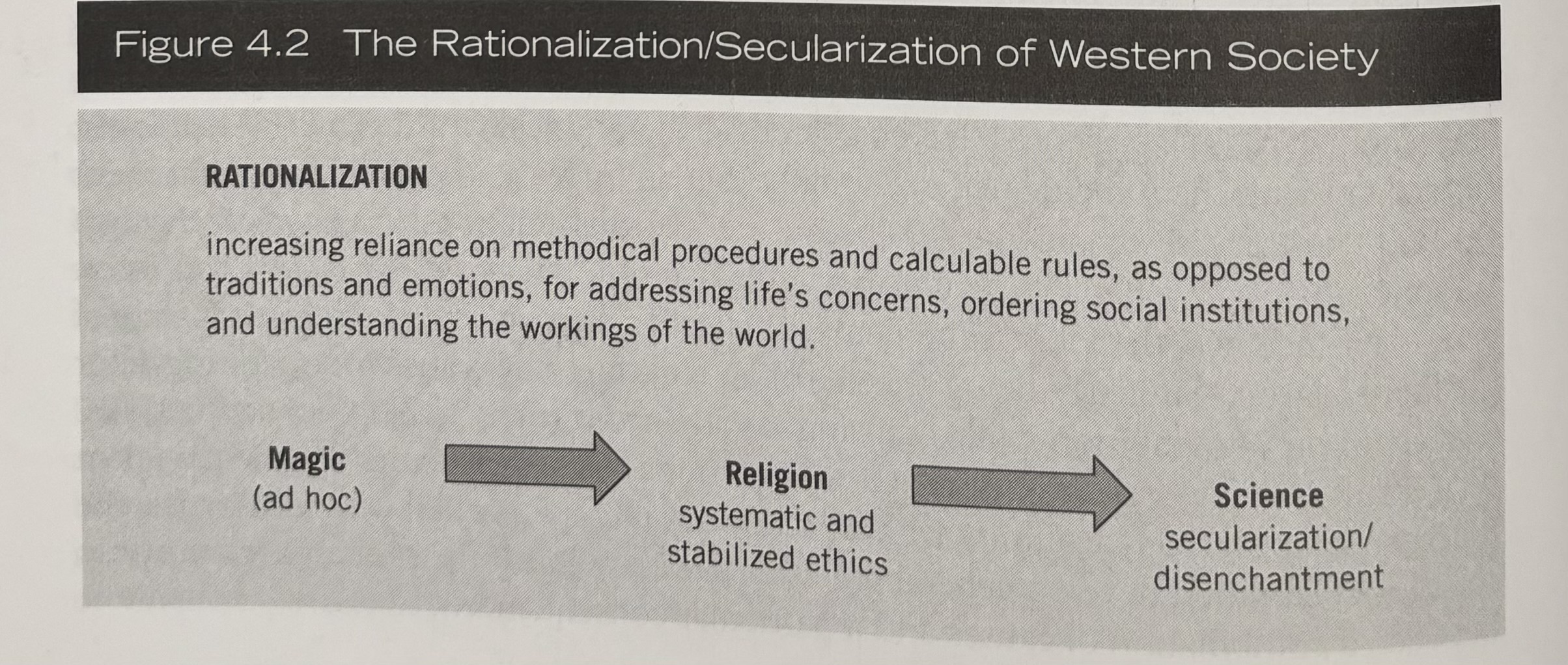
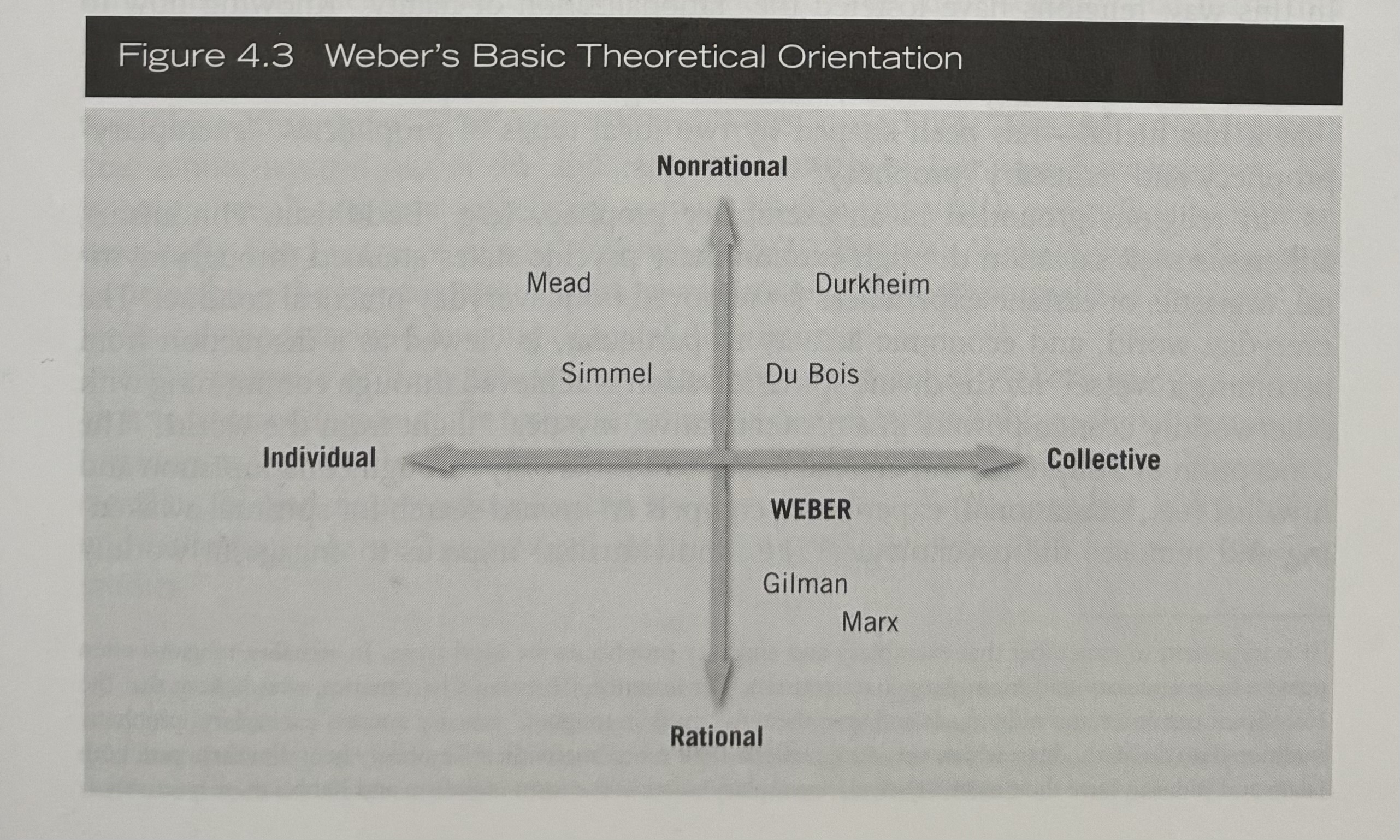
Weber's orientation spans individual actions, rational/irrational motivations, and collective structures.
Religion as a social force: Weber studied five major world religions to show how religious ideas shape action and social order.
Religion and rationalization: religions can foster rationalized economic ethics, contributing to capitalism via different ethical logics (exemplary vs. emissary prophecy).
Exemplary prophecy: ascetic, otherworldly focus (e.g., some Buddhist/Hindu paths) that can hinder worldly economic ethics.
Emissary prophecy: personal God requires active mastery of the world (e.g., Judaism, Christianity, Islam); leads to a calling and a rational, worldly ethic conducive to capitalism.
Mnemonic for Prophecy Types:
Exemplary = Example (setting an example through contemplation).
Emissary = Emit (sending a message, actively engaging the world).
Protestantism, ascetic Protestantism, and the calling: Puritan and Calvinist traditions reframed work as a calling to honor God, promoting a disciplined, accumulative economic ethos.
Bureaucracy emerges with rationalization, especially in capitalist economies. Weber highlighted the tension between efficiency and the loss of individuality.
Figure 4.2 (Rationalization/Secularization of Western Society) traces the shift from magic/religion to science/secularization/disenchantment.
Weber’s ambivalence about rationalization: technical progress can erode meaning and spiritual life (reflecting Nietzsche's nihilism).
Prototypical quotations/statements:
The Puritan wanted to work in a calling; we are forced to do so.
"Man [was now] dominated by making of money, by acquisition as the ultimate purpose of life."
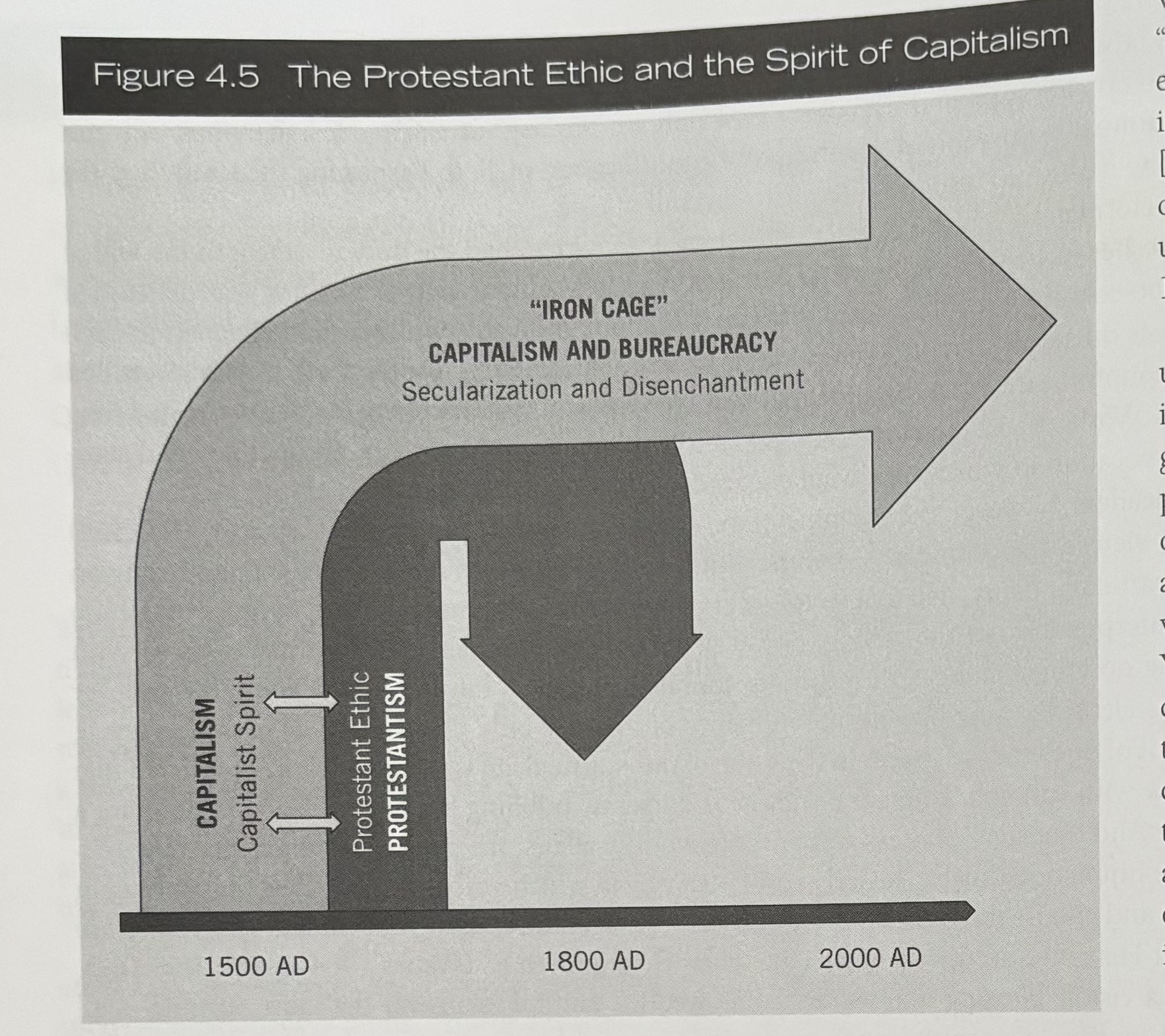
The iron cage: rationalization and bureaucracy trap individuals in impersonal systems, leading to loss of meaning.
Readings Overview: The Protestant Ethic and the Spirit of Capitalism
The Protestant Ethic (Weber 1904–1905) explored how Protestant ideas contributed to capitalism beyond material conditions.
Central claims:
Capitalism's rise correlated with Protestant areas in Western Europe.
The Protestant ethic, alongside structural factors (e.g., rational bookkeeping, legal systems), combined to produce capitalism.
Calvinism and Puritanism redefined the calling: labor became a duty to God; worldly success signaled grace.
Asceticism (restraint in consumption, disciplined work) fostered capital accumulation via saving/reinvestment, supporting capitalism's growth but contributing to disenchantment as religious motives waned.
Mnemonic for Protestant Ethic's Link to Capitalism (C.A.L.L.I.N.G.):
Capitalism's rise.
Asceticism.
Luther vs Calvin.
Labor as duty.
Investment/saving.
No frivolous spending.
Grace/election sign.
Luther and the Reformation: Luther's calling stressed submission to God for one's station. Calvin and Puritans reinterpreted it as working for God's glory, aligning with capitalist needs.
Puritan asceticism and wealth: Wealth, if honestly earned and prudently used, became a sign of divine blessing, a conduit for moral legitimacy.
Franklin’s critique and the “Spirit of Capitalism”:
Franklin symbolized the secular, bourgeois spirit where "money begets more money" and "time is money." His ethics showed utilitarian and deistic elements.
The rhetoric of "time is money" and "credit is money" secularized the Protestant ethic into a rational, market-driven ethos.
Action consequences: Ascetic Protestantism fostered modern capitalism through disciplined labor, saving, and reinvestment, but rationalized daily life, diminishing ultimate meaning.
Wesley’s critique: pious diligence and wealth could erode religious devotion, highlighting the tension between religious virtue and secular capitalism.
Figure 4.5 traces the historical arc from Protestantism to capitalism to the iron cage, showing disenchantment.
Excerpted passages to remember (Weber's Protestant Ethic):
Remember, that time is money.
Remember, that credit is money.
Money’s prolific generating nature.
The good paymaster is lord of another man’s purse.
Maxim: always save and invest wealth.
The paradox: the ascetic Protestant ethic built capitalism, but capitalism's rationalization turned economic life into a self-sustaining system lacking intrinsic moral anchors.
Overall takeaway: The Protestant Ethic shows how religious ideas interact with economic life, creating a rationalized capitalist ethos and a new social psychology prioritizing efficiency and accumulation, while precipitating disenchantment.
The Distribution of Power within the Political Community: Class, Status, Party (Weber, 1925)
Weber defines power as "the chance of a man or of a number of men to realize their own will in a social action even against the resistance of others" (Weber 1925/1978c:926).
Power sources are cross-cutting:
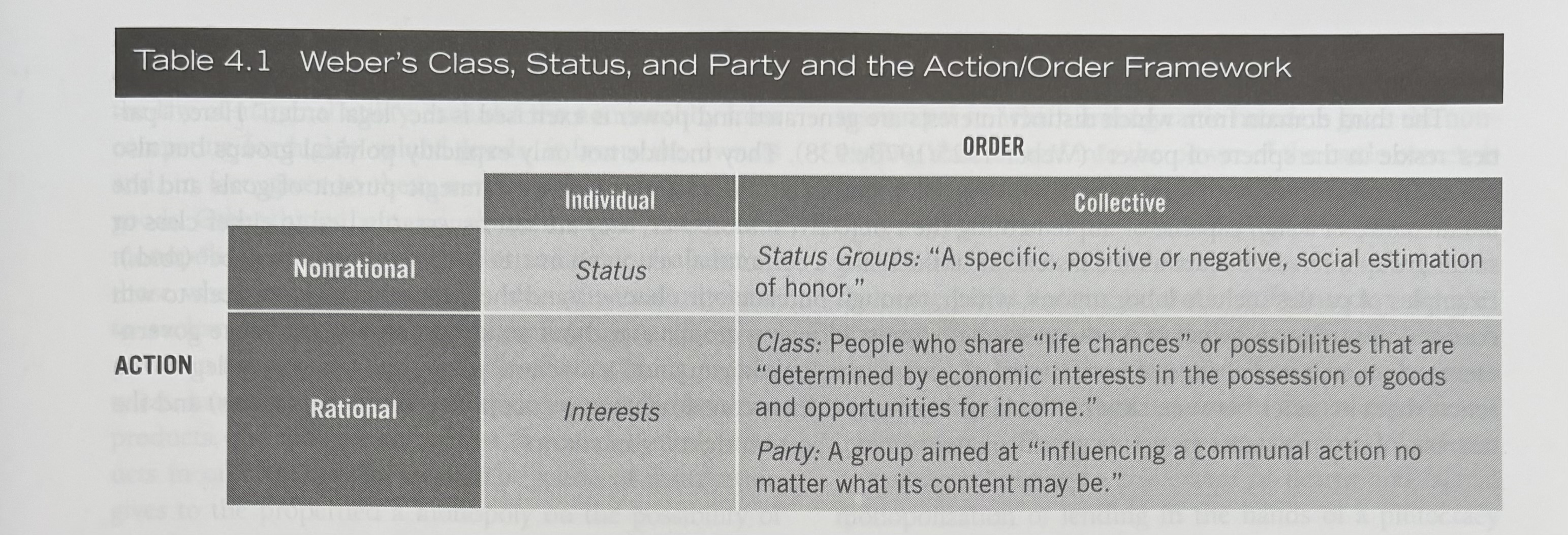
Class: group sharing life chances based on economic interests (possession of goods, income opportunities) within markets. It's a market-conditions-based formation.
Status groups (Stände): communities defined by social estimation of honor, relying on "styles of life" and conventions, affecting social interaction and opportunities.
Parties: groups aiming to influence communal action, political or organizational (e.g., unions, lobbying groups). Their primary aim is to influence power structures via collective action.
Mnemonic for Class, Status, Party (CSP): "Can Such Power exist?"
Key distinctions:
Power can be exercised independently of property; economic power doesn't guarantee status or political power.
Class is market-driven; status groups are honor/lifestyle-driven; parties are organizational agents.
Class situation is driven by property distribution and market opportunities.
Status honor involves exclusive lifestyles, rituals, and restricted interaction (e.g., endogamy, clubs) which can constrain economic/social mobility.
Ethnic segregation and caste: Status stratification can lead to caste-like structures with sharp social boundaries.
Economic conditions in status stratification: Stable wealth/income bases strengthen status stratification. Economic transformations can shift towards class-based explanations.
Parties in modern governance: Operate in the power sphere, collective, associational, and concerned with policy. They can draw from class or status bases and vary in organization.
Intersections: Class, status, party, and the legal order influence and constrain each other.
Practical takeaway: Weber’s framework shows how power in modern societies is distributed across economic, social, and political dimensions, shaped by the legal order.
The Types of Legitimate Domination (Weber, 1925)
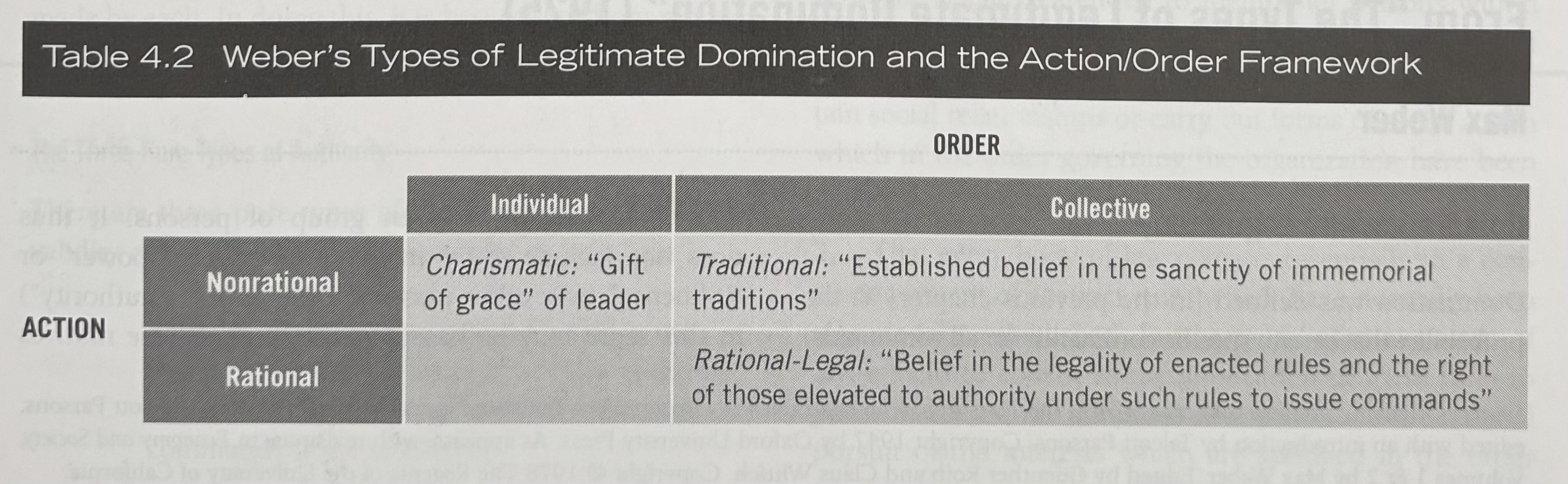
Weber defines three ideal types of legitimate domination (authority): 1) Rational-legal authority (legal authority): obedience to an office/position established by impersonal rules; authority from office, not person; hierarchical, impersonal administration, merit-based selection, salaries, career progression, primary occupation, within jurisdiction. 2) Traditional authority: obedience to established traditions and the person holding traditional authority; leadership based on hereditary/traditional claims; personal retainers; loyalty to person; rules based on custom; limited innovation. 3) Charismatic authority: obedience based on leader’s extraordinary qualities/revelations/acts; personal loyalty; unstable leadership requiring routinization to sustain it (transforming into rational-legal or traditional forms).
Mnemonic for Types of Legitimate Domination (RTC): "Really Tough Choices (exist in power)."
Key features and contrasts:
Charismatic authority is irrational regarding formal rules; rational-legal relies on calculable, impersonal rules.
Traditional authority is anchored in sacred traditions, resistant to rationalization but stabilized by custom.
Routinization of charisma means a charismatic movement continues after the founder's death by establishing legal/rational or traditional rule.
Legitimacy rests on belief systems justifying commands; obedience depends on perceived legitimacy.
The "office" and bureaucratic staff: in legal authority, hierarchy, competency, and salaried staff create durable, impersonal governance sustained by staff independence and expertise.
Bureaucracy: The Ideal-typical Modern Organization
Weber’s Bureaucracy is the quintessential form of modern administration, technically superior due to precision, speed, objectivity, continuity, and impersonality.
Features of an ideal bureaucracy (monocracy):
Official jurisdictional areas with assigned duties.
Stable hierarchy, clear chain of command.
Clear competence for each office, standardized procedures.
Offices filled by free contractual relations; merit-based selection (tests/diplomas).
Offices are a career; promotion by seniority/achievement.
Primary occupation; separation of ownership/private life from official duties.
Salaries and pensions; formal tenure; organization controls appointments.
Strict discipline and control.
Mnemonic for Bureaucracy Features (HIRED):
Hierarchy.
Impersonal rules.
Records (written).
Expertise (technical).
Duties (defined).
The bureaucratic model applies across state, private, and large organizations.
Bureaucracy and mass democracy: Democratic mass politics contribute to bureaucratization, reinforcing bureaucratic structures as leaders are elected.
Technical superiority: Division of labor, trained professionals, impersonal rules, and fixed procedures optimize efficiency and predictability. Relies on written records (the Kontor) and subordinates.
The paradox of bureaucracy: Enables mass organization and services but generates alienation and loss of personal freedom; officials become "small cogs." Bureaucracy is durable and hard to dismantle.
Leveling of social differences and democratization: Bureaucracy fosters formal equality and reduces privileges, elevating professional officials. Requires standardization and impersonal decisions.
Perpetuity: Hard to dismantle due to expert training, file systems, and societal dependence on complex, technologically advanced bureaucratic organizations.
Relationship to capitalism: Aligns with capitalist efficiency and rational organization of production, though its impersonality can alienate workers and citizens.
The Leveling of Social Differences and Democratic Tensions
Administrative democratization: Bureaucracy accompanies mass democracy; professional administrators replace personal governance, and public budgets replace ad hoc systems.
Mass parties and bureaucratic consequences: Democratic mass parties institutionalize bureaucracy and discipline; elections reinforce centralized party structures.
Demands of democracy vs. bureaucratic efficiency: Democracy aims for shorter terms and participation; bureaucracy requires continuity and technocratic expertise.
Broader implication: Modern political life combines rational-legal authority, mass political organizations, and bureaucratic administration, shaping governance and social control.
Practical significance: Bureaucratic administration under capitalism coordinates large-scale production and services but creates new surveillance and depersonalization.
Core Concepts Consolidated
Verstehen as methodological cornerstone: Interpretive understanding of social action is essential.
Ideal types as analytical tools: Abstract categories used to compare real-world cases and identify causal patterns.
Rationalization: Historical process of social life organized by methodical procedures and calculable rules, often at the cost of meaning.
Iron cage: Metaphor for disenchantment and constraint from bureaucratic and instrumental rationality.
Mnemonic for Iron Cage (COLD):
Constraint.
Organization (impersonal).
Loss of meaning.
Disenchantment.
Spirit of capitalism: Cultural-ethical disposition valuing labor, frugality, and accumulation, rooted in Protestant asceticism but secularized by capitalism.
Nexus of religion, economy, and politics: Weber’s multifaceted approach shows how beliefs, institutions, and power structures interlock.
Key mathematical/causal intuition in Weber’s framework:
Causality is probabilistic and contingent; not deterministic. Seek constellations of causes with "elective affinity." Example:
Historical trajectory: Weber’s analysis explains modern institutions (bureaucracy, law, class/status hierarchies, party politics) and cultural ideas' interaction with material conditions.
Connections to Previous Lectures and Real-World Relevance
Links to Durkheim: Contrasts functionalist emphasis on social facts; Weber foregrounds subjectivity and meaning.
Links to Kantian epistemology: Distinction between predictable natural world and interpretive, value-laden social realm.
Real-world relevance: Weber’s framework analyzes contemporary organizations, political parties, and social stratification.
Ethical and philosophical implications: Weber’s ambivalence about rationalization prompts reflection on efficiency vs. meaning and human agency within bureaucratic systems.
Notable Formulas and Numerical References
Causal logic (illustrative): if x > 32^\circ F then
Prototypical quotes to remember (Protestant Ethic passages):
Time is money.
Credit is money.
Money begets money.
The good paymaster is lord of another man's purse.
Save and invest.
Key concept: "Iron cage" underscores trade-off between material progress and existential meaning.
Important dates and figures to remember:
Weber (1864–1920).
Luther, Calvin, Baxter.
Nietzsche.
Marx.
Practical Study Tips
Remember the four types of social action and real-world examples.
Understand ideal types as analytical tools.
Explain the difference between class, status, and party and their contribution to power.
Discuss Weber's three pure types of domination and their legitimacy.
Know bureaucracy's core components, why it's dominant, and the tensions it creates.
Trace the Protestant Ethic's argument on capitalism's rise and subsequent disenchantment.