Physical Education
POINTERS TO REVIEW IN
PHYSICAL EDUCATION AND HEALTH 3
- Social dances are communal dances performed in any given space. They are synonymously referred to as ballroom dances, but ballroom dances are performed in balls or formal social functions.
- BALLROOM DANCE
- IS A SET OF PARTNER DANCE
- which are enjoyed both socially and competitively around the world.
- THE TERM BALLROOM DANCING
- is derived from the word "ball". which in turn originates from the latin word ballare which means to dance.
- LATIN AMERICAN DANCES
- distinguish themselves by the costumes worn by performers. They are somewhat revealing, tight-fitting, sexy yet sophisticated in nature. They are also distinguished by the nature of the movements. They are freer and can be performed in close or open hold.
- MODERN STANDARD DANCES
- wear formal, ankle length gowns for females and coat-and-tie for males. Most of the time, movements in these are restricted to close ballroom position with partner.
- CHA CHA
- The cha-cha dance originated from Cuba and was originally known as the cha-cha-cha
- The dance gained popularity around the 1950's
- It is based on a lively triple step that can be danced to Cuban music or Latin rock.
- The timing is 2, 3, 4, and 1 (full beat on 2, full beat on 3, half beat on 4, and a half beat and full beat on 1)
- JIVE
- The Jive is lively and fast-paced dance that is typically danced to up-beat swing or contemporary music.
- Originating in the US, this dance was influenced by the boogie, rock 'n roll, African/American swing and Lindy Hop.
- It is a very happy, hoppy, energetic dance with plenty of knee lifting, bending, rocking and rocking of hips.
- PASO DOBLE
- The Paso Doble is a theatrical Latin dance with Spanish and French origins.
- It is a dramatic dance that tells a story through sharp, staccato movements, striking body poses, and flamenco style footwork.
- The Paso Doble is a passionate dance based on a Spanish bullfight. The leader represents the proud Spanish matador and the woman or follower is the Matador’s cape. The follower will sometimes also represent the bull, picador or flamenco dancer.
- The name of the dance, “Paso Doble” is believed to trace back to a French military march with a similar name, “Paso Redoble.”
- RUMBA
- Rumba is universally recognized as the dance of love.
- It is danced to slow, sensual music with a Latin beat and features a hip action known as “Cuban Motion.”
- Rumba tells the story of love and passion between a strong man and a teasing woman.
- SAMBA
- The Samba is an energetic and lively dance that is currently popular in many parts of the world.
- Syncopated rhythms, bouncing actions, and rolling hip movements characterize the dance. It may be danced with or without a partner.
- It is one of the five international Latin dances developed in Brazil during the 19th century.
- It is considered the dance of celebration and joy.
- A Samba dancer is called a sambista.
- FOXTROT
- The Foxtrot is a smooth, progressive dance characterized by long, continuous flowing movements across the dance floor.
- It is danced to big band (usually vocal) music.
- The dance is similar in its look to Waltz, although the rhythm is in a 4/4 time signature instead of 3/4.
- Developed in the 1910's, the Foxtrot reached its height of popularity in the 1930's
- It is composed of fairly simple walking steps and side steps. The dance combines slow steps, which use two beats of music, and quick steps, which use one beat of music. The footwork timing is usually "slow, quick, quick" or "slow, slow, quick, quick."
- QUICK STEP
- The quickstep is a light-hearted dance of the standard ballroom dances.
- The movement of the dance is fast and powerfully flowing and sprinkled with syncopations.
- The upbeat melodies that quickstep is danced to make it suitable for both formal and informal events.
- Quickstep was developed in the 1920s in New York City and was first danced by Caribbean and African dancers.
- SLOW WALTZ
- The Slow Waltz, or the English Waltz, is the first and perhaps the most famous of the International Standard dances.
- The International Slow Waltz is like the Smooth Waltz in musicality and rhythm, however, like all standard dances, the lead and follow remain in closed position and do not separate throughout the dance.
- The Waltz is very characteristic because of its rise and fall action. As a couple dances the waltz, they rise and fall according to the beat of the 3/4 timing of the music.
- TANGO
- Tango is a partner dance that originated in the 1890s.
- It is mostly danced in either open embrace, where lead and follow have space between their bodies, or close embrace, where the lead and follow connect either chest-to-chest or in the upper thigh, hip area.
- VIENNESE WALTZ
- This whirling, thrilling dance dates back to the early 1700’s in Europe. It was a dance first popular with the common folk and then with the upper classes.
- Viennese Waltz is danced in fast ¾ time with a 1-2-3 rhythm and features a series of left and right turns as the couple whirls around the dance floor.
- Viennese Waltz is characterized by its speed (twice as fast as Waltz) as well as a rise and fall and sway (less than Waltz). With its elegance and turns, Viennese Waltz has an air of magic about it.
- Hip-hop
- Cultural movement from the African-American group of people who were looking for a creative outlet to vent their frustrations and disappointments with society.
- It has developed as a “cultural and artistic phenomenon affecting the youth worldwide as it reflects the social, economic, political, cultural realities and condition of their lives.
- Rapping/MCing
- - Vocal elements and rap music is the heart of the hip-hop musical genre.
- Disc Jockeying
- - means scratching or turn table record mixing.
- Break Dancing/ B-boying
- - It started as a form of fighting, a mixture of physically demanding movements which exploited the daredevil prowess of their performers and stylized punching and kicking movements.
- Graffiti Art
- - Also known as aerosol art. It was began as a way of “tagging” for one’s crew and developed during the 1970s on the subways of New York and expanded to the city walls themselves.
- Street dance
- - It started in the 1970s and was made popular in the 1980s by media’s exposure of several hip-hop groups in America.
- - It is a freestyle in nature and maybe practiced in either a dance studio or in an open space outdoor.
- - The word street dance is a “Filipino version” of hip-hop dance that was specifically used by Filipino dancers.
- 2 main categories of street dance styles
- - New School
- - Old School
- Krump
- - Characterized by unrestrained rapid fire and highly energetic moves of the limbs and torso.
- Street Jazz
- - Combination of hip-hop dance styles and jazz dance movements.
- House Dance
- - Dance styles that emphasizes fast, complex footsteps with fluid movements of the torso.
- Break Dancing
- - It is an unstructured and highly improvisational style that incorporates and acrobatic movements.
- Popping
- - A quick contraction and relaxation of muscles to producing jerking of various joints.
- Locking
- - It relies on fast, distinct arm and hand movements combined with relaxed hips and legs.
- - It has specific movements that make it different from popping and other hip styles.
- Wacking
- - Waacking (also whacking) is an element from the punking street dance created in the gay clubs of Los Angeles during the 1970s disco era.
- - The style is typically done to 70s disco music and is mainly distinguishable by its rotational arm movements, posing and emphasis on expressiveness.
- List of power moves used in break dancing
- Windmill
- - It is a move in which the dancer spins from his upper back to his chest while twirling his legs around his body in a V-shape.
- Head spin
- - The dancer wearing a stocking cap or handkerchief and uses his hands to aid in speeding up the spin.
- Flare
- - This is an incredibly difficult move borrowed from gymnastics.
- Jackhammer
- - It is a move performed on the ground having the dancer balancing on one hand and laying his body on the elbow of the same arm.
- Top Rock
- - This is a simple dance done standing up to initiate break dancing.
- Up Rock
- - This is a doing a toprock with someone else, sort of like a fight but without contract and very rhythmic.
- 6 Step - It resembles walking in a circle on the ground and only one hand is touching the ground at a time.
- Moon Walk- A move where a dancer slides backward while their legs appear to be walking forward.
- Worm - A move in which a dancer lies on the ground and forms a rippling motion through his body.
- CHEER DANCE
- -CHEER DANCE is relatively new in the field of sports and dance as it has only emerged during the early 1990's as part of the cheerleading events. It is one categories in International Cheerleading Competition that focuses on dance techniques and basic elements of cheerleading, excluding stunts and advance gymnastics skills.
- What is Cheerleading?
- - Cheerleading is an event that consists of cheers and organized routines for sports team motivation, audience entertainmennt, or competition. The routines contain many components of cheers, jumps, dance, gymnastics, and stunting.
- HISTORY OF CHEERLEADING
- -Cheerleading history is linked closely to the United States history of sports, its sporting venues, as well as the historical development of overall crowd participation at many athletic events (History of Cheerleading, 2015).
-In the late 1880s, the first organized recorded yell done in locomotive style was performed in an American campus and was first seen and heard during a college football game. - CHEER DANCE
- -Cheerdance is from the words, cheer and dance. To cheer is to shout out words or phrases that may help motivate and boost the morale of a playing team and perform during a game. Dance, on the other hand, is a physical activity where one expresses emotions or gestures while performing bodily movements usually in time with rhythm.
-Cheerdancing originated from cheerleading which is the performance of a routine, usually dominated by gymnastic skills such as jumps, tumbling skills, lifts and tosses combined with shouting of cheers and yells to lead the crowd to cheer for a certain team during a game or sports activity. It originated in the United States. - Cheer – Cheearleading
- CATEGORY:
- PARTNER STUNT 2 PERSONS (MALE/FEMALE)
- GROUP STUNTS 5 PERSONS (2 FEMALE/3 MALE)
- TEAM CHEER (16 SMALL GROUP/25 LARGE GROUP
- EQUIPMENT/PROPS
- -CHEERLEADING MATS
- -Pompoms
- -MEGAPHONE
- -BANNER
- -FLAGS
- HEALTH BENEFITS OF CHEER DANCE
- ✓ Healthy level of fitness
- ✓ Strength Training
- ✓ Coordination
- ✓ Flexibility
- ✓ Improved posture
- ✓ Team building
- ✓ Confidence
- ✓ Knowledge in following directions
- ✓ Setting personal goal
- ✓ Better relationships with fellow team members
- Equipment. It is recommended to use mats and even surfaces when learning new skills in cheerdance.
- Fitness. Dancers should maintain a good fitness level. Proper warm-up and cool-down exercises should be observed during and after the activity.
- BASIC CHEER ARM MOTION
- BEGINNING STANCE - Feet together, hands down by the side in blades
- CHEER STANCE - Feet more than shoulder width apart, hands down by the side in blades
- LOW "V" - Arms extended down forming a “V
- HIGH "V" - Arms extended up forming a “V”, relax the shoulders
- TOUCHDOWN - Arms extended straight and parallel to each other, fist facing in
- LOW TOUCHDOWN - Arms extended straight down and parallel to each other, fist facing in
- CLASP - Hands clasped at the chin, elbows in
- CLAP - Hands in blades at the chin, elbows in
- TABLETOP - Arms bent at elbow, fists in front of shoulders
- BOW AND ARROW - One arm extended to side with other arm bent at elbow in a half “T” motion
- OVERHEAD CLASP - Arms are straight above the head in a clasp and slightly in front of the face
- LOW CLASP - Arms extended straight down in a clasp and slightly in front of the body
- PUNCH - One arm extended straight up, one arm on hip in a fist
- L MOTION (LEFT L SHOWN) - One arm extended to the side with other arm extended in a punch motion, (Left L shown)
- DIAGONAL - One arm extended in a high “V” and the other arm extended in a low “V” (Right Diagonal shown)
- "T" MOTION - Both arms extended straight out to the side and parallel to the ground, relax the shoulders
- HALF "T" - Both arms parallel to the ground and bent at the elbows, fists into shoulders
- SIDE LUNGE - Lead leg bent with the knee over the ankle, back leg straight, feet perpendicular to each other
- FRONT LUNGE - Lead leg bent with the knee over the ankle, back leg straight, feet perpendicular to each other
- Cheer Stunts
- PARTNER STUNTS
- GROUP STUNTS
- PYRAMID
- BASIC GYMNASTICS SKILLS – cheer dance incorporates simple gymnastics skills such as jumps and tumbling to add to the thrill of the game and the effect of a routine. Also, these help cheerleaders to develop a higher spirit level and enhance crowd motivation. These skills must work smoothly with the cheer.
- TWO (2) BASIC GYMNASTICS SKILLS
- JUMPS AND LEAPS
- A. JUMPS – is the transfer of weight from one or both feet to both feet landing.
- B. LEAPS – locomotor movement characterized by a take-off on one foot, a long flight phase and a landing on the opposite one(1) foot.
- ACROBATICS – “she sealed the title with a powerful display of acrobatics and tumbling.
- TYPES OF JUMP
- TUCK
- SPREAD EAGLE
- DOUBLE HOOK
- TOE TOUCH
- SIDE HURDLER
- FRONT HURDLER
- PIKE
- DOUBLE NINE
- TUMBLING – very dynamic and an excellent way to shake a crowd up quickly. Properly incorporated tumbling can be a real attention getter and crowd pleaser. Tumbling may be executed simultaneously by several tumblers or the entire squad. Thus, it is imperative that cheerleaders in a squad should have an identical technique in tumbling to strengthen the uniformity of the routine.
- FORWARD ROLL
- A. Squat down with hands on the ground then,
- B. tuck head in with chin down.
- C. Roll unto upper back and
- D. rotate onto feet continuing to standing position.
- E. back to position.
- BACKWARD ROLL
- A. From a standing position, squat down continuing to a
- B. sitting position with hands placed close to ears and palms facing up.
- C. roll backward while placing the weight of the body on both feet,
- D. Continue on through a squat position.
- CARTWHEEL
- A. With one foot in front,
- B. stand on the foot and lean down until both hands are on the ground,
- C. transfer weight from one hand to the other while driving legs above and over the body.
- D. place one leg on the ground and continue on through a standing position.
- ROUND-OFF
- A. Rotation on the Short Axis
- B. Twist on the Long Axis
- C. Handspring from shoulders & wrists
- D. Snap down phase.
- PERFORMANCE CHEER
- POMPOMS - Poms are required to be used throughout the routine. Important characteristics of a pom routine include synchronization and visual effects, along with proper pom placement and technique. Motions should be very sharp, clean and precise. Your team should be synchronized and appear as “one.” A routine that is visually effective is extremely important, including level changes, group work, formation changes, etc. Keep in mind that a pom routine carries a more traditional cheerleading theme, while incorporating the concepts of Jazz and Hip Hop.
- HIP-HOP - Hip-hop incorporates street style influenced movements and rhythms with an emphasis on execution, style, creativity, body isolations and control, rhythm, uniformity and musical interpretation. The uniformity of all movement throughout the performance should complement the beats and rhythm of the music. There is also an additional focus on athletic incorporations such as jumps, freezes, floor work and other skills. Distinctive clothing and accessories reflecting the Hip Hop Culture must be worn.
- JAZZ - Incorporates and exhibits traditional and stylized movements and combinations with strength, attack and presence, formation changes, group work and technical elements. An emphasis is placed on proper technical execution, extension, control, body placement, style, musical interpretation, continuity of movement and team uniformity. The overall impression of the routine should be up-tempo, lively, energetic and motivating- while allowing for texture of movement to utilize musicality.
- FESTIVAL DANCE
- A festival is an event ordinarily celebrated by a community and centering on some characteristic aspect of that community and its religion or cultures. It is often marked as a local or national holiday.
- Festival dances are cultural dances performed to the strong beats of percussion instruments by a community of people sharing the same culture usually done in honor of a Patron Saint or in thanksgiving of a bountiful harvest.
- NATURE OF FESTIVAL DANCE
- - Religious Festival
- -Secular Festival
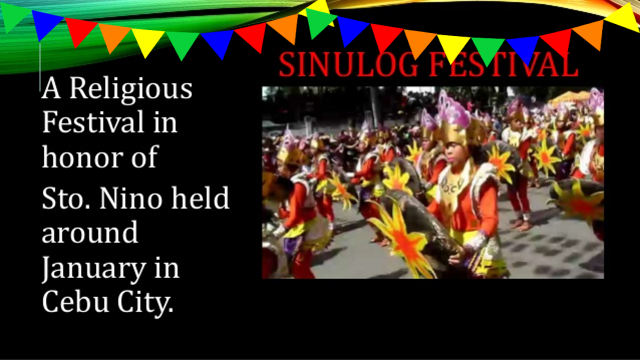
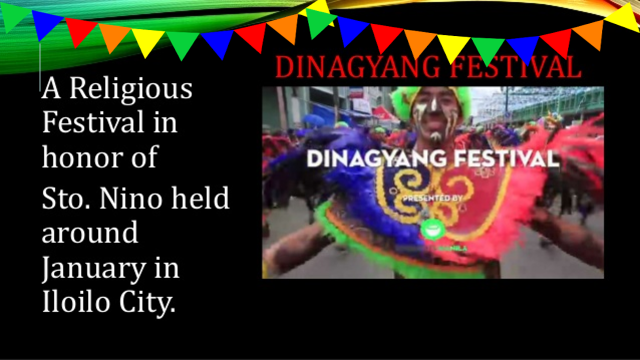
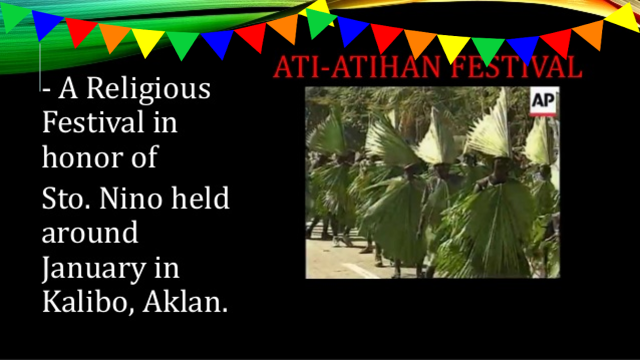
- Religious Festival are festivals dedicated for patrons, gods, saints, and others related to any Religion.
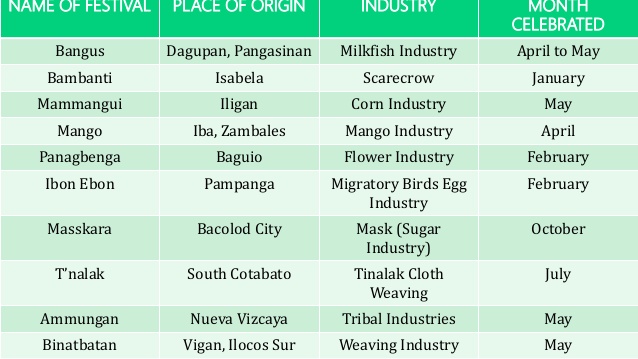
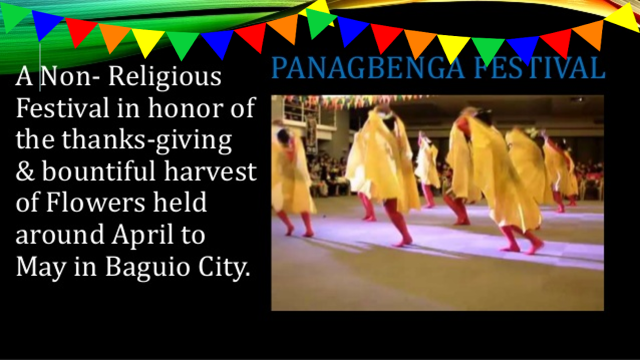
- Secular Festival-is a festival celebrated as thanksgiving or celebration of people’s industry or bountiful harvest.
- WHY DO FILIPINOS DO FESTIVALS?
- Filipinos do festivals primarily to celebrate.
- We celebrate our unity amidst the diversity of cultures; and
- We celebrate our industry bringing about a bountiful harvest.
- WHAT VALUE DO FESTIVALS TEACH US?
- Festivals help us to keep connection with our roots, culture, origin and preserve it. They relieve us from monotomy of life.
- Festivals teach us forget enmity and embrace one another and create bond of love, an environment of cultural harmony. When time of festival comes, the aura changes, positivity all around.
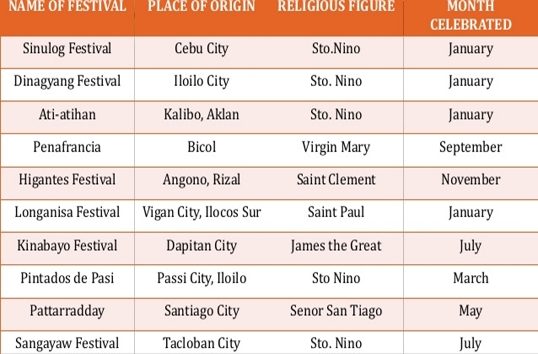
- SOME FAMOUS RELIGIOUS FESTIVALS
- SOME FAMOUS SECULAR FESTIVALS
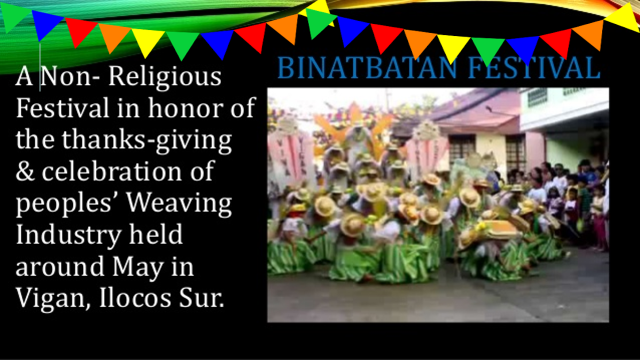
- LESSON 4: MODERN AND CONTEMPORARY DANCE
- MODERN DANCE
- was developed in the early 1900’s the time when dancers came out against the stiffness and restraints of classical ballet. It involves the use of many dance steps that are unusual and often interpret a dancer’s emotions and mood.
- Created its own techniques
- Costumes
- Shoes
- Gave more attention to self-expression
- Individual creativity rather than technical expertise
- What is Contemporary?
- Contemporary Dance can be described as a mix between various style of dance. It combines the technical elements of jazz and ballet with fluidity and expression of modern dance.
- Concert Dance
- Can be danced to almost style of music and can be united with any other dance forms to create new movement styles
- Sub-genres: conceptual dance, pedestrian contemporary
- Often focuses on breathing, alignment, raw emotion, opposing movement
- Contemporary Dance Defined…
- The name “Contemporary Dance” describes a range of techniques and styles used in classes, workshops and dance choreography.
- It was developed in the 20th century as a recreation against the rigid techniques of ballet.
- Pioneers such as Isadora Duncan and Martha Graham searched for ease of movement using the body’s natural lines and energy, allowing a greater range and fluidity of the movement that typical and traditional dance techniques.
- Contemporary dance is characterized by its versatility: it can be danced to almost any style of music, or united with
- Isadora Duncan
- was the mother of Modern Dance
- she is the first European performance took place in London 16 March 1900.
- Merce Cunningham
- is the Father of Contemporary Dance
- American Modern Dancer and Choreographer who developed new forms of abstract dance movement.
- Martha Graham
- was the mother of Contemporary Dance
- influential American dancer, teacher, and choreographer of modern dance whose ballets and other works were intended to “reveal the inner man.”
- Over more than 50 years she created more than 180 works, from solos to large-scale works, in most of which she herself danced.
- She gave modern dance new depth as a vehicle for the intense and forceful expression of primal emotions.
- ELEMENTS OF CONTEMPORARY DANCE
- Theme- most basic elements of dance. It conveys the message of dance.
- Design- pattern of movements in time and space.
- Movement- bodily actions of the dancer that included his steps.
- Technique- the skill of movement executed by the dancer
- Music- the auditory background to which a dancer moves
- Costume and Body Paraphernalia- Properties worn by the dancer that help reflect the message, customs and beliefs
- TYPES OF DANCES
- FOLK DANCE/ ETHNIC DANCE
- Social dances that portray the beliefs, interests, habits, customs, and practices of the native
- BALLROOM DANCES
- Dances of public entertainment, usually performed in pairs in ballrooms, nightclubs, auditoriums or in public places.
- Which are enjoyed both socially and competitively around the world, and growing all the more popular in North America.
- THEATRICAL DANCES
- Performed for the entertainment of the audience in a theater.
- THE BIG NAMES IN PHILIPPINE DANCE
- ALICE REYES
- National Artist for Dance (2014)
- The name Alice Reyes has become a significant part of the Philippine dance
- As a dancer, choreographer, teacher and director, she has made a lasting impact on the development and promotion of contemporary dance in the Philippines.
- Her dance legacy is evident in the dance companies, teachers, choreographers and the exciting Filipino modern dance repertoire of our country today.
- LIZA TERESITA PACHECO MACUJA-ELIZALDA
- Founder of Ballet Manila
- Ballet Manila has reached its 20th years.
- In 198 she was recognized in Europe and become a Prima Ballerina of Kirov Ballet, in Leningrad.
- Douglas Nierras
- In Jazz, he is the most prominent.
- He has more than two decades of involvement in dance through choreography, pedagogy, and production.
- He is famous for his Metanoia, in which he collaborated with Ryan Cayabyab to create – minute ballet set.