The Moon
Lunar Phases → the different appearances of the Moon as seen from Earth, caused by its position relative to the Sun during its orbit.
the Moon completes a cycle of phases approximately every 29½ days
Lunar Phases
☾ As Earth orbits the Sun, the Moon orbits around Earth, completing one loop roughly every four weeks.
☾ Lunar phases are a consequence of the Moon’s 27.3-day orbit around Earth
The same side of the Moon always faces Earth because the moon makes exactly one rotation around it own axis during it of its orbital revolutions around Earth
Half of the moon is illuminated by the sun and half is dark
the amount of this illuminated half that we see from Earth depends on the Moon’s position in its orbit.
We see a changing combination of the bright and dark faces as the moon orbits Earth
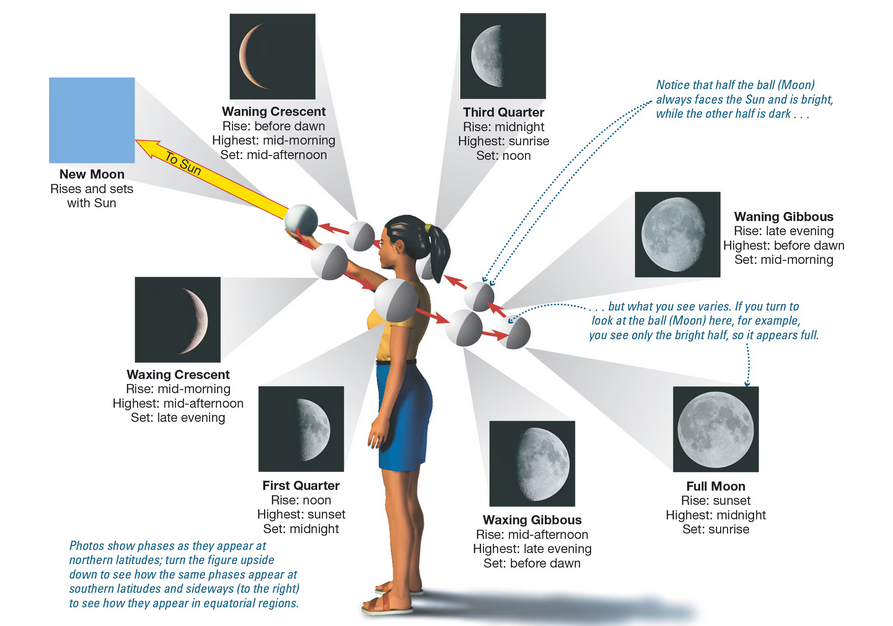
☾ The phase of the Moon depends on its position relative to the Sun as it orbits Earth.
☾ The Moon’s phase also determines the times of day at which we see it in the sky
☾The Moon’s phase affects not only its appearance, but also its rise and set times
EXAMPLE:
➪ the full moon must rise around sunset, because it occurs when the Moon is opposite the Sun in the sky.
➪a first-quarter moon must rise around noon, reach its highest point around sunset, and set around midnight because it occurs when the Moon is about 90° east of the Sun in our sky.
➪ a third quarter moon rises around midnight and sets around noon
➪ the waxing crescent phase typically rises in the morning and sets in the evening because it occurs when the Moon is positioned between the Earth and the Sun, making it visible in the daylight hours.
➪the waxing gibbous moon rises in the afternoon and sets late at night (it approaches the full moon phase, allowing for extended visibility during the evening hours)
Waxing → moon phases that go from new to full (“increasing”)
moon visible in afternoon/evening
rises later in the day
Waning → moon phases that go from full to new (“decreasing”)
moon visible in night/morning
sets later each day

─ The time between the new moon and the full moon is about two-weeks
─ At new moon, the half of the Moon facing the Sun if full illuminated
─ If it is full, the Moon will rise around sunset
─ At new moon, we see only the “night” side of the moon
The Moon’s Synchronous Rotation
☾ Although we see many phases of the Moon, we do not see many faces. From Earth we always see (nearly) the same face of the Moon.
Synchronous Rotation → The rotation of an object that always shows the same face to an object that it is orbiting because its rotation period and orbital period are equal.
it is a consequence of Earth’s gravity affecting the Moon in much the same way that the Moon’s gravity causes tides on Earth.
► The moon:
moves linearly in a certain direction
1) forward and backward
2) leftward and rightwards
3) upward and downward
it can also rotate
4) around the upward-downward axis
5) around the left-right axis
6) around the forward-backward axis
► The motions can be decomposed into different components
linear motion with respect to..
the earth, the sun, the Milky way
rotation around it own….
north-south pole, the earth, the sun, the Milky War
Lunar and Solar Eclipse
▷ A lunar eclipse occurs when Earth comes directly between the Sun and the Moon, so that Earth’s shadow falls on the Moon.
▷ A solar eclipse occurs when the Moon comes directly between the Sun and Earth, so that the Moon’s shadow falls on Earth.
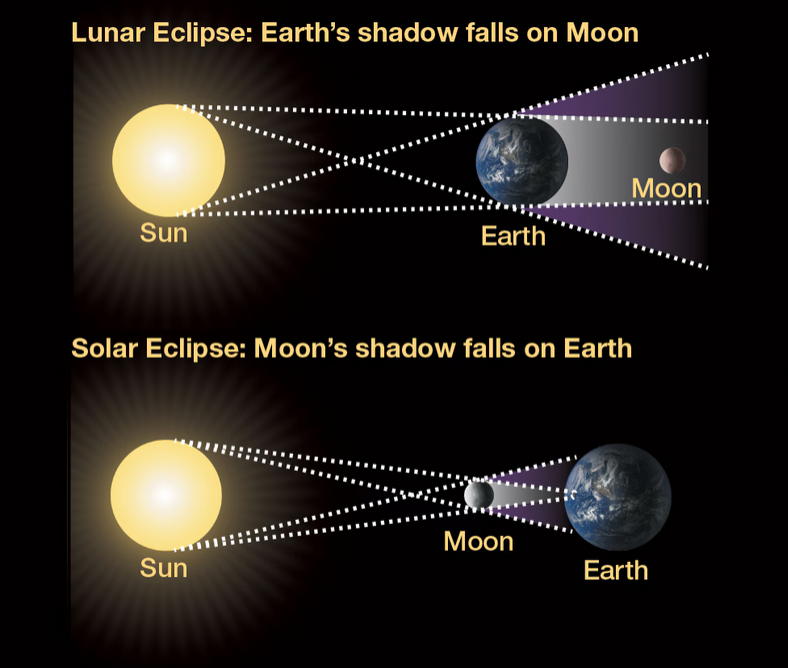
⦾ We see a lunar eclipse when Earth’s shadow falls on the Moon, and a solar eclipse when the Moon blocks our view of the Sun.
⦾ Lunar eclipse occur when Earth’s shadow covers the entire moon
⦾ Solar eclipse occurs when the Moon’s shadow covers only a small portion of Earth
⦾ Eclipse can only occur when the sun, Earth, and moon are all in a nearly straight line
A solar eclipse can occur only during a new moon, when the moon lies between the Sun and Earth.
A lunar eclipse can occur only during a full moon, when the Moon and Sun are on opposite sides of Earth.
Shadow Region
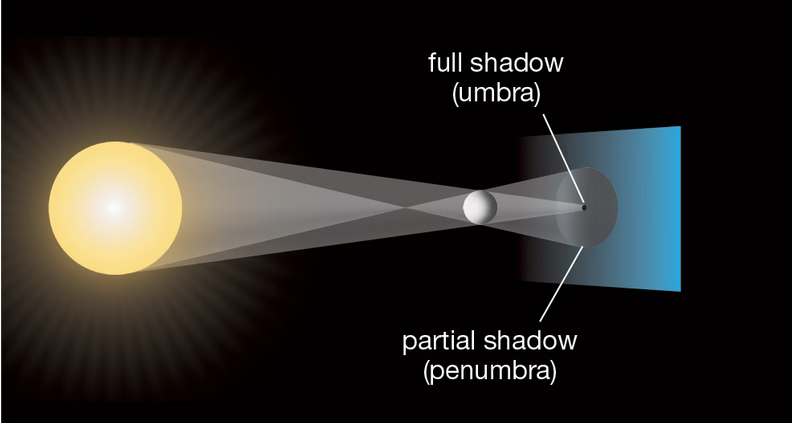
⦾ The moon has two distinct shadow regions
▷ Full Shadow (umbra) → sunlight is full blocked
▷ Partial Shadow (penumbra) → light from only part of the Sun is blocked
Lunar Eclipse
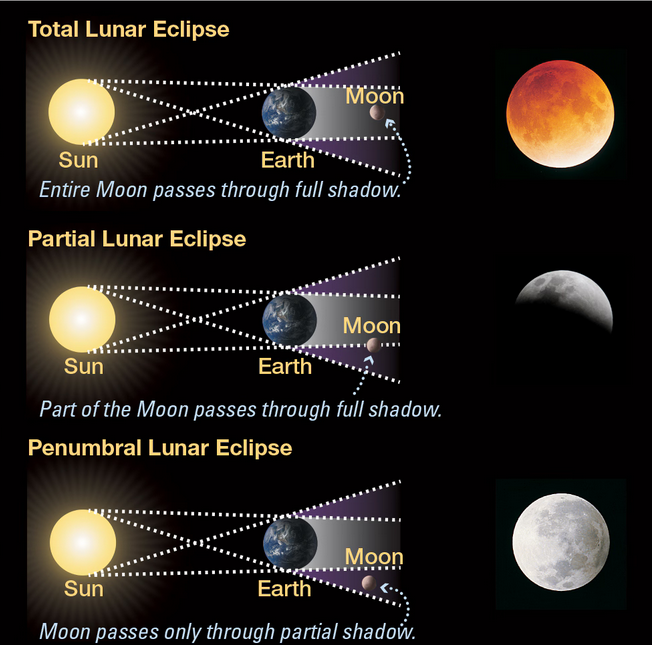
⦾ A lunar eclipse begins at the moment when the Moon’s orbit first carries it into Earth’s partial shadow. We only see three types of lunar eclipses
▷ Total Lunar Eclipse → when the sun, moon, and earth are perfectly aligned and when the moon passes through earth’s full shadow
▷ Partial Lunar Eclipse → when only part of the full moon passes through earth’s full shadow (with the rest in the partial shadow)
▷ Penumbral Lunar Eclipse → when the full moon passes only within earth’s partial shadow (penumbra) and does not fall within the full shadow
Totality → The portion of a total lunar eclipse during which the Moon is fully within Earth’s full shadow or a total solar eclipse during which the Sun’s disk is fully blocked by the Moon.
─ In a Total Lunar Eclipse the Moon becomes dark and eerily red during totality, when the Moon is entirely engulfed in the full shadow
usually lasts about an hour, with partial phases both before and after.
Solar Eclipse
⦾ There are three types of solar eclipses
▷ Total Solar Eclipse → when the Moon is in a part of its orbit where it is relatively close to Earth, the Moon’s full shadow can cover a small area of Earth’s surface (up to about 270 kilometers in diameter).
It begins when the disk of the Moon first appears to touch the Sun; over the next hour or so, the Moon appears to take a larger and larger “bite” out of the Sun
As totality approaches, the sky darkens and temperatures fall. During the few minutes of totality, the Moon completely blocks the normally visible disk of the Sun, allowing the faint corona to be seen
The surrounding sky takes on a twilight glow, and planets and bright stars become visible in the daytime. As totality ends, the Sun slowly emerges from behind the Moon over the next couple of hours.
▷Annular Solar Eclipse → when the Moon is in a part of its orbit that puts it farther from Earth, the full shadow may not reach Earth’s surface.
a ring of sunlight surrounding the Moon––in the small region of Earth directly behind the full shadow.
▷ Partial Solar Eclipse → in which only part of the Sun is blocked from view.
the combination of Earth’s rotation and the Moon’s orbital motion causes the Moon’s shadow to race across the face of Earth at a typical speed of about 1700 kilometers per hour
as a result, the full shadow traces a narrow path across Earth, and totality never lasts more than a few minutes in any particular place.
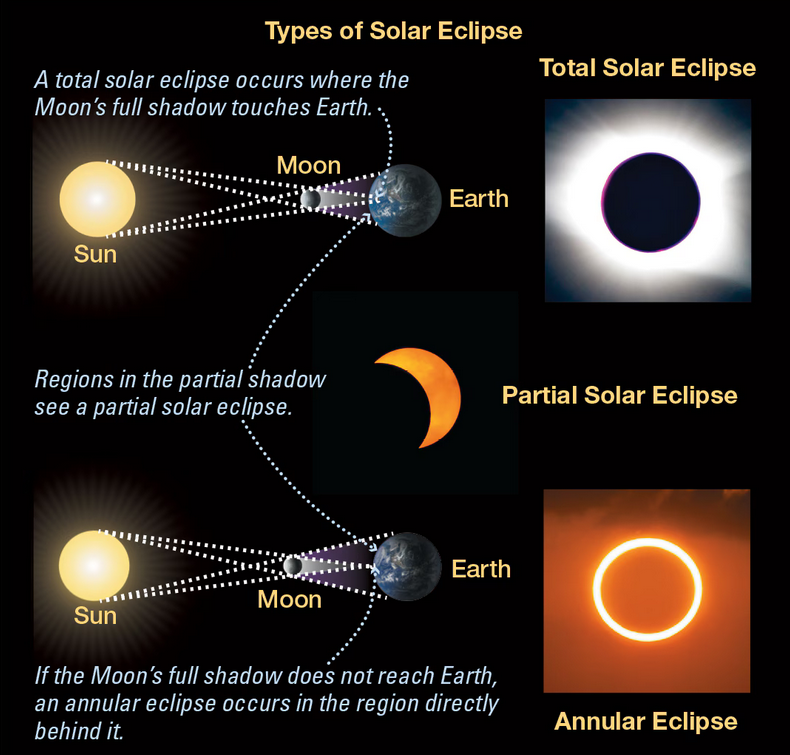
☼ A total solar eclipse is visible only within the narrow path that the Moon’s full shadow makes across Earth’s surface.
Conditions for Eclipses
⦾ The reason why we don’t have solar and lunar eclipses each month (every time there’s a full or new moon) is because the the Moon’s orbit is slightly inclined (by about 5°) to the ecliptic plane (the plane of Earth’s orbit around the Sun).
⦾ The Moon’s orbital inclination means that the Moon spends most of its time either above or below the ecliptic plane.
⦾ The Moon crosses through this ecliptic plane only twice during each orbit—once coming out and once going back in—at the two points called the nodes of the Moon’s orbit.
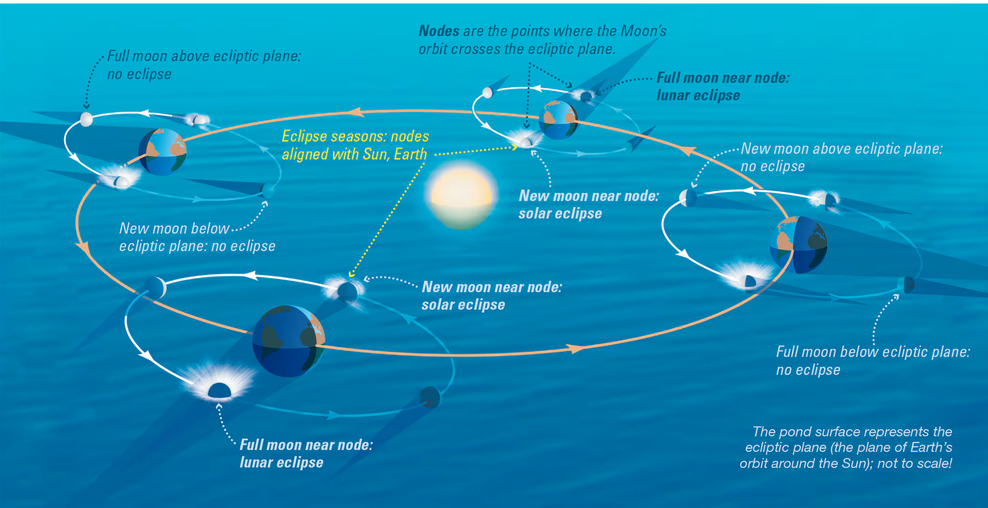
─ The nodes are aligned approximately the same way throughout the year
─ They lie along a nearly straight line with the Sun and Earth about twice each year.
⦾ Eclipses can only occur during eclipse seasons, which are periods during which lunar and solar eclipses can occur because the nodes of the Moon’s orbit are aligned with Earth and the Sun.
each last about 5 weeks (on average)
►Eclipses can occur only when…
1) the phase of the Moon is full (for a lunar eclipse) or new (for a solar eclipse) and
2) the new or full moon occurs when the Moon is very close to a node, which means it is during an eclipse season.
☼ Eclipse seasons occur about twice a year, and each season has a lunar eclipse at full moon and a solar eclipse at new moon.
Predicting Eclipses
⦾ The combination of the changing dates of eclipse seasons and the 29½-day cycle of lunar phases makes eclipses recur in a cycle of about 18 years, 11⅓ days, called the saros cycle.
Astronomers in many ancient cultures identified the saros cycle and used it to predict when eclipses would occur.
Today, we can predict eclipses with great precision because we know the details of the orbits of Earth and the Moon