Fuel / Air Ratio
Relative Mass - the mass of an object or substance in comparison to the mass of another object or a standard reference mass
EXAMPLE
Relative Density “specific gravity”
RD = density of a substance / density of freshwater
Pseawater = 1025 kg/m³
Pfreshwater = 1000 kg/m³
RDseawater = 1025 / 1000
= 1.025
ATOM
Mass of Carbon = 1.99 × 10⁻²⁶
Mass number = number of protons + number of neutrons
A - atomic
M - mass
U - unit
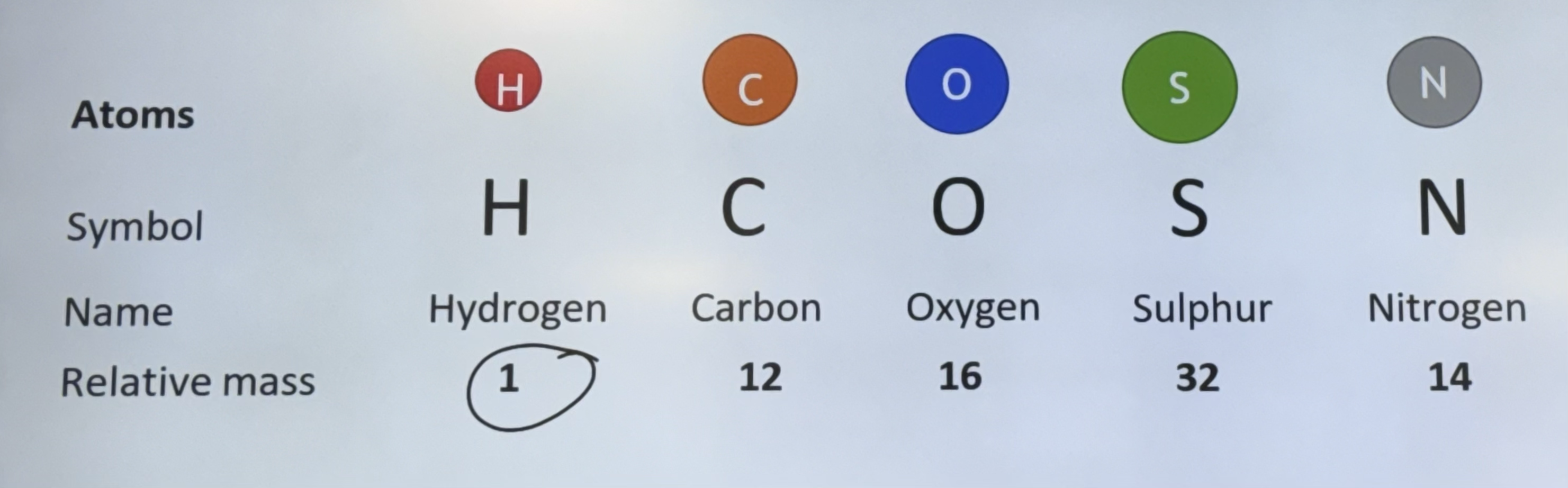
Symbol | H2 | H2O | CO2 | O2 | SO2 |
Name | Hydrogen | Water | Carbon Dioxide | Oxygen | Sulphur Dioxide |
relative mass | 2 | 18 | 44 | 32 | 64 |
Calculate the Relative Mass of CH4
C = 12
H x 4 = 4
CH4 = 16
Calculate the mass of oxygen required to burn 1kg of carbon completely to carbon dioxide.
C + O2 ——→ CO2
12 32 44
for 1kg → 32/12 = 2.67
1 + 2.67 = 3.67 kg
Calculate the mass of oxygen required to burn 1kg of hydrogen completely to water.
2H2 + O2 —> H2O
4 32 36
for 1kg → 32/4 = 8
4/4 = 1
1 + 8 = 9 kg
Calculate the mass of oxygen required to burn 1kg of sulphur completely to sulphur dioxide.
S + O2 —> SO2
32 32 64
for 1kg → 32/32 = 1
32/32 = 1
1 + 1 = 2 kg
Air consists of 23% oxygen and 77% nitrogen by mass
Oxygen is an active element
Nitrogen is an inert gas and takes to active part.
An excess supply of air is always necessary for a complete combustion
To obtain 1kg of oxygen, what would be the supply of air?
23 % x Air = oxygen
Air = Oxygen / 23 %
= 1 / 23
= 4.348 kg
For complete combustion, 4kg of air supply is required. What would be the supply of air in KG for the following conditions?
Excess Air supply | KG |
40% | 4 + (4 × 40%) = 5.6 |
100% | 4 + (4 × 100%) = 8 |
120% | 4 + (4 ×120%) = 8.8 |
220% | 4 + (4 × 220%) = 12.8 |