Sampling Distribution of a Sample Proportion
Sample Proportion Statistic
Is a random variable
Is represented by p̂ (“p-hat”)
Estimates population proportion parameter p
Has a distribution with mean and variance
Is related to the total number of successes (x).
Is an unbiased estimator of the population parameter p.
In the context of sampling distributions, "unbiased" refers to a sampling distribution that accurately represents the population parameter it is estimating.
It has a mean that is equal to the true population parameter being estimated.
On average, the estimates obtained from the sampling distribution are not systematically overestimating or underestimating the true population parameter.
Formulas
Expected Value or Mean of p̂ » E(p̂ ) = p
Standard Deviation of sampling distribution of p̂ » 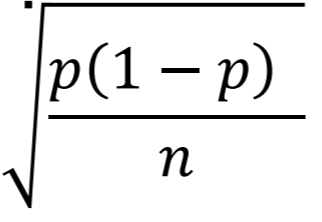 In the above formulas:
p is the population proportion.
n is the sample size.
Checks
Independent Sample Condition Check
The standard deviation of the sample proportion is valid if the assumption of independence is upheld
“Is sample size n less than 10% of the population size N?”
n < 0.1N (if true, passes check and can be assumed independent)
Note: if population size is only “large” then determine what N must be at least. If reasonable for the situation, write that as a statement and pass check.
Normal Approximation Check
np ≥ 10
nq ≥ 10 or n(1-p) ≥ 10
Only passes check if both of the above checks are true.