European history class 9
democratisation and social movements
take-away points: nationalism
19th c phenomenon aided by state formation (centralisath ction and legitimation) and export of French revolution
earlier: printing press, folklore and mythical past, romanticism, philosophy
top-down process: the invention of mass traditions
state created hymns, flags, use of public infrastructure (public musea), national histories
yet, incomplete without mass adoption of traditions and identification
not necessarily negative yet tendencies fro exclusion/racism
superiority, racial hierarchies, justification for imperialism
process of cultural homogenisation at the cost of internal minorities
laden with ambiguities
humanism and equality vs slave trade and repression of internal minorities
opportunities for women to become politically involved
democratisation
parliamentary government rather than full democracy
3 dimensions to democracy:
majority of people can vote (often operationalised as universal male suffrage)
the autonomy of the legislature vis-à-vis the executive (control function; autonomy for making decisions)
the establishment and protection of civil rights or poitical freedoms
democracy = multi-dimensional concept: potential trade-offs between dimensions
extension of suffrage rights often accompanied by restrictions of political freedoms and of the autonomy of the legislature
better to speak of parlementarism than of democracy in 19th c
governments traditionally imposed strong limitations on labour associations
France: Napoleonic civil code: any association of over twenty people was put under the control of the regional prefect
Britain: the right of workers to negotiate wages was denied; only allowed to collect funds and create unions later on
mutual ais associations (insurance associations, producer and retail co-operatives) would form the basis of growing class consciousness and labour mobilisation 2ns half 19th c
growing acknowledgement of the right of unions to engage in collective bargaining of higher wages, and better living conditions
elected assemblies yet right to vote was still limited to qualified men
educated, property owning men
qualifications served to ensure that the poor masses would not use parliament to confiscate property from the rich
composition of parliament reflected old powers
parliamentarians were not a professional class
campaigns for suffrage reform were mainly the initiative of middle-class reformers
competition with aristocracy
lawyers and doctors outraged by the excesses of industrial capitalism
growing income inequality — growing polarisation and mobilisation
by 1914, the socialists were the largest single group in German reichstag and the French assembly, and a growing, though very divided, number in Italy
but elite attempts to weaken power of the masses and defuse social conflict
government coordination of mutual-aid sickness and pension schemes
no real international socialist movement — by 1914, international worker solidarities made way for nationalist considerations
extensions of the right to vote: conquered or granted?
modernisation paradigm: from 1960s onwards, democratisation strongly linked to industrialisation
industrialisation/economic growth generates social change (urbanisation, break up traditional world, emigration, secularisation…), and new policy challenges
socio-economic development promotes organisation middle-class, crucial agent democracy (power-sharing)
2 central hypotheses:
revolutionary threat hypothesis (mass conquering)
argument: suffrage extension from crisis; elite calculation: loss income suffrage would entail estimated to be less severe than loss income resulting from revolution
so countries with highest income inequality early adopters suffrage extension?
no: higher degree inequality, greater loss income suffered by suffrage extension — provokes elite resistance
relation income inequality and suffrage extension best understood as inverted u-curve
political competition hypothesis (elite granting)
threat revolution is one of causal drivers of democratisation
no singular pathway to democratisation; much depends on elite competition
aristocracy: prefer weak parliament to retain control decision-making via informal networks
middle-class: prefer strong parliament to gain control decision-making
working class: want suffrage and strong parliament
→ aristocracy can weaken bourgeois powers by extending suffrage; weakens position middle-class in parliament
→ elites can weaken representatives by adopting social reforms and/or by restricting political freedoms
female suffrage: crucial factors
sociological determinants: issue female suffrage appeared on political agenda only when significant part middle and upper class women could work outside household and demonstrated being worthy of the vote
governing coalitions and fear of losing vote share because of catholic woman: none of 6 countries that first enfranshised women were predominantly catholic
survival analysis: delay in adopting universal male suffrage
reveals interdependence between extension of suffrage and level of parliamentary autonomy (weak parliament = earlier universal male suffrage than strong parliament)
suffrage extension reflects elite calculations
when parliament weak, aristocracy may introduce universal suffrage to discourage middle-class from seeking an extension of the powers of parliament
why? as result of universal male suffrage, middle-class becomes a minority in parliament and finds it less advantageous to press for an extension of the powers of parliament
extension of suffrage: Germany
most progressive franchise of the time
weak parliament
assumption that universal male suffrage would strengthen the conservative voice of the countryside
yet, facilitates growth socialist party
form of electoral authoritarianism
relation between suffrage extension and respect for civil rights/political freedoms
suffrage extension → new electorate → increase in worker representatives in parliament → growing parliamentary pressures for social reform
elitist reaction: weaken electoral base of worker representatives
imposing heavy restrictions on political rights/freedoms
state-led social reform and welfare schemes
survival analysis demonstrated how elites can use the multiple dimensions of democracy (suffrage, parliamentary autonomy and political liberties) to remain in power
early extension of suffrage oftentimes evidence of parliamentary weaknesses
when suffrage extended, often attempts to restrain political liberties or weaken the electoral base of socialist parties
explains:
shortcomings of modernization paradigm: industrialization and the ensuing threat of revolution is but one causal determinant
why suffrage extension and strengthening of parliamentary autonomy rarely occurred at the same time
the paradoxical use of suffrage extension as a means to slow down democratisationrift bet
socialism
the international workingmen association: the first international
harsh repressions against 1848 revolutions
strong philosophical discussions
Marx’ belief in a dictatorship of the proletarians criticised as form authoritarian socialism
rift between Marc and mutualists and anarchists
contention over strategy: direct economical struggle against capitalism (muutualism, anarchism) vs parliamentary activity (Marxists)
Paris commune
French defeat Franco-Prussian war, to allow for peace treaty, French elites attempted ot disarm Parisian republicans; Parisian workers seized powers
commune was a body elected by universal suffrage; functionaries were paid no more than a skilled worker; handed closed workshops/factories over to labourers
didn’t last long: lack of decision-making power, alliance French bourgeoisie and German army
greatly inspired Marx and affirmed his beliefs in the need for an uprising of proletarians and a full dismantling of all remnants of teh bourgeois political and economic system via a temporal dictatorship
Russian revolution (1917): vanguard party and the creation of Soviets or workers’ councils
Leninist model
vanguard party: elites mobilize the masses and shape consciousness
seizing the state through revolution (or reform ?) and socialize the means of production
withering away of the state → classless society
Proudhon
utopian socialist, father anarchism, member of parliament
believed in a socialist revolution proposed from below, as opposed to imposing a revolution from above
against republican slogan: social revolution si the end, political reovlution the means
revolutionary parties lacked scheme for equalising property ownership or political influence, to provide material equality or spiritual freedom for individuals
revolutionary parties believed that, as the result of their intervention, the general will would form and produce social and political justice
as result, primary object of revolution = the constitution of a new government
conceived any revolution from above as restraint on individual freedom and the natural synergies that would emerge between individuals
rigid social collectivism destroys individual initiative
preferred steady democratisation whereby workers would learn, through education and mutual exchanges, their rights
wanted, instead, to absorb politics into economics
goal = balance opposing forces without ever destroying one side in favour of the other
equilibrium favoured over synthesis: struggle of competing views and interests is so essential to progress that to resolve it would bring death to social institutions
instead of a reorganised government, citizens need freedom to promote their individual interests in competition with their fellows and find ways of balancing them via co-operative, mutually beneficial relationships
model of co-operative bank: government should not be concerned with organising production but with organising circulation (making instruments of production available to everyone
bank model to reduce interest charge on loans
extends credit to borrowers free of charge
issues bank notes payable in products; thereby promoting the distribution of commoditiess
bank notes become letters of exchange wehreby the cost of a product is measured by its labour hours
credit can be obtained by depositing products
functions as a centre of direct economic exchange
goods can be deposited inr eturn for notes
notes can be used for purchase of goods/services at local merchants/producers
as more producers and merchants join, more people begin to stand in mutual relations of credit to one another
what’s old about 19th c social movements?
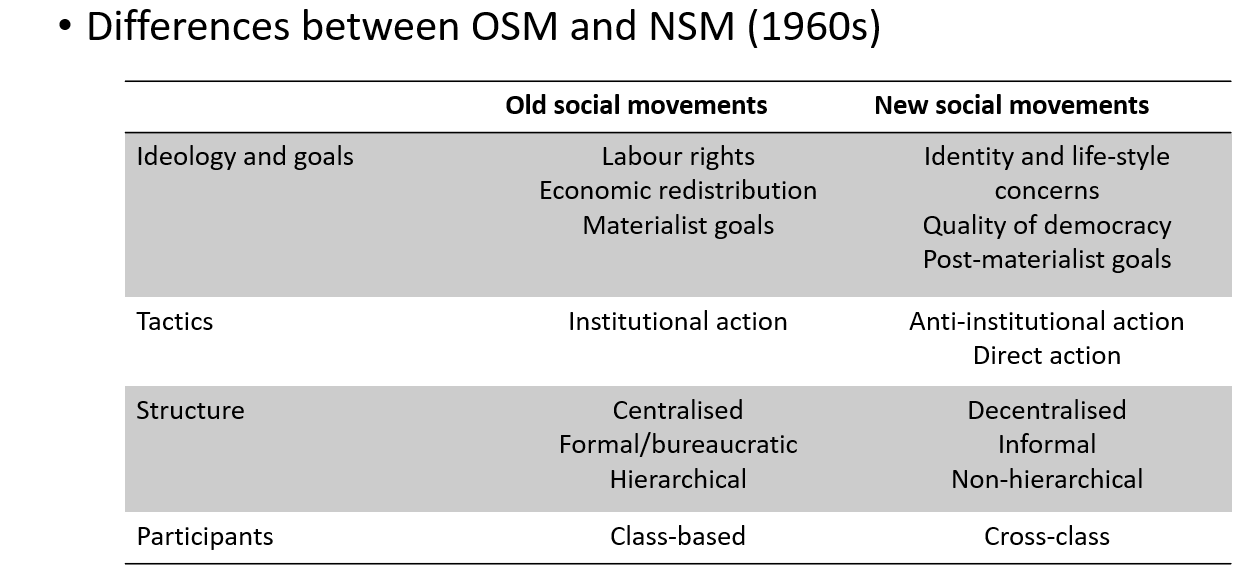
19th c movements and promotion non-materialist values
identity politics
rise modern state and ideology of rights (inclusion/exclusion of citizenship) promoted nationalism
feminism and politicization of gender relations
abolitionist movements/end of slavery: morality and humanity
urbanisation - break up of traditional family life
utopian socialism - Owen
textile mill UK: cocnerns for morality workers
socialist creed = bad working conditions make for bad people
education, limits on child work, better housing conditions without loss of productivity
cooperation village new harmony
continuity rather than rupture old and new social movements
yet, dominance materialist/labour issues and parliamentary (or conventional) forms of political participation
main legitimate questions for politicsc entered on how to organise politics and political economy (role state in economy)
when other issues were raised, they had a hard time attracting serious attention
after 1848 social revolutions and repressions, workers increasingly opted for parliamentary way to seek reform
as result, we tend to associate 19th c with labour associations