Quadratic Equations & Inequalities
Square Root:
x²=16
√x²=√16
x= ±4
{-4,4}
Factoring
x²=16
x²-16=0
(x-4)(x+4)
x=-4 and x=4
{-4,4}
Quadratic formula
(-b±√(b²-4ac))/(2a)
(-0±√(0²-4(1)(-16)))/(2(1))
(±√64)/2
±8/2
±4
{-4,4}
Standard form: y= ax²+bx+c
Vertex form: y= a(x-h)²+k
Zero-product property: If ab=0, the a=0 or b=0
EX: if (x+3)(x+7)=0, then (x+3)=0 or (x+7)=0
Distance fallen (in feet)at time t (in seconds): d(t)=16t²
Height (in feet)at time t(in seconds): h(t)+h0-16t²
h0 is the object’s initial height in feet
Complex numbers:
i^0=1
i^1=i
i²=-1
i³=-i
i^4= 1
√-a = i√a
EX:
√-5 —> i√5
√-64 —> 8i
√-72 —> 6i√2
When you have stuff like i^a, divide by the power of 4 until you are left with a remainder which will give you the answer
EX:
i^9
9/4 —> 8 +1
* The 8 represents how many times 4 can go into 9, and 1 is the remainder
+1 —> i^1
i^1 —> i
Complex number —> a +bi
*i = √-1
Real number: b=0
imaginary number: b≠ 0
Pure imaginary number: a= 0, b≠0
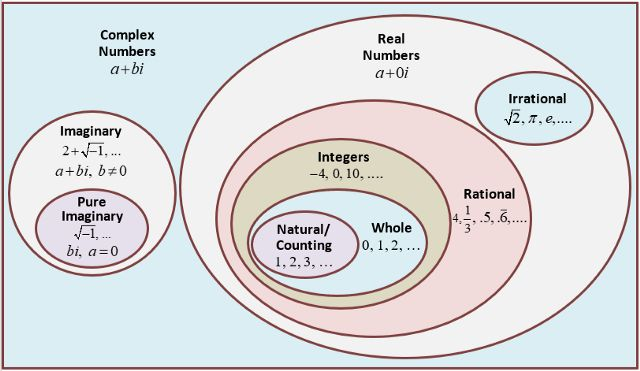
ALWAYS rewrite √-1 as i
Adding & subtracting
(2+3i)+(4+5i)= 6+8i
add 2+4=6
3i+5i= 8i
(6+7i)- (3+4i)= 3+ 3i
subtract 6-3=3
7i-4i=3i
*tip for subtraction multiply the negative out un till it looks like: 6+7i -3 -4i. Then solve
Solving for x and y
EX: 10x + (3-3y)i = 10 + 9i
Solve for x by pairing the real numbers(or just numbers that don’t have i)
10x=10
x=1
Solve for y by pairing the i’s
(3-3y)i = 9i
(3-3y)=9
-3y=6
y=-2
Multiplying
*use the box method after simplifying for best results
(√2 + 2√-1) (√8 +3√-1)
(√2 +2i)(√8 +3i)
4+3i√2 + 4i√2 +6i²
4+ 7i√2 +6(-1)
-2+ 7i√2
Dividing
*i cannot be left in the denominator
EX:
21-7i/i
21-7i/i multiply by the opposite of i: -i
-21i +7i²/-i²
-21i +7(-1)/-(-1)
-21i -7/ 1
-7 -21i
*if you have something like 1+4i multiply it by 1-4i
*if you have something like 4i√3 multiply by -i√3
Absolute value
EX: |3-4i|
a=3 b=-4
√3²+(-4)²
√9+16
√25
Answer: 5
What to do if it’s to the 5th or 3rd power?
EX:
(2+i)³=2+11i
(2+i)(2+i)(2+i)
(2+i)(2+i)= 3+4i
(3+4i)(2+i)= 2+11i
-√-2
(√2)(√2)(√2)(√2)(√2)
(2)(2)(√2)
-(4√2)(i^5)
-4i√2
Discriminants
Quadratic formula: (-b±√(b²-4ac))/(2a)
Discriminant formula: b²-4ac
*the equations below are used when a or c are not provided to you
b²-4ac>0 and a perfect square —> 2R, rational
V(touches line twice)
b²-4ac>0 and not a perfect square —> 2R, irrational(still has √)
V(touches line twice)
b²-4ac=0 —> 1R, rational
V (touches line once)
b²-4ac<0 —> 2nonR
V (doesn’t touch line)
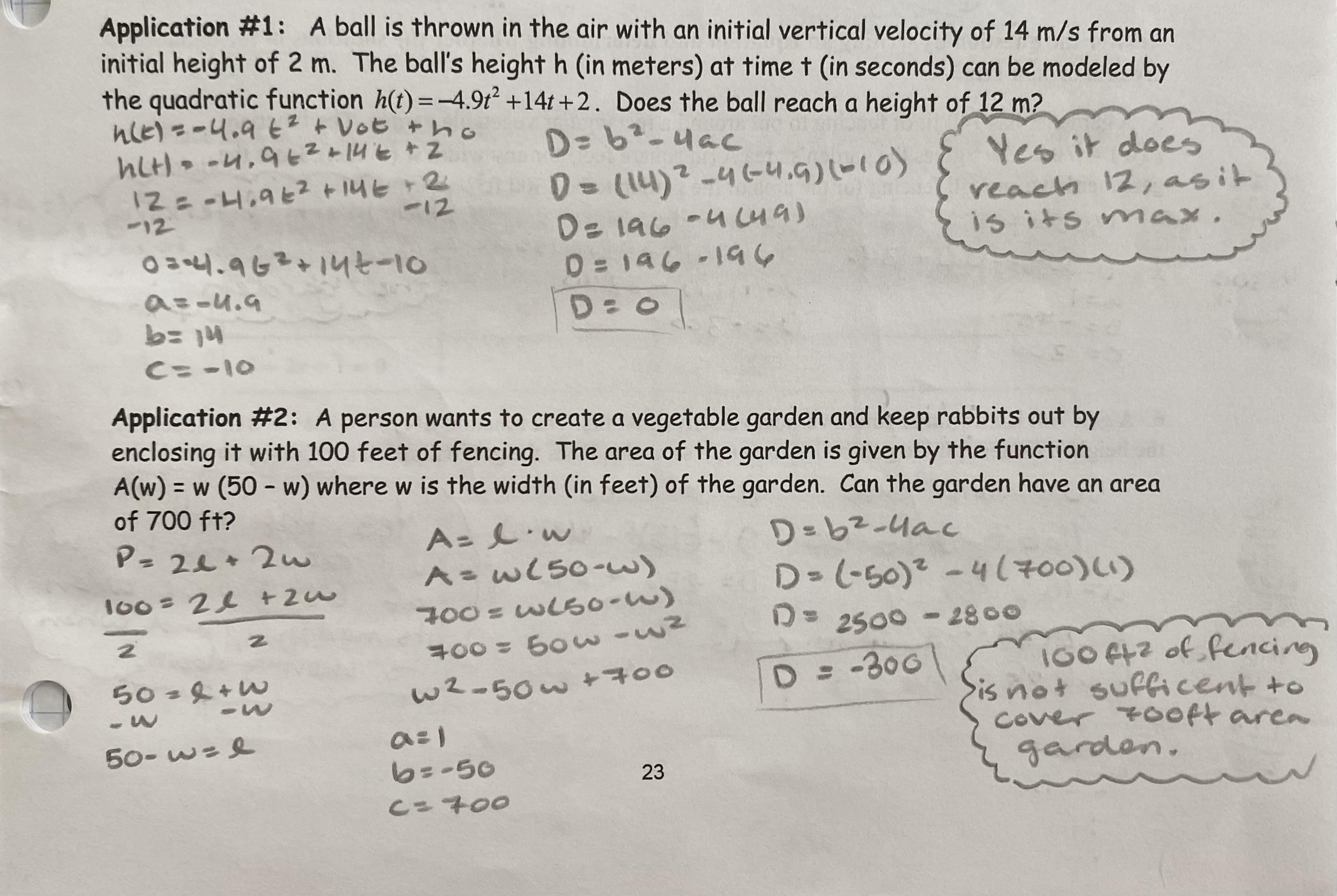
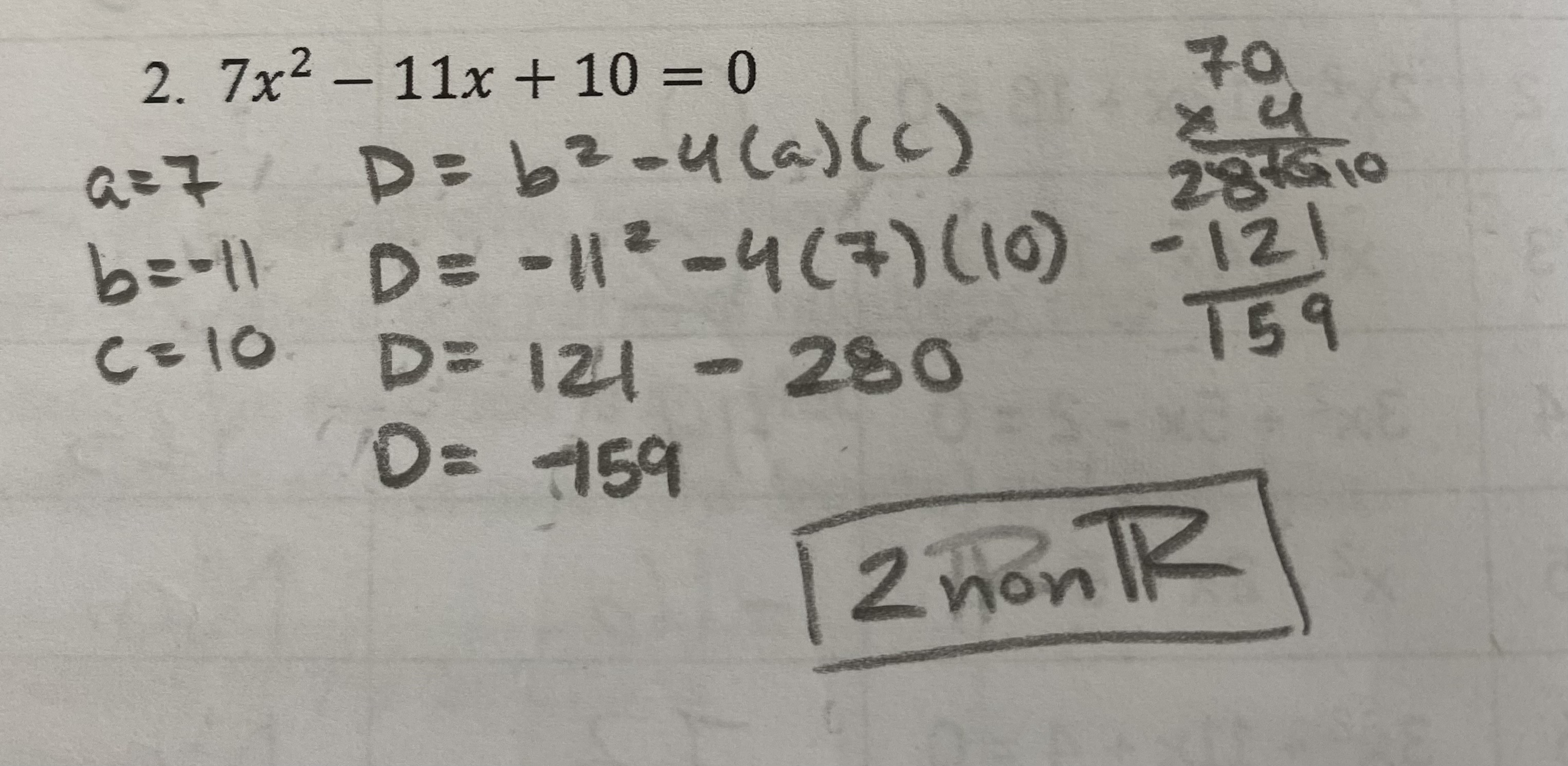 Apply to real-world scenarios
 Graphing
EX: shaded outside(or) and (0,0) is false
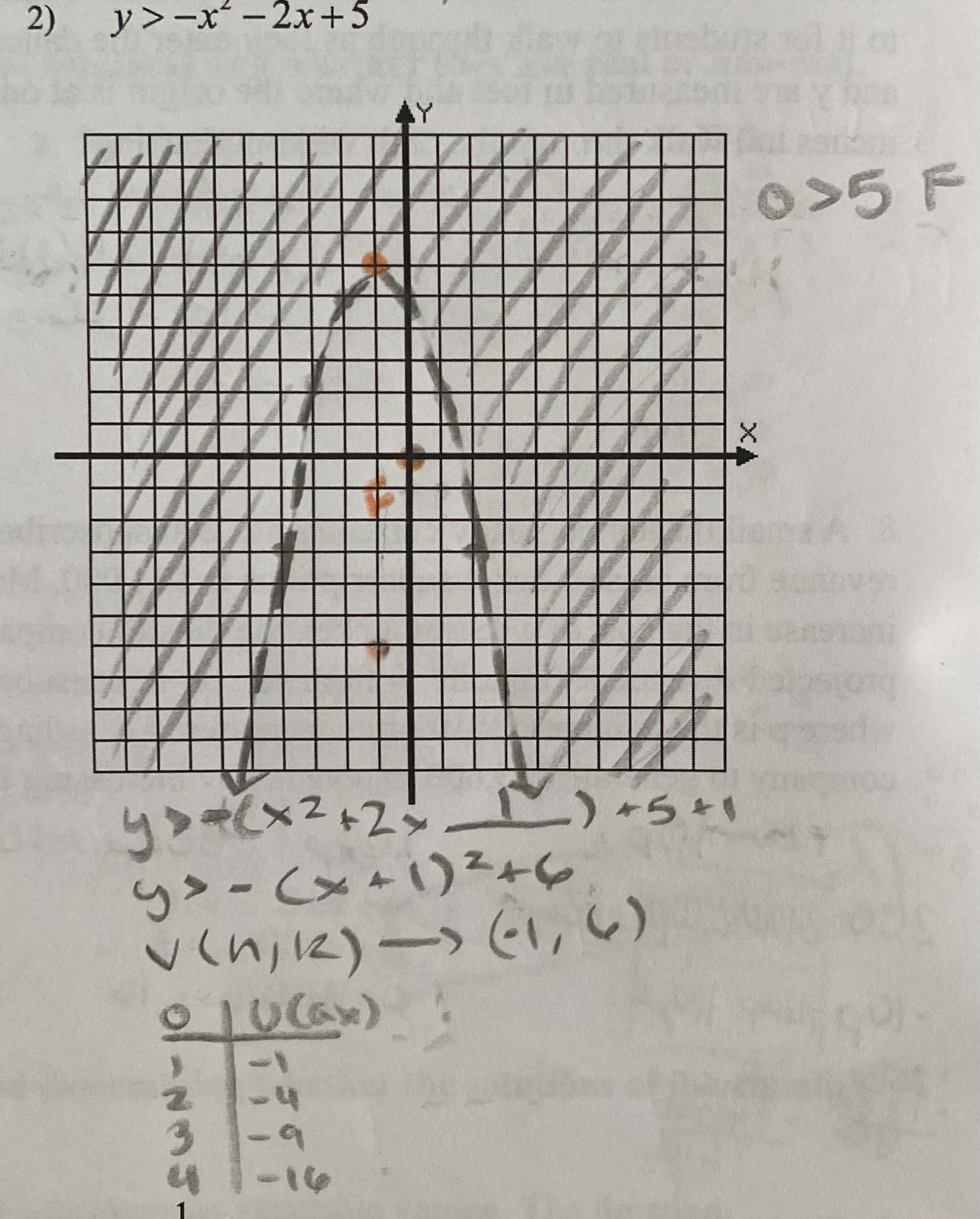 EX: shaded inside(and) and (0,0) is true
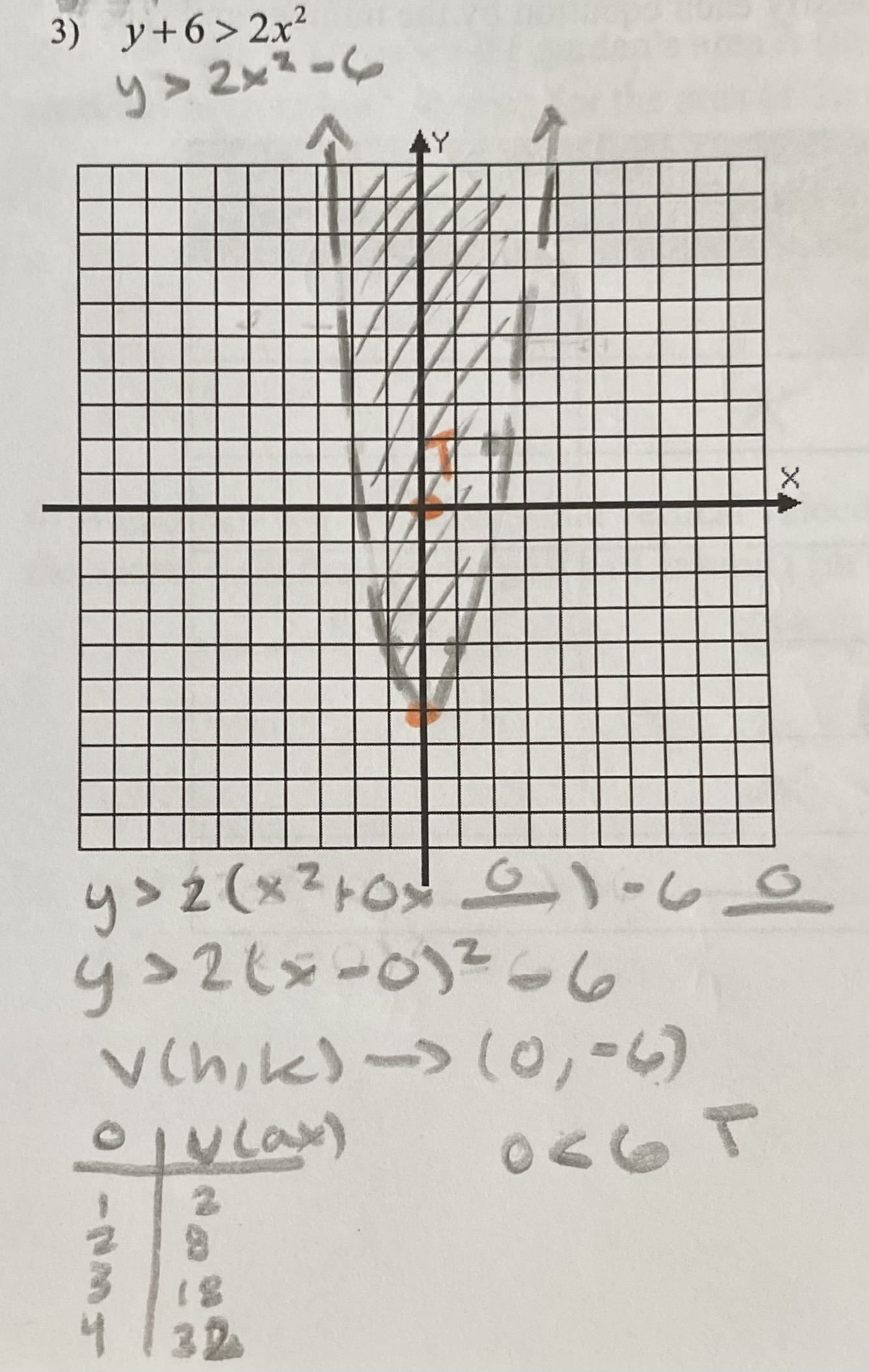 Solving algebraically
*if a is positive parabola points up(or)
*if a is negative parabola points down (and)
EX:
x² -5x -6 >0
a is positive so “or”
(x-6)(x+1)
x=6 x=-1
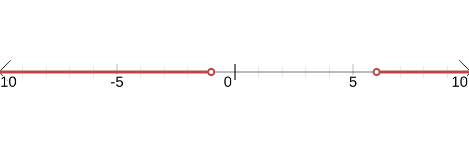
Inequality: x< -1 or x>6
Interval notation:(-∞,-1)U(6,∞)
 TEST:
TEST:
0² -5(0) -6 >0
-6>0 False
*We wanted (0,0) to be false because (0,0) is not located on any of the red areas of the number line