What is Money?
Introduction to Measures and Definitions of Money
Speaker: Jacob Reed from ReviewEon.com
Objective: Understand the measures and definitions of money.
Resource: ReviewEon.com for additional materials such as the total review booklet for microeconomics or macroeconomics exams.
The Barter System
Definition: Barter is the exchange of goods and services for other goods and services, without money.
Example: If one person has an umbrella and wants a hammer, they must find someone who has a hammer and wants an umbrella.
Key Concept: Mutual Coincidence of Wants
To make a trade, both parties must want what the other has.
Drawback: The barter system increases transaction costs due to the need for both parties to match their wants.
Functions of Money
1. Medium of Exchange
Money enables a more efficient trading system than barter, reducing transaction costs significantly.
Example: A person with an umbrella only needs to find someone willing to pay with money, rather than another person who wants an umbrella.
2. Unit of Account
Money serves as a standard of value for priced goods and services.
Prices are expressed in dollars, allowing for easy comparison.
Example: Different prices for various fruits guide purchasing decisions based on perceived value.
Real-life Scenario: A $22,000 car vs. a $60,000 car creates distinct mental images based on price.
3. Store of Value
Money preserves the value of labor and resources over time.
Example: A farmer's strawberries will spoil, but selling them for money converts their fleeting value into something lasting.
Limitations: Inflation impacts the effectiveness of money as a store of value; purchasing power can diminish.
The Federal Reserve targets a 2% annual inflation rate, meaning that the value of money decreases annually by this percentage.
Origin and Evolution of Money
Original Forms of Money:
Typically included commodity money like livestock, bushels of wheat, cowry shells, and gold.
Commodity Money: Has intrinsic value (for example, gold has physical worth).
Transition to Representative Money:
Each currency bill was backed by a commodity (e.g., $500 gold certificate).
This system is largely outdated today.
Modern Money:
Fiat Money: Current currency has value because the government backs it; it lacks intrinsic value and commodity backing.
Example: The U.S. dollar is not backed by gold or silver and is considered legal tender for all debts, public and private.
Measuring the Money Supply
1. Monetary Base (M0):
Narrowest measure of money supply which includes:
Bank Reserves (not used for transactions)
Currency (paper and coins)
2. M1 Money Supply:
Includes:
Currency
Checkable deposits (like checking accounts)
Savings deposits
Represents money effectively used as a medium of exchange in the economy.
3. M2 Money Supply:
Broader measure that includes all of M1 and additional forms of money that can be easily converted into cash:
Small time deposits (like certificates of deposit)
Money market mutual funds.
Visualization of Money Supply**
Venn Diagram Explanation:
Monetary Base includes:
Bank Reserves (not part of M1)
Currency
M1 Money Supply includes:
Currency
Checkable deposits (not part of the monetary base)
Savings deposits (not part of the monetary base)
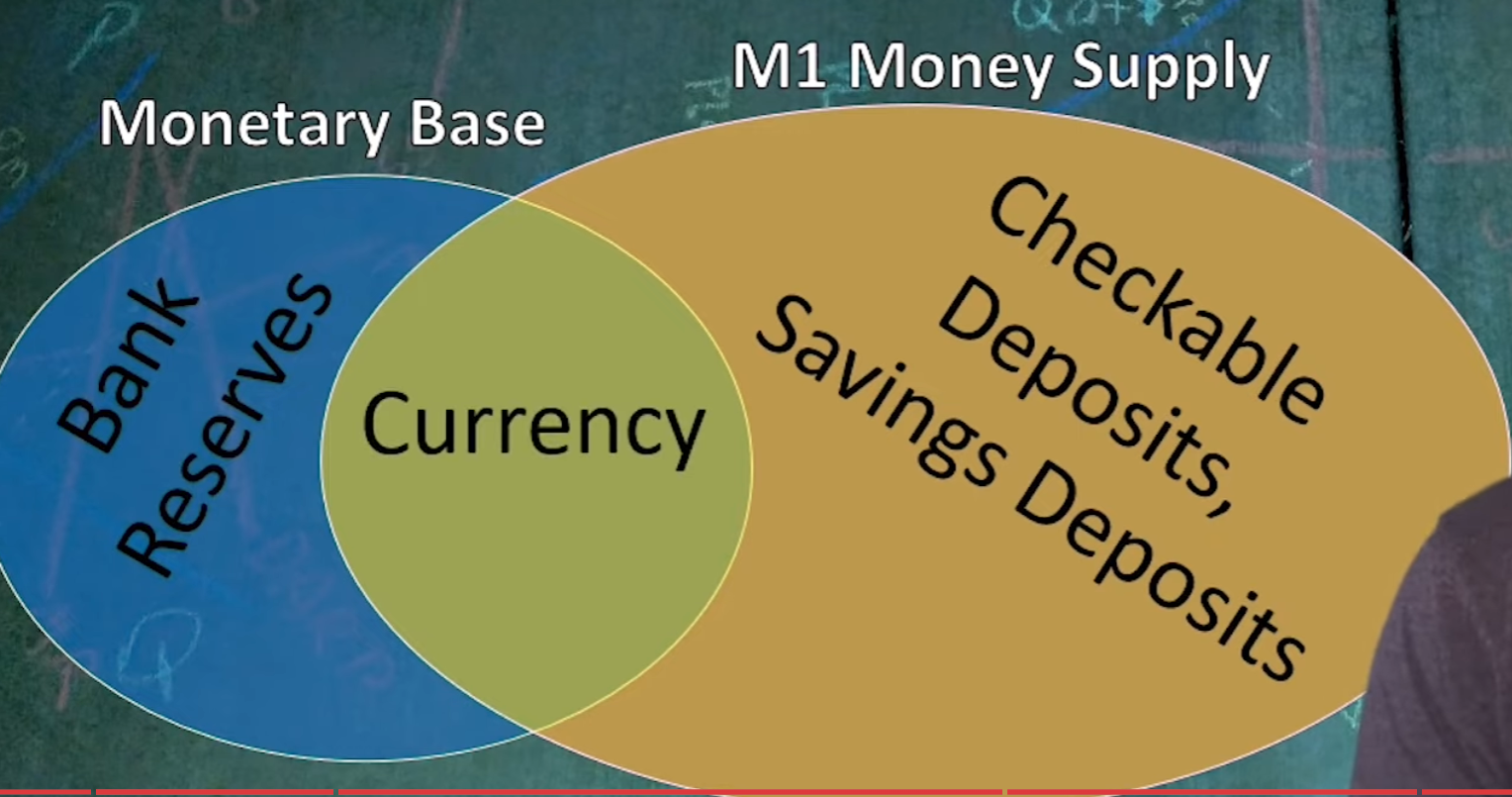
M2 is inclusive of all components in M1 and small time deposits.
Conclusion
Overview of the definitions and measures of money covered in this discussion.
Encouragement to utilize ReviewEon.com resources for further assistance in economics preparation.
Closing remark and invitation for future interactions from Jacob Reed.