3.2.1 Business Objectives
Spec:
Different business objectives and reasons for them:
profit maximisation
revenue maximisation
sales maximisation
satisficing
b) Diagrams and formulae to illustrate the different business objectives:
profit maximisation
revenue maximisation
sales maximisation
Profit Maximisation
An assumption in classical economics is that firms seek to maximise profits.
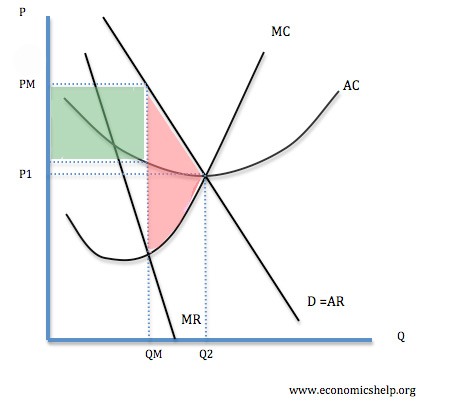
Profit = Total Revenue (TR) – Total Costs (TC).
Therefore, profit maximisation occurs at the biggest gap between total revenue and total costs.
A firm can maximise profits if it produces at an output where marginal revenue (MR) = marginal cost (MC)
Why 😀 :
Re-investment in R and D - i.e. new capital, innovation
Dividends for shareholders - rewards
Lowers costs - more competitive when prices are lower
Reward entrepreneurship
Usually the aim for monopolies and oligopolies due to lack of competition
But
It is hard to know when MC=MR
Principle agent problem - easier to revenue maximise
Avoid scrutiny from competitions authorities - i.e. too low standards/ competitive pricing
Key stakeholders are harmed
Profit satisficing
= Sacrificing profit to satisfy as many key stakeholders as possible
Can any of these shareholders lose out from profit maximising ?
Shareholders - Not really as simply higher dividends
Managers - Not really as usually higher wages
Consumers - Yes as potentially higher prices than if productively efficient so decreases consumer surplus
Workers/TU - Yes as may be sacked due to cost cutting affects in order to increase profit magins
Govt. - If prices are high and wages are low govt. doesn’t like this and investigate and punish
Environment - Cost cutting i.e. dumping waste and can tarnish reputation - may lose out on investors or market share
Revenue Maximisation
= Where MR = 0 on diagram
Why?
Economies of scale - Greater quantity than profit max point - Lower AC then lower prices
Predatory pricing - due to lower prices than profit max - aim to drive out competitors
Principle agent problem - agents might revenue max to ‘impress’ their principles ( shareholders ) for benefits i.e. bonuses or pay rises
Sales Maximisation
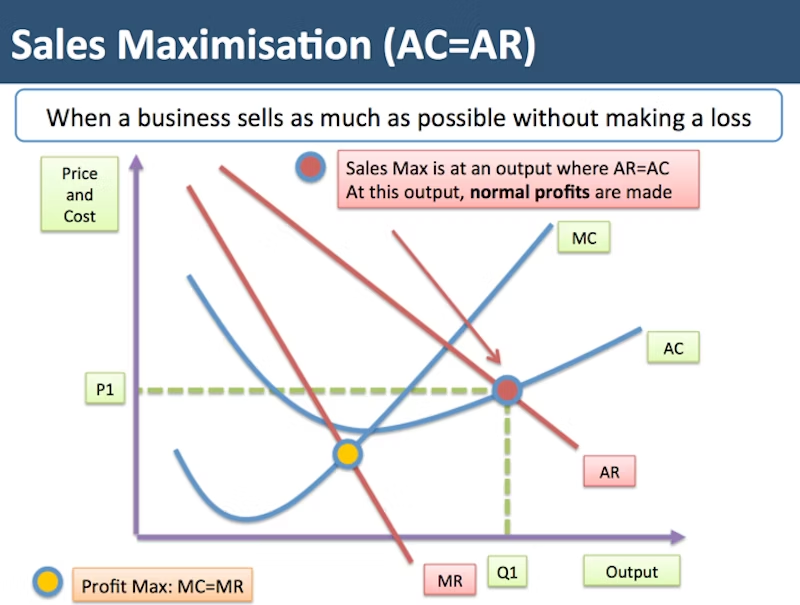
= Where AR meets AC
( Break even ) = normal profit
Used for the most growth
Why ?
Economies of scale
Limit pricing - essentially ‘breaking even’ which deters other firms entering the market which limits competition - not classed as predatory pricing as still covering costs - still illegal
Principle agent problems - using growth this time
Flood the market - Loads of consumers are aware of your product which increases consumer loyalty and then later down the line can change objective to prof max i.e Netflix
Contestable markets will use this
What are other business objectives ?
Survival - In short run in a very competitive market - increase brand awareness and then loyalty
Public Organisations - not for profit - just produces to maximise societies welfare ( P=MC )
Corporate Social Responsibility ( CSR ) - i.e. the Body Shop not testing on animals
‘Revenue maximisation is a more realistic business objective than profit maximisation for many businesses.’
Para one KAA
K - Revenue maximisation may be a more realistic option for firms operating in monopolistic competition. Monopolistic competition is a market where barriers to entry are fairly low, market concentration is dilutes and products are near homogenous - however, there is not perfect knowledge in this market
Firms in monopolistic competition include:
Coffee shops
Hair salons
A - Firms in these markets may choose to revenue max because this may increase their market share - due to high levels of competition.
This is because when firms revenue max - MR = 0 in comparison to profit max where MR=MC because of this giving lower prices to consumers
As a result of this, increasing consumer surplus and allows the coffee shop to build their consumer base which is more inelastic - increasing retention
Despite, if they were to profit max in the LR they would make larger proportions of SNP, by revenue max, they are still making a substantial profit whilst building their consumer base
Furthermore, the small proportion of SNP made by the coffee shop may reduce entry of new firms into the market - market price mechanism
Therefore, by focusing on revenue max, coffee shops are preventing new entrants, to an extent and increasing consumer retention
E - However, in evaluation, this is highly dependent on the contestability of the market.
By revenue maximising, firms are still making a substantial SNP - whuch may still in turn attract new entrants - due to the low barriers to entry of monopolistic competition
This may be furthered by the differing degrees of sunk costs per market - i.e. in the coffee market if an entrepeneur already has a building, he may only then need to invest in coffee machines and staff - little/no permits/qualifications needed - LOW sunk costs
Therefore, by even a smaller degree of SNP, this will not deter some entrants in monopolistic competition
Because of this, the coffee shop may be better profit maximising and making a high degree of SNP in the long run in which they can reinvest in the LR - dynamically efficient - differentiate their products and increase market share
K - In turn, profit maximisation may be the objective for firms operating in a monopoly or oligopoly market - this is due to their high concentration ratios
High concentration ratios meaning they won’t have large degrees of competition - definitely not in a monopoly - especially dominant of 40% i.e. Railway
Because of this, there will be little to no price competition - esp in oligopolies as this wouldn’t be rational due to the interconnected nature - Kinked Demand Curve
I.e. Parmaceutical companies may want to profit maximise so they can achieve dynamic efficiency and therefore compete on non price - i.e. quality
Or, perhaps they could utilise dynamic efficiency by exploiting technological economies of scale
This will make they more productively efficient and because of this TC will fall proportionately faster than the rise in total output
Therefore, firms such as Pfizer can move closer to minimum efficient scale where costs are lowest and output is highest
This can then be translated into lower prices for the consumer, increasing consumer surplus and increasing market share - this may be beneficial in a fairly competitive market i.e. Supermarkets
E - However, if firms become too big as a result of profit max - they may suffer from dis economies of scale - where LRAC exceed TQ
This can happen via poor coordination/communication - this reduces this efficiency of firms - reducing productivity - increasing unit labour costs and not benefitng
Therefore, firms may want to operate at a profit saticficing level - this is where shareholders are simply satisfied with the amount of profit aquired i.e. CF drug is actually sold at a loss
This may improve cosnumer welfare due to lower prices and in a roundabout way actually increase market share and therefore profit margains
As well as this, avoid attention from the CMA - i.e. blocked mergers Asda Sainsburies - who may impose profit restrictions - windfall taxation
OR revenue max to satisfy principles in PA problem !