Complex Ions & Ligands
Complex Ions
What is a Complex Ion?
Complex Ions are formed when one or more molecules (or negatively charged ions) bond to a central metal ion by donating a lone pair of electrons to form a coordinate bond.
The molecules/ions are known as ligands.
Shapes and Coordination Number
Coordination Number Definition
A Coordination number is the number of is the number of coordinate bonds attached to the central metal ion.
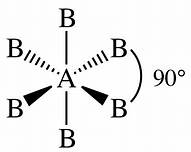
Octahedral
Coordination Number - 6
Bond angle - 90 degrees
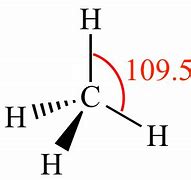
Tetrahedral
Coordination Number - 6
Bond angle - 109.5 degrees
Example of a Complex Ion - CuCl2
CuCl2 (aq) → CuCl2 (aq) | ||
Positive and negative ions held together by electrostatic forces | Here H2O is added (a ligand) The complex ion formed here is [Cu(H20)6]Cl2 or [Cu(H20)6]2+ | The ions are surrounded by water molecules. |
The Structure of CuCl2 (aq)
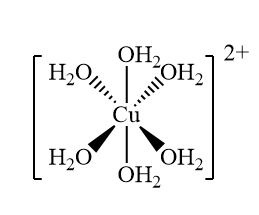
Key things to features of the structure:
The ligands (H2O) are attached via coordinate bonds.
These cannot be tested for.
The ions (Cl2) are attached via ionic bonds.
These can be tested for by making precipitates. E.g. Chloride with AgNO3
Ligands
Types of ligands
Monodentate
A monodentate ligand is a ligand that donates one lone pair of electrons to the central metal ion.
Type of ligands | Name | Formula | Charge on Ligand |
Monodentate | Water | :H2O | 0 |
Ammonia | :NH3 | 0 | |
Chloride | :Cl- | -1 | |
Cyanide | :CN- | -1 | |
Hydroxide | :OH- | -1 |
Bidentate
A Bidentate ligand is a ligand that donates two lone pairs of electrons to the central metal ion.
Type of ligands | Name | Formula | Charge on Ligand | Add. Info |
Bidentate | 1,2-diaminoethane | C2H8N2 / H2NCH2CH2NH2 | 0 | Lone pairs come from both :N |
Ethanedioate (Oxalate ion) | C2O42- | -2 | Double bond to two O Negative charge comes from the 2 single bonded O, with 2 lone pairs each. (-1 + -1 = -2) |
Ligand Substitution Reactions
What are Ligand Substitution Reactions?
Ligand Substitution Reactions happen when a more powerful ligand replaces a less powerful ligand in a complex ion.
These reactions can lead to a change in the coordination number for the complex ion.
Key Ligand Substitution Reactions:
Adding excess NH3:
[Cu(H2O)6]2+ + 4NH3 → [Cu(H2O)2(NH3)4]2+ + 4H2O
Adding conc. HCl to copper:
[Cu(H2O)6]2+ 4Cl- → [CuCI4]2- + 6H2O
Adding conc. HCl to cobalt:
[Co(H2O)6]2+ + 4Cl- →[CoCl4]2- + 6H2O