Diversity Unit Review
Why do we classify organisms?//
- To divide and organize them
- To create a universal classification and name to avoid confusion between different cultures and languages
\\Phylogeny//
- Evolutionary history, including relationships with other organisms based on past ancestors
\\Taxonomy//
- Is the identification, classification, and naming of species
\\Carlos Linnaeus//
- Father of Taxonomy
- Developed the system for naming species: Binomial Nomenclature
\\Taxon//
- (pl. taxa)
- Particular classification of an organism at each rank level
- (i.e phylum Chordata or order Rodentia)
\\Binomial Nomenclature//
- Two-part naming structure
- An organism’s scientific name or species name has two parts
- Genus part + Species name
\\Rules for writing Binomial Nomenclature//
- The scientific name is italicized, with the genus name capitalized, and the species is in lowercase
- I.e Homo sapiens
- When the name is written by hand, both parts are underlined
- I.e Homo sapiens
\\Organism//
- A life form, with multiple functions, put together
\\Species//
- A group of organisms that can interbreed in nature and produce fertile offspring
\\Domain//
- Broadest, most inclusive rank
- Bacteria
- Archaea
- Eukarya
\\Kingdom//
- Second most general rank
- Includes six different taxa (animals, plants, protists, bacteria, fungi, archaea)
- Incredible structural diversity (internal and external forms) within the kingdom
\\Classifcation of Kingdoms//
- When classifying only kingdom rank, the following characteristics can be used
- Number of cells (unicellular or multicellular
- Cell wall material (if present)
- Nutrition (autotroph or heterotroph)
- Autotroph: captures energy from sunlight/abiotic substances
- Hetereotroph: obtains energy by consuming other organisms
- Primary means of reproduction (asexual or sexual)
\\The 6 Kingdoms//
- Bacteria
- Archaea
- Animalia
- Plantae
- Protista
- Fungi
\\Levels of Organization(ranks)//
- Domain
- Kingdom
- Phylum
- Class
- Order
- Family
- Genus
- Species
\\Prokaryotic Cell//
- (before the nucleus)
- No membrane-bound nucleus
- Simpler internal cell structure
- No membrane-bound organelles
- Only organelles or ribosomes, which are not membrane-bound
- Usually smaller, and simpler
\\Eukaryotic Cell//
- (true nucleus)
- Membrane-bound nucleus
- More complex internal cell structure
- Usually larger (up to 1000x)
- Membrane-bound organelles
\\Dichotomous keys//
- Many scientists use classification manuals to identify organisms
- Usually, it involves completing a two-part question or dichotomous key
- The key is constructed so that a series of choices must be made, and each choice leads to a new branch of the key
- If the choices are made accurately, the end result is the correct name of the organism being identified
\\Virus//
- It is a non-cellular particle made up of DNA or RNA and a capsid that can invade a living cell; host specific
- Not considered living since they cannot live outside of cells
- Dependent on the internal physiology of cells
- Are not cellular and this lack cytoplasm, organelles, and cell membranes
- A virus must infect a host cell in order to be functional
\\Capsid//
- A protein coat that wraps around a virus
\\Viral Size//
- Range in size from 30nm to 300nm
\\Viral Shapes//
- Polyhedral
- Helical
- Enveloped
- Complex
- P.H.E.C
\\Polyhedral//
- Many-Sided (Refers to capsid)
- Examples include:
- Poliovirus, rhinovirus, adenovirus
\\Helical//
- Nucleic acid is enclosed in a hollow cylindrical capsid
- Examples include:
- Tobacco mosaic virus, rabies
\\Enveloped//
- Contains a membrane coat surrounding the capsid
- Usually roughly spherical, but highly pleomorphic
- Can be helical of polyhedral
- Examples include:
- Influenza virus, Herpes simplex virus
\\Complex//
- A combination that usually contains additional structural components attached
- Best shape
- Examples include
- Bacteriophage, poxvirus
\\Bacteriophage//
- A virus that infects bacteria
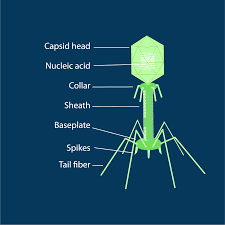
\\Lytic Cycle//
- Attachment
- The virus attaches to the body of the cell
- Entry / Injection
- The virus invades a hostel cell and injects is viral DNA or RNA into the host cell
- Replication
- The host cell makes copies of new viral proteins and nucleic acids
- Assembly
- New viral particles are put together
- Lysis and Release
- New viral particles are related to the environment when the cell is lysed and are able to invade new cells
- (When symptoms start)
- Quicker incubation period
\\Lysogenic Cycle//
- Some viruses can remain dormant inside a cell
- They are called latent viruses
- They may remain inactive for long periods of time, possibly even years
- In this cycle, the viral DNA joins the host chromosome and a provirus(prophage) is formed
- Viral DNA joins with the chromosome DNA
- Later they activate to produce new viruses in response to an external signal or trigger
- At that point, they go into the lytic cycle
- Examples: HIV and Herpes
\\Retrovirus//
- A type of lysogenic virus
- Enveloped viruses with an RNA genome
- Replicate via a DNA intermediate (enzyme reverse transcriptase) to convert RNA into DNA
- The viral DNA enters the chromosomes of the host cell, forming a provirus
- When the host cell divides by mitosis it replicates the provirus along with its own DNA
- The process can continue for years with no harm to the host
- At any time, the provirus can separate from the host chromosomes and complete the more damaging lyric cycle
- Examples:
- Human immunodeficiency virus (HIV), and herpes simplex virus
\\Connection to human health//
- Some virus infections can be prevented by making vaccines
- Our bodies make antibodies when exposed to the vaccine to fight the virus
- (Memory Cells)
\\Viruses and Biotechnology//
- Viruses are not entirely bad
- Can be useful tools in biotechnology
- Biological role (Artificial):
- They can be used to make many copies of desirable genes
- Can be used in medicine for ‘gene therapy to repair bad genes
\\Prions: Non-Viral Disease-Causing Agents//
- Disease-causing proteins that become harmful when they change molecular shape
- They cause deadly brain diseases such as Creutfeldt-Jacob disease (CJD), or Mad Cow Disease
\\Bacteria//
- Smallest independently living organisms
- The most abundant living organism
- Can be beneficial (majority) or disease-causing
- Can live in different environments
\\Characteristics of Math//
- Unicellular (some many stick together in colonies)
- Prokaryotic
- Have a single circular DNA loop (no chromosomes)
- May contain an additional loop called a plasmid DNA
- Have small ribosomes (compared to eukaryotes)
- Have a cell wall made of a material called peptidoglycan
\\Bacteria Size//
- Can range in size, usually between 0.2 and 10um
- Larger than viruses, smaller than eukaryotic cells
\\Bacteria Shape//
- Cocci
- Round
- Coccus(s)
- Bacilli
- Rod-Shaped
- Bacillus
\\Spiral Bacteria//
- Vibrios
- Curved Rods
- Spirilla
- Helical shape and fairly rigid bodies
- Spirochetes
- Helical shapes and flexible bodies
\\Other Bacterial Shapes//
- Star-Shaped Bacteria
- Rectangular Bacteria
- Pleomorphic Bacteria
- They can change their shape and contort
- No characteristic shape
\\Bacteria Colonies//
- Diplo
- Pairs(2)
- Tetrad (Not a prefix)
- Groups of 4 (cocci)
- Sarcinae (Not a prefix)
- Groups of 8 (cocci)
- Strepto
- Chain
- Staphylo
- Grape-like clusters (cocci)
\\Bacteria Movement//
- Flagella
- Singular Flagellum
- “Tail-like” projection that helps push the bacterium (similar to a tadpole); most motile bacteria move like this
- They can have one or more flagella
- Spiral bacteria use internal like flagella; they twist along an internal axis and move
- (similar to a screw)
- Gliding bacteria
- The mechanism is not quite clear but they just glide over surfaces
\n
\\Gram State Classification//
- Some bacteria can be classified on the cell wall’s response to Gram Stain
- Gram Stains (crystal violet) show differences in amino acids and sugar molecules
- Gram-positive
- A thick wall composed of many layers of peptidoglycan
- The thick wall blocks the escape of the crystal violet iodine complex
- Stains purple
- Gram-negative
- A thin layer of peptidoglycan
- Can not retain the dye
- Stains pink
- Larger in number and more diverse
\n
\\Bacterial Growth//
- Bacteria grow exponentially in “ideal” conditions
- Unlimited food and space
\n
\\Zone of Inhibition//
- Normal Growth
- Cloudy areas around the disc
- Inhibited Growth
- Less cloudy areas around growth
- Total inhibition
- Clear areas around the disc show an absence of growth
\n
\\Bacteria Reproduction//
- Binary Fission
- Form of asexual reproduction
- DNA duplicates
- Cell divides
- Daughter cells separate
- Conjugation
- Form of sexual reproduction
- DNA(normally from a plasmid) passes from one bacterium cell to another via a structure called a pilus
- Produces new genetic combinations
\n \n
\\Plasmids//
- Are small DNA loops that contain genes different from those of the chromosome
- They can split from the chromosome and rejoin it
- Can be transferred through conjugation, resulting in new genetic combinations and is an agent for increasing biodiversity
- Plasmids are important in genetic engineering
\n
\\Antibiotic resistance//
- Through the process of conjugation, a bacterium can acquire the gene (from a plasmid DNA) that allows it to become resistant to an antibiotic
\n
\\Gas Exchange//
- Oxygen requirements for bacteria vary
- Aerobe
- Requires oxygen
- E.x Genus - Corynebacterium - skin
- Obligate Anaerobe
- Die when exposed to oxygen
- E.x genus- Clostridium - large intestine
- Facultative Aerobes
- Use oxygen when present, but can grow without it
- E.x Genus - Escherichia - large intestine
- Bacteria are mesophiles -organisms that occupy moderate (less extreme) conditions
\n
\\Biological Role of Bacteria//
- Plant Growth (fix nitrogen)
- Decomposition (organic materials)
- Food Digestion (symbiotic bacteria - human gut)
- Human food (cheese, yogurt)
- Photosynthesis: bacteria are producers in food chains
\n
\\Endospores: Protecting Genetic Material//
- Some species of bacteria can form endospores
- Hard-walled structures that protect and store the organism’s genetic material
- Resistant to high temperatures, drying out, freezing, radiation, and toxic chemicals
- When suitable conditions return, the endosphere germinates back into an active bacterium
- So far not found in Archaea
- Examples:
- Clostridium Tetani
- Clostriudium Botulinum
\\Archaea Cell Type//
- Prokaryotic (no nucleus)
- Unicellular
\n
\\Archaea Cell Structure//
- Cell wall, no peptidoglycan
- The cell membrane contains unusual lipids that can withstand high and low temperatures
- Similar shapes to bacteria
- Some form aggregations(like colonies)
\n
\\Archaea Methods of Reproduction//
- Reproduce by binary fission and conjugation
\n
\\Archaea Biological Role//
- Some archaea produce methane
\n
\\Connection to Human Health Archeaea//
- None
- This type of organism is rarely in contact with humans
\n
\\Characteristics of Archaea//
- Live in an aerobic (oxygen-rich) or anaerobic (oxygen-poor) habitats
- Arcahae are extremophiles
- Organisms that live in extreme environments
\n
\\Thermophiles//
- Endure temperatures over 100C (e.g hot springs, deep sea vents)
\\Acidophiles//
- Endure low pH levels (e.g mine drainage lakes, volcanic craters)
\\Halophiles//
- Endure salt concentration of about 20% (e.g salt lakes)
\\Methanogens//
- Anaerobes that live in the depths of swamps and sewage, and the digestive tracts of animals give off methane
\\Psychrophiles//
- Live in unusually cold temperatures
\\Thermoacidophiles//
- Live in environments that are both hot and acidic
\\Types of Arcahea//
- Thermophiles
- Acidophiles
- Halophiles
- Mathanogens
- Psychrophiles
- Thermoacidophiles
- TAHMPT
Animal-Like Protists
- Unicellular Eukaryotic
- \n