22.8 Using immobilised enzymes
Enzymes have been indirectly for thousands years in biotechnologies including brewing, baking and making cheese and yoghurt. Many biotechnologies still use whole microorganisms as their enzyme source, more recently they are being used in isolation.
Isolated enzymes
less wasteful - whole microorganisms use up substrate growing and reproducing, producing biomass rather than product. Isolated enzymes do not.
More efficient - isolated enzymes work at much high concentration than is possible when they are part of the whole microorganism.
More specific - no unwanted enzymes present, so no wasteful side reactions take place.
Maximise efficiency - isolated enzymes can be given ideal conditions for maximum product formation, which may differ from those needed for the growth of the whole microorganism.
Less downstream processing - pure product is produced by isolated enzymes. Whole microorganisms give a variety of products in the final broth, making isolation of the desired product more difficult and therefore expensive.
Most of the isolated enzymes used in industrial processes are extracellular enzymes produced by microorganisms. → They are generally easier and therefore cheaper to use than intracellular enzymes.
Extracellular enzymes are secreted, making then easy to isolate and use.
Each microorganism produces relatively few extracellular enzymes, making them easy to identify and isolate the required enzyme. In comparison, each microorganism produces hundreds of intracellular which would need extracting from the cell and separating.
Extracellular enzymes tend to be much more robust than intracellular enzymes. Conditions outside a cell are less tightly controlled than inside the cytoplasm, so extracellular can cope with greater variation in temperature and pH.
However intracellular enzymes are sometimes used as there is a bigger range so they can provide an ideal enzyme, that are very specific.
Examples of intracellular enzymes
glucose oxidase - for food preservation
asparaginase - for cancer treatment
penicillin acylase - converting natural penicillin into semi-synthetic drugs which are more effective.
Immobilised enzymes
Isolated enzymes are more efficient than whole organism, but using free enzymes is often wasteful, they are not cheap to produce but at the end of the process they cannot usually be recovered so they are lost.
Used in industrial processes, they are immobilised - attached to an inert support system over which the substrate passes and is converted to product.
(enzymes are usually bound to membranes to carry out their repeated cycles of catalysis)
Because they are immobilised, they can be recovered + reused, they do not contaminate the end product therefore less downstream processing is needed. → making it more economical.
Advantages of using immobilised enzymes
they can be reused - making it cheaper
Easily separated from the reactants and products of the reaction they are catalysing so reduced downstream processing - cheaper
More reliable - high degree of control over the process as the insoluble support provide provides a stable microenvironment for the immobilised enzymes.
Greater temperature tolerance - immobilised enzymes are less easily denatured by heat and work at optimum levels over much wider range of temperature, making bioreactor less expensive to run.
Ease of manipulation - catalytic properties can be altered to fit a particular process more easily than those of free enzymes
e.g immobilised glucose isomerase can be used continuously for over 1000 hours at temperatures of 60-65 ‘c. The ability to keep bioreactors running continuously for long periods without emptying and cleaning helps to keep running costs low.
Disadvantages of using immobilised enzymes
Reduced efficient - the process of immobilising an enzyme may reduce its activity rate.
Higher initial costs of materials - immobilised enzymes are more expensive than free enzymes or microorganisms. However immobilised enzymes do not need to be replaced frequently.
Higher initial costs of bioreactors - the system needed to use immobilised enzymes is different from traditional fermenters so there is an initial investment cost.
More technical issues - reactors which use immobilised enzymes are more complex than simple fermenters 0 they have more things which can go wrong.
How are enzymes immobilised?
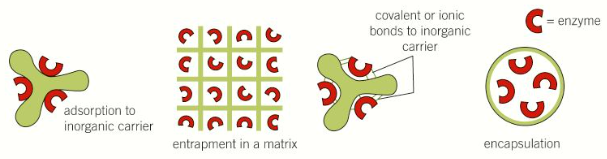
Can be bound to the surface of insoluble supporting materials by adsorption onto the surface or by covalent or ionic bonds.
They may be entrapped in a matrix, encapsulated in a microcapsule (like proteases for detergent use)
Behind a semi-permeable membrane.
Surface immobilisation - adsorption to inorganic carriers eg cellulose, silica, carbon nanotubes, polyacrylamide gel.
simple and cheap to do
can be used with many different processes
enzymes very accessible to substrate and their activity to virtually unchanged.
enzymes can be lost from matric relatively easily.
Surface immobilisation - covalent or ionic bonding to inorganic carriers
covalent bonding - e.g carriers with amino, hydroxyl, carboxyl groups
ionic bonding - e.g polysaccharides like cellulose, synthetic polymers.
cost varies
enzymes strongly bound and therefore unlikely to be lost
enzymes very accessible to substrate
pH and substrate concentration often have little effect on enzyme activity
active site of enzymes may be modified in the process making it less effective.
Entrapment - in matrix e.g polysaccharides, gelatin, activated carbon
widely applicable to different processes
may be expensive
can be difficult to entrap
diffusion of the substrate to and product from the active site can be slow and hold up reaction
effect of entrapment on enzyme activity very variable, depending on matrix.
Entrapment - membrane entrapment in microcapsules (encapsulation) or behind a semi-permeable membrane e.g polymer-based semi-permeable membranes
relatively simple to do
relatively small effect on enzyme activity
widely applicable to different processes
relatively expensive
diffusion of the substrate to and product from the active site can be slow and hold up the reaction.
In some cases, whole microorganisms may be used as this avoids time-consuming and expensive process of extracting the pure enzyme and immobilising it before the process starts. However the organism needs food, oxygen and a carefully controlled environment to work at their optimum rate.
Using immobilised enzymes
they allow continuous production, especially useful when large quantities of products are wanted
Immobilised penicillin acylase used to make semi-synthetic penicillins from naturally produced penicillins. Many types of bacterias have developed resistance to naturally occuring penicillins so they are no longer very effective drugs. Many bacteria are still vulnerable to semi-synthetic penicillins produced by penicillin acylase so they are important in treating infections caused by bacteria resistant to the original penicillin.
Immobilised glucose isomerase used to produce fructose from glucose. Fructose is much sweeter than sucrose or glucose and widely used as a sweetener. Glucose is produced from cheap, starch-rich plant material, then glucose isomerase is then used to turn the cheap glucose into marketable fructose.
Immobilised lactase used to produce lactose-free milk. Immobilised lactase hydrolysis lactose to glucose and galactose giving lactose- free milk.
Immobilised aminoacylase used to produce pure sample of L-amino acids used in the production of pharmaceuticals, organic chemicals, cosmetics and food.
Immobilised glucoamylase, which can be used to complete the breakdown of starch to glucose syrup. Amylase enzymes break down starch into short chain polymers called dextrins. The final breakdown of dextrins to glucose is catalysed by immobilised glucoamylase.
Immobilised nitrile hydratase, an enzyme playing a role in plastics industry. Acrylamide is very important used in the production of many plastics. It is made by the hydration of acrylonitrile. Traditionally had been done using h2so4 and reduced copper catalyst but conditions were extreme and yield poor. Immobilised nitrile hydratase takes place under moderate conditions so cheaper and 99% yield and no wanted by products.
Nitrile hydratase - enzyme that catalyses the conversion of acrylonitrile to acrylamide in a hydration reaction
Nitrilases - group of enzymes that catalyse the hydrolysis of nitriles e.g acrylonitrile to carboxylic acids and ammonia.
Immobilised enzymes in medicine
Used as diagnostic tools and manufacture of drugs e.g fungus Rhizopus arrhizus is immobilised and used in the production of the steroid drug cortisone.
Biosensors are used in accurate monitoring of blood and urine levels of substances such as glucose, urea, amino acids, ethanol, lactic acid and monitoring of waste treatment, water analysis and control of complex chemical processes.
They are based on an electrochemical sensor in close proximity to an immobilised enzyme membrane, the enzymes react with a specific substrate and the chemicals produced are detected by the sensor. Because of the size of the response is relate to the concentration of the substrate, these sensor can be very sensitive and accurate in their measurement and so can eb used e.g by people with diabetes to determine their blood glucose levels and therefore judge the insulin dose they need.