Exam 1
@@Week 1@@
%%Vocab%%
^^Basic Vocab^^
- Axon - specialized extension of neurons
- Bell-Magendie law - dorsal spinal nerves roots contain only sensory fibers and ventral spinal roots contain only motor fibers
- Biological Psychology - field that relates behavior to bodily processes
- Conserved - In context of evolution, refers to trait passed on from common ancestor to two or more descendant species
- Dependent variable - The factor that an experimenter measures to monitor a change in response to the manipulation of an independent variable
- Dualism - belief that there are different kinds of substance that exist independently; one for consciousness/feelings, and another for behavior and bodily functioning
- Golgi staining - silver staining procedure that allowed for visualizing occasional cells
- Holism - brain function is not localized; instead function is distributed more homogeneously throughout
- Independent variable - the factor that is manipulated by an experimenter.
- Levels of analysis - The scope of experimental approaches. A scientist may try to understand behavior by monitoring molecules, nerve cells, brain regions, or social environments, or some combination of these levels of analysis
- Mind-body problem - concerned with reconciling the relationship between mental processes and bodily states/processes
- Nerve-net theory - branches of nerve cells formed a continuous net
- Neuroscience - study of the nervous system
- Ontogeny - process by which individual changes throughout life (growing up/older)
- Phrenology - outdated idea that skull features indicate brain development, such that specific faculties could be detected by surface features
- Reductionism - scientific strategy of breaking a system down into increasingly smaller parts in order to understand it.
- Santiago Ramon y Cajal - began to work with silver stains in 1887 and made significant technical improvements to the method
- Synapses - Point at which each neuron contacts many other cells
- Theodore schwann - first to propose neuron doctrine in 1839
bell-magendie law - dorsal spinal nerves roots contain only sensory fibers and ventral spinal roots contain only motor fibers
- used this to hypothesize that one might have to look at the nervous system in an entirely different way
^^Neuron - (nerve cell) basic unit of nervous system^^
- your head contains estimated 86 billion nerve cells
- spatial relationships are critically important
- basic elements for connectivity in brain
^^connectionism - suggests that mental phenomena and behavior can be described in terms of interconnected brain regions subserving different (sub)functions^^
- dominant conceptual framework for understanding brain functioning
^^neuroplasticity - nervous system changes in response to experience/environment^^
- important for development, bonding, etc.
- Dendritic Spines - part of neuron that is in constant motion changing shape in course of seconds
^^localization theory - different parts of the brain serve different functions (relates to reductionism)^^
- structures which look same/different should have same/different functions
- Ventricular localization theory is wrong
- Lateral ventricles - receptacle for sensory information
- Middle (third) ventricle - fantasy, ideation, cognition
- fourth ventricle - memory
^^Monism - belief that the universe is only comprised of one type of substance^^
- forms of monism include:
- materialism - everything that exists is physical by nature
- mentalism - (since) physical and psychological phenomena are mentally constructed, and therefore only explicable in terms of the mind
- identity position - mental processes and brain processes are the same but described in different terms
^^emergentism - is a different idea that a property of a system is more than the sum of properties of its individual parts, it cant be understood by combining them together^^
- usually this applies to consciousness - may be an emergent property from the brain that occurs beyond certain levels of complexity
- still dependent on more basic properties in a system so functions more like parallel view to reductionsim
^^consciousness - state of awareness of ones own existence and experience^^
- Also examines how experience or environment modifies brain and behavior
Aspects of consciousness
- Consciousness matters so we can do things
- Consciousness is bound up with brain activity
- Some brain activity/behavior is unconscious.
- deepest parts of brain are important for arousal.
- topmost parts of brain are for experiences
^^Behavioral Neuroscience - the application of principles of biology in order to study physiological, genetic, and developmental mechanisms of behavior in human and non-human animals^^
Related fields to behavioral neuroscience
- biological psychology (biopsychology/psychobiology)
- same thing as behavioral neuroscience; although more out of date
- physiological psychology (synonym of behavioral neuroscience)
- Neurobiology - same as neuroscience but more tradition in biology
- Neurology - branch of medicine that studies the brain and nervous system. Especially diseases in them.
- Neuropsychology - similar to biopsychology; but involves study of brain lesioned/damaged people to make inferences about function; may use cognitive testing and brain imaging
- psychophysics - not neuroscience at all; quantitatively investigates the relationship between physical stimuli and the sensations and perceptions that they affect
Neuron Doctrine
- most scientists thought that branches of nerve cells formed continuous net
- Nerve net theory
- used against cortical localization theory
- theodore Schwann first to propose in 1839
- entire body, including nervous system, was made up of individual cells
Silver staining/Golgi staining
- Camillo Golgi developed silver staining procedure that allowed for visualizing occasional cells (Golgi staining)
- santiago Ramon y Cajal - started working with silver stains in 1887 and made significant technical improvements
- cajal amassed extraordinary archive of anatomical data describing neuron structure
- found evidence that neurons interconnected BUT they’re autonomous units
- considerable insight into cell and brain function
- most important neuroscientist in history
Important Figures
- Thomas Willis
- Oxford physician
- proposed that cerebral hemispheres, controlled memory and the will
- imagination, long thought to be part of the soul, was also tied to the cerebral hemispheres
- brain material was also implicated in sensation and movement
- cerebellum and brain stem were more involved in vital and involuntary systems
- most important figure in post renaissance era to generate interest in looking for functional contributions from individual brain parts
- Rene Descartes
- highly influential philosopher of post-renaissance era
- well-known proponent of dualism
- most lasting contribution is the notion of the brain as a “reflexive machine”
- Legallois
- isolated the respiratory center to just one small part of the brain system
- franz joseph Gall
- cortical localization
- phrenology - idea that skull features were indicative of brain development, such that specific faculties could be detected by surface features
- paul broca
- first to provide definitive proof of cortical localization (not based on skull surface features)
- noted that language production center was typically present on left hemisphere
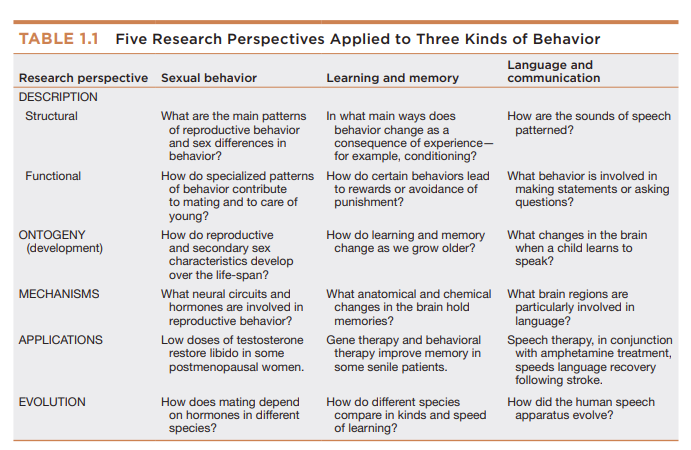
%%Perspectives of Analysis in Behavioral Neuroscience:%%
- Descriptive - what does a behavior look like
- functional (specific patterns)
- structural (main patterns)
- Developmental - of behavior and its biological characteristics over the life span
- Mechanistic - involves some manipulation to relate a behavior to the activity of the brain, circuits, cells, molecules, or genes
- Evolutionary - how behavior/function diversified from earlier or less complex species
%%Charles Darwin’s Natural Selection Theory - two different emphases emerged%%
- continuity of behavior and biological processes among species that reflects shared ancestry
- the species-specific differences in behavior and biology that have evolved as adaptations to different environments
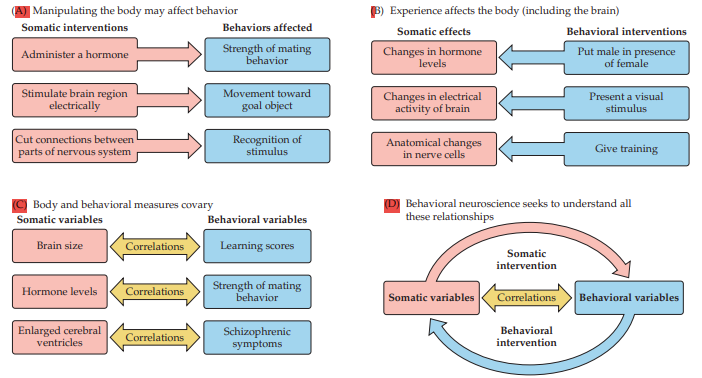
%%Three Main Approaches to studying neuroscience of behavior%%
- somatic intervention - change body structure/chemistry
- behavioral intervention - change behavior/environment
- correlational - covariation of 2 measures (between somatic & behavioral changes)
- correlations should not be taken as proof of causal relationship
- even if a causal relation exists, the correlation does not reveal which variable is independent and which is dependent
- two factors might be correlated only because a third, unknown factor affects the two factors measured
- leads to forming hypothesis which can then be tested to establish if variable is causing changes to other
%%levels of analysis in behavioral neuroscience from largest to smallest%%
- behavioral
- mind & behavior
- systems
- brain
- neural systems
- subsystems
- local networks
- cellular
- neurons
- synapses
- molecular
- molecules
D
%%Some Facts%%
- whole brain is active when doing almost any task
- structures which look different should have different functions
Week 2
Cells of the nervous system
- human nervous system is comprised of 2 kinds of cells
- neurons
- similar to other cells of body but have distinctive shape
- shape determines its connections with other neurons and its contribution to nervous system
- function related to shape of neuron
- all have following major components
- Dendrites (from synapses)
- neuron may have many dendrites but only one axon
- Soma/cell body
- Axon
- Presynaptic terminals (onto synapses)
- Synapse
- information flow thru neurons is always conveyed in 1 direction: from#1→#5
- Glia
- many subtypes within each category
- human brain contains aprox. 100 billion neurons and 1 trillion glia
- prefrontal cortex - most evolved brain region. highest-order cognitive abilities. most sensitive to stress
- part of cerebral cortex
- outermost layer of brain
- cerebellum - part of brain that helps coordinate and regulate a wide range of functions and processes in both your brain and body
Dendrites and Spines
- dendrites - branching fibers with a surface lined with synaptic receptors responsible for bringing info into neuron
- some also contain dendritic spines
- tiny protuberances providing sites for postsynaptic contact
- highly “plastic” which allows rapid changes in connectivity following environmental experience
Cell body
- cell body (soma, perikaryon)
- contains nucleus, mitochondria, ribosomes, and other structures found in other cells
Axon
- Axon - thin fiber responsible for transmitting nerve impulses toward other neurons, organs, or muscles - neurons only have one axon, but it may branch (i.e. bifurcate)
- presynaptic terminals or boutons - end points of an axon where the release of chemicals to communicate with other neurons occurs
more about axonal structure
- Myelin sheath - insulating material made up of lipids that covers neuron axons
- has interruptions in sheath called:
- nodes of ranvier - increase the efficiency of impulse propagation down the axon
Contrasts between axons and dendrites
| property | axons | dendrites |
|---|---|---|
| number | usually one per neuron with many terminal branches | usually many per neuron |
| diameter | uniform until start of terminal branching | tapering progressively toward ending |
| Axon hillock | present | no hillock-like region |
| sheathing | usually covered with myelin | no myelin sheath |
| length | ranging from practically non-existent to several meters long | usually much shorter than axons |
Basics of neuronal cell biology
- terms used to describe the neuron include the following:
- afferent axon
- bringing info toward structure
- efferent axon
- carrying info away from structure
- interneurons
- neurons with dendrites and axons that are completely contained within a single structure
neurons have electrical properties
- all info in neurons conveyed through electrical activity
functional divisions of a neuron
- input zone - mostly dendrites (some cell body) area where neurons receive info from other neurons
- integration zone - cell body; area where all incoming info into neuron is combined to determine whether or not to send signal of its own
conduction zone - - axon; carries the neuron’s own electrical signal away from the cell body and toward the next neuron (axons may branch, or collateralize)
- Output zone - specialized swellings at the ends of axons called axon terminals or boutons
- where neurons activity is transmitted across synapses to other neurons
Synapses - sites of communication between neurons
- synapse - space between the axon terminal/bouton and the postsynaptic membranes of two neurons
- active zone - region in the presynaptic bouton that regulates release of chemicals for communication with the neuron on the postsynaptic side
- presynaptic axon terminals contain thousands of tiny hollow spheres called synaptic vesicles
- synaptic vesicles - serve as “packages” that contain neurotransmitter molecules
- neurotransmitters - are specialized chemical substances that are used to communicate with the postsynaptic neuron
- they are released from vesicles, cross the synaptic cleft(space) and bind to postsnaptic receptors
- receptors - specialized proteins that capture and react when the neurotransmitter binds to them;this results in localized changes in the electrical activity of the postsynaptic cell
Postsynaptic density (PSD)
- postsynaptic density (PSD) - protein-dense network attached to the postsynaptic membrane
how to view neurons
- light microscope - shines visible light on sample
- laser-scanning microscope (LSM) - uses fluorescent labeling in tissue; use laser to excite fluorescent label and it emits a photon
- confocal LSM - use pinhole to eliminate out-of-focus info
- electron microscope - use beam of electrons as source of illumination;since wavelength is smaller than light, it can reveal smaller objects
- live imaging - ways to do using “reporter mice” that contain fluorescently-tagged cells in the brain
other cell types of the nervous system
- glia - the other major components of the nervous system that exchange chemicals adjacent neurons
- astrocytes - star-shaped cells with numerous processes that extend in all directions
- microglial cell - very small cells; extend and retract very fine processes to survey for damage in the nervous system
more types of glial cells
- oligodendrocytes & Schwann cells - build the myelin sheath that surrounds axons of neurons
- radial glia - guide the migration of neurons and the growth of their axons and dendrites during brain development, and occasionally, during adulthood
Blood-brain barrier
- blood-brain barrier (BBB) - separation between circulating blood and surrounding extracellular fluid in brain
- two layers
- specialized endothelial cells that prevent diffusion in and out of blood vessels
- Astrocytes that support and ramify the endothelial cells
- chemicals can cross either by passive or active transport
- passive transport - diffusion across can happen freely
- active transport - energy is required to move substances across and is more tightly regulated
Structure of the vertebrate nervous system
- neuroanatomy - study of structure or organization of the nervous system
- localizationist/connectionist approach
Themes in neuroanatomy
- Hierarchical vs. Network - increasing complexity; systems are overlaid over simpler ones vs. equally-weighted units working cooperatively
- serial vs. parallel - separation and sequence of different pathways (ie. sensory-to-motor) vs. simultaneous multiple levels of processing of related information
Major divisions of the vertebrate nervous system
- nervous system comprised of two major subsystems:
- peripheral nervous system (PNS) - somatic and autonomic nervous systems
- somatic nervous system
- consists of axons conveying messages (1) from the sensory organs to the CNS and (2) from the CNS to the muscles
- autonomic NS
- sends and receives messages to regulate the automatic behaviors of the body (heart rate, blood pressure, respiration, digestion, etc.)
- homeostasis
- property of a system that regulates its internal environment for maintaining a stable, constant condition
- divided into two subsystems that oppose each other
- sympathetic nervous system
- preps u for fight or flight/preps organs for rigorous activity
- increases heart rate, blood pressure, respiration, etc.
- comprised of sympathetic ganglia, that lie in close proximity to the spinal cord
- long postganglionic fibers - project to targets, often by traversing long distances
- norepinephrine - chemical neurotransmitter used by sympathetic the postganglionic neurons
- parasympathetic nervous system
- promotes maintenance of body under resting conditions/ facilitates vegetative, nonemergency responses
- comprised of long preganglionic axons - extending from spinal cord and short postganglionic fibers that attach to the organs themselves
- acetylcholine - chemical neurotransmitter released from postganglionic neurons in parasympathetic NS
- central nervous system (CNS) - brain and spinal cord
- Spinal Cord
- comprised of
- gray matter - located in center of spinal cord. densley packed w/cell bodies and dendrites
- white matter - composed mostly of myelinated axons that carries info from gray matter to the brain or other areas of spinal cord
- dorsal root ganglion - brings sensory info into CNS via dorsal horn
- ganglion - bunches of neuronal cell bodies all together outside the CNS (Nucleus - groups of cells within CNS)
- tracts - clumps of axons
- segmentation - each part of the cord sends sensory info to brain and receives motor commands for specific body parts
- Dorsal side contains axons w/incoming sensory info and the ventral side is fro outgoing motor axons
- central canal - fluid-filled channel in center of spinal cord
- ventricles - 4 fluid-filled cavities within brain containing cerebrospinal fluid
- cerebrospinal fluid (CSF) - clear fluid in brain and spinal cord
- provides cushioning for brain
- reservoir of hormones and nutrition for brain and spinal cord
- meninges - membranes that surround brain and spinal cord
- 3 layers
- dura mater - outermost. thick skin-like layer
- arachnoid space - contains blood vessels and CSF
- pia mater - innermost, thinner layer
Important terms for orientation in nervous system
- dorsal - toward back, away from stomach side. top of brain considered dorsal because has that position in four-legged animals
- ventral - toward stomach away from dorsal (back) side
- Anterior/rostral - toward front end
- prosterior/caudal - toward rear end
- superior - above another part
- inferior - below another part
- lateral - toward the side, away from the midline
- medial - toward midline, away from side
- proximal - located close (approx) to point of origin or attachment
- distal - located more distant from point of origin or attachment
- ipsilateral - on same side of body (two parts on left or two on right)
- Contralateral - on the opposite side of the body (one on the left and one on the right)
- Coronal plane - plane that shows brain structures as seen from front (or frontal plane)
- sagittal place - a plane that shows brain structures as seen from side
- horizontal plane - a plane that shows brain structures as seen from above (or transverse plane)
Major divisions of brain
- three major division
- forebrain - diendiencephalon (hypothalamus, thalamus); telencephalon (cortex, basal ganglia, limbic system)
- most anterior and prominent part of mammalian brain
- consists of
- two cerbral hemispheres
- subcortical regions that lie underneath
- diendiencephalon
- hypothalamus
- small area near base of forebrain conveys messages to pituitary gland to control endocrine function (release of hormones)
- has neural projections to many brain regions
- motivated behaviors: eating, drinking reproduction, defensive, etc.
- pituitary gland - hormone-producing gland found at base of, and controlled by, hypothalamus (not part of forebrain but part of endocrine hypothalamic system)
- thalamus - intermediary between “sensorimotor” info between subcortical and cortical systems
- also processes info between sensorimotor and motivational systems
- often refer to as relay between cortex and subcortical systems, but lots evidence shows its key structure in info processing
- telencephalon
- basal ganglia
- 3 parts
- caudate nucleus
- putamen
- globus pallidus
- associated w/voluntary movement, procedural learning, “habit” behaviors
- (motor theme)
- lesser roles in memory and emotional expression
- limbic system
- consists of a number of interlinked structures, whose name is derived from formation of border around brainstem and forebrain
- includes olfactory bulb, hypothalamus, hippocampus, amygdala, and cingulate gyrus of the cerebral cortex
- supports variety of functions broadly relating to emotion:
- behavior, motivation, long term mem, olfaction (small)
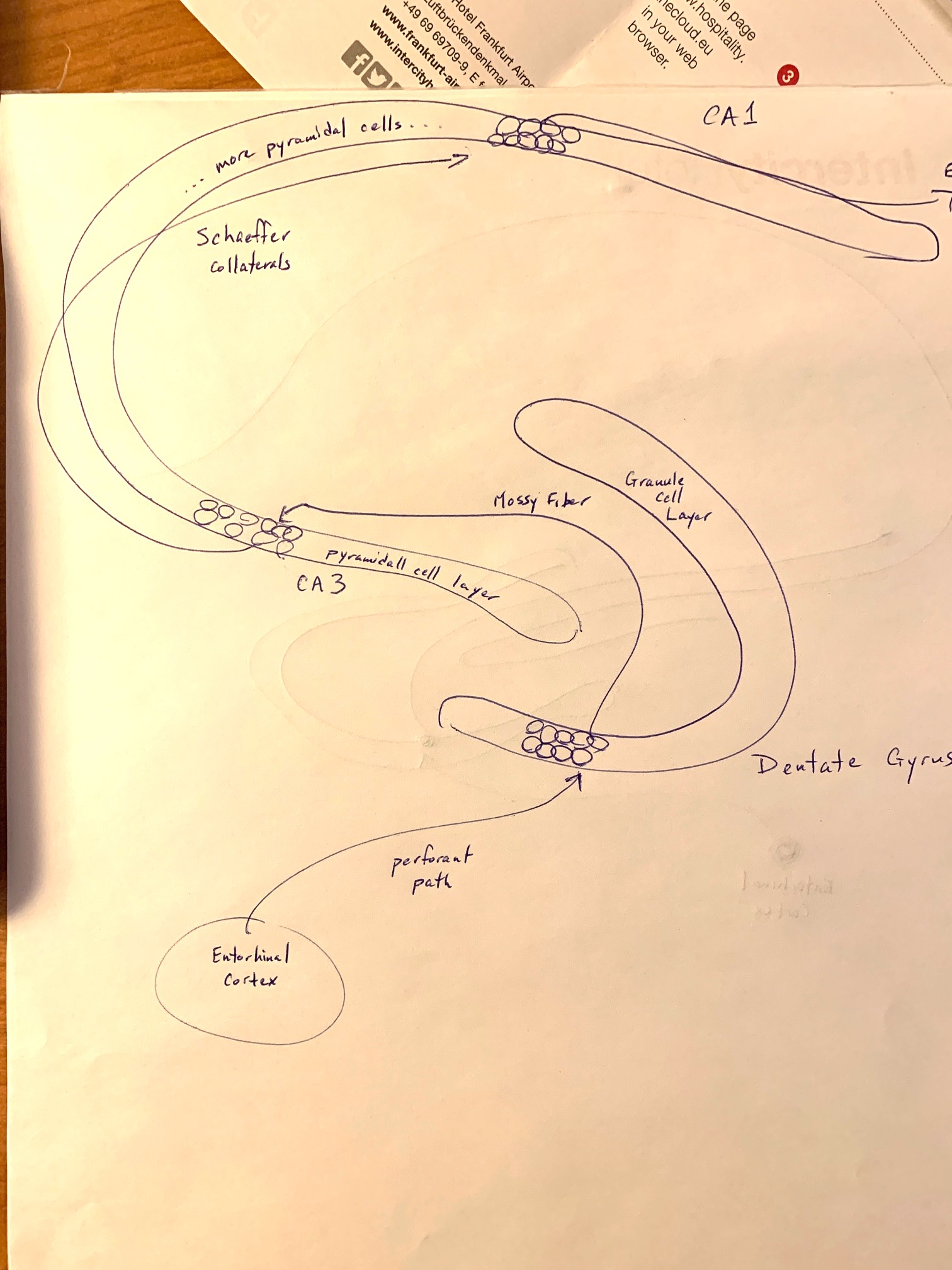
- hippocampal formation
- lare seahorse-shaped structure located between thalamus and cerebral cortex
- critical for storing converting short to long term mem; spatial learning
- structures in hippocampal formation
- entorhinal cortex
- dentate gyrus
- CA3
- CA1
- subiculum
- key pathways:
- perforant
- mossy fiber
- schaeffer collaterals
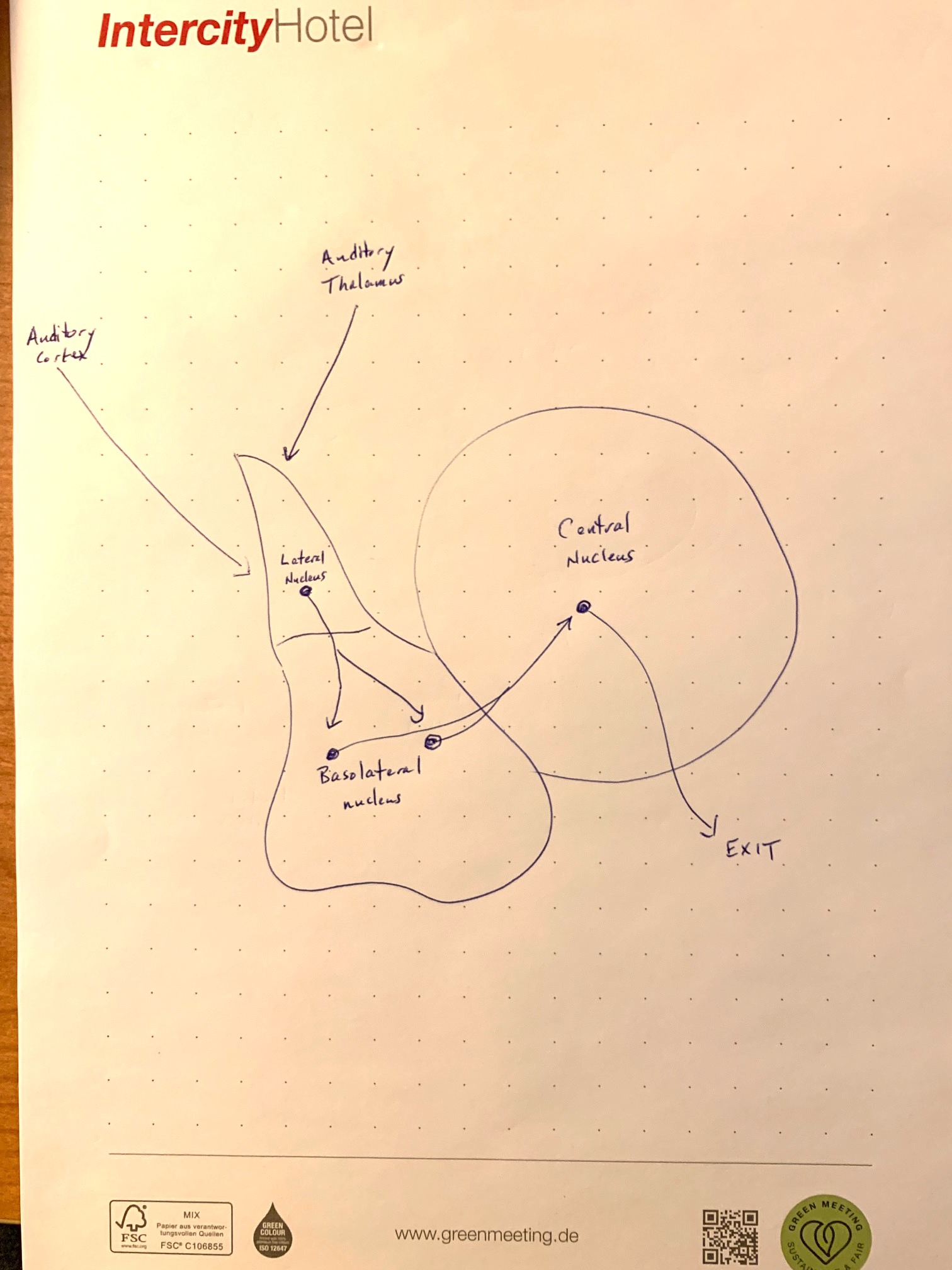
- amygdala - collection of nuclei located in the base of temporal lobe that is implicated in expression of certain types of emotion (mostly in response to threatening/fear-evoking situations)
- consists of
- lateral amygdala
- basolateral amygdala
- central nucleus of amygdala
- midbrain
- midbrain quite small and fewer landmarks
- mesencephalon
- superior and inferior colliculus
- appear as bumps (2 for each) on top of surface of midbrain
- colliculi - important for orienting to visual (superior) and auditory (inferior) stimuli
- together colliculi referred to as tectum
- hindbrain
- myelencephalon
- synonyms - medulla or brain stem
- located just above spinal cord
- responsible for vital reflexes such as breathing, heart rate, vomiting, salivation, coughing and sneezing
- cranial nerves - most are connected to medulla
- allows control of
- sensations from head
- muscle movements in head and eyes
- some parasympathetic outputs to organs
- Metencephalon
- cerebellum
- located in hindbrain with many deep folds
- helps regulate motor movement, balance and coordination
- important for shifting attention between auditory and visual stimuli
- pons
- latin for bridge
- contains structures important for sleep-wake regulation
cerebral cortex
- most prominent part of mammalian brain and consists of the cellular layers or lamina on outer surface of cerebral hemispheres
- joined by a large axon bundle - corpus callosum
- organization
- neocrtex
- contains 6 distinct lamina (layers) that are parallel to surface of cortex
- cells of cortex also decided into columns that lie perpendicular to laminae that serve as functional units
- allocortex -
- type of cortex that have fewer than 6 layers
- eg. hippocampus; cerebral cortex in less complex animals like rats and mice
- major divisions
- 4 lobes of cerebral cortex include
- occipital lobe - visual processing
- parietal lobe - somatosensory
- temporal lobe - language, memory;hearing
- frontal lobe - motor processing; complex cognitive functions
prefrontal cortex
- executive functions - ability to differentiate among conflicting thoughts, determine good/bad, same/different, future consequences, etc.
- represents and stores knowledge about behaviors, including the consequences and expected outcomes in complex situations
Hippocampal circuitry drawing
Amygdala circuitry drawing
Week 3
Neurophysiology
- neurophysiology - examination of electrical and chemical signaling processes within and between neurons
- info conveyed within neurons - electrical signals (resting potential and action potential)
- information conveyed between neurons - chemical signals
basic terms and concepts
- action potentials (AP) - electrical signal conveyed down the axon
- axon hillock - part of the cell body where AP is initiated
- when AP arrives to the axon terminal/bouton, it triggers release of neurotransmitter vesicles across the synapse
- neurotransmitter - chemical mediators between synapses
- membrane of neuron maintains electrical gradient which is a difference in the electrical charge between the inside and outside of the cell
- this gradient is called the resting potential (RP) and is actively maintained by the neuron
How to build resting potential in neuron
- plasma membrane - allows small uncharged chemicals but not ioans to flow both into and out of cell
- since membrane is a lipid bilayer it is hydrophobic
- anions (-) and cations (+) - ions that have either gained or lost electrons, respectively, and bear a net charge
- lipids are hydrophobic (“water hating”)
- polar molecules and ions are hydrophilic (“water liking”)
More terms and concepts
- voltage - measure of the stored (or potential) electrical energy; eg. ion build up across the membrane
- current - measure of rate of flow of electrical energy; also think of as movement of ions
- Voltage is indicated by the term “potential” or “potential difference” ie. think of as amount of energy required to move an ion from one point to another in space
Three major players in resting potential
- potassium (K+) - membrane is permeable to K+; more concentrated inside of neuron
- sodium (Na+) - impermeable to NA+; more concentrated outside of neuron
- Proteins - the intracellular space is filled with proteins, and they have a net negative charge; these can’t diffuse out of the cell due to their very large size
- chloride (Cl-) - this is a minor player, but it does contribute a bit; membrane is partially permeable to Cl-
- calcium (Ca++) - also a minor player, membrane is partially permeable to Ca++
Summary: 4 factors that determine the resting potential
- Selective membrane permeability (ion channels, negatively charged proteins)
- Concentration gradient (part of the equilibrium potential)
- electrical gradient (part of the equilibrium potential)
- when these 2 are equal for k+ this accounts for resting potential
- Sodim-potassim pump (3Naa+OUT for every 2K+IN)
Comments
- Because there is a potential (usu. -70mV) across the cell membrane, we say that the neuron is polarized
- hyperpolarization - more negative (e.g., -70mV)
- depolarization - more positive (or less negative; e.g., -50 mV)
How to change the membrane potential
- hyperpolarization - increasing the polarization or the difference between the electrical charge of two places → cell becomes more NEGATIVE
- deporalization - decreasing the polarization towards zero → cell becomes more POSITIVE
- excitation threshold - levels above which any stimulation produces a massive depolarization → action potential
Action potential
- action potential (AP) - rapid electrical depolarization that is propagated down the axon toward the end of the neuron
- voltage-sensitive ion channels - membrane protein-forming channels whose permeability depends upon the voltage difference across the membrane → there are 2 types:
- V-sens. Na+ channels - open rapidly at depolarization potential of about -40 mV, including the action potential
- V-sens. K+ channels - open more slowly, and repolarize the membrane
- refractory period - time during which the neuron resists the production of another action potential
- absolute refractory period - first part of the period in which the membrane can not produce an action potential (i.e., when V- sens. Na+ channels are open)
- relative refractory period - the second part in which it takes a stronger than usual stimulus to trigger an action potential (i.e., can sometimes happen when V-sens. K+ channels are still open)
- some local anesthetics block V-sensitive channels
- lidocaine
- novocaine
- Tetrodotoxin (TTX) - also a V-sens. Na+ channel blocker
All-or-none law
Factors that affect AP direction and velocity
- larger diameter = faster conduction velocity
- Myelination = faster velocity;produces saltatory conduction
- nodes of ranvier - the myelin sheath of axons are interrupted by short unmyelinated sections called (nodes of ranvier)
- saltatory conduction - describes “jumping” of the action potential from node to node
- multiple sclerosis - disease in which the myelin sheath is destroyed on motor neurons and leads to loss of muscle coordination and motor control
Some interneurons don’t produce conventional APs
- local neurons/interneurons - have short axons, exchange information only with close neighbors
- such neurons may produce graded potentials ie. that vary in magnitude and decay over time
Concept of synapse
- Sir Charles Scott Sherrington - performed the critical experiments to validate the concept of the synapse
- Sherrington conducted his research investigating how neurons communicate with each other by studying spinal reflexes (automatic muscular responses to stimuli) in dogs
Summation - temporal
- temporal summation in neurons, whereby repeated stimuli in a neuron produce a higher frequency of action potentials in a neuron
Summation - spatial
- spatial summation - that synaptic input from several locations can have a cumulative effect and trigger a stronger response (ie. higher rate of action potentials)
Discussion 1
behavioral neuroscience - application of biology to study the physiological, genetic and developmental mechanisms of behavior in human and non-human animals
- Biology+Psychology=Behavioral Neuroscience
1 in five people will experience some type of psychiatric disorder in their lifetime
perspectives for studying mental processes
- descriptive - what ddoes this behavior look like
- evolutionary - how does the behavior compare across species?
- developmental - how does this behavior compare across the lifespan
- mechanistic - how does the behavior change when the brain is manipulated
reductionism - reducing complex things to their interactions or fundamental parts
emergentism - system is greater than the sum of its parts
two schools of thought
- monism - universe only comprised of one substances that follows same set of rules
- mind and body manifestations of same substance
- ppl are fluid filled meat sack
- dualism - universe comprised of seperate substances that follow different rules (descartes)
- mind-body problem
- problem of consciousness
localization - different parts of the brain serve different functions
- basis of phrenology
- paul broca - lesion mapping methods
holism - function not localized, instead distributed homogenously
- brain is continuously connected and necessary for all processes
neuron doctrine
- our conceptual framework for studying the brain
- each neuron is a single distinct unit
- championed and proven by the father of modern neuroscience: Ramon Y Cajal
- allows for neurons to be studied individually or in a circuit
anatomy of a neuron
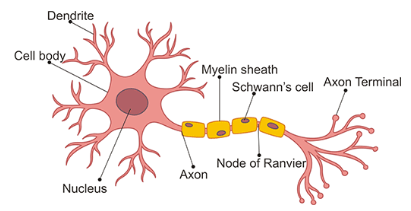
classifications of neurons
- classification based on
- appearance
- function
- motor sensory interneuron
molecular biology primer
- DNA (deoxyribonucleic acid)
- double stranded molecule
- located in nucleus of most cells
- stores genetic info
- rna (ribonucleic acid)
- single stranded molecule
- located throughout cell
- involved in coding, decoding, and regulating gene expression
- protein
- large biomolecules, long string of amino acids
- important for cellular structure (ex. cytoskeleton) and function (ex. enzymes)
- made based on DNA genetic code that is transported via mRNA
- nucleotides
- DNA
- Guanine (G)
- Cytosine (C)
- Thymine (T)
- Adenine (A)
- RNA
- Guanine (G)
- Cytosine (C)
- Uracil (U)
- Adenine (A)
- Replication
- process of duplicating DNA
- occurs in the nucleus
- steps
- helicase unzips the dna strand
- DNA polymerase adds new nucleotides to the unzipped strand
- all copying of DNA is complimentary
- GCAGTC → CGTCAG
- Transcription and translation
- transcription : DNA copied into messenger RNA (mRNA)
- occurs in Nucleus
- RNA polymerase adds new base pairs during mRNA transcription
- mRNA transports genetic info
- translation: mRNA read and assembled into protein
- occurs in cytoplasm
- ribosomes read mRNA and create amino acid sequence
Discussion 2
- operational definition of free will
- no external control or cues affect occurrence or emergence of voluntary act
- subject feels that they wanted to complete the voluntary act, on their own initiative, and feels control over what is being done and when to do it, or not
- readiness potential (RP)
- also called bereitschaft potential
- slow electrical charge detectable prior to the performance of a self-paced, voluntary act
- shows when brain has decided to act
- Kornhuber and Deecke (1965): First to observe \n RP
- Occurred up to one second before \n movement
- In this study, subjects had to act within a \n 30 second timeframe
- Different about libets experiment
- Libet defined free will/voluntary movement \n under the constraint that there should be no \n external control or cues to affect occurrence or \n emergence of the voluntary action
- Subject should feel that they wanted to act, of \n their own initiative, that they are in control
- Based on this, Libet removed the 30 \n second time restraint
- actions without readiness potential
- tourettes
- quick reactions to unwarranted stimuli
- determinism
- all events are fully determined by natural laws that govern the activities of nerve cells in the brain
- monism
- non-determinism
- conscious will may exert effects not in accord with physical laws
- dualism
- methods
- EEG to measure readiness potential (RP)
- EMG to record movement
- wrist flick or flexion
- 9 subjects
- 40 trials per subject
- NOT TIME CONSTRAINT TO MOVE
- libets conclusions
- Voluntary movement is initiated \n unconsciously, but this does not mean there is \n no free will
- Even though actions are started unconsciously, \n they can be stopped consciously
- roughly 100msec window to veto actions
- 50msec before action is too late
- no definitive proof of determinism or non-determinism, but we feel like we have free will, so we might as well believe we do until proven otherwise