Ch. 5.1 Nuclear Chemistry
Radioisotope
A radioisotope
is an isotope of an element that emits radiation
can be one or more isotopes of an element
includes mass number in its name
The atomic symbol of iodine-131, a radioisotope used in the diagnosis and treatment of thyroid disorders, has a mass number of 131 and an atomic number of 53

Natural Radioactivity
Radioactivity comes from unstable nuclei, which are
found in carbon, hydrogen and elements with atomic numbers 20 and higher
defines as nuclei in which the nuclear forces cannot offset the repulsions between the protons
radioactive, emitting small particles of energy called radiation to become more stable
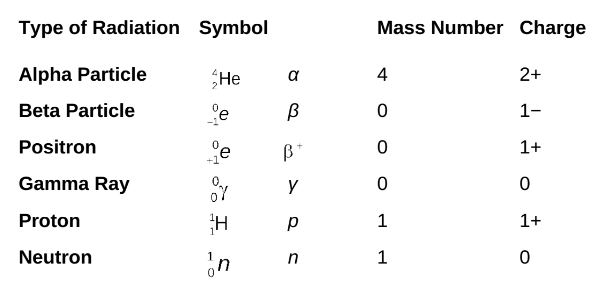
Radiation may take the form of
Alpha (α) particles
Beta (β) particles
Positrons (β+)
Gamma (γ) rays (pure energy)
Stable vs. radioactive isotopes:
Stable isotopes do not decay.
Radioactive isotopes decay and emit radiation.
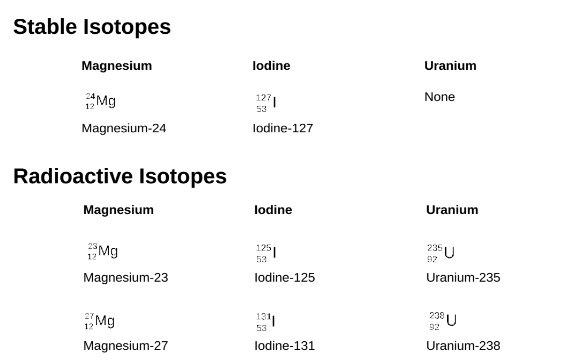
Types of Radiation
Emitted radiation types:
Alpha particles (α): identical to a helium nucleus.
Beta particles (β): high-energy electrons.
Positrons: positively charged electrons (β+)
Gamma rays ( ) pure energy, no mass or charge
Quick identifiers:
Alpha, Beta, Positron, Gamma.
Some Forms of Radiation
Biological Effects of Radiation
Ionizing radiation strikes molecules in its path and
knocks away electrons in molecules, forming unstable ions such as H2O
causes undesirable chemical reactions
damages the cells most sensitive to radiation, rapidly dividing cells in bone marrow, skin and reproductive organs, thus causing cancer
Radiation Protection
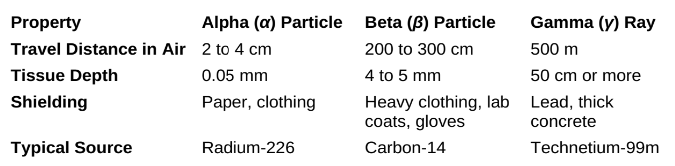
Radiation protection requires
paper and clothing for blocking alpha particles
a lab coat or gloves for blocking beta particles
dense shielding such as lead or concrete to block gamma rays
for those working in an environment where radioactive materials are present, exposure should be limited by
minimizing the amount of time spent near a radioactive source
increasing the distance from the source
Properties of Radiation
Additional notes on safety, relevance, and context
The content emphasizes practical safety in clinical settings where nuclear medicine is used.
Ethical and practical implications include responsible handling of radiopharmaceuticals, minimizing patient and worker exposure, and adhering to regulatory guidelines for radiation protection.
The material connects to foundational principles of nuclear physics: emission processes, particle types, and shielding design based on penetration depth and interaction with matter.