Evidence for Evolution
Core Lines of Evidence (4 Records)
Artificial Selection
Fossil Record
Anatomical Record (homology, development, vestiges)
Patterns of Distribution (Biogeography)
Molecular Record
Artificial Selection (Human-Directed Evolution)
Plants independently domesticated on every major continent.
• Maize (N. America)
• Wheat/Barley (Europe, Asia)
• Rice (Asia)Wild rice- chewy, long spiky thorns and harder casing. Domestic rice came from the fact people were harvesting and eating the longer spiked corn while only planting the shorter spiked rice. We did this without knowing anything ab genetics.
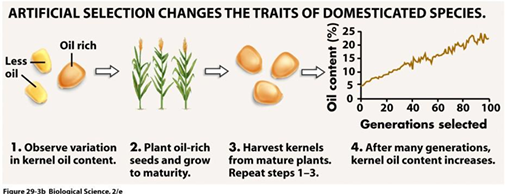
Quantitative‐Trait Selection experiment (kernel-oil lines of maize)
Measure variation (starting mean oil).
Replant highest-oil seeds.
Repeat generations.
Result: oil content climbs toward ; low-oil line drops toward .
• Demonstrates heritability and response to selection (Darwin’s mechanism in “real time”).
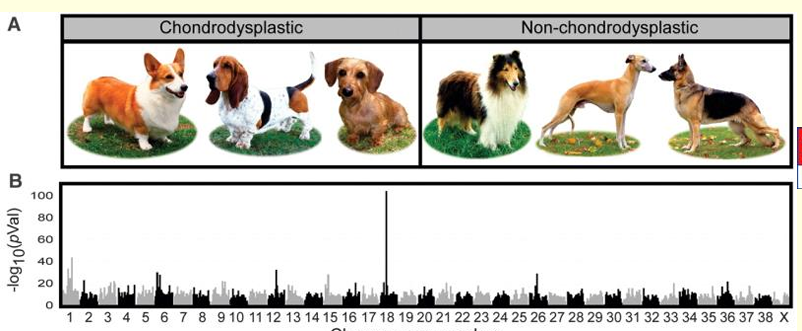
Wolves are taller (non-chondrodysplastic.) You can get chondrodysplastic dogs by picking out the shortest puppies in the litter, shorter dogs are better for getting rid of vermin and dig quickly. Terriers are the ultimate mice killers, corgis are good for herding cattle.
Dog Breeds: extreme morphological diversification in yr.
• Whole‐Genome Association pinpoints chondrodysplasia (short legs) to two SNP peaks on chromosome 18; phenotype linked to ectopic expression of .
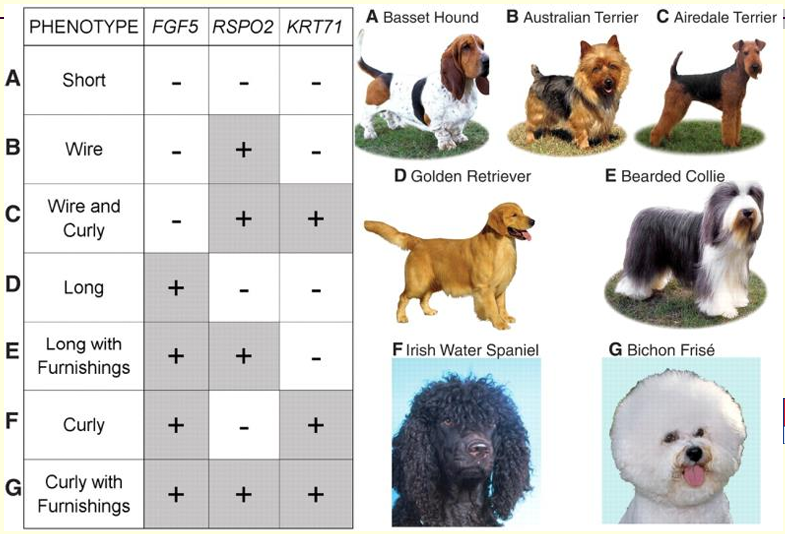
• Coat variation governed by only three genes: (wire hair/ furnishings), (hair length), (curl).
• Example of complex phenotypes reducible to a handful of allelic combinations—underscores power of small mutational changes.
Fossil Record
Principle: when fossils are arrayed stratigraphically (old → young) a progressive morphological series emerges.
Rarity of Fossilization
• Soft tissues decay; specific sediment, pressure, mineralization required.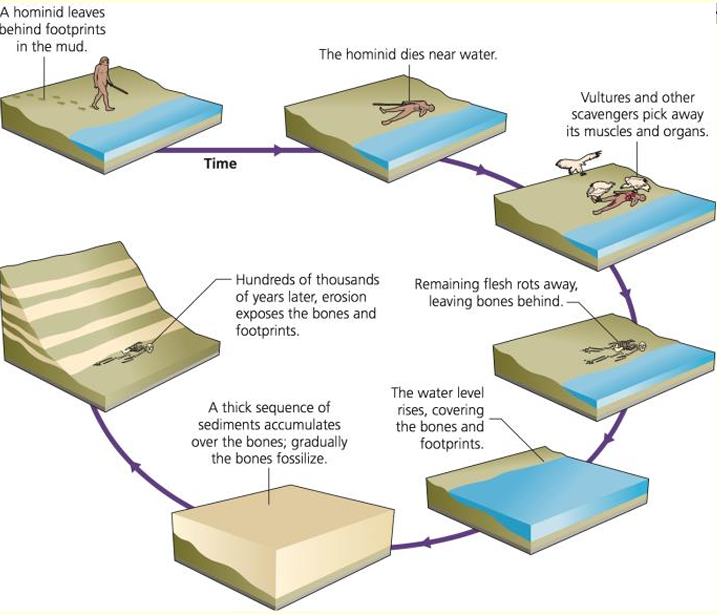
Or if you are buried or die in a cave, since you’re not exposed to the elements.
Water species usual fossilize in sedimentary rock after underwater mud slides, and the water then needs to recede.
Horses have a great fossil record.
They were tiny and forest dwellers, small molars, and had five toes. They ate leafy greens instead of grass, until something happened to their climate. During the Hypohipus period, forests began drying out and grasslands replaced them. Greyhound sized horses could not see predators in tall grasslands, the taller ones survived and were able to reproduce. They lost their toes when they started running faster and on their toes more often.
Transitional Forms
• Horse lineage: gradual trends in body size, limb digit reduction (4 → 1), molar crown height increase—tracks shift from forest browsing to grassland grazing.
• Tiktaalik (≈): fish‐amphibian transitional mosaic; limb bones homologous to tetrapod humerus/radius/ulna; discovered 2004 Ellesmere Island.
• Demonstrates predictive power—paleontologists hypothesized correct time & environment before discovery.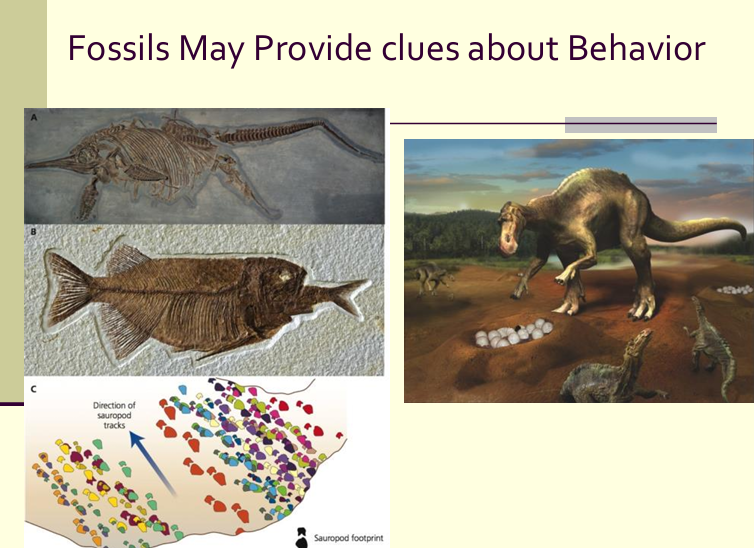
Behavioural Inference
• Dinosaur nesting sites, bite marks, trackways. Were they communal? Or individual?
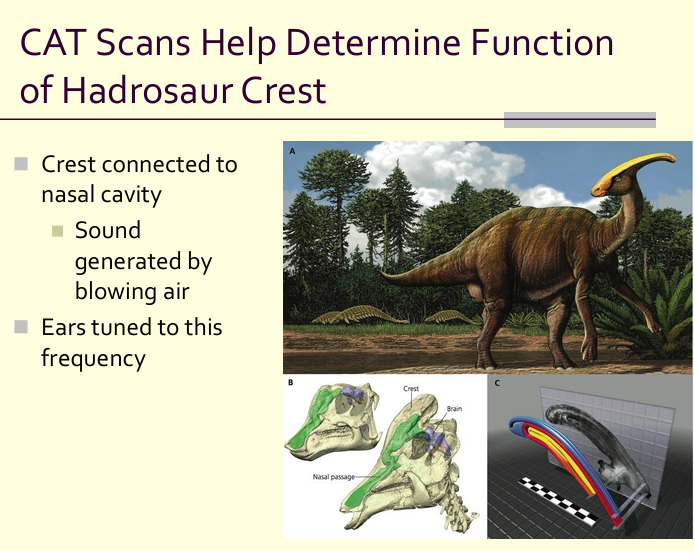
• Hadrosaur crest investigated via CT; internal tubes connect to nasal cavity—likely resonating chambers; auditory bullae tuned to generated frequency—example of functional interpretation.The fish ate fish, inferred from the image above.
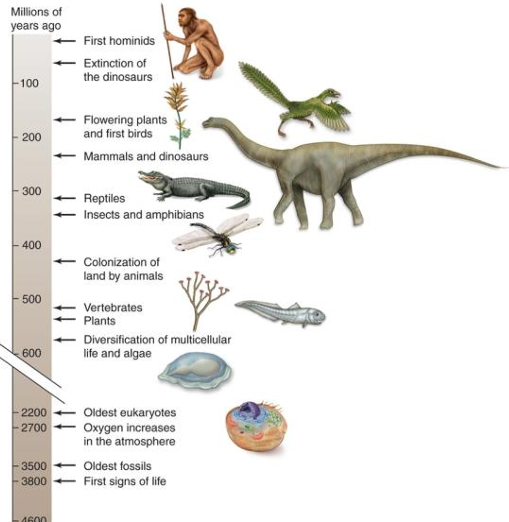
We should be able to see how we developed from single cell to multi cellular creatures when we study fossils.
Sexual diamorphism, top female, bottom female.
Anatomical Record
Homology vs Homoplasy
Homologous trait: similarity due to common descent.
• Example: hair unites all mammals; inherited from mammalian ancestor.Homoplastic/Analogous trait: similarity without common descent; arises via solving a similar problem in the same way.
• Example: bird wings vs bat wings—independent acquisition of powered flight.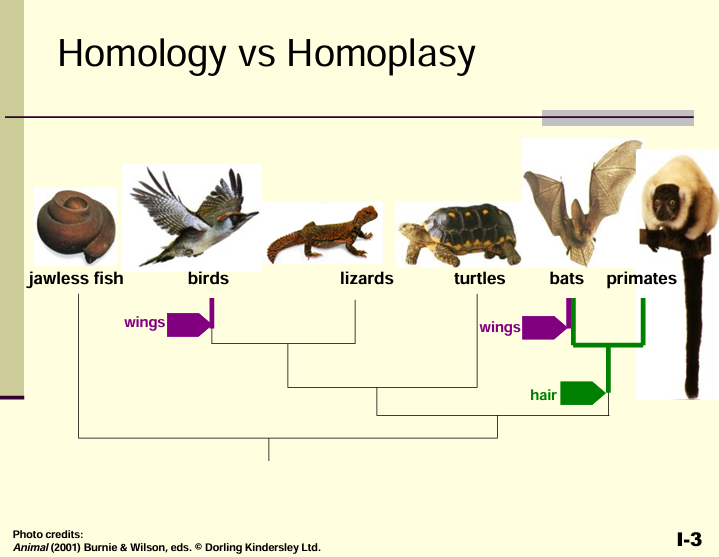
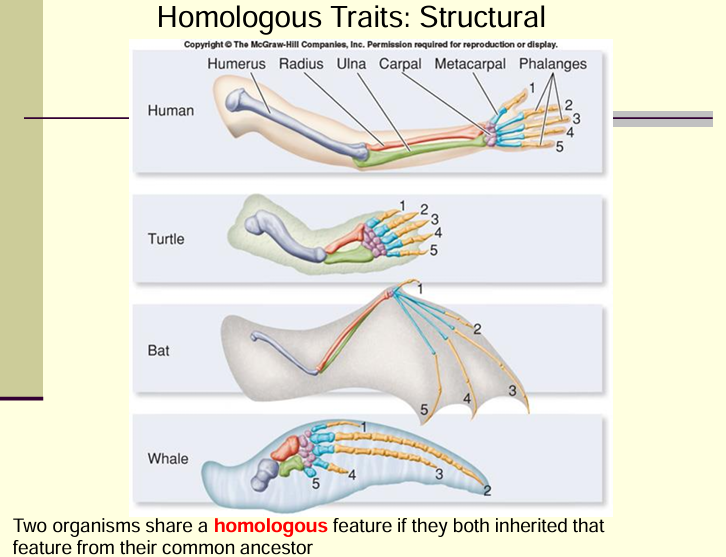
Major Structural Homologies
Limbs from fins: lobe-finned fish pectoral girdle bones map to early tetrapod humerus–radius/ulna structure.
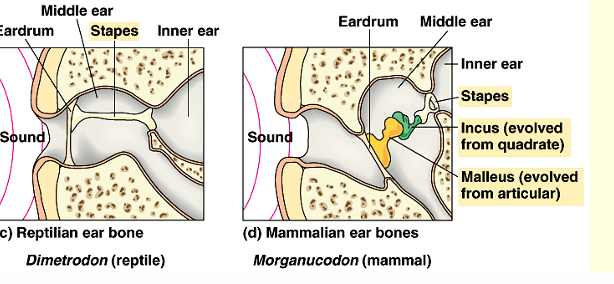
Jaws from gill arches: first pharyngeal arches of agnathan fish remodeled into vertebrate mandible & maxilla.
Serial homology inside lineages (e.g.
• Vertebrate forelimb diversified to bat wing, human arm, whale flipper, horse leg).
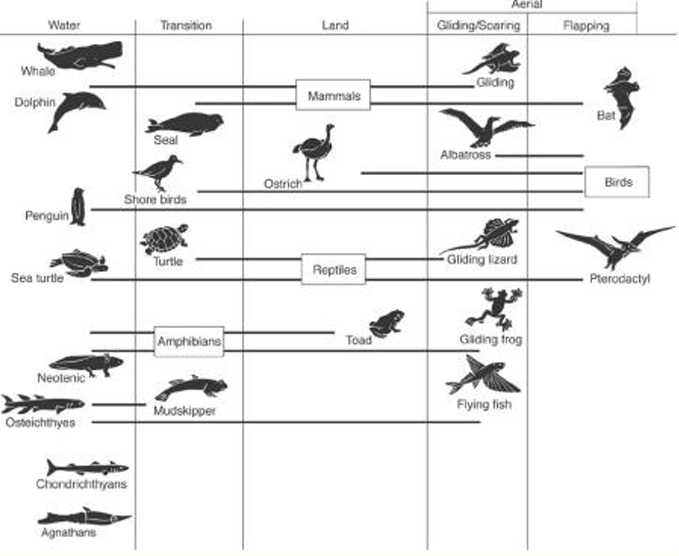
Convergent Design (Analogous)
Organisms in similar environments (water, sky, desert) evolve similar body plans despite distant ancestry.
• Provides natural “replicates” testing adaptive hypotheses.Aquatic animals all look for a torpedo shape for less drag in the water.
Comparative Embryology & Development
Embryos reveal hidden homologies lost in adults: pharyngeal pouches → fish gills, mammalian Eustachian tube.
“Ontogeny does not strictly recapitulate phylogeny” but early stages show conserved developmental modules.
Genetic basis: HOM/Hox genes (possess a -bp homeobox) specify anterior–posterior patterning across Bilateria.
• Protein products are transcription factors; nearly identical DNA-binding domains in insects and vertebrates.
• Gene duplications create paralogous clusters, reducing lethality of single mutations (developmental robustness).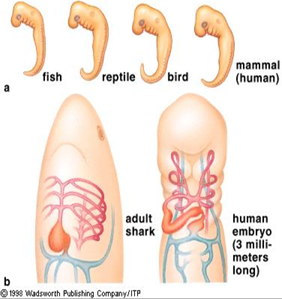
Regulatory Gene Evidence
Conserved expression gradients of transcription factors in flies ↔ mice—supports deep homology of body-plan toolkit.
Comparative Embryology ◼Embryos do demonstrate recapitulation of phylogeny ◼They make rapid leaps in development ◼So what controls the patterning of embryos
Vestigial & Atavistic Features
Vestigial: reduced or repurposed remains of ancestral structures.
• Whale pelvic girdle & residual hind limbs.
• Boid & python pelvic spurs (former limbs).
• Human appendix (ancestral cecum for cellulose digestion); today minor immune role.Atavism: re-expression of ancestral trait by developmental glitch.
• Horse fetuses occasionally develop extra toes; humans rarely with post‐anal tail.
• Confirms latent genetic/developmental pathways inherited from ancestors.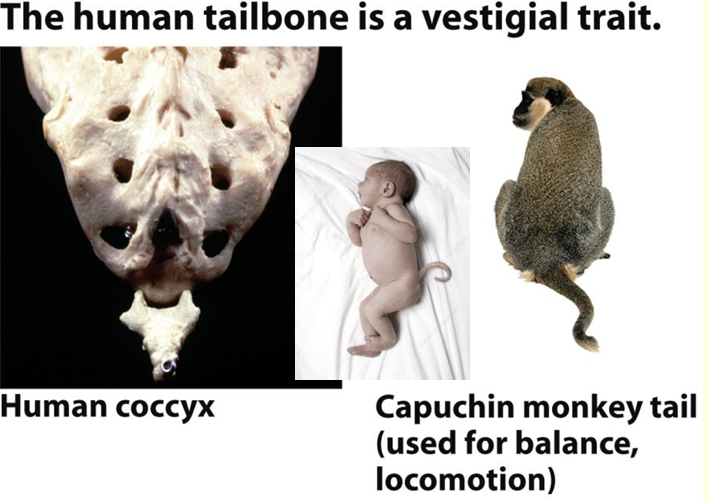
Happens when genes activate incorrectly or failed to be inactivated properly
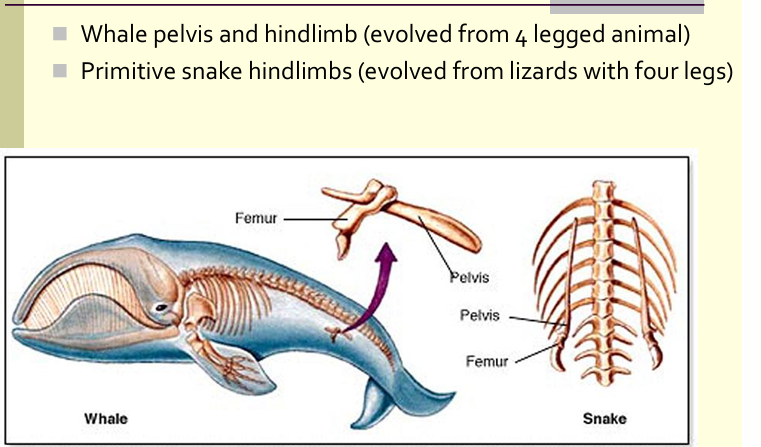
Cobras can “stand” up due to their pelvis, they keep it because its advantagous
Biogeography (Patterns of Distribution)
Definition: study of spatial distribution of organisms, past & present.
Oceanic islands: endemic species resemble nearest mainland relatives; implies colonization followed by divergence (e.g., Darwin’s finches, though not explicitly in slides).
Continental break-up example: Allosaurus widespread on Pangaea; isolation produced Giganotosaurus (S. America), Carcharodontosaurus (Africa), Acrocanthosaurus (N. America).
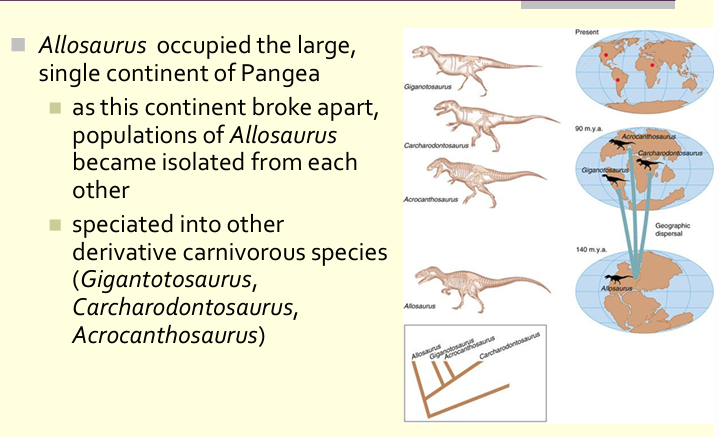
Same species on multiple continents explains former land bridges (Beringia, Gondwanan links).
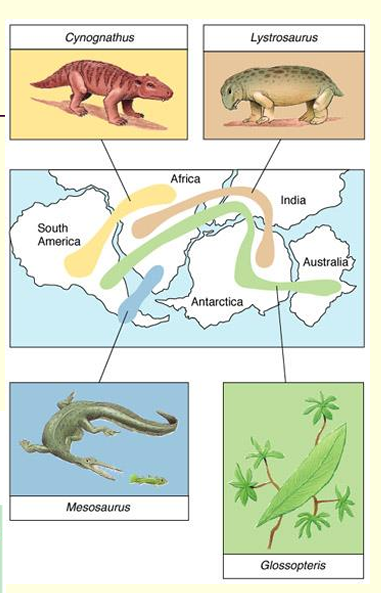
Wallace Line video: sharp faunal turnover between Bali & Lombok reflects deep-water barrier even during glacial low sea levels.
Darwin did not know about molecular record or genes at the time so he did not use this as evidence.
Molecular Record
When we know how many molecular mutations have occurred, we can decide a molecular clock.
General Principle
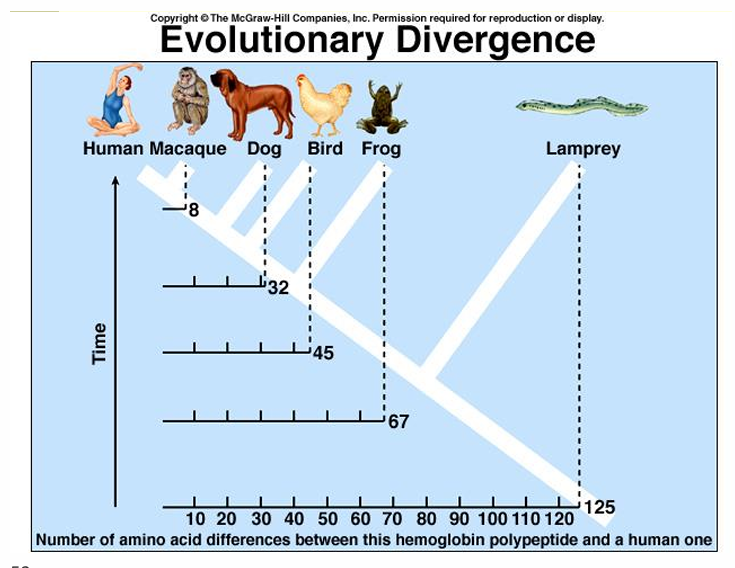
The longer two lineages have been separated, the more DNA or protein differences accumulate (molecular clock).
• Provides an independent timescale that largely agrees with fossil dates.
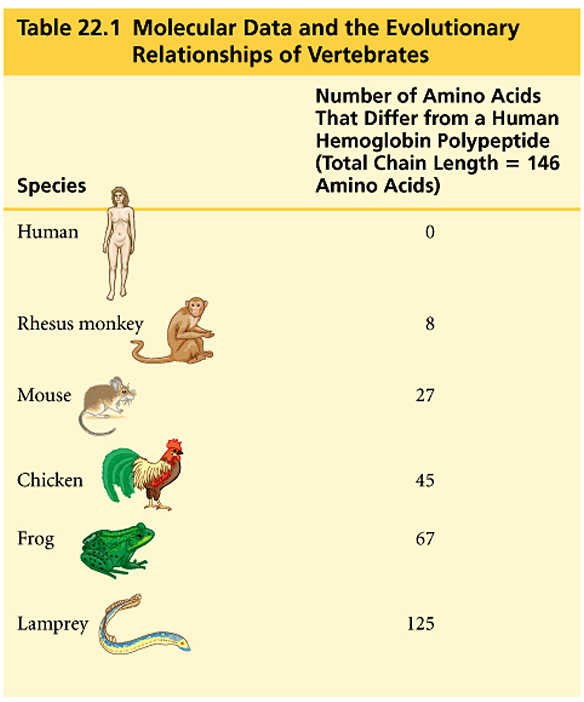
Hemoglobin Example
Amino-acid differences (out of residues in -chain) relative to human:
• Rhesus monkey
• Mouse
• Chicken
• Frog
• Lamprey
Plot of differences vs divergence time shows near-linear trend.
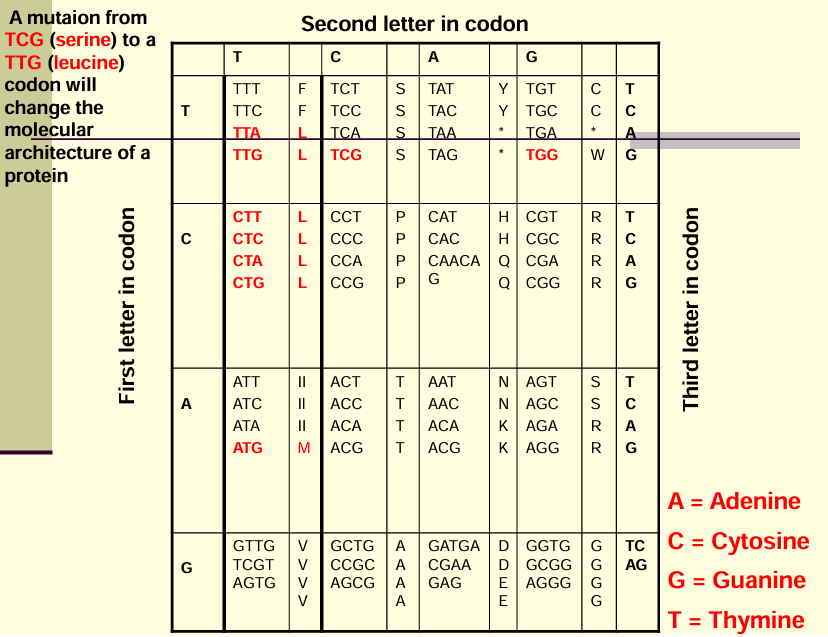
Neutral mutations vs ones with impact.
Genetic Code & Mutation Consequences
Standard codon table: e.g. , .
• Point mutation can change amino-acid chemistry, potentially altering protein architecture/function.
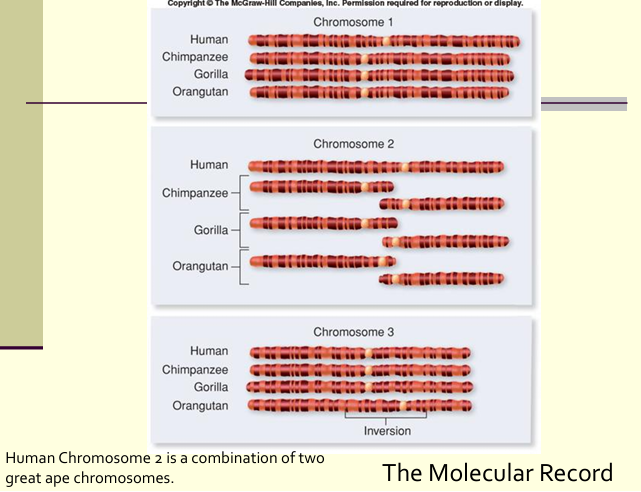
Chromosomal Evidence
Human chromosome 2 = fusion of two ancestral ape chromosomes; retains inactivated telomere repeats at internal junction and vestigial centromere → clear cytogenetic signature of common ancestry with other great apes (who keep them separate).
Gene Duplication & Brain Evolution
locus: ancestral single copy duplicated three times → paralogs .
• promotes spine maturation; delays maturation, increasing spine density—hypothesized neuronal plasticity boost in hominins and Neanderthals.
• Illustrates how duplication plus neofunctionalization can drive major phenotypic innovation (complex cognition).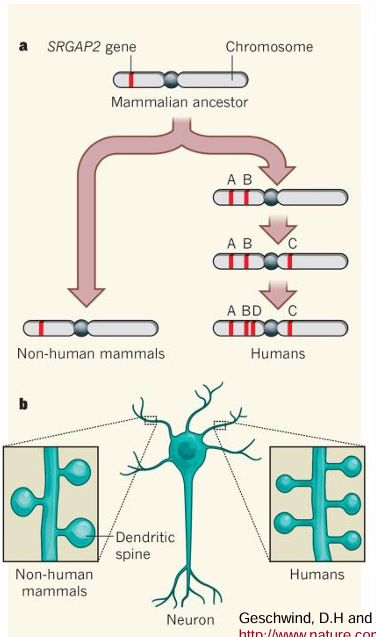
Our brains did not get bigger first, the mutation occurred first, so we know that even though we split earlier our brains didnt develop to be larger until later.
Synthesis / Big-Picture Takeaways
Multiple independent datasets (artificial breeding, fossils, anatomy, development, genes, geography) converge on the same historical narrative: life shares common ancestry and has diversified through descent with modification.
Ethical/Practical Implications
• Understanding artificial selection guides crop improvement & dog health.
• Recognizing homology informs medical research (e.g., mouse models).
• Awareness of molecular clock underpins pathogen tracking (influenza, HIV).Evolutionary theory is not a hypothesis resting on a single line of evidence but an integrative framework tying together disparate observations across biology and geology.
Evolution has a wealth of evidence supporting it from a variety of different fields: ◼ Human’s own history of altering feed animals and crops
◼ Paleontological evidence from fossils, particularly transitional fossils
◼ Similarity of structures arising from the same tissue origins
◼ Conservation of genes controlling developmental processes throughout the animal and plant worlds
◼ Distribution of animals on islands and continents
◼ Molecular record showing genetic rearrangements