What is soil?
Soil is a thinlayer of material on the Earth’s surface
It’s a very important naturalresource
Soil composition
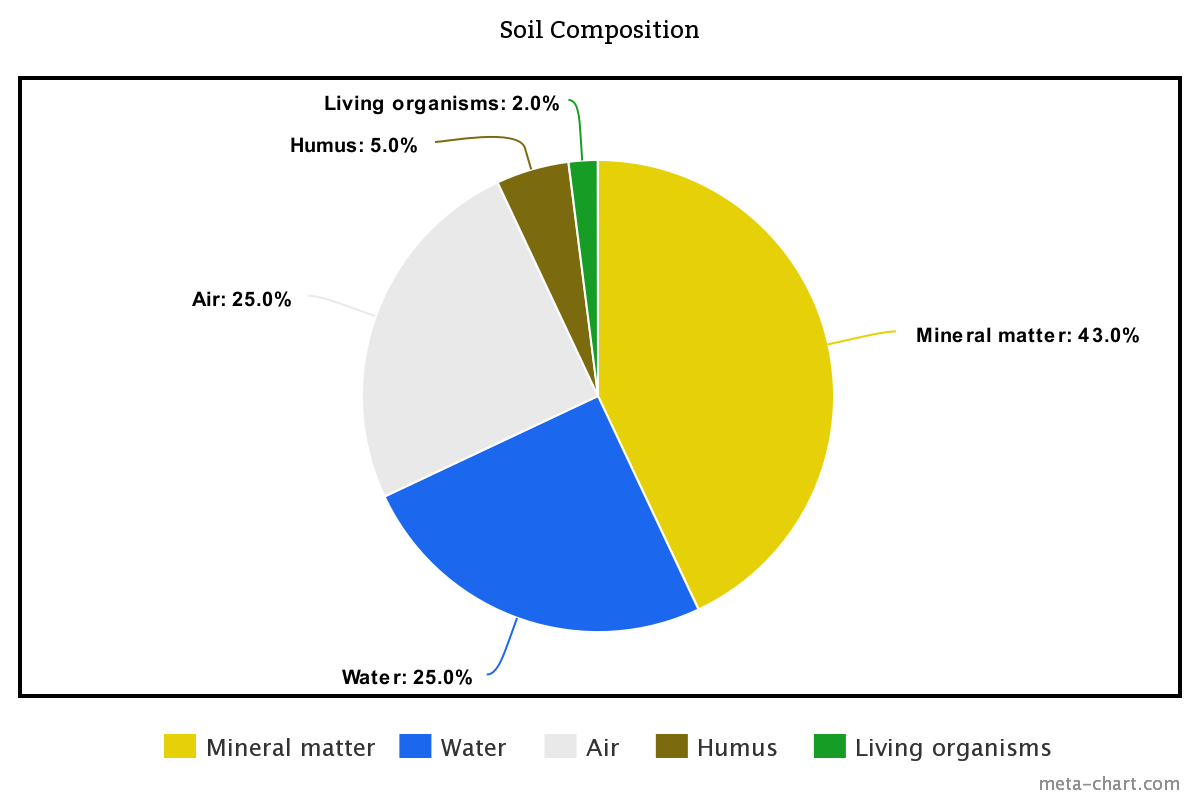
- [[Mineral Matter[[
- ]]Air]]
- {{Water{{
- }}Humus}}
- <<Living organisms<<
[[1. Mineral Matter[[
- Mainingredient in soil
- Weathered and eroded rockparticles
- Provides minerals to help plants grow
]]2. Air]]
- Fills spaces between rock particles
- Air contains oxygen and nitrogen
- plants need this to survive
- Needed by livingorganisms
{{3. Water{{
- Helps to bind soil
- Dissolvesminerals so plants can absorb them
}}4. Humus}}
- Forms when animals and plants decay and rot
- Jellylikesubstance
- Provides nutrients
- Makes soil fertile
<<5. Living Organisms<<
- Earthworms
- Bacteria
- Fungi
- Insects
- Burrowinganimals
- Mixup the soil
- Allow air and water to pass through the soil
- Breakdown plants and animals => organicmaterial
Soil texture
- What the soil feels like
- Three groups:
- sand
- silt
- clay
- Particles of sand => largest
- Particles of clay => smallest
Soil profiles
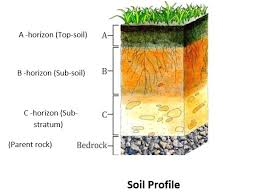
O Horizon
This layer contains organicmaterial. Lots of plantlitter (leaves and rotting vegetation) which provides humus for the soil
A Horizon
Upper layer of soil also known as topsoil. Where most of the livingorganisms live. It’s darker as it has the highesthumuscontent, meaning it’s also the mostfertile
B Horizon
Also know as subsoil. Lighter in colour as it contains less humus however there is more stones as it is located closer to the bedrock
C Horizon
This layer is called bedrock or parentmaterial. The lowersection is solidrock but the topsection may be broken into rockparticles
Leaching
- Water passes through the soil when it rains
- This washes minerals, humus and nutrients from the Ahorizon to the Bhorizon
Most plantroots are located in the A horizon, plants can’t access the minerals, humus and nutrient that are in B horizon which can affect their growth
In extremelywetconditions minerals buildup between the two horizons. It becomes cemented together to create an impermeablelayer. Water can’t flow through making the soil above waterlogged
Brown Earth soils
- Most common soil type in Ireland
- Lowland areas
- Formed on boulder clay that was glacially deposited
- Loam => even mix of sand, silt and clay
- Ideal for crops
- Deciduous forests
- Lots of humus => fertile
- Very little leaching
Influence of soil on vegetation
Depth
- Deep fertile soils => support a widevariety of crops => highnutrientcontent
- Shallow infertile soils => limited type of vegetation
Acidity
- Some plants such as rhododendrons grow in acidicsoil
- Notmany plants grow in acidic soil
- Lime => spread on land => reduceacidity => increasefertility
Drainage
- Clay soil => easily waterlogged => difficult to cultivate
- Sand soils => welldrained => support a widerange of crops
Influence of vegetation on soil
Plant litter
- Vegetation => plantlitter => humus => fertile soils
- Soil under deciduous trees are morefertile because there is moreplantlitter
Soil erosion
- Bind and protects soil from massmovement
- When the vegetation is lost it becomes vulnerable to erosion
Leaching
- Vegetation acts as an umbrella against rain
- Lesswatergetsintothesoil => lessleaching
Human interference with soil
1. Deforestation
Cutting down of trees for economicpurposes
Two major effects:
- Removal of trees reducesplantlitter => soillosesfertility
- Exposure of soil can lead erosion, flooding and massmovement
- Flooding:lowlandareas
- Massmovement:Uplandareas
==Solution==: Forestmanagement and reforestation (plant of trees)
2. Intensive farming
Lead to desertification => expandingofdesert
==Example==: The Sahel
- Over-cropping
- Crop continuously grown on land => nutrientsremoved => soil becomes exhausted
- Mainly by monoculture (1 type of crop) and cashcrops
- Example: coffee or cotton
- ==Solution==: Carefulmanagement and crop−rotation
- Overgrazing
- Toomanylivestockonapieceofland => intensivegrazing => vegetationandrootsdestroyed
- Soil is left open and vulnerabletoerosionandweathering
- ==Solution==: changingfarmingpractices and education