Understanding China's political system
Introduction
China’s position:
world’s second-largest economic power
one of five permanent members of the United Nations Security Council
the only Communist Party-led state in the G-20 grouping of major economies
The Chinese Communist Party (CCP) has been in power since 1949 (76 years)
China’s political institutions and political culture have evolved significantly over those decades - explains why it has avoided its fate so far
Committed to maintaining a permanent monopoly on power ←→ neither monolithic nor rigidly hierarchical
leaders and institutions representing different sets of interests is common at every level of the system
One test of a political system is its ability to manage political transitions
November 2012 - Communist Party Politburo member and Chongqing Municipality Party Secretary Bo Xilai fell from grace, exposing at least one serious rift in the leadership
Many have questioned the long-term viability of China’s current political system, in which the Party remains above the law
retired Premier, Wen Jiabao, called for political reform, including reform of “the leadership system of the party and the state,” warning that, “Without the success of political structural reform, it is impossible for us to fully institute economic structural reform. The gains we have made in reform and development may be lost, new problems that have cropped up in China’s society cannot be fundamentally resolved and such historical tragedy as the Cultural Revolution may happen again”
December 2012 - Xi Jinping called in for full implementation of China’s state constitution and declared that, “No organization or individual has the special right to overstep the Constitution and law, and any violation of the Constitution and the law must be investigated.”
also repeatedly mentioned the need for the Party to police itself, rather than allowing any outside body to do so
January 2013 - he urged Party organizations and members to abide not by the state constitution, but rather by the Party’s constitution, a separate document
Overview of China’s Political Institutions
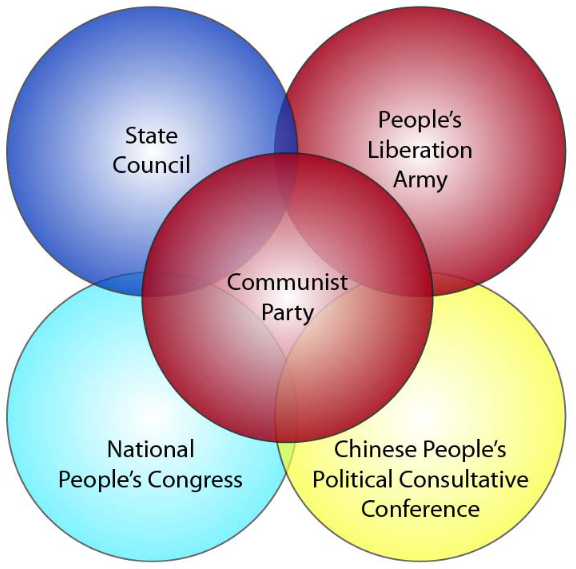
The Chinese Communist Party dominates state and society in China
Four pillars:
People’s Liberation Army (PLA) 2,25 million people (1,5 million from the People’s Armed Police, 800k internal security forces)
State Council (implementation of its policies and day-to-day administration of the country, the top State officials at every level of administration usually concurrently hold senior Party posts, to ensure Party control)
National People’s Congress (NPC) (oversees the State Council, as well as four other institutions: the Presidency, the Supreme People’s Court, the public prosecutors’ office, and the military, most significant power is its ability to initiate and shape legislation)
Features of China’s Formal Political Culture
Collective leadership
No supreme leader since the death of Deng Xiaoping
The Communist Party’s Politburo Standing Committee (PSC),11 form a collective leadership in which each man has a rank, from one to seven, and shoulders primary responsibility for a specific portfolio
The collective leadership feature of the Chinese political system is designed to guard against a repeat of the excesses of the era of the PRC’s founding father, Mao Zedong, when a single outsized leader was able to convulse the nation with a series of mass political campaigns
The Military as an Armed Wing of the Communist Party
an armed wing of the Communist Party, with the Party’s exercise of “absolute leadership” over the military a fundamental guarantee of Communist Party rule, not a national army belonging to the state
Xi escribed obeying the Party’s command as “the soul of the military” and the military’s ability to engage in combat and win battles as a “top priority.”
A major tool for Party control of the military is the General Political Department (GPD) - one of the four “general departments” of the PLA headquarters
responsible for political training and military personnel matters, including management of personnel dossiers, promotions, and job assignment
GPD political commissars serve side-by-side with military commanders at all levels of the PLA, and head the Party committees in all PLA units - almost all PLA officers are Party members
Scholars and others in China have sometimes broached the possibility of strengthening the PLA’s institutional ties to the State by “de-politicizing” it, or “nationalizing” it - the Party has repeatedly rejected such notions
The Legislature: Strong on Paper, Weak in Practice
unicameral legislature, the National People’s Congress, as “the highest organ of state power.” (1982 constitution). The constitution gives the NPC the power to amend the constitution and many other powers, but in reality, the NPC exercises many of those powers in name only
The NPC’s role is simply to ratify the Party’s decisions at “electing” top state officials
Some analysts see a related reason for the NPC’s weakness in the dual identity of most of its deputies and the way they are “elected.” The Party nominates all candidates for positions as deputies, usually nominating 20% to 50% more candidates than available positions
85% of the current NPC’s nearly 3,000 deputies hold concurrent posts as Communist Party or state officials or civil servants
As a guarantee of Party control of the legislature, a member of the Party’s seven-man Politburo Standing Committee serves concurrently as chairman of the NPC Standing Committee
The Power of Provincial Governments
Provincial leaders are powerful players in the Chinese political system - Six of them, all Party Secretaries, sit on the Party’s Politburo, making them among the 25 most powerful officials in the country
Outreach to provincial leaders has become an important element of U.S. policy toward China as a consequence of the 2011 inauguration of a U.S.-China Governors Forum
Levels of administration (4 levels)
34 provincial-level governments
more than 300 prefectural-level administrative units, including prefectures and prefectural-level cities - regular prefectures have administrative agencies instead of political structures that mirror the central government
nearly 3,000 counties and county-level cities
approximately 40,000 townships and towns
Central government ministries have bureaus in the provinces, but they report both to their ministry in Beijing and to the provincial leadership. When priorities are in conflict, the leaders of such bureaus tend to put the provincial leadership’s interests first
Document-Based Culture
The statements of individual leaders are almost always less authoritative than documents approved by the collective leadership, with the most authoritative documents being those approved by the Communist Party Central Committee
Heavy reliance on paper documents
In the U.S.-China relationship, the great store China places in documents helps explain why the Chinese side has pushed so hard for the issuance of a series of detailed joint statements between the two countries
The Importance of Ideology
Ideology matters more in China than in many other political systems
In 2007, China finally passed a law protecting private property rights ←→ public ownership (constitution)
The Ideal and Reality of Meritocracy
An important element of the Communist Party’s bid for ideologically based legitimacy is the notion that people rise within the Party or State hierarchy based on what the Party constitution describes as “their moral integrity and their professional competence,” and “on their merits without regard to their origins.”
A detailed 2012 study found no evidence of a correlation between rank in the Communist Party hierarchy and success in delivering “exceptional economic growth” - however, the Party awarded promotions based on factional ties, familial ties to senior leaders, and educational qualifications
Age and Term Limits for Official Positions
Introduced beginning in 1997, enforcement of age and term limits for top Party and State positions has brought a degree of predictability
no one older than 67 was appointed or reappointed to the Politburo Standing Committee or the broader Politburo. In 2012, the Party extended that age limit to all members of the Central Military Commission
ministers, provincial Party Secretaries, and governors cannot be older than 62 when appointed to new terms, and have a retirement age of 65
all top officials are limited to two five-year terms in the same posts
Penchant for Long-Term Planning
The Chinese political system places a heavy emphasis on long-term planning