Lecture 2: History, Psychodynamic & CBT
Please note that the first half of the lecture looking at history is merely to provide a broader context and you shall not be directly examined on these topics.
Defining Psychopathology
1. Deviation from Statistical Norms: Thoughts, behaviours or characteristics that are statistically unusual compared with the general population.
2. Deviation from Social and Political Norms: Thoughts or behaviours that differ from what society considers normal, appropriate or acceptable.
3. Maladaptive Behaviour and Harmful Dysfunction: Thoughts or behaviours that interfere with everyday functioning or cause harm to oneself or others.
4. Distress and Disability: Psychological experiences that cause significant personal distress or impair an individual's ability to function in everyday life.
Key takeaway: No single definition adequately captures psychopathology. Clinical psychologists consider multiple factors, including context, distress, functioning and potential harm.
History of Mental Health
Neanderthals (Homo neanderthalensis) 400,000–40,000 years ago (YA). ~40,000 YA: Neanderthals disappeared as a distinct population, potentially due to a combination of climate change, small population sizes, competition and assimilation into Homo sapiens populations.~300,000 YA: Homo sapiens first emerged in Africa, gradually developing increasingly complex social behaviours, symbolic thought and cultural traditions.

Ancient times - Mesopotamia
• ~3000–500 BCE: Mesopotamians often understood mental illness through supernatural explanations, including the influence of gods and spirits. • The “hand” of a deity: Certain symptoms were attributed to particular gods, whose influence could cause illness or unusual behaviour.• Treatment: Healers combined spiritual rituals, prayers and offerings with practical remedies to alleviate suffering. ‘Ishtar’ god of love, war, fertility ‘shamash’ sun god
Ancient times - Egypt
• Mental illness was sometimes explained by supernatural forces and treated with spells and rituals. • Temples: Important centres for healing, sometimes involving medicinal drinks and psychoactive substances. • Early medicine: Physicians also used observation and practical treatments.
The Edwin smith papyrus 1600 BCE – oldest known text on trauma and brain injuries
Ancient times - India
• Early texts: Descriptions of depression and anxiety in the Ramayana and Mahabharata. • Causes: Gods, spirits, witchcraft and supernatural forces. • Physical causes: Imbalances in bodily fluids, poor diet and illness. • Psychological causes: Fear, emotional shock and excessive joy. • Treatments: Herbs, ointments, prayers, charms and emotional support.
Image is of the ‘Charaka Samhita’ 1st-millennium BCE, a key text in Indian traditional medicine (Ayurveda) Life is of four dimensions: Sukha (happy), Duhkha (unhappy), Hita (good) and Ahita (bad).
Ancient times - China
• Emotions were believed to be connected to specific bodily organs. • Causes: Excessive emotions and emotional shock could cause illness. • Some mental disturbances were also attributed to spirits or demonic possession.
African traditions
• Ancient Nubia (modern Sudan): Healing traditions combined herbal medicines, religious rituals and spiritual explanations of illness. • Ethiopia and the Horn of Africa: Early healing traditions included medicinal plants, spiritual practices and religious approaches to suffering.
Ancient times – Greece and Rome
Socrates (470 – 399 BC) Recognised potential positive aspects of madness, including creativity, love and divine inspiration Hippocrates (~460–370 BCE): Classified mental disorders, including mania, melancholia and paranoia. Asclepiades (~124–40 BCE): Promoted humane treatments, including diet, exercise and massage. Treatments: Diet, medicines, bloodletting, talking therapies and religious rituals, but also restraints and harsh physical punishments.The four ‘Humors’. Stoic philosophers: Believed that emotional distress arises from how we interpret events, rather than the events themselves…
Middle ages – Muslim world
Islamic Golden Age (~8th–13th century CE) • Islamic scholars preserved, translated and expanded ancient Greek medical knowledge. • Ibn Sina (Avicenna, 980–1037): Emphasised diet, lifestyle and prevention, alongside medication when needed. • Haly Abbas (10th century): Advocated diet, exercise and other non-drug approaches to treating illness, including mental disorders. • Bimaristans (hospitals): Provided organised medical care, including treatment for people experiencing mental illness.
Medieval Europe (~5th–15th century CE)
• Mental illness was sometimes viewed as punishment for sin, a test of faith or demonic possession. • Treatments included prayer, fasting, confession and religious rituals. • Trepanning (drilling a hole in the skull) was also practised, although not necessarily to treat mental illness. • Medical explanations and treatments continued alongside religious approaches
1600s-1800s - Asylums
• Asylums increasingly became institutions for housing people experiencing mental illness. • Conditions were often overcrowded, unsanitary and harsh, with patients sometimes restrained or confined. • Treatment was frequently limited, with an emphasis on containment rather than recovery. • Bethlem Royal Hospital (Bedlam): Founded in London in 1247, becoming one of Europe's most famous psychiatric institutions.
1700s – Improvement of treatment
• Philippe Pinel (1745–1826): French physician who advocated more humane treatment of people experiencing mental illness. • Promoted moral treatment, emphasising kindness, dignity, structured routines and psychological support. • Challenged the widespread use of chains and physical restraints in asylums. • Helped shift psychiatric care towards observation, understanding and rehabilitation.
1700s – ‘Moral therapy’, York Retreat, Tuke Family
• Founded in 1796 by William Tuke (1732-1822), an English Quaker philanthropist. • A small institution in York, initially accommodating around 30 patients. • Promoted moral treatment, emphasising kindness, dignity and humane care. • Encouraged social interaction, meaningful activities and structured daily routines, rather than punishment and restraint. • Became an influential model for reforming psychiatric care in Britain and beyond
1700s – Enlightenment values…almost
• Benjamin Rush (1746–1813): American physician and an early pioneer of psychiatry in the United States. • Promoted the systematic study and medical treatment of mental illness. • However, continued to use bloodletting, purging and physical restraints. • Developed the tranquilizer chair, designed to restrict patients' movement and supposedly calm them. • Illustrates the contradiction between Enlightenment ideals of scientific progress and often harmful treatments.
1800s – Public campaigns for better treatment
• Dorothea Dix: American reformer who investigated the mistreatment of people with mental illness in prisons and asylums. • 1843: Published a powerful report exposing neglect, abuse and inhumane living conditions, campaigning for institutional reform. • Nellie Bly: American journalist who pretended to be mentally ill to gain admission to an asylum. • 1887: Published Ten Days in a Mad-House, exposing abuse and neglect at the Women's Lunatic Asylum on Blackwell's Island, New York. • Impact: Both helped raise public awareness and encourage improvements in psychiatric care
1800s-1950s – Asylums increase
• 19th century: Large psychiatric asylums expanded across Europe and North America. • Miasma theory: The belief that disease spread through "bad air" encouraged the construction of institutions in rural areas, away from crowded cities. • Overcrowding: Many patients remained institutionalised for years or decades, with limited prospects of recovery or discharge. • USA (1950s): Approximately 500,000–560,000 people were living in psychiatric hospitals (today ~60,000). • UK (1950s): Around 150,000–200,000 psychiatric hospital patients, depending on the year and definition used (today ~ 20,000). • Legacy: Growing concerns about institutionalisation and poor conditions helped drive the move towards community-based mental health care.
First World War (1914-18) Large numbers of soldiers experienced psychological trauma, including shell shock. Second World War (1939-1945) Increased demand for psychological treatment and more practical, shorter therapies. NHS (1948) Made mental health treatment more accessible in Britain.
1950s – Medical Model
• Psychiatric medication became increasingly widely used to treat mental illness.
• Many medications were originally developed for other medical conditions.
• New antipsychotics and antidepressants helped manage symptoms.
• Greater emphasis on biological explanations of mental illness.
• Medication helped support the move from asylums towards community care
Antipsychopatics make it easier to manage the patients, but do not solve the problem. It allowed patients to go back to the community.
Lobotomy
• Egas Moniz: Developed the procedure and received the 1949 Nobel Prize in Medicine.
• Walter Freeman: Popularised lobotomies in the USA.
• Tens of thousands underwent the procedure, often with serious and irreversible consequences
. • Abandoned as safer treatments became available. •
Electroconvulsive therapy (ECT)
Introduced in 1938 to treat severe mental illness.
• Still used today, particularly for severe depression.
• Modern ECT is performed under general anaesthesia, with muscle relaxants.
• Use has declined substantially since the mid-20th century.
‘Deinstitutionalisation’ ‘Care in the community’ Medical Model
• Large psychiatric asylums were gradually closed.
• Patients increasingly received treatment and support within the community.
• Greater emphasis on independence, recovery and social inclusion.
• However, community services were often underfunded, leaving some people without adequate support
The “DSM”
• DSM (1952): First published as a manual for classifying mental disorders.
• Helped establish a more standardised approach to psychiatric diagnosis.
• Expanded considerably over time, recognising more disorders and diagnostic categories.
• Widely used by clinicians, researchers, insurers and policymakers.
• Highly influential, but also criticised for medicalising normal human experiences and expanding diagnostic boundaries.
This will be on the exam
Psychodynamic theory
Jean-Martin Charcot (1825-93)
• French neurologist working at the Salpêtrière Hospital in Paris.
• Studied hysteria, including symptoms such as paralysis and seizures.
• Used hypnosis to investigate psychological and physical symptoms.
• Demonstrated that hypnosis could induce, alter or temporarily remove symptoms resembling those of hysteria, including paralysis, loss of sensation and seizure-like episodes.
‘Talking therapy’ arrives! Josef Breuer (1842-1925) Bertha Pappenheim(‘Anna O’) (1859-1936)
• Austrian physician and early pioneer of talking therapy.
• Treated Bertha Pappenheim (Anna O.), who experienced symptoms of hysteria.
• Used hypnosis and encouraged patients to talk about distressing memories and emotions.
• Developed the cathartic method, based on the idea that expressing repressed emotions could relieve symptoms
People started feeling better by talking about their feelings. Bertha described it as a “talking therapy” and Josef adopted the term. A way to verbalize what we are going through, externalisation. To put a label on feelings, makes the feelings malleable when talking to someone.
Sigmund Freud
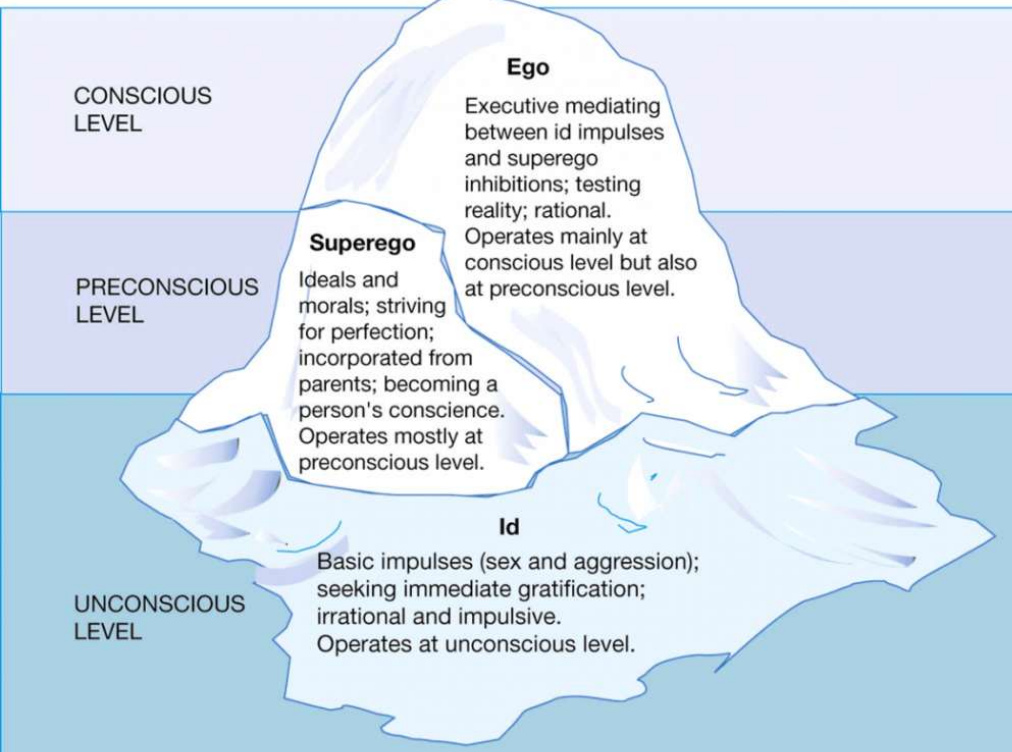
Freud’s Structural Model of the Mind
• Id: Unconscious desires and impulses. Seeks immediate pleasure.
• Ego: Balances the demands of the id with the realities of the world.
• Superego: Internalised morals, rules and ideals. Our sense of right and wrong.
• Psychological distress: Can arise from conflicts between these three parts of the mind. Key idea: Our behaviour is influenced by competing desires, moral expectations and reality.
Can’t acces the uncoscious, outside of control, most of the work is done in the conscious
The different dimensions of our minds, id and superego and ego. Supergeo comes from parents moral, society rules. Therapies happen at the ego and superego as you cannot speak to ID.
Reductionist approach, devil vs angel on the shoulder but it is not always correct. The id is not always bad and superego is not always good.
Anna Freud (1895-1982)
• Sigmund Freud's daughter, who became an influential psychoanalyst.
• Pioneered child psychoanalysis, adapting therapy for children.
• Developed understanding of ego defence mechanisms, such as repression, denial and projection
Psychodynamic – Ezriel’s triangle of conflict (1952)
Defences (D) – try to manage the conflict between anxiety and impulses (to avoid uncomfortable feelings)
Anxiety (A) – guilt and shame due to conflict between impulses and societal rules/norms
Impulses/Feelings (F) – sexual desire, anger, attachments, joy, grief, excitement etc.
Psychodynamic – Maladaptive Defences
Defenses can be maladaptive but they can be adaptive to deal with conflict between ID and Superego
Denial – individual denies true source of anxiety
Repression – try and stop awareness of anxiety provoking thoughts/mental images
Regression – retreat into an earlier stage of psychological development
Reaction formation – reacting the opposite to how you feel
Projection – assigning anxiety provoking parts of yourself to other people
Rationalisation – trying to find an alternative explanation to avoid blame
Displacement – switching the target of your impulse to someone elseIdealization/devaluation – attribute exaggerated positive/negative characteristics
Psychodynamic – Adaptive Defences
Sublimation – transform impulse into something positive
Self-observation – monitoring which situations lead to conflict
Self-assertion – expressing thoughts and feelings calmly but clearly
Humour – reframing situation in ironic or amusing way e.g. Dark Humour
Altruism – Dedication to needs of others (without self-sacrificing)
Affiliation – Seeking support from others
Anticipation – think of the pros and cons of action beforehand
Psychodynamic - Aims
• Explore the unconscious
• Bring the unconscious conflicts into the conscious to relieve the anxiety and conflict
• Works best with mood disorders (depression and anxiety)
• Generate insight and self-awareness
Psychodynamic - Techniques
Free association – client encouraged to express whatever comes to mind
Transference – therapist is the target for emotional responses (e.g. represents important person in client’s life)
Countertransference – how the therapist reacts to the client
Dream analysis – analyse the symbolic meaning of dreams to reveal inner conflicts Interpretation – bring it all together to help the client understand their inner conflicts
Psychodynamic – Post-Freudians
Psychodynamic – Positives
• Accepts roles for both nature and nurture
• Thinks about impact of childhood
• Honest and open with client to help find the truth
• Quite detailed in its explanations
• Played an important role in advancing therapy
• Has been expanded upon by post-Freudians
• Shorter forms have been created (brief therapy)
• Some unconscious processing has been found in social psychology (implicit bias) or cognitive psychology (automatic processing)
Psychodynamic - Criticisms
• Deterministic – everything is due to your unconscious and so you have little control! Very little room for free will. • Not empirically tested (at least early on!) • Can take a long time (multiple days per week for years) • Does not work well with some disorders (OCD, schizophrenia) • Relied upon case studies of wealthy Austrians (limited sample) • Inherited the biases of its time (sexist, elitist attitude to women) • Not falsifiable…
CBT – Response to Freud
Aaron T Beck (1921-2021)
• Trained in psychodynamic, but critiqued Freud’s method
• Some patients not getting better
• Origin of mental health problem not important to treat it
• Wanted to be more scientific to build an evidence base for treatment
• Wanted therapy to be falsifiable (measures and testing ideas)
Beck was fascinated by the thinking processes of behaviours. It is the interoretation of feelings beign depressed is not just being sad, is thinking you are worthless, not what you gothrough is how you do it , stoicism.

CBT – Behavioural techniques
Extinction – conditioned response fades away
Flooding – overwhelm anxious response so it disappears
Counter-conditioning – condition an adaptive alternative behaviour
Systematic desensitisation – build up to more distressing stimuli
Exposure therapy – exposure self to distressing triggers
Aversion therapy – positive punishment if maladaptive behaviours occur
Functional analysis – figure out the role of conditioned reactions
Response shaping – use of punishment and reward to gradually change response
CBT – Cognitive psychology
Albert Ellis (1913-2007) Rational Emotive Behavioural Therapy (REBT)
Also believed on the unconscious but focused on the “visible” part of it. Believes that people disturb themselves with their own thoughts. Humour because it is thought, feeling and behaviour.
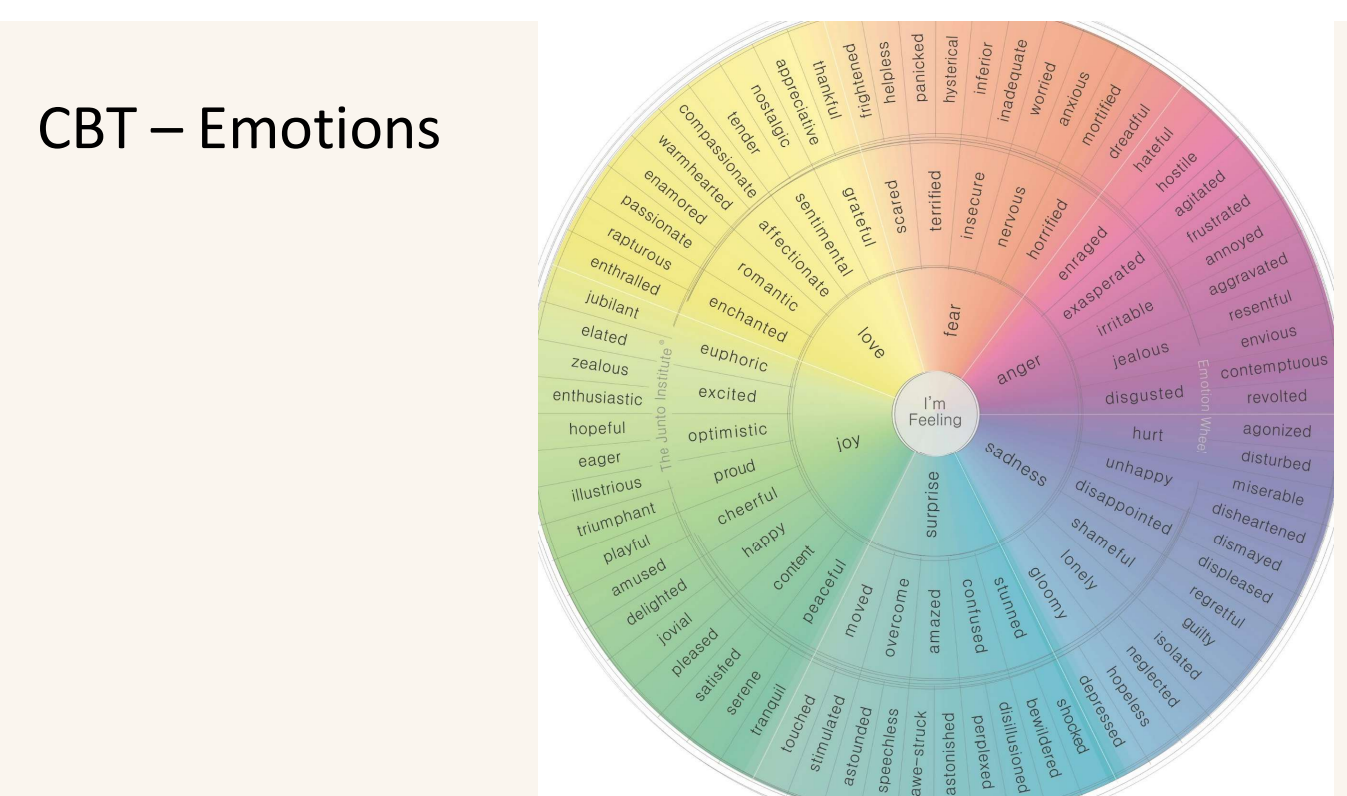
Interpretation of events is everything. EG someone insults you, you interpret the insult (you must believe it enough) then you feel sad. Can’t control the world, or emotions but you can control your actions consequently\ how you interpret.


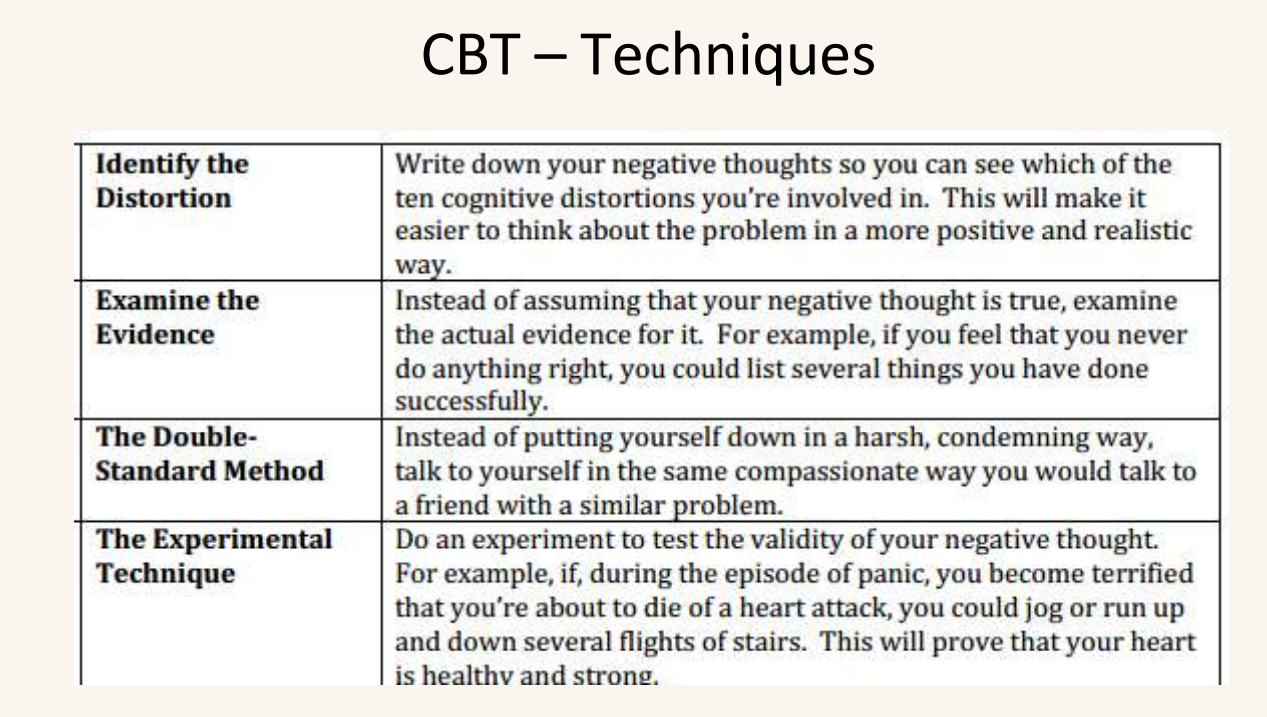
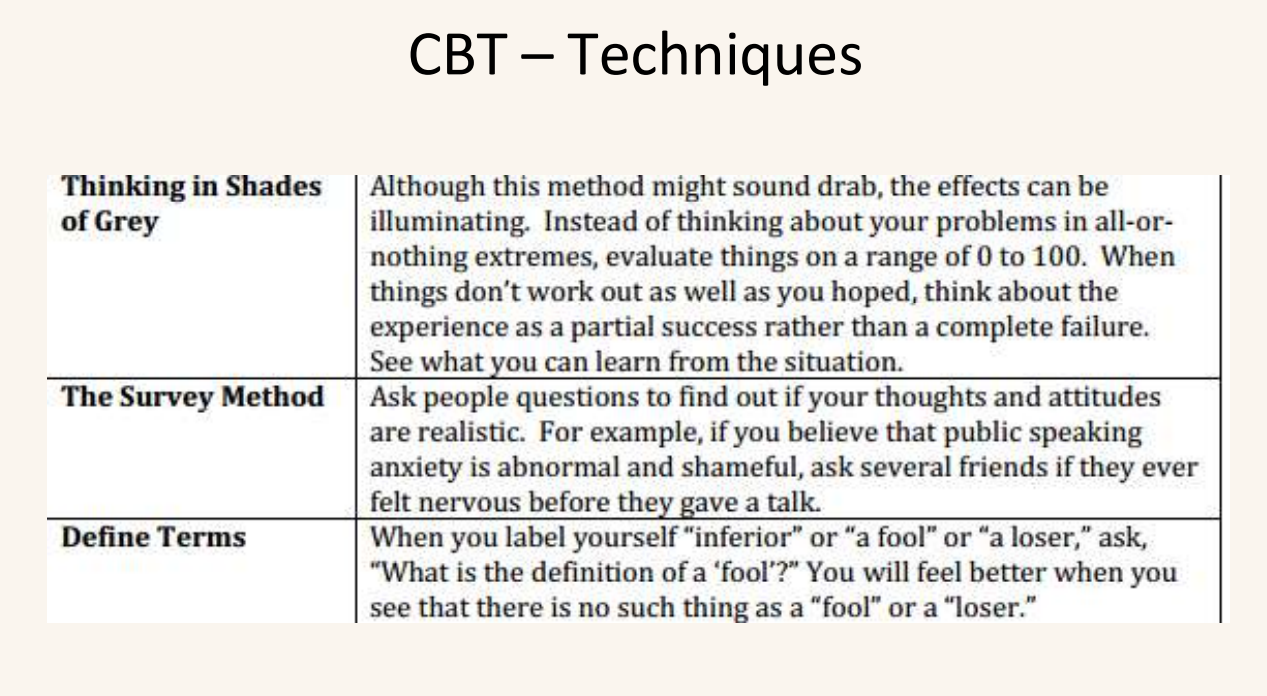
We try to get people to challenge their thinking, how they interpret things.


Evaluating CBT
Positives • Easier to operationalize • Led to several (somewhat) effective therapies • Tries to measure and test its hypotheses • Falsifiable
Limitations • Reductionist (only five systems?) • Overly structured and manualised • Misses the complexity of the individual
