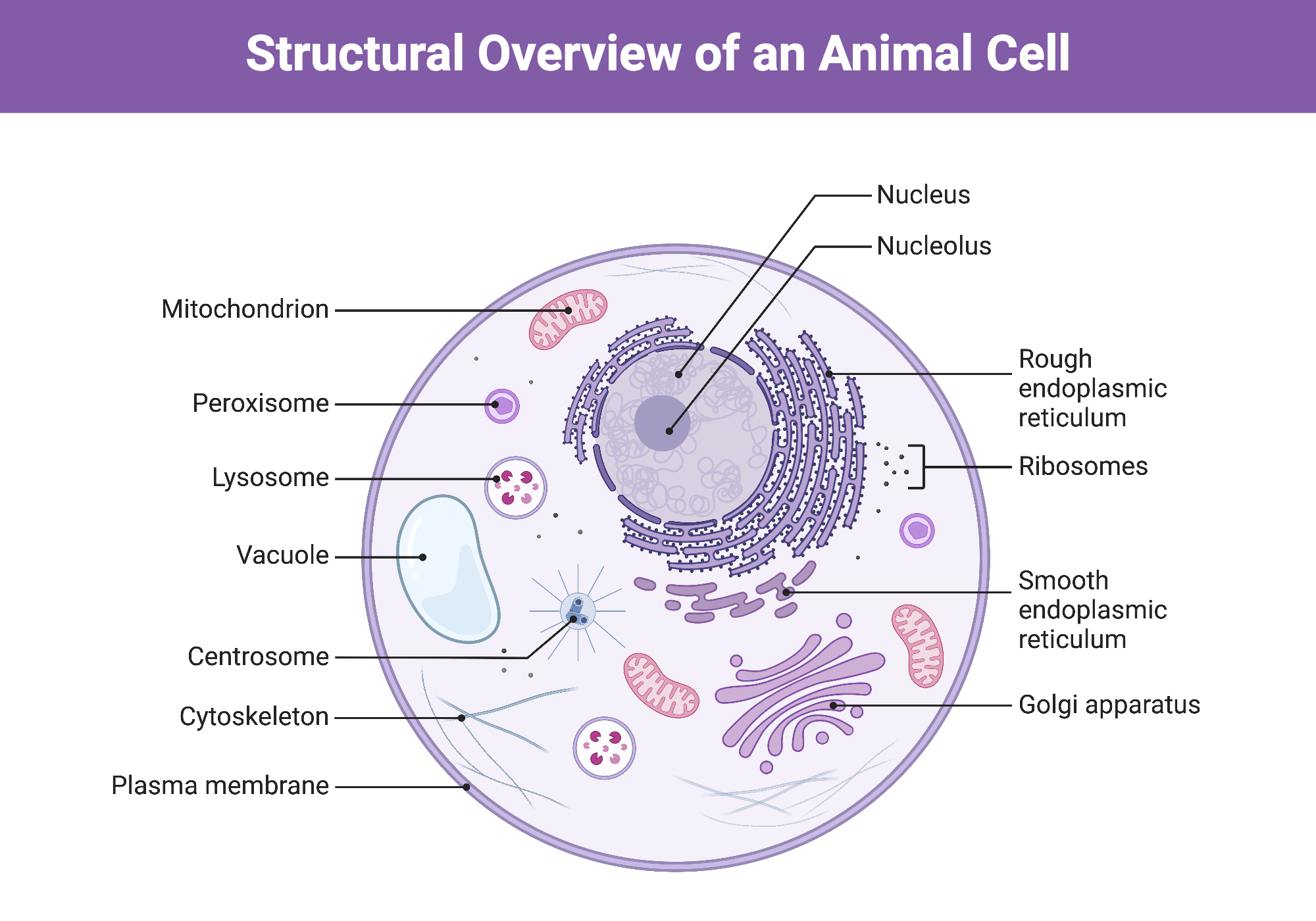
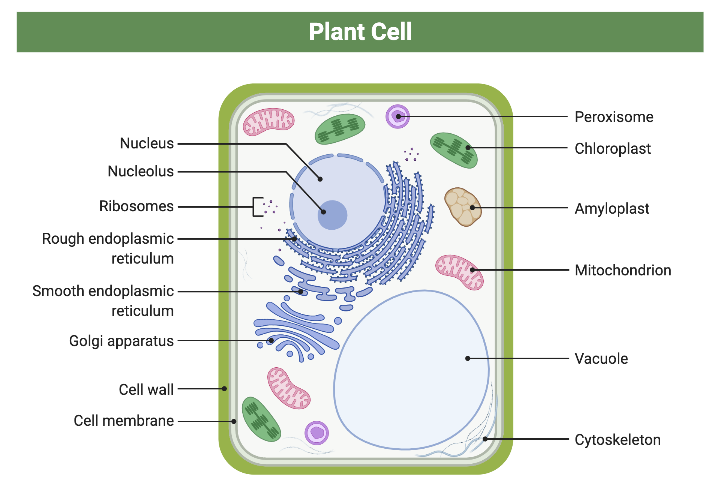
Organelles
Cell Specialization
Each cell type is specialized to have a specific job in multicellular organisms.
Cell Specialization is controlled by DNA (gene expression).
Different cell types use (express) different genes to become different.
A cell’s structure (such as shape and contents) determines its function.
In multicellular organisms, cells organize into tissues, organs, and organ systems.
A specific structure is important for each kind of cell as they each have different jobs and their structure matches their job.
Organelles inside each cell are needed to perform various functions for the cell to be efficient (to be able to do multiple things at once).
Three basic parts of All Cells
The three basic parts of all cells are
plasma membrane
cytoplasm
DNA - kept in a specific place
Nucleus (eukaryotes)
Nucleoid Region (prokaryotes)
Plasma Membrane
also called - cell membrane
made of a phospholipid
bilayer with proteins inserted in it
Encloses/Surrounds the cell
Selectively Permeable
only allows certain things in or out
Cytoplasm
A watery semi-fluid (cytosol) area containing organelles
Fills the space between the plasma membrane and nucleus (if there is one)
Cytoplasm is the cytosol AND the organelles
DNA (Genetic information)
DNA exists bound with proteins to form chromosomes
Genes control cellular activities by controlling protein synthesis
Two general cell types
Represent two domains of life
Prokaryotes
prokaryotic cells
Eukaryotes
eukaryotic cells
Word root karyo
means nucleus
Prokaryotic cell structure
No nucleus
has nucleoid structure instead
“Pro”
pre/before
“Karyo”
nucleus
Simple structure
NO membrane-enclosed organelles (does have some without membranes)
Most common example: Bacteria Parts of the Prokaryotic Cell
DNA
in nucleoid region
Cytoplasm
Plasma membrane
Ribosomes
Cell Wall
outside of membrane
Capsul
outside of cell wall
Eukaryotic cell structure
Has a nucleus
“Eu”
true
“Karyo”
nucleus
More complex structure
Has membrane-enclosed organelles (and some without)
Examples: Animals and Plants
Eukaryotic Cells | Prokaryotic Cells (aka bacteria) |
|---|---|
Has a nucleus | no nucleus |
has membrane bound organelles | no membrane bound organelles |
complex | simple |
larger | smaller |
evolved later | first to evolve |
animalia, fungi, plantae, prolista | eubacteria, archobacteria |
Organelles
a structure that performs a specific function for a cell
made of macromolecules
Plasma Membrane (also known as Cell Membrane)
Function
Protect the cell
Allows nutrients and other helpful substances into the cell
Lets waste products out
Found in
animal cells
plant cells
Nucleus
Function
Where genetic information is held
Cell’s control center
Found in
animal cells
plant cells
Nucleolus
Function
produces and assembles the cell’s ribosomes
ribosomal DNA is transcribed here
Found in
animal cells
plant cells
Cytoplasm
Function
holds the components of the cell together
protects them from danger
Found in
animal cells
plant cells
Mitochondria
Function
transform the chemical energy of foods into a form (ATP)
ATP can be used for cellular work
Mitochondria synthesize energy for the cell, known as ATP
Found in
animal cells
plant cells
Rough Endoplasmic Reticulum (RER)
Function
produces proteins for the cell
transports them around the cell
Found in
animal cells
plant cells
Smooth Endoplasmic Reticulum (SER)
Function
store, transport, and detox things in a cell
synthesizes carbs, lipids, and steroid hormones
detoxifies toxins and drugs and stores it for later
Found in
animal cells
plant cells
Ribosome
Function
synthesizes proteins in a cell
Found in
animal cells
plant cells
Golgi Apparatus (Golgi Body)
Function
transporting, modifying, and packaging proteins and lipids into vesicles for delivery to targeted destinations
Found in
animal cells
plant cells
Cytoskeleton
Function
helps cells maintain their shape and internal organization
provides mechanical support that enables cells to carry out essential functions like division (creation of new cells) and movement
Found in
animal cells
plant cells
Lysosome
Function
helps cells in digestion and breaking down waste
contains proteins and enzymes within a membrane
Found in
animal cells
Transport Vesicle
Function
help most materials such as proteins and other molecules from one place in the cell to another
Found in
animal cells
plant cells
Flagella & Cilia
Function
flagella
helps to move an organism from one place to another
detect temperature and pH changes
Cilia
move the cell and move fluids past the cell
Found in
animal cells
Centrioles
Function
arrange chromosomes during mitosis (cell division)
Found in
animal cells
Large Central Vacole
Function
stores water
maintains its cell’s turgor pressure
pressure exerted by fluid in a cell that presses the cell membrane against the cell wall
Found in
plant cells
Small Vacuole
Function
sequesters waste products
hold food/nutrients
Found in
animal cells
Chloroplasts
Function
during photosynthesis processes which oxygen releases
make sugar/glucose
make active compounds
lipids, nucleotides, amino acids, and more
Found in
plant cells
Cell Wall
Function
provides support and structure to the cell
surrounds the cell membrane
protects the cell from the outside environment
Found in
plant cells
probacteria
plant cells | both | animal cells |
|---|---|---|
vacuole | plasma membrane | flagella |
chloroplasts | nucleus | cilia |
cell wall | nucleolus | centrioles |
geometric shape | cytoplasm | small vacuole |
mitochondria | irregular shape | |
rough ER | ||
smooth ER | ||
ribosome | ||
golgi apparatus | ||
cytoskeleton | ||
transport vesicle |
|
|