Oxidative phosphorylation
Oxidative phosphorylation
generates ATP using the flow of protons through ATP synthase
occurs across the inner mitochondrial membrane of the cristae
4 proteins are involved in the electron transfer chain
Reactants and products of OP
reactants
reduced NAD
reduced FAD
oxygen
ADP and inorganic phosphate
products
NAD
FAD
water
ATP
Stages of OP
reduced NAD and reduced fad release hydrogen
transfers protons and electrons into the mitochondrial matrix
high energy electrons are passed to an electron carrier from reduced NAD and FAD
the electrons are passed along a series of electron carrier molecules in the electron transport chain
embedded in the inner mitochondrial membrane
energy is used to actively transport protons across the inner mitochondrial membrane from matrix to intermembrane space
the accumulation of protons in the intermembrane space sets up a steep electrochemical gradient of protons across the inner membrane
protons diffuse back into the mitochondrial matrix
down electrochemical gradient across the inner membrane
facilitated
releases energy and catalyses the synthesis of ATP from ADP and inorganic phosphate
oxygen is the final electron acceptor
combines with electrons and protons to form water
thus maintains concentration gradient
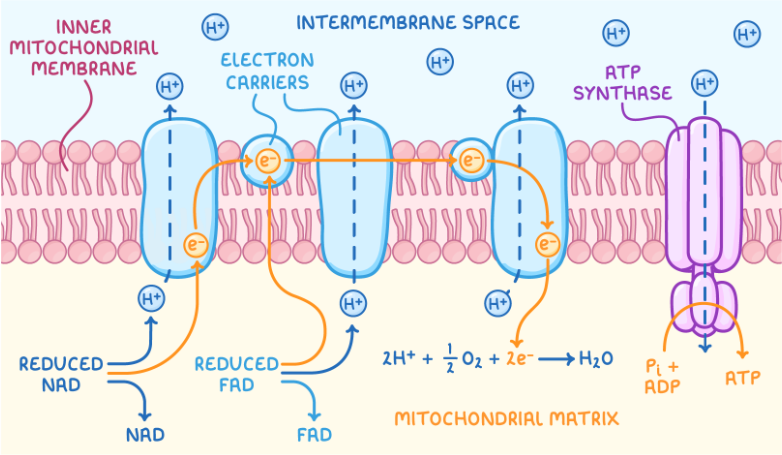
Chemiosmosis
diffusion of protons across the partially permeable inner mitochondrial membrane
down their electrochemical gradient through ATP synthase channels
ATP yield per glucose molecule
Stage | ATP used | ATP synthesised | Net gain in ATP |
Glycolysis | 2 | 4 | 2 |
Link reaction | 0 | 0 | 0 |
Krebs cycle | 0 | 2 | 2 |
Oxidative phosphorylation | 0 | approx 30 | approx 30 |
Total | 2 | 36 | 34 |