3 - Authorship and Ownership
1. Copyright vs Related Rights
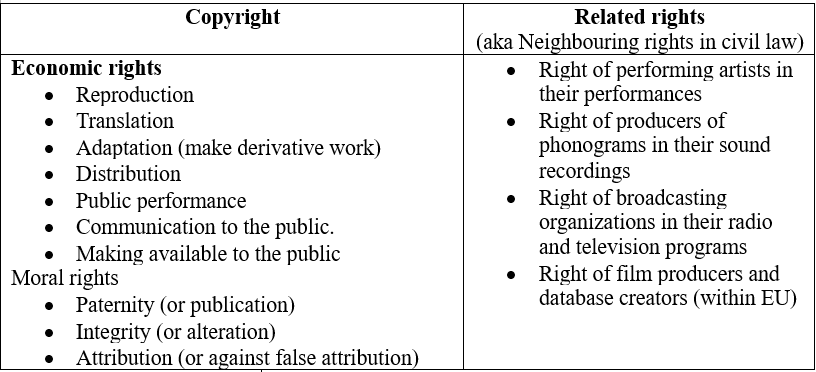
2. Copyright and International Treaties
Berne Convention (Incorporated in TRIPS)
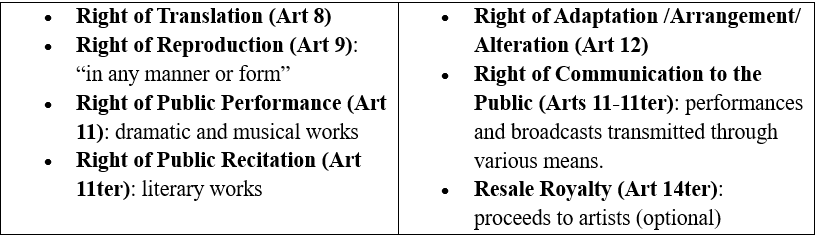
TRIPS Art 11
Introduces rental rights for computer programs and cinematographic works,
Authors can authorise or prohibit commercial rental of original works.
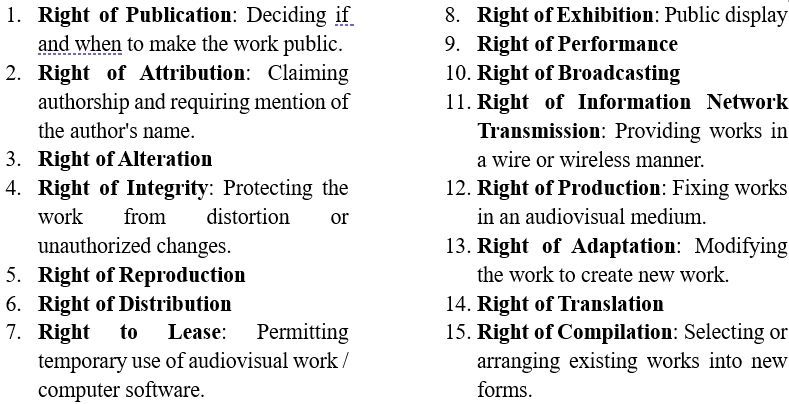
17 U.S.C. §106
© owner has exclusive rights to do and to authorise:

PRC Copyright Law, Art 10
Related (or Neighboring) Rights
Established under the Rome Convention for the Protection of Performers, Producers of Phonograms, and Broadcasting Organizations
20 years of protection of performers' rights
Art 19 Implied license: A performer gives up all his further rights once he consents to incorporate his performance in a
visual or audiovisual fixation
TRIPS added rights preventing unauthorized fixation, reproduction, and communication to the public for performance and broadcasts.
Beijing Treaty on Audiovisual Performance (2012) Art 2b
“Audiovisual fixation” = the embodiment of moving images, whether or not accompanied by sounds…, from which they can be perceived, reproduced or communicated through a device
Garcia v. Google, Inc.
Actress claimed a right over her 5-sec performance in a controversial film.
Held: cannot claim; brief role is not independently copyrightable; recognizing such rights would create chaos in film production
Note: courts always only apply national law, not international agreements
3. Economic Rights
Rights of Reproduction
HK CO s23(2): “to copy a work” = “reproduce the work in any material form”
inc. storing in medium by electronic means
inc. trans-dimensional reproduction (2D to 3D) (recall Meshwerks)
Fox Broadcasting Co v. Dish Network LLC (US):
DVR device allows users to record programmings and access them through internet connected device and to automatically skip commercials
Subscribers’ copies - No infringement (fair use; not initiated by D)
D’s quality assurance copies - infringed P’s right
Right of Adaptation (creating derivative work)
17 USC, s.101: “a work based upon one or more preexisting works, such as a translation, musical arrangement, dramatization, fictionalization, motion picture version, sound recording, art reproduction, abridgment, condensation, or any other form in which a work may be recast, transformed, or adapted.”
PRC CL, Art. 10(14): “to create a new original work by making changes to a pre-existing work.”
Qiong Yao v. Yu Zheng: D’s screen play of Palace 3 (宮鎖連城) infringed P’s adaptation right in her novel and screen play of “Plum Blossom Scar” (梅花烙)
Right of Public Distribution
Limited by Doctrine of First Sale (doctrine of exhaustion)
Not applicable to rental of software/phonorecords
17 U.S.C s. 106.3: Right “to distribute the copies or phonorecords of the copyrighted work to the public by sale or other transfer of ownership, or by rental, lease, or lending;”
PRC CL, art 10(6): "the right to provide the public with original copies or reproduced copies of works by means of sale or donation”
Right of Public Performance
PRC CL, art 10(9): “publicly performing a work or of communicating the performance of a work to the public by any means.”
17 U.S.C. s. 101: “To ‘perform’ a work means to recite, render, play, dance, or act it, either directly or by means of any device or process or, in the case of a motion picture or other audiovisual work, to show its images in any sequence or to make the sounds accompanying it audible.”
To perform a work “publicly” means (17 USC s. 101)
to perform or display it at a place open to the public or at any place where a substantial number of persons outside of a normal circle of a family and its social acquaintances is gathered; or
to transmit or otherwise communicate a performance or display of the work to a place specified by clause (1) or to the public, by means of any device or process, whether the members of the public capable of receiving the performance or display receive it in the same place or in separate places and at the same time or at different times.
Fortnightly Corp. v. United Artists Television, Inc. (US Supreme Court)
D (Fortnightly)’s CATV system receive, amplify & modulate signals from TV stations, converted freq and transmitted to subscribers. Did not edit programs. © of films broadcasted by the TV stations owned by P (UAT), P did not authorise the carriage of broadcasts by CATV
Held: did not infringe P’s right to “perform… in public for profit
Broadcasters = exhibitors who perform; Viewers = audience → CATV only enhanced viewers’ capacity → = viewers
CATV systems do not (re)broadcast as they do not select the programs to be viewed, they only carry without editing whatever programs they receive
Columbia Pictures Industries v. Redd Horne (US)
“Showcasing” of film in private rental booths infringed P’s rights of public performance (not right of reproduction/distribution)
Authorisation of one exclusive right does not waive the others; rights under 17 USC s106 are seperate and distinct.
First sale doctrine not applicable; only applies to right of distribution
“A place open to public”, not a “semi-public place”: “Any member of the public can view a motion picture by paying the appropriate fee.”
4. Moral Rights
Personal to the authors
Remain with authors even after economic right transferred
maintain at least until expiry of economic right
Not recognized by TRIPS (art 9)
Moral Rights in PRC
CL arts 10(1)-(4): rights of publication, attribution (authorship), alteration & integrity
Beijing RongXingHe Info Consulting Ltd. v. Kewen Info.
D used P’s product pictures on website without P’s watermark and © notice, some pics were cropped
Held: D infringed P’s rights of attribution, alteration, reproduction and communication through info network
Moral Rights in US
Not recognised generally
17 U.S.C. s. 106A (Visual Artists Rights Act / VARA 1990): gives qualifying visual artists the following rights:
Right to claim authorship
Right to prevent the use of one’s name on any work the author did not create
Right to prevent use of one’s name on any work that has been distorted, mutilated, or modified in a way that would be prejudicial to the author’s honor or reputation
Right to prevent distortion, mutilation, or modification that would prejudice the author’s honor or reputation
Right to prevent the destruction of a work of art if it is of “recognized stature”
Moral Rights in HK
Rights of attribution, integrity & against false attribution
Authors of literary/dramatic/musical/artistic work & Director of film
Same duration as copyright
Except right against false attribution: life + 20 yrs
Actionable by personal representatives after death)
Cannot sell/transfer
Except rights of attribution and integrity: may be passed to another person upon the death of the author or director
Rights of attribution and integrity do not apply to computer programs and computer-generated works
Can be waived
5. Authorship and Ownership
Authorship
UK CDPA s.9(1); HK CO s11(1): Author = natural person who creates the work
PRC CL Art 11: citizen who created the work
Art 11(3): “A legal person or an unincorporated organization is regarded as the author of works that are presided over 主持 by [‘‘], that are created at the will of and on behalf of [‘‘], and for which [‘‘] bears responsibility.”
PRC CL Art 12: “The natural person, legal person, or unincorporated organization whose name is attributed to the work is its author…, except where there is evidence to the contrary.”
Works of Joint Authorship
Contributions inseperable under Common Law: UK CDPA s10(1) & HK CO s12(1); “Joint work” = with intention that contributions be merged into inseperable parts: 17 USC s101
Civil Law: can be separable / inseperable
When authors combined their works: German Copyright Act art 9
When work can be separated into independant parts and exploited separately: PRC CL art 13.2
Copyright Ownership
Authorship ≠ Ownership - Authorship always stays with author
Initial ownership vests in author; can be transferred
Authors of joint work = co-owners
Transfer of © ownership ≠ ownership of material object (e.g. in which copyrighted work is fixed)
Work Made For Hire (WMFH)
Common law: employers雇主 own © in works created in the course of employment subject to any written agreement to the contrary: 17 USC s201(b); UK CDPA s11(2); HK CO s14(1)
Made in the course of employment = there is a material and chronological connection between the making of the work and the employment (Stevenson, et al. v. MacDonald & Evans)
Civil Law: same but subject to transfer of ownership, not written agreement
PRC CL art 18: employee has © in “service works”, employer has priority right to use
17 USC §101: WMFH is
a work that is prepared by an employee within the scope of his employment, or
a work specially ordered or commissioned for use as a contribution to a collective work, as a part of a motion picture or other audiovisual work, as a translation, as a supplementary work, as a compilation, as an instructional text, as a test, as answer material for a test, or as an atlas地圖/圖集, if the parties expressly agree in a written instrument signed by them that the work shall be considered a work made for hire.
The work is commissioned to an independent contractor
The work must be one of the above categories to qualify as a WMFH
Community for Creative Non-Violence v. Reid (US Supreme Court)
CCNV hired R to create sculpture; orally agreed that CCNV give $ while R donate his service
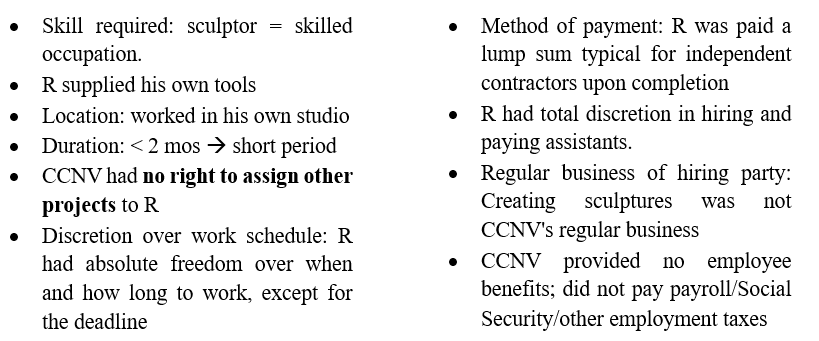
Held: not WMFH - R is independent contractor and not employee; sculptor; no written agreement; sculpture does not fall under any of the 9 categories under 17 USC s101(2)
Factors for determining “employee”:
Commissioned Work
HK CO, ss 15(1)-(2)
The actual author is the first owner of copyright, unless there is an express, but not necessarily written agreement between that author and the commissioning party which “entitles” the latter to the copyright.
Even without any express agreement, the commissioning party has the exclusive exploitation rights, as well as the power “to restrain any exploitation of the commissioned work for any purpose against which he could reasonably take objection.”
Guangdong Foodstuffs v. Tung Fook Chinese Wine [2000] 2 H.K.C. 388
2 commissioned food labels: one with an express oral agreement, another with only “oral understanding”.
Held: commissioning party owned copyright in the first label, and imposed a constructive trust obligating the author to convey copyright in the second label, although the commission fell short of the statutorily required express agreement
PRC CL Art 19: to be agreed upon in a contract between parties. Where the contract has no clear agreement, the copyright belongs to the commissioned person
6. Analysis of Copyright Infringement
I. Access to the Work
Whether D has reasonable opportunity to encounter/obtain P’s work
Selle v. Gibb
Burden of proof on P
“… although proof of striking similarity may permit an inference of access, [P] must still meet some minimum threshold of proof [] that the inference of access is reasonable.”
II. Substantial Similarities
2-step test (Harney v Sony):
Dissection: unprotected vs protected elements
Unprotected elements: pose, clothing, background etc - facts or realities which P did not create.
Protected elements: P’s original expressive choices, inc. the composition (framing the subjects against the church and sky), lighting, shadows, colors, placement of the subjects in the center of the frame.
Substantial Similarity: Compare the works holistically, focusing only on the protected aspects.
“Substantial” = “whether an average lay observer would recognize the alleged copy as having been appropriated挪用 from the copyrighted work.”
Ideal Toy Corp. v. Fab-Lu Ltd., cited in Steinberg v. Columbia Pictures Industries, Inc. (US)
Portion does not matter - Steinberg
Jin Yong v Jiangnan (PRC): “similarity” = similarity in expression
Christian Silvain v Ye Yongqing (PRC): When large no. of paintings involved, they “can be considered as a whole and combined with the author's creative experience, creative methods, creative style and other factors”
Steinberg v. Columbia Pictures Industries, Inc.
D argued that his drawing is more “detail” - rejected
Legally: "A copyright infringement may occur by reason of a substantial similarity that involves only a small portion of each work."
Factually: The similar portion was the iconographically significant portion. The addition of more detailed elements did not eliminate the substantial similarity with the protected expression - "no plagiarist can excuse the wrong by showing how much of his work he did not pirate."