Final Exam Textbook Notes
Island Arcs
Island-arc type of igneous activity is realted to convergent plate situtations that result in the subduction of one plate beneath another.
The initial model was that oceanic crust was partially melted as it was subducted and heated at depth. The melts then rose from the point of melting through the overriding plate to form volcanoes just behind the leading plate edge. Partial melts tend to be less mafic than their parent melt.
Only oceanic curst can be subducted to any great extent because continental crust is too thick and buoyant. The overrding plate, however, is indifferent to density ane can be either type.
If the overring plate is oceanic, the resulting magmatism forms an island arc. If the overriding plate is continental, its called a continental arc or an active continental margin
Island-Arc Volcanism
Intra-oceanic subduction results in an arcute chain of volcanic islands. Island arcs are generally 200 to 300 km wide and several thousand Kilometers wide
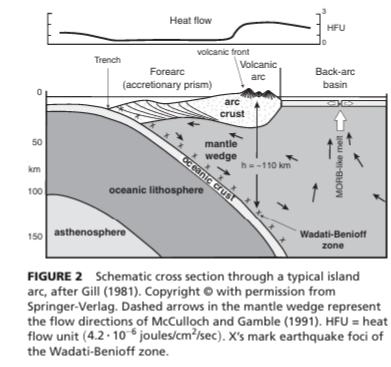
A trench is the surface expression of the plate boundary
The subduction dup angle is generally less with younger and hotter subducted lithosphere and with thicker subducted crust (due to aseismic ridges or oceanic plateaus) due to the greater buoyancy
Wadati-Benioff zone represents the upper boundary of the cool, relatively brittle subducting slap where it slips against the overring plate and mantle
Forarc: The portion of the arc between the volcanic front and the trench is called the fore arc, which is composed of flows and pyroclastic materials from the volcanic arc, imaature sediments eroded from the growing arc, and oceanic sediments scraped from the subducting plate. The fore arc is typically highly deformed and imbricated by thrusting as a result of plate convergence. Slivers of oceanic crust and mantle (ophiolite) can be caught up in the thrusting and incorporated into the pile. The accumulation is often called an accretionary prism, or accretionary wedge
Back arc basin: behind the arc
-MIRB-like volcanism that creates thin ocean-type crust in an extensional tectonic environment behind the volcanic arc.
-basalts still dominate most arcs but can be subridnatein orthers
ISLAND ARC VOLCANIC ROCKS AND MAGMA SERIES
all three magma series are well represented at subduction zones. The calc-alkaline series, however, is essentially restricted to convergent boundaries (it is also recognized in some continental rift areas), and is generally the dominant series in them
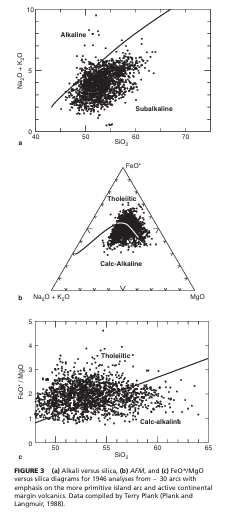
The abundance of calc-alkaline rocks in volcanic arcs is indicated in Figure 3 From Figure 3a we can see that alkaline magmas are only a minor constituent of orogenic zones (they are more common above plumes in intraplate and ridge settings), and we shall not be discussing them much in this chapter. Figures 3b and 3c indicate that both tholeiites and calc-alkaline magmas are well represented in volcanic arcs (but more evolved rocks, toward the alkali corner of Figure 3b and toward the high-SiO2 end of Figure 3c, are more calc-alkaline).
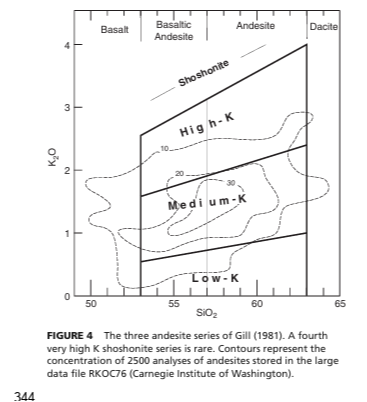
Gill (1981) stressed the importance of K2O in subduction-related rocks, calling it “the most significant variable in major element composition between andesites for tectonics” He adopted an alternative classification of orogenic magma series, first proposed by Taylor (1969), based on a combination of K2O and SiO2. Figure 4 shows the three principal K-based series: low K, medium K, and high K. Contours for more than 2500 analyses of “andesites” (as named in the source literature) are also plotted in the figure. From these data you can see that all three series are well represented in subduction-related magma suites. A fourth series, very high K (or shoshonite), also occurs, but it is relatively rare.
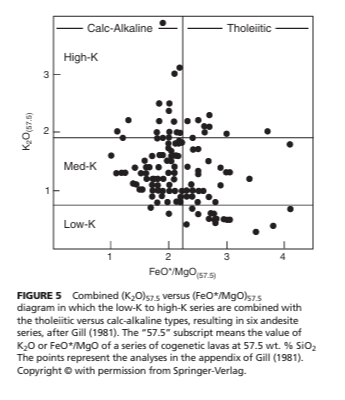
Figure 5 suggests that, of the six common series, the low-K type is dominantly tholeiitic, the medium-K series is more calc-alkaline, and the high-K series is mixed. Thus most orogenic rock suites might most simply be described by three principal series: low-K-tholeiitic, medium-K-calc-alkaline, and high-K (mixed). The first of these hybrid series corresponds to the “island-arc tholeiite” series of Jakes and Gill (1970), and the second and third correspond to the “calc-alkaline” and “high-K” series, respectively, of Peccerillo and Taylor (1976)
one can clearly see from the data in Figures 3 to 5 that the compositions of arc rocks (and series) form a continuumrather than falling into any conveniently neat (yet artificial) groupings. In other words, convergent plate boundaries are complex places, with a variety of processes taking place and a similar variety of products. Perhaps we should not expect arc magmas to conform to a classification concept. Many rocks plot at or near the boundary curves, and it is not uncommon for some magma series to cross a boundary (usually from more tholeiitic primitive magmas to calc-alkaline derivative ones).
As noted earlier, the tholeiitic series occurs in a variety of tectonic environments, where it usually results from shallow partial melting of rising mantle and even shallower differentiation. Calc-alkaline magmas, on the other hand, are essentially restricted to subduction zones.
MAJOR ELEMENT GEOCHEMISTRY OF ISLAND ARCS
The basalts of all three island-arc series are similar to MORBs. Al2O3and K2O are higher than in MORBs, whereas MgO (and Mg#) is lower. Al2O3is also higher than in ocean island basalts, but it is variable and can be as low as , which overlaps with MORB. High Al2O3content is particularly common in association with calc-alkaline magmas, and basalts with are called high-alumina basalts. Several investigators have noted this association and have proposed that high-alumina basalts are parental to the calc-alkaline series.
Tonga-Kermadec: low-K tholeiitic
• Guatemala:medium-K calc-alkaline
• Papua New Guinea Highlands: high-K (calc-alkaline)
serve to illustrate the chemical characteristics of each series. Variation within a series is controlled mostly by fractional crystallization resulting in progressively increasing SiO2 and perhaps by magma mixing in the more evolved portions. The effects of crustal contamination are minimized in these intra-oceanic arcs because the crust is thin and not much different than the arc magmas themselves. Projecting back toward more primitive magmas the trends converge, so there is less variation among the parental basalts. True primary magmas are rare, and chemical differences are due to a number of factors, including different sources, depth and extent of partial melting of the source, fractionation during ascent, depth of magma segregation from the source, mixing of magmas from different series, etc.
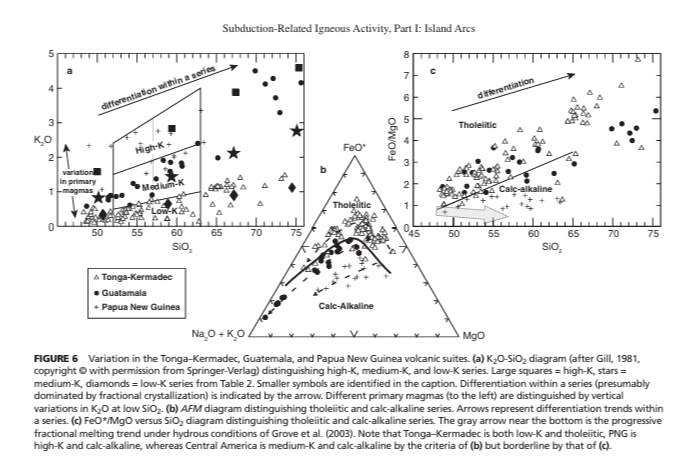
Figure 6b is an AFM diagram for the three series. Note that the low-K Tonga–Kermadec series is indeed tholeiitic and shows the typical Fe enrichment in the early stages of differentiation. The medium-K Guatemalan and high-K PNG series fall within the calc-alkaline field and show less Fe enrichment. All three series show significant alkali enrichment as they evolve. Note that the Guatemalan data cross from more primitive tholeiitic affinities to more evolved calc-alkaline ones. orogenic series on AFM diagrams, implying that something in the subduction zone environment favors calk-alkaline evolution even if the parent is tholeiitic. In general, the higher the K2O + content , the less Fe enrichment, so that the high-K series plots closest to the base of the AFM triangle. The most differentiated rhyolites in the high-K series also plot closest to the alkali corner, as we would expect.
Figure 6c is the FeO*/MgO versus SiO2 diagram of Miyashiro (1974). Here again, the high-K series is calcalkaline and the low-K series tholeiitic, but the medium-K series straddles the border between the two types, and appears slightly more tholeiitic. This confusion in tholeiitic versus calc-alkaline character in medium- to high-K series. is common, and the Fe-enrichment is probably related as much to H2O and oxygen content, and their effect on FeTi-oxide formation during shallow level fractional crystallization, as to intrinsic differences in parental magma type.
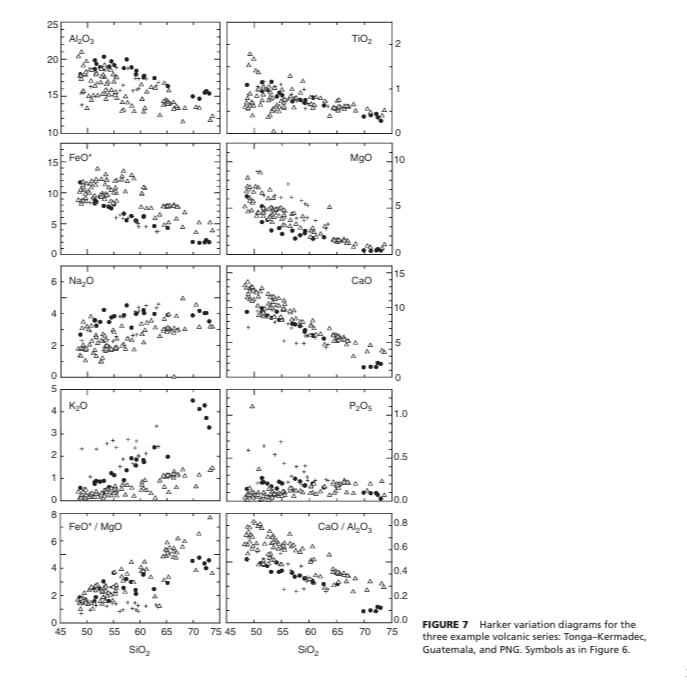
Figure 7 shows a series of major element variation (“Harker”) diagrams for the three series. Although these data represent more than one volcano in each arc and cannot be interpreted rigorously as cogenetic, the diagrams serve to illustrate the general differentiation trends for the three series. The decrease in Al2O3, MgO, FeO*, and CaO with increasing SiO2 are all familiar by now and are compatible with fractional crystallization of plagioclase and mafic phases, such as olivine or pyroxene. Fractionation of plagioclase should cause CaO/Al2O3 to increase for these compositions, but this ratio decreases in the three series (Figure 7). Thus clinopyroxene probably also forms and removes calcium as well. The K2O diagram is the same as in Figure 6.
Because the three series were chosen on the basis of varying K2O contents there is considerable spread in this diagram. K2O and Na2O are largely conserved, and thus have positive slopes as they concentrate in the more evolved melts. The decrease in TiO2 is probably a result of fractionation of an Fe-Ti oxide. FeO*/MgO is also included in the figure, and increases in all three series, a fact obscured somewhat by the constant sum effect in the AFM diagram ( A + F + M must be normalized to equal 1.0). The increase in FeO*/MgO is greatest for the low-K tholeiite series and least for the high-K series, as we saw in Figure 6b. Although it does not show up on Harker diagrams very well because it is the abscissa, SiO2 increases progressively throughout the calc-alkaline series. In tholeiites, SiO2 remains relatively constant until the late stages. This silica enrichment and the iron enrichment and elevated H2O content (resulting in a more explosive nature) are the most obvious and consistent differences between calc-alkaline and tholeiitic magma series.
SPATIAL AND TEMPORAL VARIATIONS IN ISLAND ARCS
Some spatial and temporal patterns in the distribution of magma series are found in several island arcs. Japanese low-K tholeiites occur closer to the trench, and medium- and high-K, mostly calc-alkaline, magmas (and even shoshonitic types) occur progressively farther from the trench. This pattern of higher K2O content (and lower SiO2 saturation) has been described from several arcs, particularly continental ones (see Hatherton and Dickinson, 1969; Arculus and Johnson, 1978; Gill, 1981; Tatsumi and Eggins, 1995), but there are exceptions, and even reversed patterns, known.
Kay and Kay (1994) recognized another pattern in the Aleutians related to the segmentation of the arc. Calc-alkaline volcanoes there are generally smaller and concentrated along the middle sections of the individual segments, whereas tholeiitic volcanoes are larger and more common at segment ends, nearer fracture zones or other large structures, such as seamount chains, on the subducting plate. Wheller et al. (1987) distinguished four arc segments in the Sunda–Banda arc, each of which becomes more potassic from west to east along the arc axis. Tamura et al. (2002) noted that volcanoes in NE Japan were concentrated in ten '50-km-wide 30 to 75 km segments, elongated normally to the arc axis, which they called hot fingers. The hot fingers are separated by non-volcanic gaps wide. Tamura (2003) proposed that these fingers may be elongated zones of enhanced mantle convection up and out toward the arc.
A temporal trend has also been described (Gill, 1981; Baker, 1982), in which early tholeiitic volcanism gives way to later more calc-alkaline and K-rich volcanism as many arcs mature, followed at times by an even later alkaline phase. Ringwood (1977) pointed out that this trend also has several exceptions, and considered it, at best, to express “a broad and general trend rather than a rigorous sequential development”.
PETROGRAPHY OF ISLAND-ARC VOLCANICS
can be related to the removal of plagioclase. The low-K tholeiitic series have a low negative REE slope, similar to MORB, but not as steep. Because LREE depletion (negative REE slope) cannot be accomplished by any partial melting process of a chondritic (non-sloping) type of mantle, the source of low-K tholeiites must be depleted mantle, similar to that for MORB. The REE abundances of the low-silica samples are even less than that for MORB, however, suggesting that the source of arc magmas may be even more depleted than the MORB source. Medium-K and high-K series are progressively more LREE enriched. LREE enrichment is similar to that of other highly incompatible elements, such as K itself, and can be accomplished by low degrees of partial melting of primitive mantle. An alternative explanation, proposed by Thompson et al. (1984), is that the mantle source for island-arc magmas is a heterogeneous mixture of depleted MORB and enriched OIB mantle types. Either way, there appears to be more than one source with different incompatible element concentrations, reflecting variable depletion and perhaps enrichment
t is unlikely that the three series can be derived from one another, or from a single parent, via shallow fractional crystallization because the silica contents overlap and fractional crystallization does not vary the REE slope within a series. Only at some greater depth, where different phases are stable (such as garnet) and may selectively incorporate the HREE over the LREE, would it be possible to vary the 100 Rock/MORB 10 1 Sunda: ave. C-A basalt Sunda: ave tholeiitic basalt New Zealand: high-Al basalt slope significantly by fractional crystallization. Then, perhaps, the REE pattern for one series could be derived from that of another. The HREE portion of all the curves shown in Figure 10 is relatively flat, implying that garnet, which strongly partitions among the HREE, was not in equilibrium with the melt at the time of segregation. This suggests that the three arc series are not related by deep fractionation processes. It also puts in doubt the idea that most island-arc magmas are derived from the oceanic crust of the subducted slab because the basalt should be converted to eclogite (a clinopyroxenegarnet rock) at depths of 110 km where the magmas are apparently derived. If any garnet were left in the residuum after partial melting, there should be a positive slope to the HREE portion of the curves
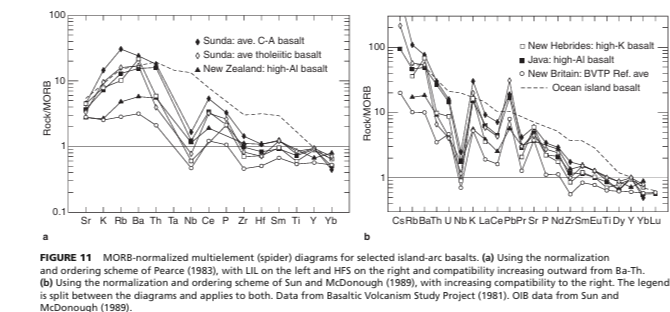
Figure 11 shows two MORB-normalized spider diagrams for island arcs, which show a broader range of trace elements than the REE diagram. Only island-arc basalts are shown because they are more likely to reflect the trace element concentrations of the source and be less affected by fractional crystallization or contamination. Figure 11a is the MORBnormalized spider diagram of Pearce (1983). In every arc in the diagram, the LIL elements (Sr, K, Rb, and Ba) are enriched and behave differently than the HFS elements (Th-Yb), which show nearly MORB-like concentrations (rock/MORB ratio of 1.0). This high-LIL/HFS pattern is now recognized as a distinctive feature of most subduction zone magmas. The large ionic radius and low valence of LIL elements make them very soluble in aqueous fluids, and are thus readily fractionated into a hydrous fluid phase, if one is available. HFS elements, with a higher valence, are much less H2O soluble and for that reason are often called immobile elements (referring to mobilization in an aqueous pore fluid). Because the LIL and HFS elements are all incompatible and behave similarly in solid–melt exchange, the “decoupling” of these two groups, and enrichment of the LILs, is most readily explained by the participation of H2O-rich fluids in the genesis of subduction zone magmas. The obvious source for H2O so deep in the Earth would be water contained in the sediments and hydrated oceanic crust of the subducted slab. These fluids, enriched in LIL elements scavenged from the sediment and crust, can both lower the melting temperature of the solid source rocks and concentrate LILs in the resulting hydrated magma. Such a model is also consistent with the common occurrence of hydrous minerals (such as hornblende), calcic plagioclase, and the explosive nature of arc volcanism.
Y and Yb are concentrated in garnet, and the lack of any negative Y-Yb anomaly in Figure 11 again suggests that the magma source was not deep and garnet-bearing. The relatively flat HFS element pattern near 1.0 means the concentration of these elements is similar to MORB, and again suggests that the source of island-arc basalt is similar to that of MORB: depleted mantle, and not subducted crust. The fact that the HREE and compatible HFS elements in both diagrams are lower than MORB (less than 1.0) may be because of the MORB standard concentration values chosen for normalization, but may also indicate, as mentioned previously, that the mantle source of many island-arc basalts is even more depleted than MORB source (Pearce and Peate, 1995).
elements than the Pearce (1983) type diagram in Figure 11a. Once again, all the arcs shown in Figure 11b have a broadly similar pattern that shows LIL enrichment, often manifested as spikes in Cs (the largest, most incompatible, and soluble element of the group), K, and Pb. An OIB analysis was included for reference in Figure 11 and has a humped (Figure 11a) or continuously sloping (Figure 11b), non-spiked pattern. This pattern is widely accepted as a coherent, non-subduction zone, or “intraplate” pattern. All of the spiked elements in the other patterns are H2O soluble and likely to be concentrated in fluids. Leeman (1996) also noted that the concentrations of several LIL elements (As, B, Sb, and Pb) increased with respect to Ce (an HFS element) in many arc magmas and attributed the LIL enrichment to their mobilization in aqueous fluids derived from the dehydrating slab. We can conclude that aqueous fluids are an important component of subduction zone petrogenesis.
The large negative trough at Nb in Figure 11b (and Ta, which is less commonly analyzed but behaves similarly to Nb) in arc magmas has been interpreted in various ways. Some investigators have noted the similarity of the overall trace element pattern between island arcs and OIBs and propose that the source of island-arc magmas is a somewhat enriched one, similar to that of OIB. They then attribute the low Nb-Ta concentrations to the presence of a residual NbTa-bearing mineral. Nb and Ta behave similarly to Ti, so rutile, ilmenite, titanite, and even hornblende are suspected of remaining and holding Nb and Ta in the source (Morris and Hart, 1983; Saunders et al., 1991). Others, such as McCulloch and Gamble (1991), noted that Nb and Ta have MORB-like concentrations ( rock/MORB = 1.0 % in Figure 11), comparable to many other more compatible elements (toward the right) that would not be incorporated in any Nb-Taconcentrating phase. The deep Nb “troughs” in Figure 11 may thus result more from the additions of the neighboring elements on each side to a MORB-like source than from any actual depletion of Nb. In other words, the trough may be an artifact of the location of Nb (and Ta) on the abscissa rather than due to an abnormally low Nb concentration in the source. McCulloch and Gamble (1991) concluded that the immobile HFS element concentrations are similar to those of MORB and probably reflect overall mantle source characteristics, whereas the LIL element concentrations reflect the more water-soluble components from the slab
ISLAND-ARC ISOTOPES
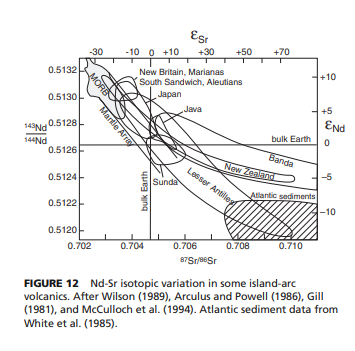
Figure 12 shows the variation in 87Sr/86Sr versus 143Nd/144Nd for several island arcs. New Britain, Marianas, Aleutians, and South Sandwich volcanics plot within a surprisingly limited range of depleted values similar to MORB. This suggests that the principal source of island-arc magmas is the same mantle source that produces MORBs, although the trace element data for these four areas still require additional enriched components. How trace elements can be enriched without affecting isotopic ratios is a vexing problem (see Hawkesworth et al., 1991). The data for other arcs extend along the enriched “mantle array” and yet further toward Nd- and Sr- enriched regions following the now familiar trends of the OIB data. Two enrichment trends, one for the Banda arc and the other for the Lesser Antilles, extend beyond the OIB field. These trends are similar to those in the Columbia River Basalts and probably represent high concentrations of two different EM-type crustal components. In the preceding two chapters we concluded that these reservoirs most closely matched the characteristics of continental crust (or sediments derived from continental crust). One of the enriched reservoirs (such as EMII) has a higher radiogenic Sr content than the other. This may represent upper continental crust that was further enriched as the deeper crust (possibly EMI) was depleted during high grade metamorphism. I proposed that these reservoirs were introduced into the mantle by subduction of sediments derived from erosion of the continents and deposited in the ocean basins or in the fore-arc sedimentary wedge. Of course this source arrived in oceanic intraplate OIB volcanics by a rather circuitous route. In the present case, directly above the subducting slab, the route is much more direct
In Figure 12, we can see that the Antilles trend, where the Atlantic Ocean crust is subducted, follows a mixing curve between depleted mantle (MORB source) and Atlantic sediments. The same is true for the Pacific data (Banda and New Zealand), where the detrital sediment has 87Sr/86Sr around 0.5123 and 143Nd/144Nd around 0.715 (Goldstein and O’Nions, 1981). These arc magmas can therefore be explained by partial melting of a depleted mantle source with the addition of a component derived from the type of sediment that exists on the appropriate subducting plate. The increasing north-tosouth chemical enrichment along the Antilles arc described above is also true for the isotopes, and is probably related to the increasing proximity of the southern end of the arc to the South American sediment source of the Amazon. The observations of Kelemen et al. (2003b), finding enriched isotopic signatures toward the west in the Aleutians, may also be correlated with a decreased continent-derived sediment input away from the North American margin
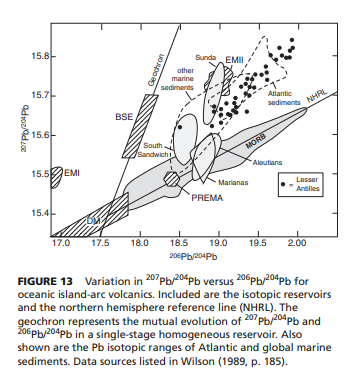
Figure 13 shows 207Pb/204Pb versus 206Pb/204Pb for a number of island arcs. Lead in mantle-derived systems is very low, and thus readily shows the effect of contamination by enriched crustal sources. Included in Figure 13 are the principal isotopic reservoirs as well as the field of MORB Pb ratios. The lead in some arcs overlaps with the MORB data, once again suggesting that a depleted mantle component would serve as a major source reservoir (end member) for subduction zone magmas. The majority of the arc data are enriched in radiogenic lead (207Pb and 206Pb), trending toward the appropriate oceanic marine sedimentary reservoir. Several arcs could represent mixing of DM, PREMA, and sedimentary sources. The Sunda data extend to EMII. The Aleutians data follow a nice mixing line between DM or PREMA and Atlantic sediments, perhaps extending beyond toward HIMU. The sources are somewhat varied, but the Pb data clearly indicate a sedimentary component in arc magmas.
PETROGENESIS OF ISLAND-ARC MAGMAS
we have found that basalts are very common in arcs and that the trace element and isotopic evidence indicates that the dominant source component resembles MORB source (depleted mantle), along with some other constituents, such as oceanic sediment and altered ocean crust
8.1 Thermal Constraints
Of the many variables capable of affecting the distribution of isotherms in subduction zone systems, the five main ones are:
1. The rate of subduction
2. The age of the subduction zone
3. The age of the subducting slab
In addition to these “first-order” plate tectonic variables, but also believed to be important (although less easy to assess), are:
4. The extent to which the subducting slab induces flow in the mantle wedge and the vigor and geometry of that flow
5. The effects of frictional or shear heating along the Wadati-Benioff zone Other factors, such as the dip of the slab, endothermic metamorphic reactions, and metamorphic fluid flow, are now thought to play only a minor role
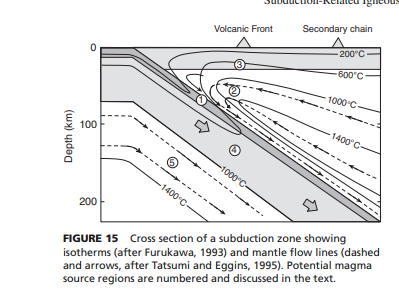
Figure 15 illustrates a typical thermal model for a subduction zone, in this case by Furukawa (1993). Isotherms will be higher (i.e., the system will be hotter) if:
1. The convergence rate is slower
2. The subducted slab is young and near the ridge (hence warmer)
3. The arc is young ( , according to Peacock, 1991)
Several potential source components for island-arc magmas are labeled in Figure 15. The principal ones, with numbers corresponding to circled numbers in the figure, are:
1. The crustal portion of the subducted slab, which includes three components:
a. The altered oceanic crust itself, which is hydrated by circulating seawater, and partly metamorphosed to greenschist facies (including chlorite, actinolite, and albite)
b. Subducted oceanic and fore-arc sediments c. Seawater trapped in pore spaces 2. The mantle wedge between the subducting slab and the arc crust
3. The arc crust
4. The lithospheric mantle of the subducting plate
5. The asthenosphere beneath the slab
The last three sources on the list are unlikely to play much of a role, at least in early arc development
We are left with the subducted crust and mantle wedge as the two principal sources of arc magmas. The trace element and isotopic data reveal a combination of depleted and enriched signatures, suggesting that both contribute to arc magmatism, but the question is how and to what extent. We know that the dry peridotite solidus is too high for melting of anhydrous mantle to occur anywhere in the thermal regime in Figure 15. The high LIL/HFS ratios of arc magmas, however, suggest that H2O plays a significant role in arc magmatism. Because we know the general composition of the constituents in Figure 15, we can model magma generation by combining this information with the pressure-temperature conditions to which the constituents are subjected as they move through the subduction zone (also shown in the figure) and considering the consequences
8.2 Dehydration and Melting in Subducted Slabs
Summary:
Island-arc magmas can (rather artificially) be subdivided into a low-K tholeiitic, medium-K calc-alkaline, and high-K mixed series. Tholeiitic rocks occur in virtually any situation involving mantle melting, but calc-alkaline rocks are essentially restricted to subduction-related environments and are hence a hallmark of subduction-related magmatism (particularly the basaltic andesites and andesites).. H2O plays a crucial role in subduction zone processes. It explains the anomalously high LIL/HFS ratios of arc lavas and dramatically lowers the melting temperatures of silicate systems, thereby solving the fundamental paradox of magmatism in intrinsically cooler-than-average tectonic regimes. WH2O also explains the 365 Subduction-Related Igneous Activity, Part I: Island Arcs occurrence of the calc-alkaline series by either shifting partial melts of the mantle wedge toward high-SiO2 and lowMg# or by fractional crystallization of calcic plagioclase, an oxide, or hornblende