Osmoregulation and Fluid Compartments
Osmoregulation Strategies in Animals
Overtime, animals have evolved different strategies to deal with osmotic stress
Osmoregulators vs. Osmoconformers
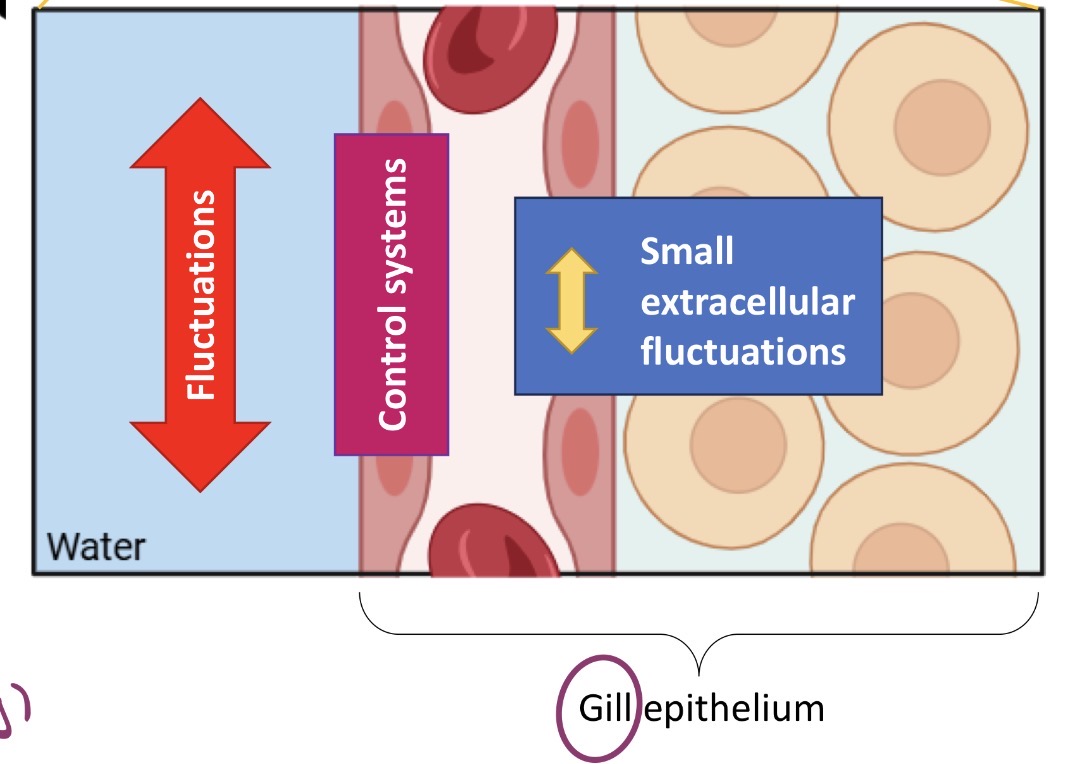
Osmoregulators (different internal environment to outside):
Constantly maintain/ regulate extracellular osmolarity and ion composition.
Strict extracellular osmotic homeostasis
Require energy to maintain homeostasis; unable to withstand changes in osmotic conditions.
Example: fresh water fish maintain their internal conditions despite low external osmolarity.
Osmoconformers (inside and outside environments match):
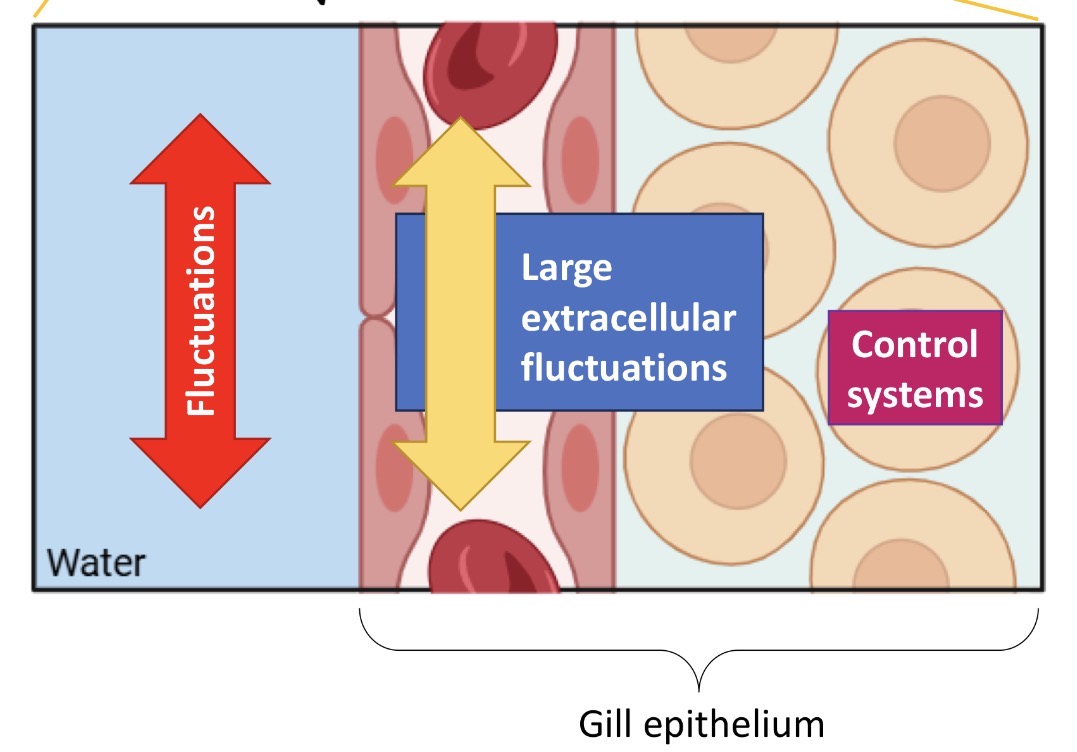
Do not actively control osmotic conditions.
Body fluids and cells are equal in osmotic pressure to the environment
Possess a high degree of cellular osmotic tolerance, → adapting to changes in external environments through increasing intracellular osmolarities with compatible osmolytes
Examples: more common among marine invertebrates and generally requires less energy than osmoregulation → crabs
Mainly found in oceans where osmolarity averages ~1000 mOsm
Osmoregulation in Different Environments
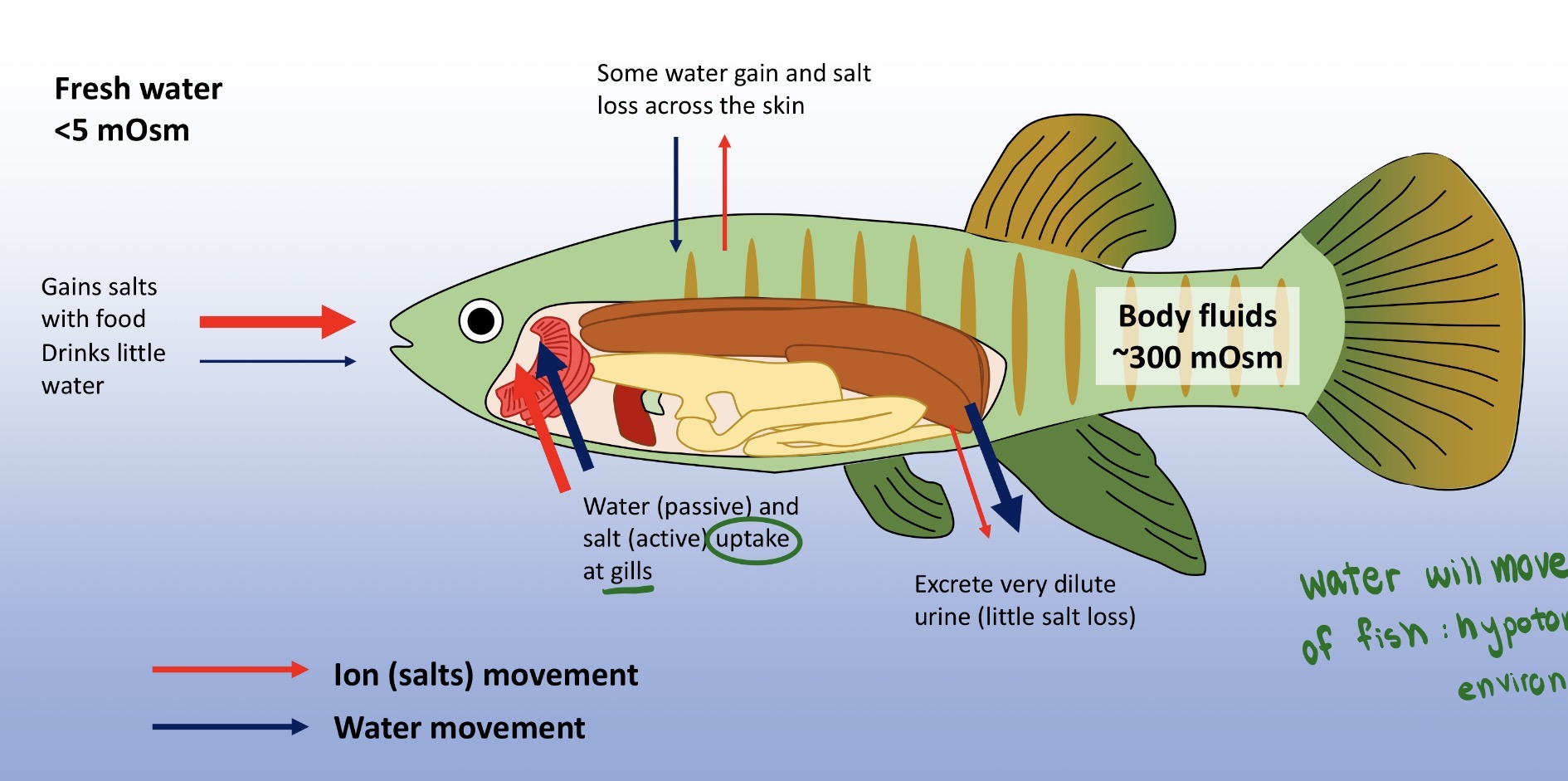
Freshwater Fish
External osmolarity: < 5 mOsm
Internal osmolarity: ~300 mOsm.
Water Movement: Water enters the fish (hypotonic environment).
Ion Movement: Fish lose salts through skin and actively uptake ions at the gills while also gaining salts from food.
Urine Production: Excretes dilute urine to manage water balance with minimal salt loss.
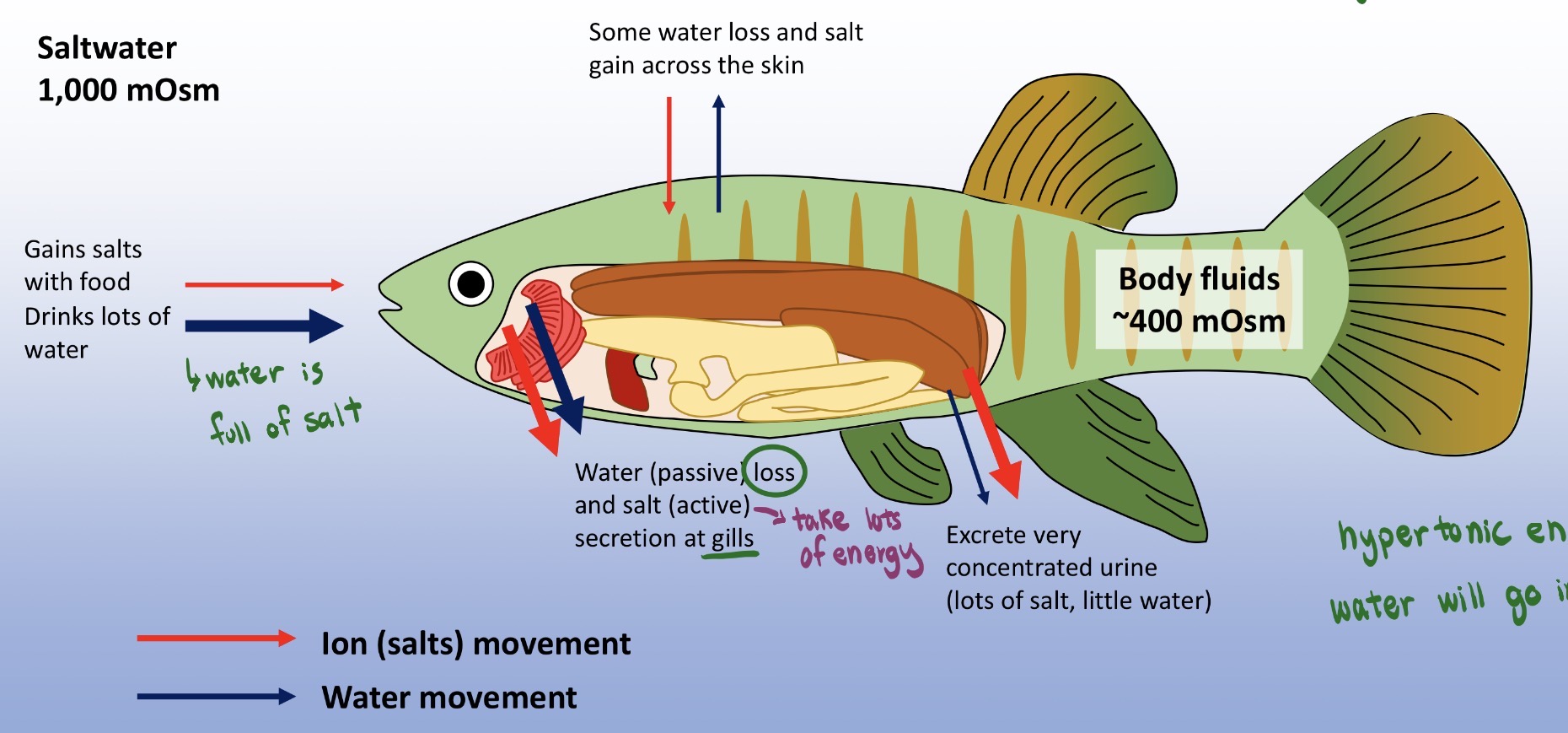
Marine Bony Fish
External osmolarity: 1,000 mOsm
Internal osmolarity: ~400 mOsm.
Water Movement: Water constantly exits the fish (hypertonic environment).
Ion Movement: Fish drink seawater (a lot of water intake), lose water and gain salts via skin, and actively excrete excess salts at gills.
Urine Production: Produces concentrated urine to conserve water while eliminating excess salts.
Types of Osmoconformers in Marine Environments
Osmoconformation is the most common strategy by marine invertebrates
energetically less expensive than osmoregulation
ECF is similar to sea water, both dominated by NaCl
ICF has same osmotic pressure as ECF
Universal solutes, K+ (400 mOsm)
Organic osmolytes (600 mOsm)
Common organic osmolytes: carbohydrates , free amino acids , methylamines , urea , methylsulfonium solutes
^ most organic osmolytes DO NOT DISTURB macromolecules and some stabilize macromolecules against denaturing
PLEASE NOTE! only the deep sea environment is stable
*in osmoconformer, no net movement of ion or water movement,
Two Types of Environments: Stenohaline (little change) and Euryhaline (large change)
Stenohaline Osmoconformers:
Live in stable environments with a narrow range of salinity and environment (e.g., deep sea).
Cannot regulate osmolytes effectively and are restricted to a narrow range of salinity.
Euryhaline Osmoconformers:
Live in highly variable salinity conditions (e.g., intertidal zones).
Capable of tolerating and regulating osmolytes to adapt to changes in their environment.
Migratory Adaptations in Salmon
Salmon hatch in freshwater, migrate to the ocean, and return to rivers to spawn.
Adaptation Mechanisms:
Physiological adjustments allow them to regulate internal osmolarity for optimal homeostasis despite environmental changes, e.g., gills pump ions to adapt to the transition between fresh and saltwater environments.
Key Terms
Osmotic: Reference to liquid moving, such as water.
Solute: Substance added to a solvent to form a solution → dissolves into solvent : e.g., salt.
Solvent: The dissolving medium in a solution : e.g., water.
Osmotic Pressure: amount of pressure exerted by solutes needed to stop the movement of water by osmosis
Osmotic Gradient (due to osmotic pressure) : water moves from low solute to high solute area
Osmolarity : the measure of solute concentration (number of osmoles per litre)
Osmolytes : inorganic ions and organic molecules like glucose and proteins
Osmoregulator: osmotic pressure of body fluids is homeostatically regulated and usually different from the external environment
Osmoconformer : body fluids and cells are equal in osmotic pressure to the environment