DNA Viruses
Class I viruses are the standard DNA virus.
They follow the central dogma.
They are ds-DNA viruses, and they transcribe this ds-DNA into mRNA which is then translated into proteins.
Class II viruses synthesise ds-DNA as the first step in the replication cycle and then proceed in the same way as Class I viruses.
DNA viruses, in general, highjack the host cell machinery for both DNA replication and transcription.
With the addition of viral proteins that are:
Viral enzymes (e.g. DNA polymerases, DNA primerases, etc.)
Protein factors to enhance virus replication at the expense of the host.
DNA Replication in Viruses:
Discontinuous Synthesis of Linear DNA
Leading Strand
Double-stranded DNA unwinds.
RNA primer binds to the end of the DNA.
DNA polymerase runs along the DNA strand, copying it.
Lagging Strand
Kawasaki fragments are bound by primers as they move along.
This creates short copies that eventually join into a single strand.
As RNA is degraded, DNA is copied through.
However, there is a problem!
When the RNA primers are regraded, some of the DNA is lost at the ends of the DNA strands. This is known as the missing sequence.
Eukaryotes solve this by having telomeres, but some viruses use circular DNA.
This means that there are no ends to lose, allowing the viral DNA to replicate efficiently without the risk of losing essential genetic information during cell division.

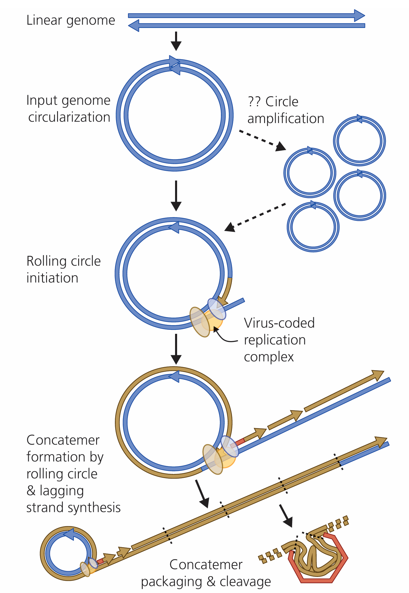
Viruses can also use rolling circle DNA replication.
They circularise their DNA temporarily.
This means that they can copy that, and the viral polymerase begins to '‘spit out’ ss-DNA copies from the circle.
The DNA polymerase produces a linear copy of the genome from the circle.
Viruses can have complementary ends that mimic circularisation.
Linear DNA has ends that are complementary to each-other, so they bind.
This is not a ‘true’ circle, but is pseudo circularisation.
There are no bonds between the end nucleotides, but because they are very close together, the polymerase continues onto the next strand.

Viruses can undergo unconventional priming.
Adenovirus has a linear dsDNA genome and uses an unusual protein-priming mechanism.
The viral DNA polymerase binds preterminal protein (pTP), and the first dCMP is covalently attached to a serine residue of pTP.
Following a sliding-back step, DNA synthesis proceeds from the pTP–dCMP primer.
The resulting viral DNA retains terminal protein covalently attached to its 5′ ends.
Example: Adenoviruses
DNA Viruses can Integrate into the Host Genome:
Many (but not all) DNA viruses, as well as retroviruses, can integrate into the host genome. The integrated DNA copy is called a provirus.
Much of the so-called "junk DNA" in our genomes appears to be remnants of ancient DNA viruses and retroviruses that integrated and were lost over time as replicating viruses.
There is also a theory that viruses move genes or gene clusters between cells, which could contribute to evolution.
Once integrated, the provirus is part of the cell's DNA, so its genes are transcribed and translated and it is copied whenever the cell divides. In a rapidly dividing cell, the virus gets copied for free, and each daughter cell becomes a new virus-producing factory.
Some DNA viruses stay extra-chromosomal: their DNA remains in the nucleus but is not integrated. These can still be passed on when the cell divides, but less efficiently, because the cell doesn't recognise the viral genome as a chromosome to segregate.
HIV (a retrovirus, covered later) always integrates and is therefore always inherited in this way.
Oncoviruses:
Examples:
Human herpesvirus 8 (Kaposi's sarcoma-associated herpesvirus): causes Kaposi's sarcoma, mainly in AIDS patients, because healthy people can fight it off.
Epstein-Barr virus (EBV): causes infectious mononucleosis ("kissing disease") and can cause B cell lymphomas.
Human papillomavirus (HPV): causes warts; subtypes 16 and 18 can cause mouth and genital cancers and are strongly linked to cervical cancer. A vaccine is now available.
Mechanisms:
Viral oncogenes: viral proteins that help the cell survive and divide. A DNA virus needs the cell alive and replicating DNA, so it forces the cell to divide. Cancer is fundamentally cell division gone wrong, so this can directly cause it.
Disrupting tumour suppressor genes: proviruses prefer to integrate into active genes, and many active genes control replication. If a provirus lands in the middle of a gene that normally dampens cell division, it switches that gene off, leading to uncontrolled replication.
Promoter insertion: viral genomes have strong promoters (often at both ends) that pull in the cell's replication machinery. If one inserts just upstream of a cellular oncogene, that gene can be massively overexpressed, forcing the cell into the cell cycle.
HIV and other retroviruses can cause cancer in the same ways, though fewer cancers are directly linked to HIV itself.
Regulation of Gene Expression
Once the viral DNA is in the nucleus (integrated or not), the virus must express its genes. DNA viruses can regulate expression over time, usually using four classes of genes (not every virus has all four):
Immediate early genes: establish infection and switch off host responses; they regulate the early genes.
Early genes: DNA replication machinery, such as DNA polymerases and replication enhancers.
Intermediate genes: mostly transactivators of late gene expression.
Late genes: structural components such as capsid proteins, needed to build new virions.
This is a cascade, and it can also work in reverse, with later products blocking earlier ones. The benefit is that the virus doesn't waste cellular resources, for example making structural proteins before it has copied its genome. Other virus types can regulate expression this way too (RNA viruses come later). Proteins are often named by phase and number, such as E3 or L4.
General notes on DNA virus replication
Entry involves travel from the membrane to the nucleus, since DNA viruses mostly replicate in the nucleus.
Viral DNA may be integrated or remain extra-chromosomal.
Assembly can occur at various locations, including budding through the nuclear envelope, which gives the virus the membrane it needs on exit.
Latency:
DNA is very stable and cells maintain it carefully, so DNA viruses are well suited to latency: remaining dormant in a cell, sometimes for decades, with the host cell effectively looking after the viral genome.
Viruses that go latent:
HSV-1: oral herpes and cold sores; latent in the trigeminal ganglion.
HSV-2: genital herpes; latent in a ganglion at the base of the spine.
Varicella zoster virus: chickenpox in childhood; latent in dorsal root ganglia and reactivates later in life as shingles.
EBV: latent in B cells; no known disease on reactivation, but it can cause cancer if it reactivates in the wrong B cells.
Cytomegalovirus (CMV): usually causes only mild flu-like illness, but goes latent in haematopoietic progenitor cells. If it reactivates around birth, it can infect the baby and cause serious congenital CMV.
Herpes simplex virus (HSV):
Structure: a double-stranded DNA genome inside a capsid, surrounded by a membrane, with a complex, protein-rich tegument between the capsid and the membrane.
Genome size: about 152 kilobases, huge compared with RNA viruses, which have genomes of only thousands of bases.
Entry and trafficking: the capsid travels along microtubules from the membrane to the nucleus using dynein-mediated transport.
Assembly and exit: capsids are assembled in the nucleus. The virus buds through the inner nuclear membrane, loses that envelope into the cytoplasm, then acquires a new membrane to exit the cell.
— — — — — — — —
How latency works in a neuron:
The virus travels all the way up the long axon to the cell body in the ganglion.
During normal infection, the tegument protein VP16 triggers immediate early (alpha) gene expression. In the huge neuron, VP16 is too diluted to do this.
The virus instead expresses latency-associated transcripts and microRNAs, which switch off its own lytic genes.
ICP0 can compensate for VP16 and trigger activation of the genome. Its expression is dampened during latency.
Reactivation happens when something (strong sunlight, stress, and so on; triggers vary between people) causes ICP0 to be suddenly overexpressed. The virus then replicates, travels back down the axon, and causes a cold sore.
Because the person is already immune, reactivations clear quickly and are milder than the primary infection.
The virus also suppresses cell defences, including apoptosis. Cell death is the ultimate antiviral defence, since a virus needs a living cell.
EBV latency
EBV goes latent in B cells and, like HSV, makes RNAs that block various processes. It also makes proteins that inhibit viral replication, prevent cell death and more.
There are thought to be multiple latency phases depending on the protein and RNA profile, from latency 0 (no proteins expressed) to stages where viral proteins actively suppress replication and block cellular responses.
Example: LMP1 (latent membrane protein 1) blocks innate immune responses by inhibiting NF-κB signalling, keeping the host cell in a state useful to the virus.
All of these products interfere with host processes so the cell can't clear the virus or die, and just carries the EBV genome.