Stages of Development
The Stages of Development
The study of human development from infancy to adolescence has changed over time, showing how our ideas about how people grow and mature have evolved. In the 20th century, psychologists like Jean Piaget, Erik Erikson, and Lev Vygotsky changed our understanding of how children develop. Piaget’s theory of cognitive development stated that children go through specific stages of thinking as they interact with their environment. Erikson built upon this research, describing psychosocial stages of development that spanned a person's whole life, with each stage marked by specific challenges and tasks. Vygotsky suggested that people's cognitive growth comes from social and cultural interactions, not just set stages. He emphasized how our culture and surroundings shape how we learn. Knowing that there are many factors contributing to individuals’ uniqueness, scientists today keep learning more about how we grow and change by using tools like brain studies, genetics, and looking at different cultures to understand how we develop.
Introduction of Erikson’s and Piaget’s stages
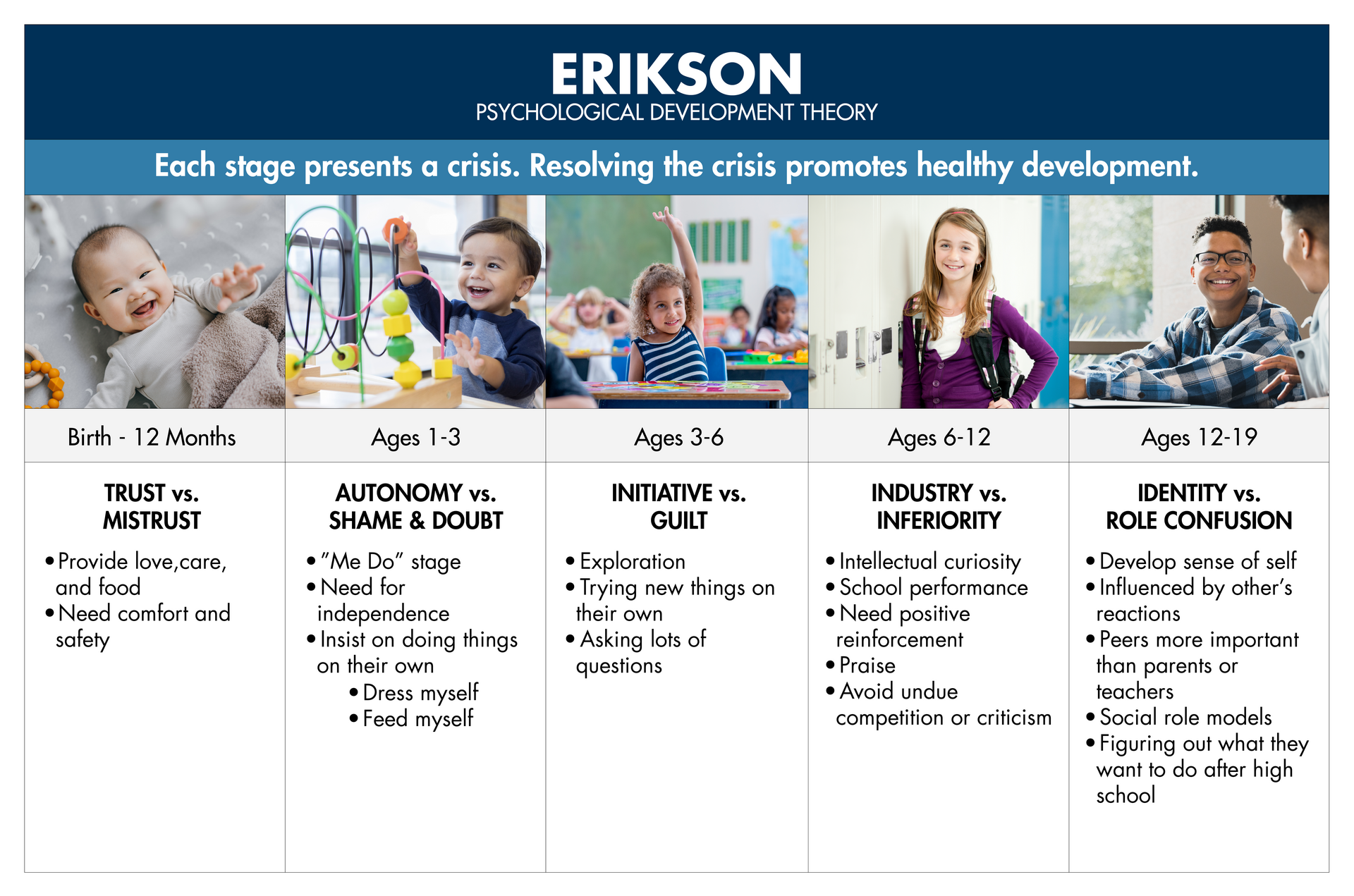
Erik Erikson's Psychological Development Theory outlines the initial five stages of psychosocial development that individuals progress through from infancy to adolescence. Figure 2.1, provides a condensed visual overview of Erikson's theory, focusing specifically on the early stages of psychosocial development. It highlights the key developmental tasks and challenges that children experience during infancy, early childhood, preschool, and school-age years, laying the foundation for later stages of development.
Figure 2.1. Erikson Psychological Development Theory
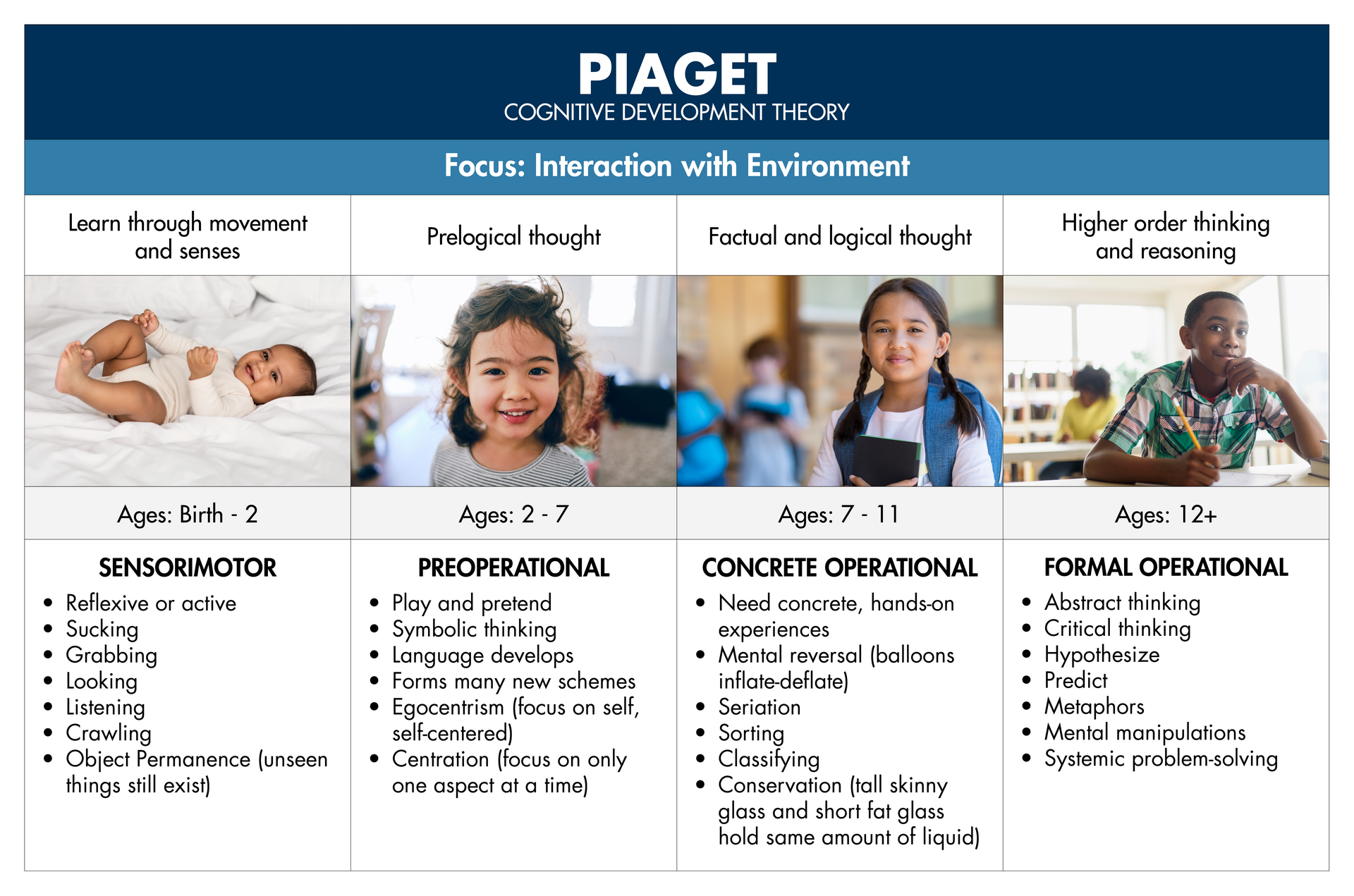
Jean Piaget's Cognitive Development Theory outlines the stages of intellectual development that children progress through from infancy to adolescence. The infographic below, Figure 2.2, provides a visual overview of Piaget's theory, highlighting the key cognitive stages and milestones that individuals progress through during childhood and adolescence and the emergence of higher-level thinking skills over time.
Figure 2.2. Piaget Cognitive Development Theory
Infant-Toddler Stage
During the infant-toddler stage, which usually lasts from birth until about three years old, children grow physically, emotionally, and cognitively. Physically, infants undergo significant changes in size, strength, and motor skills. In the first few months, they typically double their birth weight and grow several inches in length. They also start learning to do things like grabbing objects and eventually start moving around by crawling and/or walking. Emotionally, infants form attachments with their caregivers, typically their parents or primary providers, during this stage. These early relationships are very important because they lay the groundwork for how children will socialize and handle their emotions later.
During the infant-toddler period, Jean Piaget's sensorimotor stage is key to understanding how infants/toddlers think. Piaget believed that infants learn about the world by using their senses and doing things. Infants learn to recognize and respond to familiar faces, develop preferences for certain caregivers, and start communicating by crying, smiling, and making sounds. One thing they learn is object permanence, which means understanding that things still exist even when they cannot see them. In this stage, babies do things like repeat actions to figure out how things work around them. This helps them develop important skills for later, like learning language and understanding symbols.
Erik Erikson's psychosocial theory suggests that during this period, infants develop a sense of trust or mistrust in their caregivers followed by learning autonomy or shame/doubt in their abilities to explore the world. Trust is fostered when infants receive consistent care and nurturing from their caregivers, allowing them to feel secure in their environment. However, a lack of responsiveness or inconsistent care can lead to mistrust. As toddlers start to explore and do things on their own, they may develop a sense of autonomy if they are encouraged. But if they're criticized or controlled too much, they may develop shame and doubt.
Understanding these stages is important for how we teach and care for young children. Infants and toddlers learn best when they can touch and explore things around them. So, our teaching methods should be hands-on and pay attention to what they like. For example, opportunities for sensory exploration, giving them toys to touch, playing music, and letting them move around can help them learn. Creating a safe and loving environment where they feel free to explore and express themselves also helps them build trust and confidence. And because every child is different, we need to adapt our teaching to fit each child's needs and abilities.
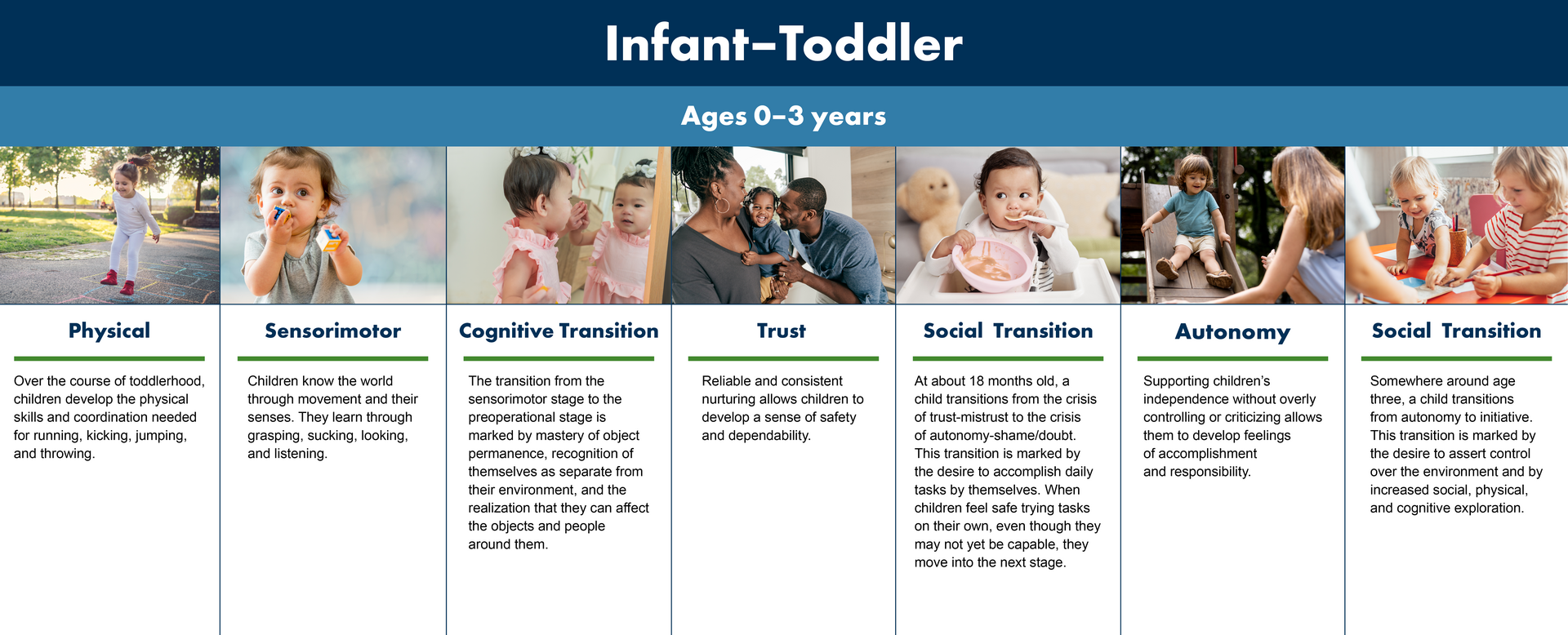
Figure 2.3 presents a breakdown of child development during the first three years. Each segment highlights the significant milestones and developmental achievements that typically occur during that timeframe.
Figure 2.3. Infant-Toddler Development
Preschool Stage
During the preschool stage, usually from ages three to four, children experience important changes physically and cognitively. Physically, they keep growing, but not as fast as when they were infants. They get stronger and better at moving, so they can do things like run, jump, climb, and balance. Fine motor skills also improve, allowing them to use forks and spoons, draw shapes, and thread beads onto strings.
According to Erik Erikson's psychosocial theory, preschoolers enter the stage of initiative versus guilt. In this stage, children start wanting to be more independent and explore the world around them. They use their imagination and creativity a lot and like to have imaginative play, however they may have feelings of guilt or anxiety if they think they did something wrong or if adults don't like what they're doing.
Preschoolers are at a stage of cognitive development called Piaget's pre-operational stage. During this stage, children start to think symbolically and develop language skills. They can use words and symbols to represent things, actions, and ideas. They enjoy imaginative play using different roles and situations. However, they still struggle with being egocentric, seeing things from others' points of view, and they may believe in magical thinking, like thinking their thoughts or wishes can change reality.
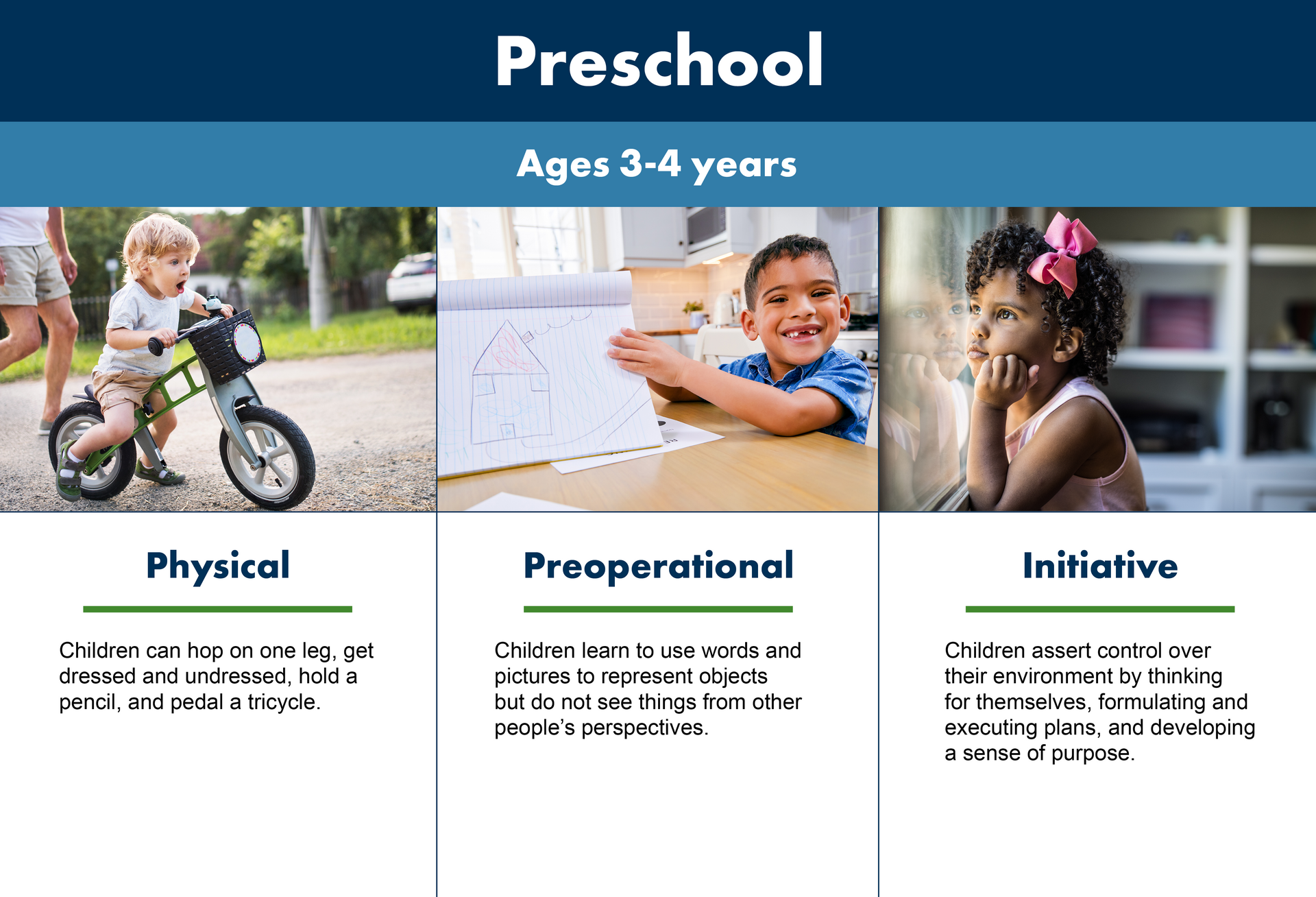
Preschoolers' cognitive abilities affect teaching strategies in several ways. When you teach preschoolers, you should encourage imaginative play and creativity to help them develop and encourage emotional development. You should also use concrete, hands-on teaching strategies to help preschoolers understand complicated concepts since their thinking is still mostly based on what they can see and feel. You should also scaffold learning experiences to help children gradually develop problem-solving skills and overcome frustration. Scaffolding is when you break down complex concepts into small, more manageable steps helping children along the way. Overall, teaching strategies should be developmentally appropriate, recognizing and building upon preschoolers' growing cognitive abilities and emotional needs. Figure 2.4 summarizes the physical, pre-operational, and initiative versus guilt stages of development.
Figure 2.4. Preschool Development
Kindergarten-First Grade Stage
During the kindergarten and first grade stage, usually around ages five and six, children keep growing physically and cognitively. Physically, they grow taller and stronger and improve muscle coordination and balance. They also develop better fine motor skills, allowing them to be better at doing things with their hands, like writing, cutting with scissors, and tying shoes. Plus, their sensory skills get sharper, so they can understand and interact with their environment more accurately.
In terms of cognitive development, children at this age are still in Piaget's pre-operational stage. They like to use their imagination and play with ideas, using words and symbols to show things. But they are still mostly egocentric, thinking about themselves, and might find it hard to understand concepts of conservation and perspective-taking. Conservation refers to the understanding that certain physical attributes of objects, such as quantity, mass, volume, and number, remain constant even when their appearance or arrangement changes. For example, in a first-grade math classroom, you could demonstrate conservation of quantity by pouring water into different containers. Despite changes in appearance due to varying container shapes, the amount of water remains constant. Through this activity, your students could grasp the concept that certain physical attributes, like quantity, stay the same even when appearance or arrangement changes. They are developing a better understanding of cause-and-effect relationships and beginning to grasp basic mathematical concepts such as counting and simple arithmetic.
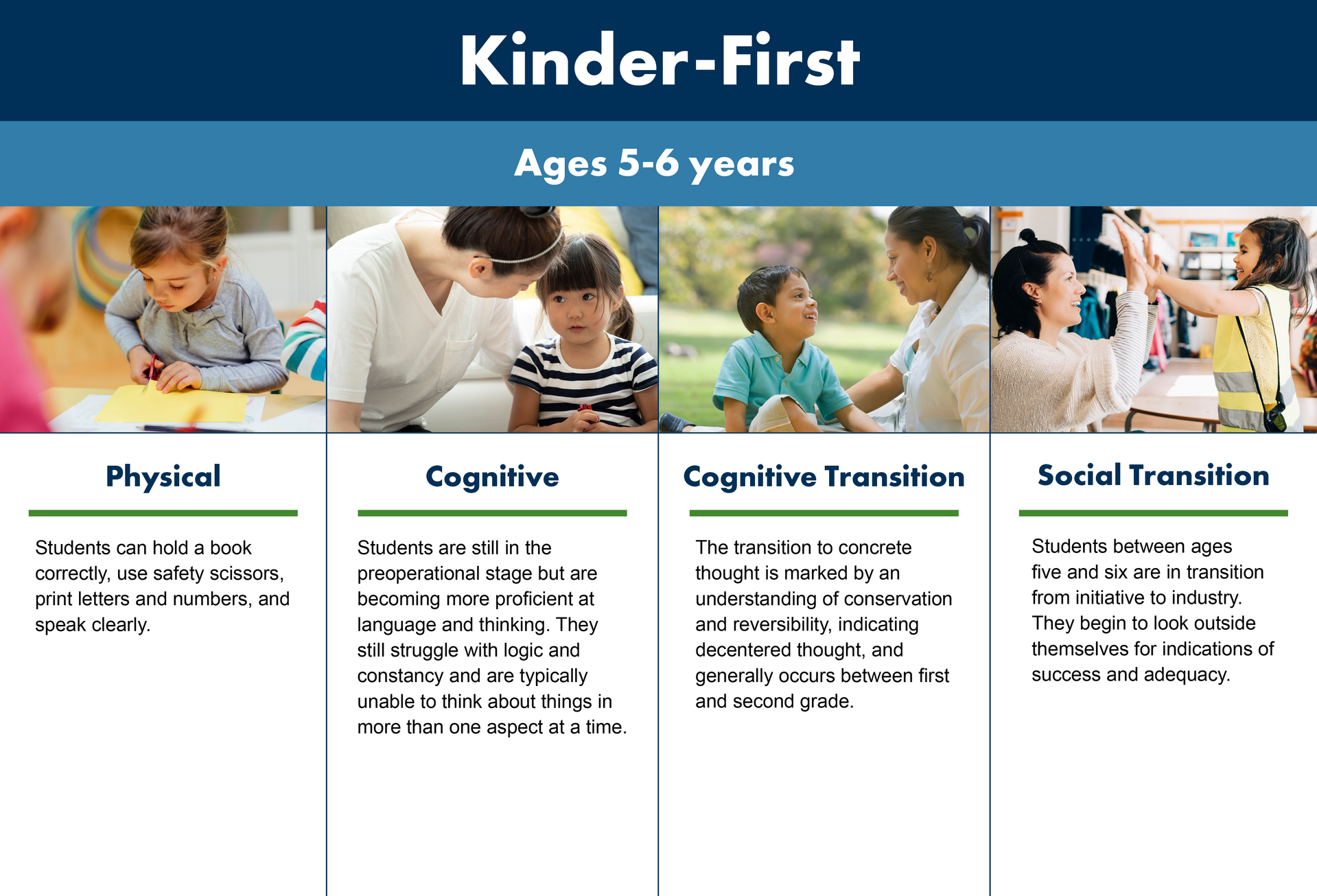
The traits seen in children during kindergarten and 1st grade have big effects on teaching strategies. When teaching kindergarten and first grades you should provide opportunities for hands-on, interactive learning experiences that allow children to explore and discover new concepts. Activities should be scaffolded to support children's emerging cognitive abilities with clear instructions. Creating a supportive and inclusive classroom may also help lessen feelings of inferiority and allow children to be more excited to learn. Figure 2.5 summarizes the physical and cognitive changes occurring in children from kindergarten through first grade, usually around ages five and six.
Figure 2.5. Kindergarten-First Grade Development
Elementary Stage
During the elementary stage, usually between ages 7 to 11, children experience sizable physical and cognitive changes. They keep getting taller and stronger, and their muscles work better, and their fine motor skills also improve. Plus, their senses get sharper, enhancing their perception and interaction with their surroundings.
During this stage, children continue to navigate Erik Erikson's Industry versus Inferiority stage. This means they start feeling more confident and proud of themselves as they learn new things and do tasks well. They start to understand themselves better and start thinking about what they're good at based on what they can do. However, they may also face feelings of inferiority or self-doubt if they perceive themselves as falling short of expectations or may compare themselves unfavorably to peers.
Children at this age move into Piaget's concrete operational stage. During this time, their thinking becomes more logical, organized, and systematic. They can do operations with concrete objects and understand concepts of conservation, reversibility, and classification. Reversibility, closely linked to conservation, involves the capacity to mentally reverse actions or procedures. For example, a child understanding reversibility recognizes that pouring water from a tall, narrow container back into a wider one would retain its original volume. Classification involves the ability to group objects or ideas into categories based on common traits, aiding children in organizing and comprehending their surroundings. Additionally, children exhibit improved problem-solving abilities, engage in more advanced reasoning, and begin to grasp mathematical concepts such as multiplication, division, and fractions.
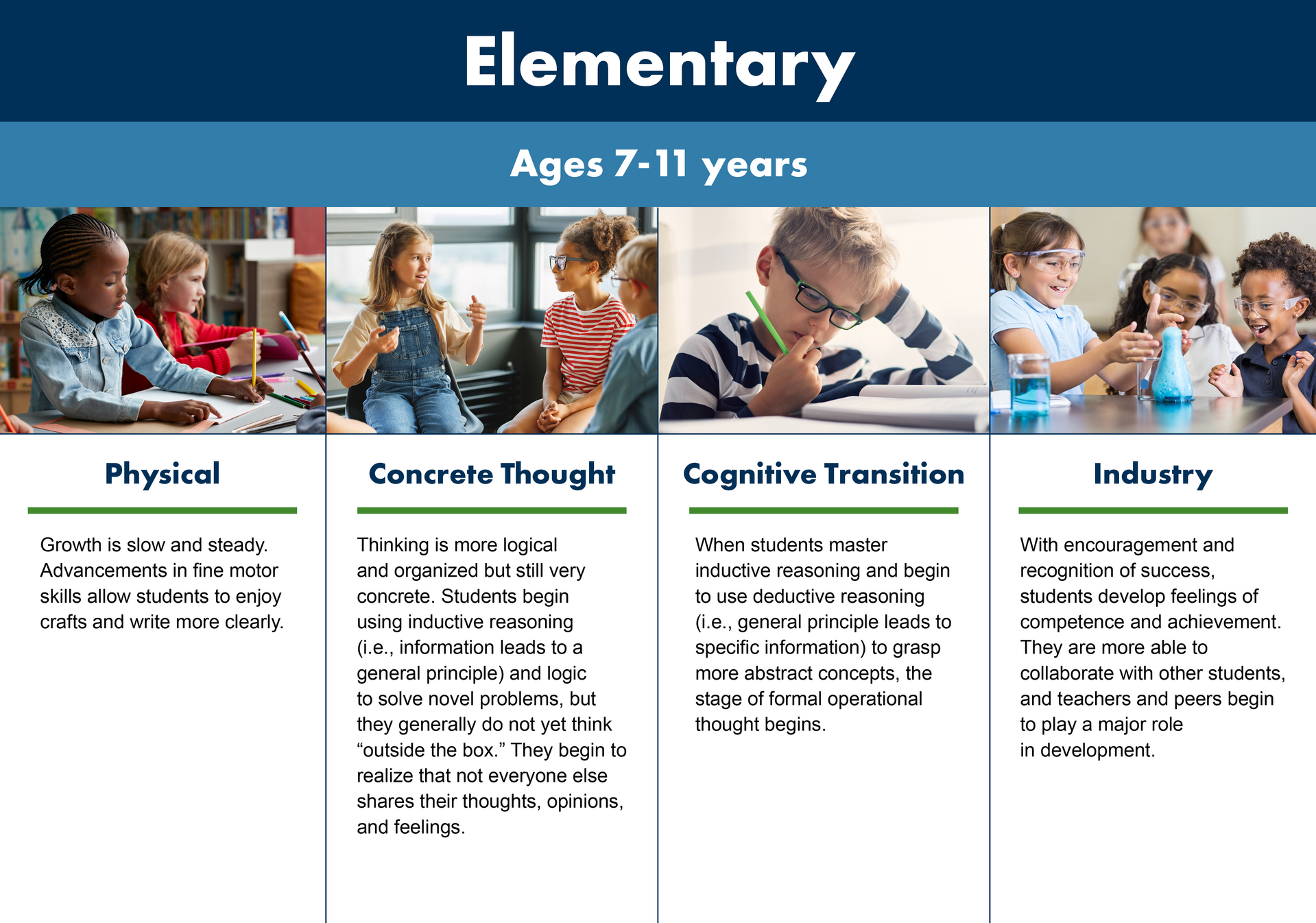
The characteristics seen in children during the elementary stage greatly affect how you should teach. You should give children opportunities for hands-on, experiential learning. Activities should be designed to promote active engagement, critical thinking, and problem-solving skills. You can help students develop a mindset of diligence, perseverance, and success, by encouraging collaboration, providing constructive feedback, and celebrating students' successes. Additionally, creating a supportive and inclusive learning environment can help decrease feelings of inferiority and promote a positive attitude toward learning. Figure 2.6 provides a summary of elementary developmental milestones.
Figure 2.6. Elementary Development
Adolescent stage
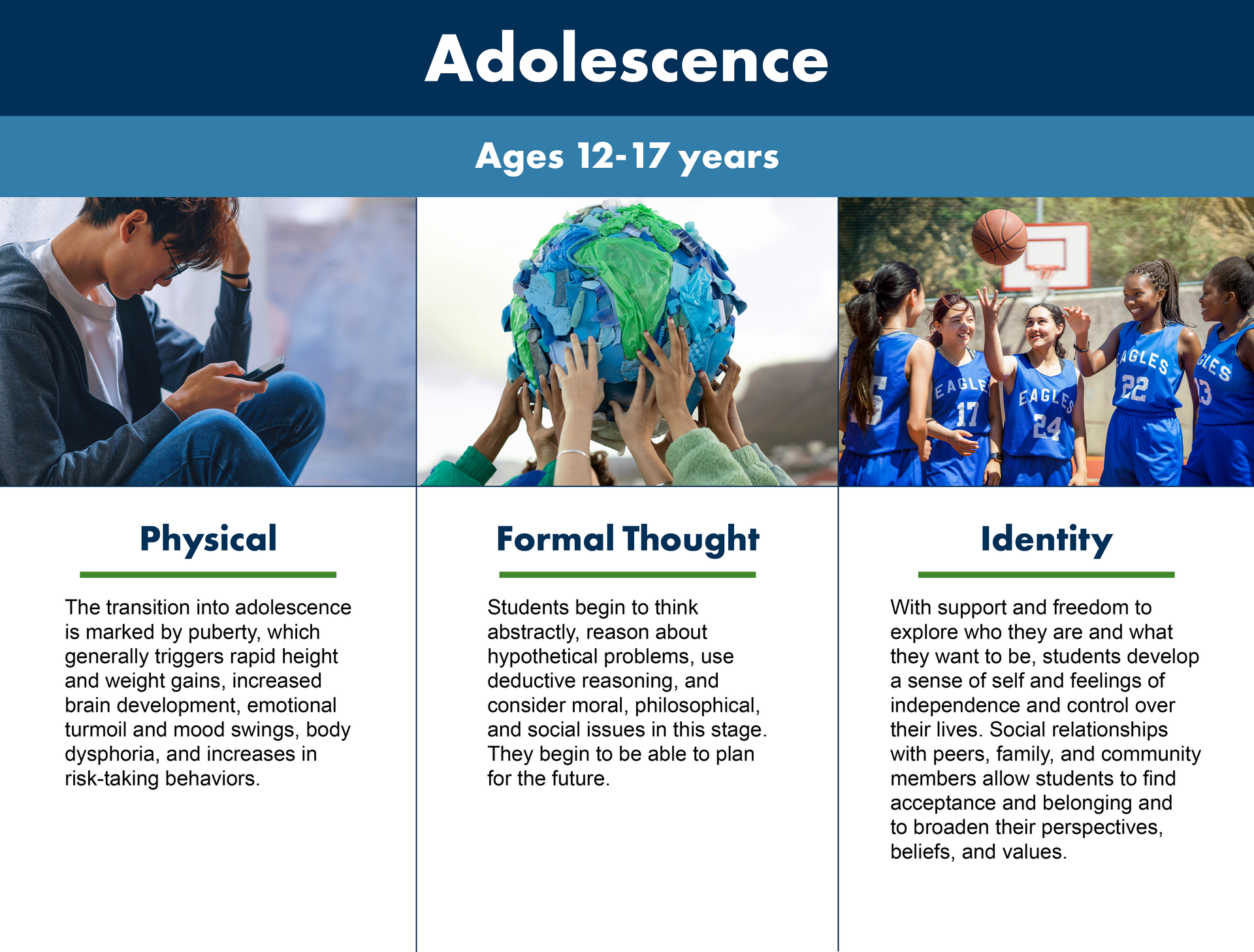
During the adolescent stage, which usually happens between ages 12 to 17, children go through significant physical and cognitive changes. The physical changes are characterized by puberty including the development of secondary sexual characteristics, growth spurts, and changes in the body. Hormones also affect their emotions and behaviors, and they start to want more freedom to be independent and figure out who they are in their social groups.
Socially, adolescents wrestle with Erik Erikson's stage of identity versus role confusion. This phase involves exploring and shaping personal identity, which includes values, beliefs, and goals. Adolescents aim to understand themselves better and form a clear identity that matches how they see themselves and where they fit in the world. They might experiment with various roles, hobbies, and friendships as they work to define who they are and find a sense of belonging.
In terms of cognitive development, adolescents move into Piaget's formal operational stage. During this time, their thinking becomes more abstract, complex, and organized. They can imagine hypothetical situations, use deductive reasoning, and look at issues from different angles. Adolescents show better problem-solving abilities, critical thinking skills, and metacognition. They are better at understanding and analyzing abstract ideas, doing more advanced thinking tasks, and expressing themselves more clearly.
The characteristics of the adolescent stage have significant effects for your strategies. You should give adolescents chances to explore their interests and values through self-reflection, discussion, and experiential learning. Curriculum should be designed to encourage critical thinking, creativity, and independent inquiry, so they can deal with complicated ideas and form their own opinions. You can help adolescents grow their thinking skills by encouraging metacognition, collaboration and experiential learning. Creating a supportive and inclusive classroom is crucial for making them feel good about learning and developing as individuals. Figure 2.7 provides a summary of adolescent development milestones.
Figure 2.7. Adolescent