Vectors
INTRO TO VECTORS
Vector vs. Scalar quantity:
Vector quantity contains magnitude and direction.
Scalar quantity can be represented with one number.
TIPS: If the example gives only a direction, it is refering to a scalar quantity, whereas if the example provides magnitude AND direction, then it is refering to a vector quantity.
EXAMPLES:
A hockey puck is an example of a vector quantity because it has a specific speed and direction on the ice.
A tennis ball served at 110 miles per hour is scalar because no direction is given, only magnitude.
Resultant Vector:
The vector that results from the addition of two or more vectors.
Basically, if the two vectors are going in the same direction, then add them. If they are going in opposite directions, then subtract.
Example for addition and subtraction:
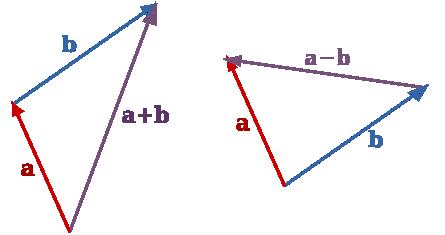
For addition, the vectors are going the same way. For subtraction, however, the vectors are going in the opposite direction. If the vectors are being shown by lines, then it is possible to rearrange the vectors to either add or subtract. However, if the vectors are being shown with terms (using letters like x, y, z), then it is easier to add or subtract based on the direction implied by the terms.
Example:
If we have vectors going (6i-7j-8k) and (3i-2j-8k), the vectors are going in the same direction since all the coefficients match up (i is positive, j is negative, k is negative), so we would add.
If we hae vectors (-8i+2j-9k) and (3i+7j+4k), then we would subtract since the vectors are NOT going in the same direction (i is negative and positive, both j’s are the same, k is positive and negative).
Tips: When connecting vectors, connect the terminal point (arrow) to the initial point (dot).
Using Vectors for Real-Life Applications:
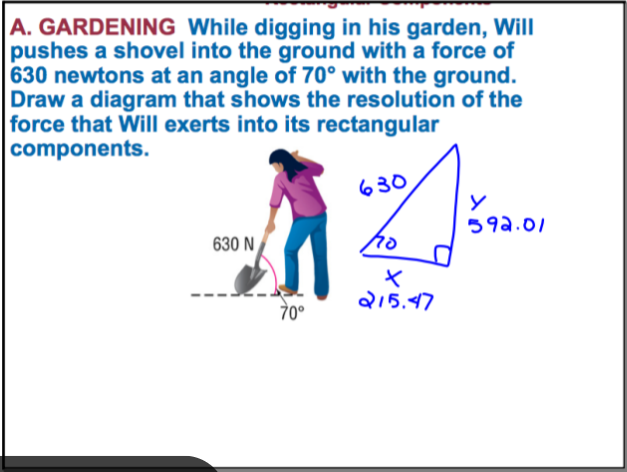
The force Will is exerting can be pictured using a right triangle (as above). This allows us to draw out Will’s force and calculate the other lengths using Law of Sines (we are given two angles, 70 and 90, and one side. We can use the two angles to find the last angle and set up a Law of Sines equation).
TIPS: Law of Sines and Cosines will be handy when dealing with these types of problems. Again, when creating a triangle with vectors, connect the terminal point (arrow) to the initial point (dot).
Video on the parallelogram method: This method visually demonstrates how to add two vectors by placing them head to tail and forming a parallelogram, with the diagonal representing the resultant vector. Law of Cosines and Sines are useful for figuing out the magnitude of the resultant vector.
VECTORS ON A COORDINATE PLANE
Expressing Vectors in Component Form:
Component form is expressed when you have two vectors, A=<x1, y1> and B=<x2, y2>
Component form is <x2 - x1, y2 - y1>
Magnitude of a Vector:
Magnitude of a vector is √(x2 - x1)2, (y2 - y1)2
Vector Operations:
Vector Addition: A+B=<x1 + x2, y1 + y2>
Vector Subtraction: A-B=<x1 - x2, y1 - y2>
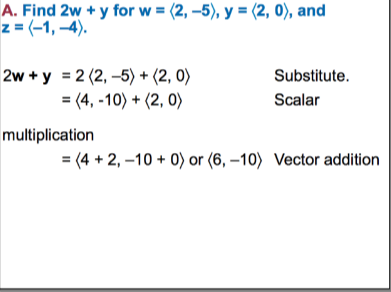
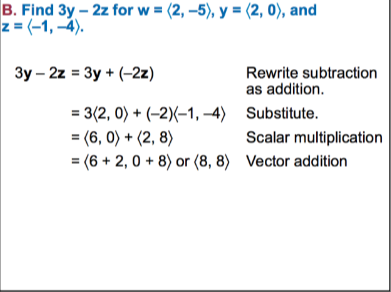
There will be substitution for vector operations, so I’ll attach some screenshots from notes
Vector Addition Example:
Vector Subtraction Example:
Unit Vectors:
u = (1/√(x2 + y2 )) v
Examples:
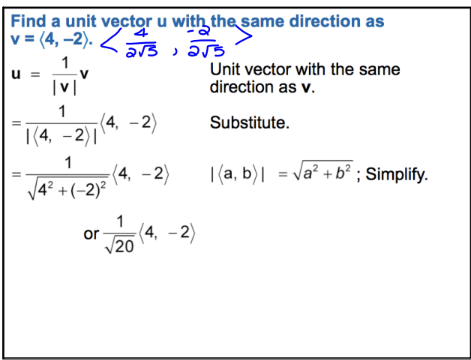
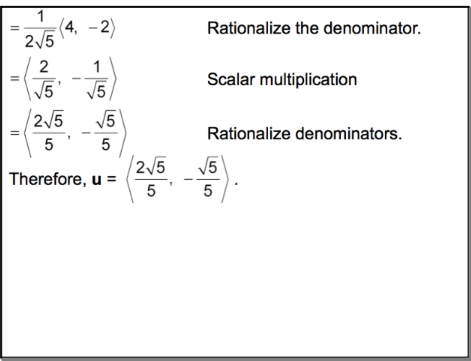
Component Form:
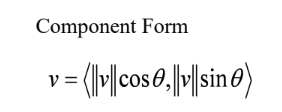
Fairly simple. Plug in the numbers given.
Example:
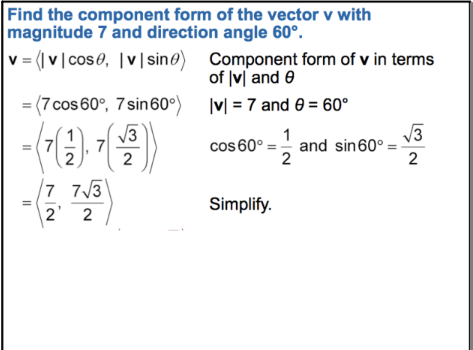
DOT PRODUCTS AND VECTOR PROJECTIONS
Dot Products/Orthogonal Vectors:
Dot products: A = <A1, A2> and B = <B1, B2>
A * B = A1B1 + A2B2
If A * B = 0, then the angles are orthogonal.
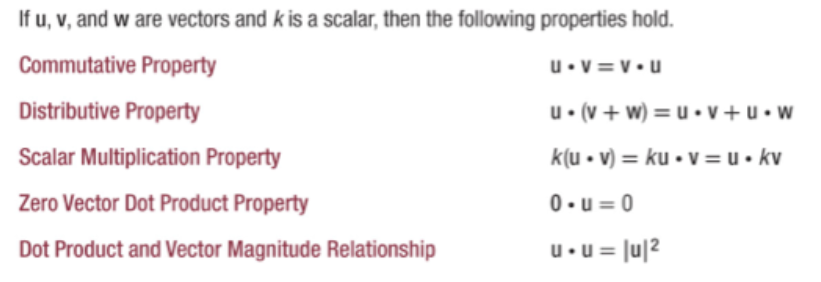
Dot Product Properties:
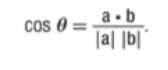
Angle Between Two Vectors:
Tips:
For the “a” and “b” below, think of it as (√x12 + y12) * (√x22 + y22 ) if a = <x1, y1> and
b = <x2, y2>
Don’t forget to inverse the cosine to find theta.
Vector Projections:
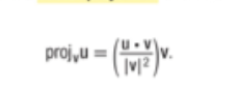
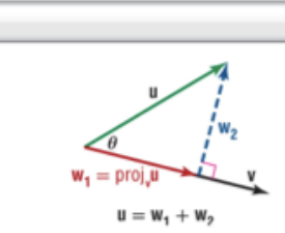
The equations u = w1 + w2 can be rearranged.
u = proj + w2
w2 = proj - u
Examples:
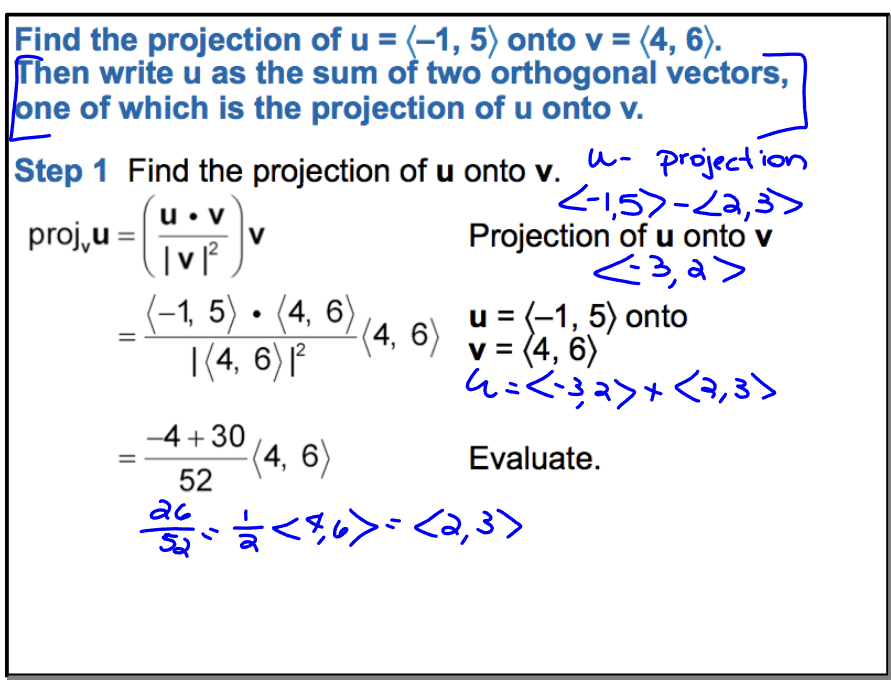
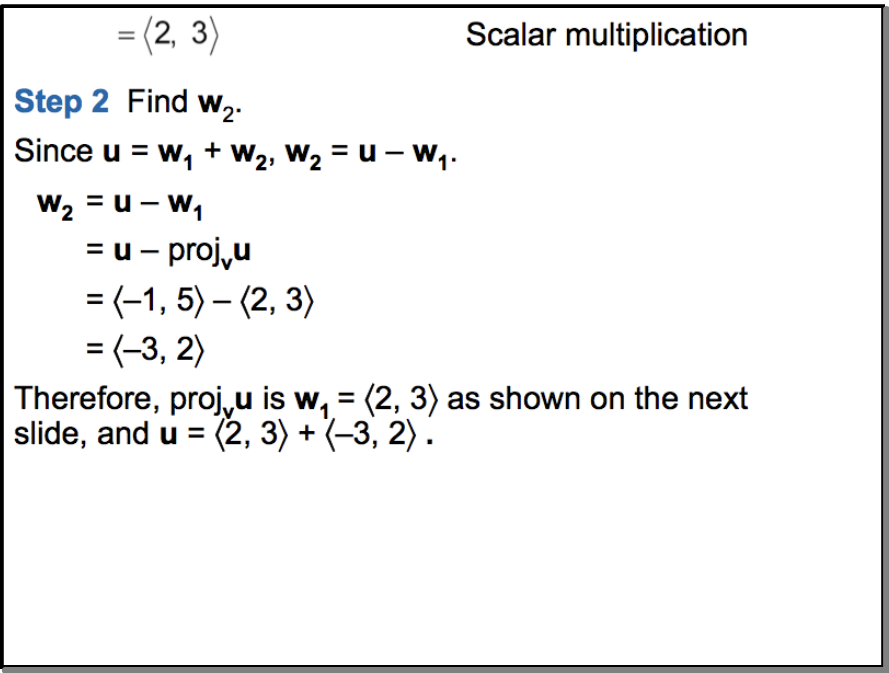
Tips: The bottom of the projection equation would normally contain a square root, but since it is being squared, no need to write it in.