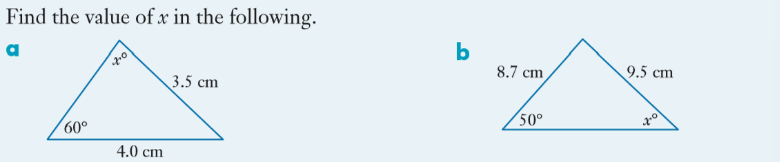
The Sine Rule
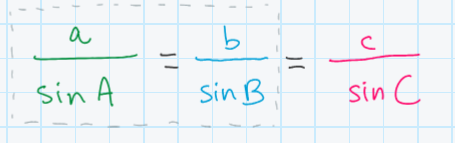
Finding sides (put sides on the numerator):
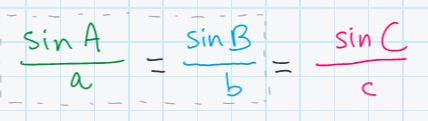
Finding angles (put angles on the numerator):
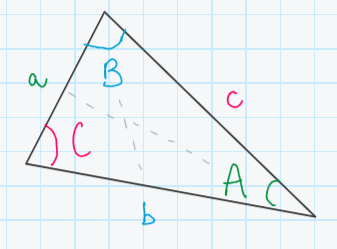
Use the sine rule for non-right angle triangles when two sides and two angles are involved (one of which will be unknown).
You must use two sides and two angles which are opposite each other (matching pairs). When you draw a line to connect them, a cross must form.
Ambiguous Case of the Sine Rule
The fact that two triangles can be produced links to the ambiguous case of the sine rule.
The ambiguous case not only happens when you’re given two sides and an acute angle not between them (SSA). If the angle is acute, you might get 0, 1, or 2 triangles.
If the angle you’re given is obtuse or right, you can get at most one triangle - so the situation isn’t ambiguous.
To figure out how many triangles are possible, you need to consider the length of the sides given, remembering that longer sides are always opposite larger angles.
For Example: