(editing)Facts 1789-1792
Opening of the Estates General and the consequences in Paris | 5th May 1789 | Elected deputies went to represent an area at the Estates General. The deputies were predominantly lawyers to represent the bourgeoisie. The fact that they were lawyers was crucial as it meant that the representatives were educated, thus, could critique the laws of the land. Despite the air of enthusiasm, Necker’s address failed to confront the most pressing issues: voting by head and a new constitution. The death of Dauphin on the 4th of June caused the King to go into mourning, postponing the issues that the Estates General had been called for, this aggravated many of the third Estate representatives. On the 3rd of June the Third Estate escalated things by insisting that the credentials of those who claimed to have been elected should be verified in a common session of all the deputies of the three estates. The Third Estate refused to do anything until the other two joined them. This meant weeks of inaction followed and the government did..On the 10th of June the Third Estate began verifying the deputies credentials without the approved authority. They became agents of their own change. Much of what was happening at Versailles was being fed back to Paris. The centre of political debate was the Palais Royal, owned by the Duc D’Orleans, who opened the Palais to the public in 1780; the writings from this encouraged the Third Estate to rise up, creating an atmosphere of sedition. The ‘talk’ that was generated here from authors and pamphleteers in Versaille was then fed back to Versailles where it entered into the debates. |
|
The Third Estate declares itself the National Assembly | 19th June 1789 | Now a political force, the Third Estate voted on naming themselves the National Assembly and by June 19th, the Clergy had voted to join the Third Estate. Now that they were no longer just the Third Estate, the unifying name presented them as a more holistic representation of the people. This is a key defining moment as the title gave the group greater legitimacy; which in the early days of the revolution was a large question on who the legitimate authority laid with. Louis' response to this was that it was ‘just a phrase’, severely underestimating the significance of this event. |
|
Tennis Court Oath and the King’s Olive Branch | 20th June 1789 | Louis decided to hold a seance royale (a session of the Estates General in the presence of the Monarch) where he would propose a series of reforms. The date was set for 23rd of June. On 20th of June, the deputies of the Third Estate found that the hall in which they met had been closed to prepare for the meeting. None of the three orders had actually been informed of the seance royale, thus, were paranoid that a plot to silence them was afoot. The assembled deputies were consequently furious. They found an empty tennis court and took the infamous Tennis Court Oath. It declared: “Nothing can prevent (the assembly) from continuing its discussions”. Necker advised the King that a seance royale was now essential. He advised Louis to accept the notion of voting in common. The Queen and his brothers protested and Louis bowed to this pressure. On 23rd of June, Louis decided to ignore the events of 10th-17th of June and said that the privileges of the nobles and clergy could not be discussed. The King was prepared to accept reforms however, including restrictions on his authority. The Third Estate would probably have accepted the reforms Louis presented back in May but now the mood had changed; they did not go far enough. The King only urged the clergy and nobility to give up their financial privileges. It was additionally declared that the three estates were sacrosanct and that spectators were excluded from future sessions. The King ended the session with a clear threat. Nothing the Estates did was valid without his approval. If they refused to cooperate, he would assume the role of sole decision-maker on behalf of the people as the only 'true representative' of the people. |
|
Storming of the Bastille Not finished, the is just lead up | 14th July 1789 | Whilst Louis compromised, he also had soldiers surrounding Paris to contain the reaction of the people from the ‘political revolution’, Louis didn’t use normal soldiers as they would have more loyalty to the French people than the King. This use of foreign troops created tensions and suspicions within Paris (The foreign units caused consternation amongst the people and the representatives as many thought that Marie Antoinette was behind their arrival). By doing this Louis exacerbated the issue which was already present. Louis had ordered troops to move into Versailles and Paris on 22nd of June. By the end of June, 4,000 troops were stationed around Paris. Many of these troops were elite army units whose loyalty Louis believed to be unbreakable. Crucially, large numbers of officers and men of the regular French Army (Guardes-Francaise) were on the verge of mutiny and were unlikely to fire on the crowds. The government claimed it was merely to maintain order and this was believable until the last days of June. On 26th of June, 4,800 extra troops were ordered into Paris and then on 1st of July, another 11,500 were moved in. It seemed the National Assembly was to be dissolved by force. In the end, the Assembly was saved by the people of Paris. |
|
The Paris Commune | 10th-17th July 1789 | The Bourgeoisie of Paris feared for their private property and also the King's intentions. So, on the 9th of July, the National Assembly became the 'National Constituent Assembly'. On the 10th the Paris Committee created a citizens militia to safeguard Paris.Then on the 15th the Paris-electors voted to create a new civic body - the commune with Sylvain Bailly as its head. The militia became 'The National Guard' and was placed under Lafayette's command. On the 17th of July, Louis visited the Hotel-de-Ville and officially recognised the revolution and donned the revolutionary cockade. This point onwards has a potential significance towards legitimacy. There is an open ended answer to control and legitimate groups. The N.C.A desperately cling to this notion. |
|
Great Fear | Late July 1789 | The peasants in the countryside heard rumours of what was happening in Paris, this miscommunication sparked violence from the peasants towards the Nobility in the respective provinces. The Great Fear, in summary, was a wave of riots that swept through France in July/August of 1789. These riots arose from economic suffering, the potential developments at Versailles and the fear of outsiders. In mid July the peasants heard rumours that the King and his aristocrats hired gangs of mercenaries (or brigands) to destroy their crops and property, as a means of imposing political control. They took up arms to defend themselves in an offensive way. The Great Fear not only exposed the depth of peasant feelings about feudal dues, it also caused some consternation amongst the Second Estate and deputies of the N.C.A. | |
August Decrees | 6th Aug 1789 | The August Decrees: Tithes, venality and all privileges were all abolished, additionally, equality of taxation for all citizens and meritocracy were introduced. By morning, noble, clergy and commoner deputies had voted to ‘abolish the feudal system entirely’. The details of this became the primary focus of the Assembly for the next two years. This was partly done so rapidly in order to assert legitimacy |
|
Declaration of the Rights of Man | Aug 1789 | Déclaration des droits de l’homme et du citoyen was passed by the N.C.A in August of 1789. The declaration was directly influenced by Thomas Jefferson working with Lafayette. Additionally influenced by the doctrine of ‘natural right’ (and Thomas Paine), the rights of man are held to be universal to everyone, always. (Didn’t apply to women, children, slaves or foreigners. So, ex-finance minister, Necker, would not have received these rights. Thus, still repressive.) Those who were deemed to hold these political rights were called ‘active citizens’. 4.3 million Frenchmen out of a population of 29 million gained the vote. Thus, ‘passive citizens’: 24.7 million. This was revolutionary, yet limited. |
|
October Days | Oct 1789 | Female sans-culottes stormed Versailles with the hopes of confronting Marie-Antoinette with knives; in response to a disgraceful feast despite the agricultural crisis France was facing. The aim was to get Louis to accept the August Decrees. Lafayette and the National Guard turned up at the last minute to save Marie-Antoinette. |
|
Church property seized | 2nd Nov 1789 | Church lands were nationalised on 2nd November, 1789. A huge amount of land was sold in 1791-2. The main beneficiaries were the bourgeoisie as they had the money to buy the land. The Biens nationaux (nationalised land) was sold off in large plots and the bourgeoisie bought the land that surrounded the towns. Peasants fared better the further away from towns they were. Many peasants who bought land were first-time land owners and even where the bourgeoisie bought most of the land they resold it to peasants in smaller parcels. The nationalisation of church land meant a significant increase in the number of small-scale landowners. It also meant that the state now paid the clergy's salaries. |
|
Assignant issued | Dec 1789 | Assignats were introduced: these were paper money printed by the government from April 1790. They were bonds to be exchanged for church lands. | |
The Civil Constitution of the Clergy | 12th July 1790 | Despite fairly radical reforms, there was little conflict between Church and state until the Civil Constitution of the Clergy was approved on 12th July 1790. The sale of Church land forged a link between the revolution and the landed proprietors who had bought the land. In order to extend the reforming principles applied to other aspects of French society to the Church, measures were introduced between August 1789 and February 1790: Tithes, pluralism and annates were all abolished, the don gratuit was abolished. Contemplative monastic orders (those that did not undertake any charity work or community work) were abolished. Protestants were to receive equal civil rights (Jews were given these in September 1791). The Civil Constitution of the Clergy tied the Church to the administrative system that had been brought in: All except parish priests and bishops were abolished. All bishops had to be approved by the French State - appointments by the Pope alone would not be recognized. All priests and bishops were to be elected by ballot and by absolute majority of those who voted. Absenteeism was to be banned. Priests were to be paid by the State year. Quite surprisingly, the Church was willing to accept the changes in order to avoid a split in the French Church. It requested that the proposals be discussed in a National Synod. This was a fair request in many respects but the Assembly did not want to give the Church a separate platform to discuss these changes - it was seen as bestowing on the Church a privileged position - something the Assembly had just abolished. As a Church Assembly was not allowed, the verdict of the Pope was eagerly awaited by the clergy. The Pope was involved in delicate negotiations over Avignon (territory in Southern France controlled by the Pope). Tired of waiting for a decision, the Assembly decreed that the clergy had to take an oath to the Constitution. |
|
Oath to the Civil Constitution is introduced | Nov 1790 | A forced oath for all clergy members to pledge allegiance to the revolution, denouncing foreign influence. |
|
Political clubs | Jacobins: The Jacobin Club included both prominent parliamentary factions of the early 1790s, the Mountain and the Girondins (deputies from the Gironde region of Bordeaux). The name Jacobins, given in France to the Dominicans (because their first house in Paris was in the Rue Saint-Jacques), was first applied to the club in ridicule by its enemies but was reclaimed by the members. Feuillants: It consisted of monarchists and reactionaries who sat on the right of the Legislative Assembly of 1791. It came into existence on 16 July 1791 when the left-wing Jacobins split between moderates (Feuillants), who sought to preserve the position of the king and radicals (Jacobins), who wished to press for a continuation of direct democratic action. Cordeliers: These radicals all hailed from the Cordeliers district in Paris and had played key roles in the storming of the Bastille. The society held its meetings in the Cordeliers Convent and quickly became known as the Club des Cordeliers. The Cordeliers leadership were mostly bourgeoisie but they had a loyal following from the Sans-Culottes. |
| |
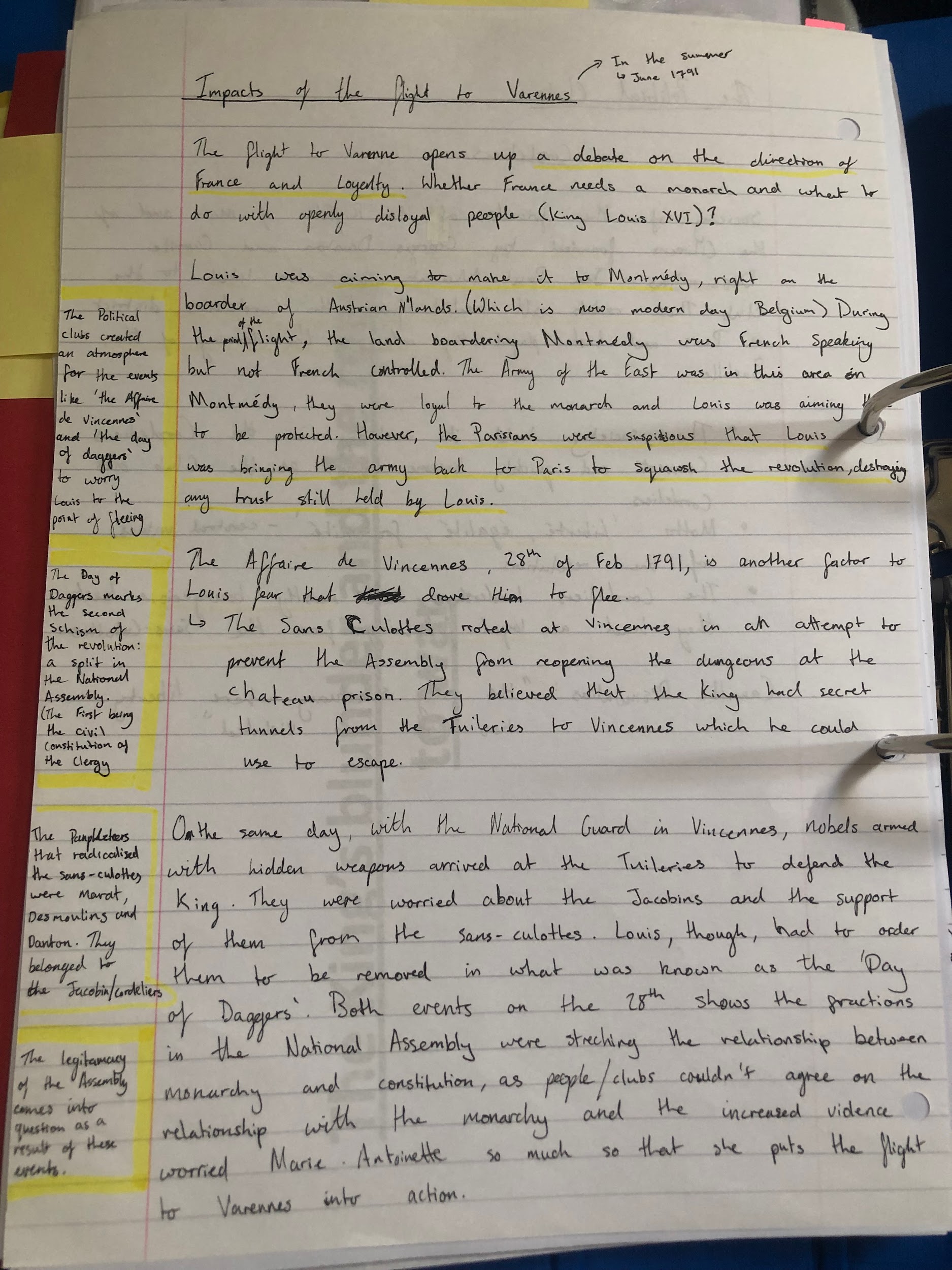
The Affaire de Vincennes and the ‘Day of Daggers’ | 28th Feb 1791 |
| |
The Royal family’s flight to Varennes | 20th June 1791 | The Flight to Varennes, during the night of 20th-21st of June 1791, was a bungled attempt by the Royal Family to escape Paris. Despite best laid plans, the Royal carriage escaped only as far as the small town of Varennes, where they were arrested after having been recognized at their previous stop in Sainte-Menehould. The plot was thwarted by the postmaster of Sainte-Menehould, who recognized the king from his portrait printed on an assignant. Detachments of Royalist cavalry, posted along the intended route, had been withdrawn or neutralised by suspicious crowds before the large and slow moving coach being used by the royal party had reached them. The intended goal of the unsuccessful flight was to provide the king with greater freedom of action and personal security than was possible in Paris. The troops under his command included two Swiss and four German mercenary regiments. When the royal family returned under guard to Paris, the crowd Silent. The King was supposed to be seen as a unifying symbol for France but was now instead a cowardly traitor. This created the debate on the abolition of the monarchy and the potential establishment of a republic. Ultimately, it caused Louis' suspension from office in July of 1791. |
|
Champ de Mars | 16th-17th July 1791 | After the Constituent Assembly declared that Louis would remain King after the flight to Varennes and retain his suspensory veto, Brissot created a petition calling for the removal of the King. From 6,000 people, the crowd swelled to 50,000 along the march to Champs de Mars, in support of the petition. This crowd included the radicals, Danton and Desmoulins. The site was supposed to be symbolic (field of war), but peaceful. However, it turned into a massacre where 50 people were shot on the command of Lafayette by the National Guard. His reputation turned tyrannical and Bailly, mayor of Paris, was later executed for his role in the event. |
|
Declaration of Pillnitz | Aug 1791 | The declaration was so significant because it appeared to be a threat to interfere with French internal affairs. Enemies of the King considered that the declaration justified their opposition and mistrust of the monarchy. However, it wasn’t truly a threat as other powers, such as Britain, wouldn’t have joined the Austrians. | |
Constitution of 1791 | Sep 1791 | The constitution consisted of the King’s right to appoint his ministers (although they could not be members of the Assembly) and military commanders. His veto could not be applied to financial or constitutional matters such as taxation. The King needed the consent of the Assembly to declare war and that the King was subject to law, thus, could not rule without the consent of the Assembly. The new system was underpinned by the bourgeoisie, it was a slightly fairer system but disproportionately benefited the bourgeoisie as they bought up most of the Church lands and were the only ones wealthy enough to become national deputies. |
|
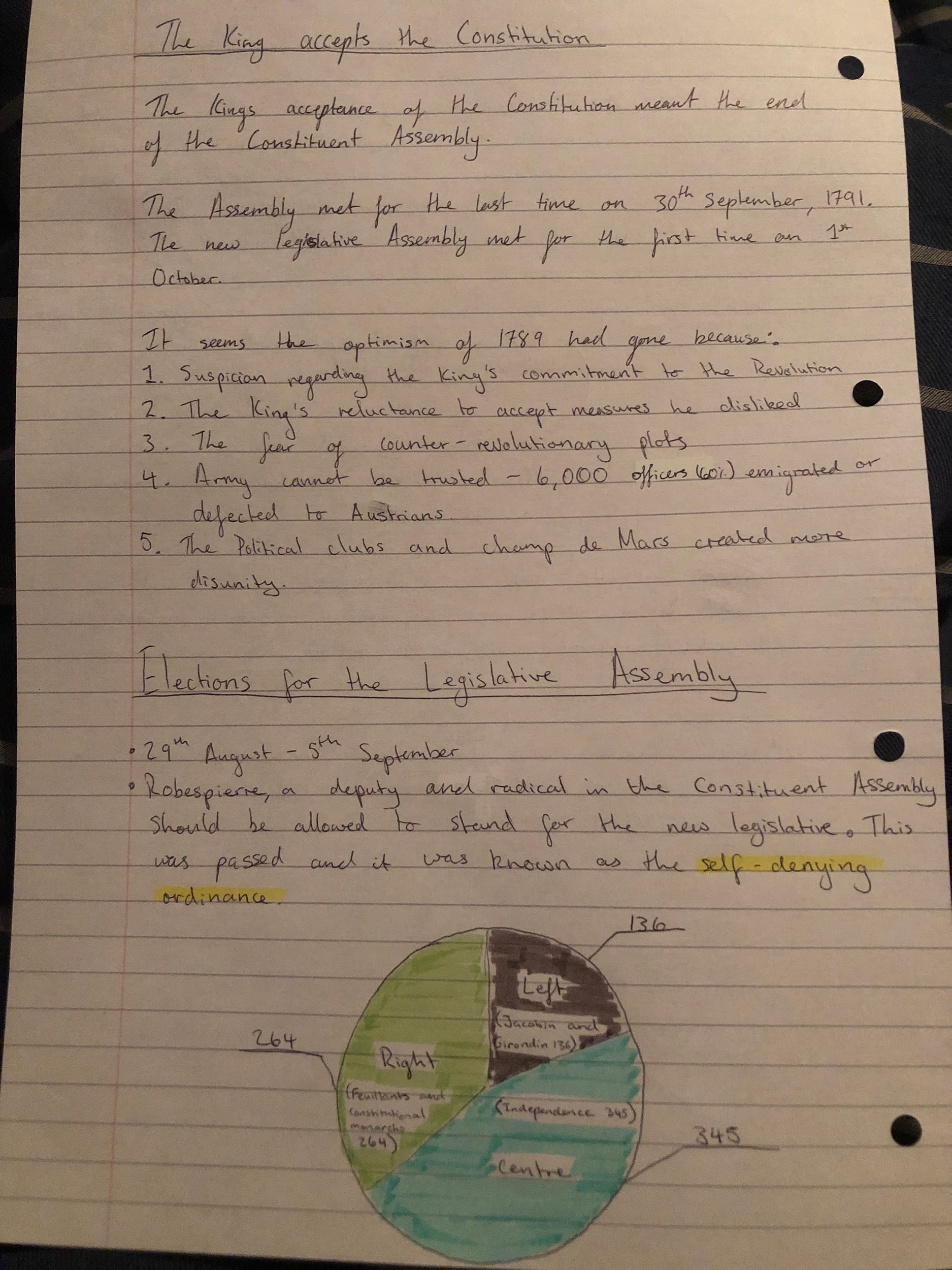
Legislative Assembly meets | 1st Oct 1791 |
The optimism of 1789 had disappeared because:
| |
Decrees against emigres and refractory priests | Nov 1791 | All refractory clergy were suspected; their property was to be confiscated. All emigres still out of France on Jan 1st 1792, would forfeit their property and be regarded as traitors. |
|
Declaration of war on Austria | 20th April 1792 | Leopold’s death in 1792 led to the ascension of young and ambitious Francis II of Austria, who accelerated war plans. France declared war on the 20th of April. Prussia then joined in June of that year, under the leadership of the vastly experienced Duke of Brunswick. | |
Dismissal of Girondin ministers | 13th June 1792 | After Louis' refusal of the laws passed on the 27th May; 1. Deportation of refractory priests, 2. Disbandment of the King’s Guard, 3. The establishment of a camp for 20,000 National Guards (federes), the Girondin protested. Louis promptly dismissed them on the 13th of June. Here, Louis fell into Brissot’s trap to expose Louis' treachery against the French people. |
|
Sans-culottes’ first journee to the Tuileries | 20th June 1792 | Leaders of the Paris sections led an armed demonstration on the Tuileries in response to the King’s actions. Louis responded by toasting to the health of the Nation whilst wearing the bonnet rouge. This action calmed some turmoil. The Girodins moved towards helping the King in a hope for a united governmental effort to prevent imminent uprisings planned by the federes and section leaders. The Girodins' ministers warned Louis that future uprisings would be worse than what happened on the 20th of June. This support was conditional on the reinstatement of the dismissed ministers on the 13th of June. Louis refused. |
|
Déclaration La patrie en danger | 11th July 1792 | The issuance of this decree called on every Frenchman to fight. The Sans-culottes demanded the admission of passive citizens into sectional assemblies and the National Guard in exchange. Their requests were granted by the end of July. The Bourgeoisie's grip on power was loosening and the Sans-culottes growing. The deputies' need for soldiers put them in a position where they could be pressured. |
|
Publication of Brunswick Manifesto | 25th July 1792 | The Brunswick Manifesto outlined demands; liberty to Louis and his family, if Louis was harmed by the parisians then the Austrians and Prussians would burn Paris to the ground, finally, the manifesto claimed that the revolution was forced upon France by the radicals by appealing to the Frenchmen outside of Paris to insinuate divisions in the cause. The Parisians mocked the manifesto. |
|
Sans-culottes’ second journee to the Tuileries | 10th Aug 1792 | The anger over Louis’ traitorous behaviour resulted in a storming of the Tuileries which was defended by the Swiss Guard. Half-way through the Swiss surrendered, however, as the emblem of the monarchy, as the built up anger was directed towards them. Thus, were butchered whilst defenceless. |
|