(CHP 2) Understanding Interests, Interactions, and Institutions
Interests: What Do Actors Want from Politics?
Interests: What actors want to achieve through political action; preferences of actors over the possible outcomes that might result from their political choices
Grouping of interests
Power or Security
Must fire be safe from threats as a prerequisite to all other goals
Economic or Material Welfare
Political actors are presumed to want higher standards of living
Ideological Goals
What political actors want or believe to be good and desirable
Actors and Interests
Actors: The basic unit for the analysis of international politics; can be either individuals or groups of people with common interests
State Interests = Security, power, territory, wealth, ideology
Politicians = Reelection/retention of office, ideology, policy goals
Firms, industries, or business associations = Wealth, profit
Classes or factors of production = Material well-being, wealth
Bureaucracies = Budget maximization, influence, policy preferences; often summarized by the adage of “where you stand depends on where you sit”
International Orgs = As composites of states, they reflect the interests of member states according to their voting power. As organizations, they are assumed to be similar to domestic bureaucracies
Nongovernmental organizations, often transnational or international in scope and membership: Moral, ideological, or poligy goals; human rights; the environment; religion
State: A central authority that has the ability to make and enforce laws, rules, and decisions within a specified territory
Sovereignty: The expectation that states have legal and political supremacy within their territorial boundaries
Anarchy: The absence of a central authority with the ability to make and enforce laws that bind all actors
National Interests: Interests that belong to the state itself
Interactions: Why Can’t Actors Always Get What They Want?
Interactions: The ways in which the choices of two or more actors combine to produce political outcomes
Cooperation and Bargaining
Cooperation: When two or more actors adopt policies that make at least one actor better off without making any other actor worse off
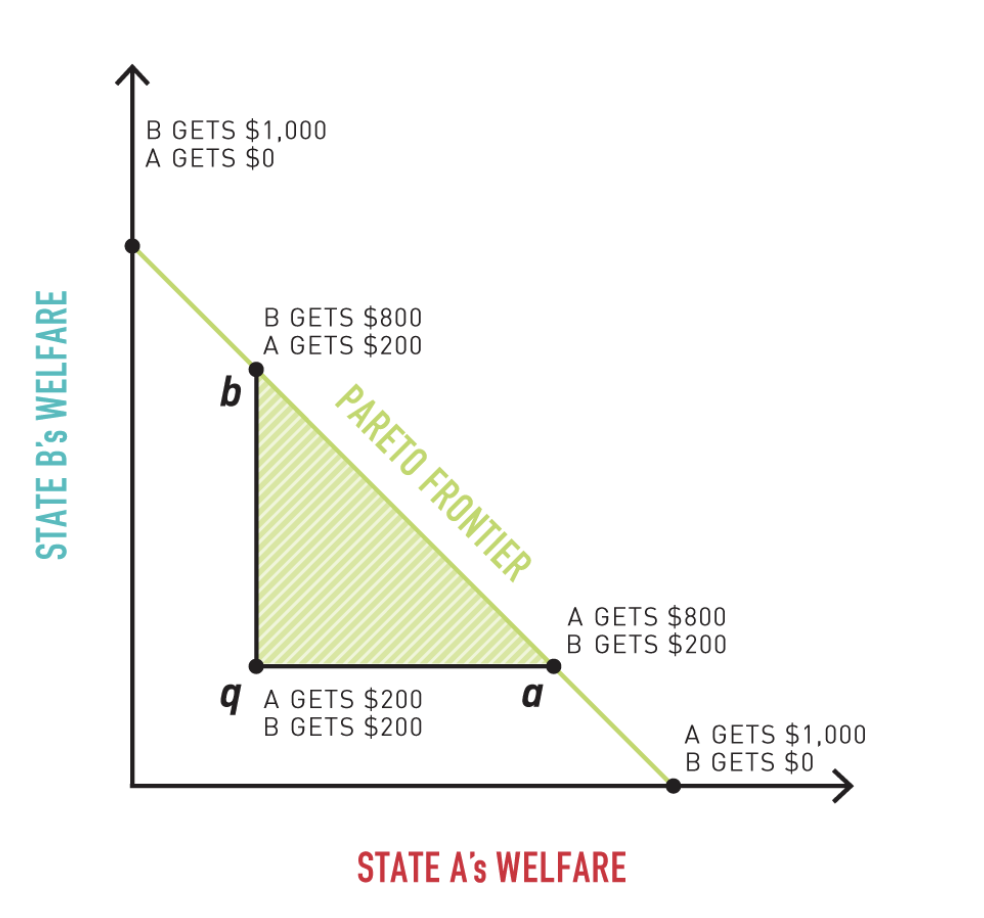
Any policy combination that leads to an outcome in the shaded area qba would make both actors better off than they are under the status quo
Any policy combination on the Pareto frontier between b and a makes the actors as well off as possible
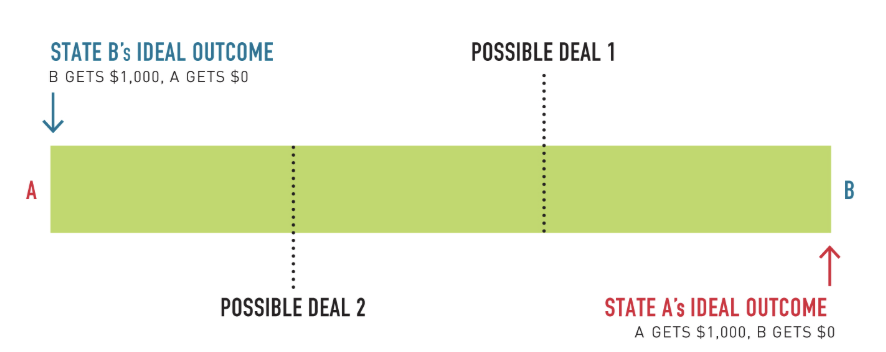
Bargaining: An interaction in which two or more actors must decide how to distribute something of value. In bargaining, increasing one actor’s share of the good decreases the share available to others.
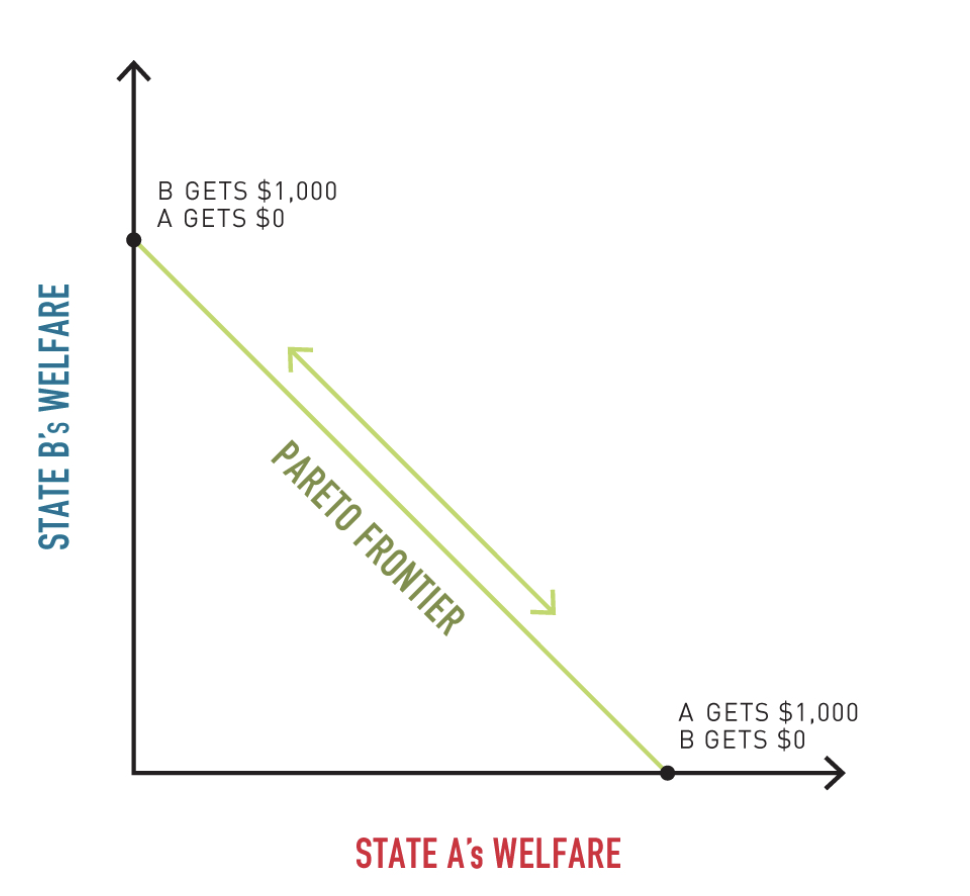
When actors bargain, they move along the Pareto frontier, as represented by the green arrow
On the frontier line, any improvement in A’s welfare comes strictly at the expense of B’s welfare
When Can Actors Cooperate?
Coordination: A type of cooperative interaction in which actors benefit from all making the same choices and subsequently have no incentive not to comply
Collaboration: A type of cooperative interaction in which actors gain from working together but nonetheless have incentives not to comply with any agreement
Ex: Prisoner’s Dilemma
Public Goods: Products that are non-excludable and non-rival in consumption, such as national defense or clean air or water
Collective Action Problems: Obstacles to cooperation that occur when actors have incentives to collaborate but each acts with the expectation that others will pay the costs of cooperation
Free Ride: To fail to contribute to a public good while benefiting from the contributions of others
Numbers and Relative Sizes of Actors
Smaller the number of actors = more likely to cooperate
Iteration, Linkage, and Strategies of Reciprocal Punishment
Iteration: Repeated interactions with the same partners
The more likely you are to interact with someone else again the more likely you are to want to cooperate
Ex: You might tip more at a restaurant you expect to visit again, compared to a restaurant you don’t expect to go ever again
Linkage: The linking of cooperation on one issue to interactions on a second issue
Enables victims to retaliate by withholding cooperation on other issues
Information
When actors lack information about the actions taken by another party, cooperation may fail because of uncertainity and misperception
Who Wins and Who Loses in Bargaining?
Cooperation = Potential to make actors collectively better off
Bargaining = Winners or Losers
Power: The ability of Actor A to get Actor B to do something that B would otherwise not do; ability to get the other side to make concessions and to avoid having to make concessions oneself
The outcome that occurs when no bargain is achieved is often called the reversion outcome
Actor more satisfied with reversion outcome = Less incentive to make concessions in order to reach bargain
Actor less satisfied with reversion outcome = Desperate to reach agreement and offers bigger concessions to make the satisfied actor agree
To shift the reversion outcome in their favor, actors have three basic ways of exercising power:
Coercion
Outside options
Agenda setting
Coercion
Coercion: A strategy of imposing or threatening to impose costs on other actors in order to induce a change in their behavior
Factors = Military force & economic sanctions
Outside Options
Outside Options: The alternatives to bargaining with a specific actor
Both sides may have outside options, but the side with the more attractive outside option has larger bargaining power to threaten to walk away
An outside option would be US imposing sanctions on an item China uses, but China just deciding to buy said item from Brazil instead
Agenda Setting
Agenda Setting: Actions taken before or during bargaining that make the reversion outcome more favorable for one party
Institutions: Do Rules Matter in World Politics?
Institutions: Sets of rules, known and shared by the relevant community, that structure interactions in specific ways
Generally serve to facilitate cooperation among their members
How Do Institutions Affect Cooperation?
There is no central authority at the global level (anarchy)
International institutions do not generally enforce cooperation among their members
Affect cooperation through:
Setting standards of behavior
Verifying compliance
Reducing the costs of joint decision making
Resolving disputes
Setting Standards of Behavior
Clear standards of behavior enable others to determine whether an actor is violating an agreement
Verifying Compliance
Outside inspectors coming into countries to verify compliance
Reducing the Costs of Joint Decision Making
Societies create political institutions—rules of the political game—that define how joint political decisions will be made (otherwise the cost to consider all potential decisions would be too big)
Resolving Disputes
Ruling on whether a given action is allowed or not according to the standards of the institutions
Resolve ambiguities in agreements
Increase the expectation that violations will be called out
Bestow legitimacy on efforts to sanction violators
Whom Do Institutions Benefit?
All institutions reflect particular policy biases
Why Follow the Rules?
Agree to comply with rules for the broader cooperation they facilitate
Actors comply with institutions because they are already in place and often cheaper than creating their own institution that sides ideologically with them
Lecture Notes
What is social science?
Finding and understanding systemic patterns and relationships in the social world
So, political science is interested in discovering these patterns in the political world (a subset of the social world)
International relations is interested in the discovery of systematic patterns of politics across state borders
It is not interested in idiosyncratic, random events, but rather in the systemic, predictable ways in which different factors influence each other
Social Science Research
Asks a question about patterns in the social (political) world
Proposes a potential answer to that question
Uses data to test the likelihood that this answer is true
Explains why this pattern (or lack thereof) is important
Types of Questions
Normative: What should be done about an issue?
Editorials in newspapers
Hypothetical: What would happen if something else happens?
Political forecasting, briefings
Factual/procedural: Facts about the world
These have objectively right and wrong answers that are readily available, even if people choose not to believe them
Some political science papers fit under this category. We call this descriptive research.
Empirical: How does this attribute of the world work?
This is (mainly) where social science research lives
All the types of questions are connected
To do research, you first need to draw on some basic facts, so factual/procedural questions can help form the basis for identifying your broader empirical questions
What is the ratio of female to male leaders in the world?
This may lead you to make an empirical question
What are the effects of increasing the share of female leaders on the likelihood of war?
The answers to your empirical questions can then help inform hypothetical questions you have about the future or alternative states of the world
What would happen if the United States had a female president?
The answers to your empirical questions may also have normative implications that can be discussed as implications of your research
Increasing female representation in politics could decrease the frequency of deadly wars
Normative vs. Positivist Questions
Normative question:
Make some type of explicit or implicit value judgment (SHOULD)
“How can we solve the problem of pollution today?'“
Positivist question:
Seeks to uncover objective truths about causes and effects (IS)
“What are the effects of carbon emissions on global temperatures?”
You don’t care if the answer is not what you expected or wanted
What is a theory?
What is the relationship between two (or more) factors, why it exists, and when it holds true
Realism
Key Concepts:
Anarchy: No hierarchically superior, coercive authority that can create laws, resolve disputes, or enforce law and order
Creates insecurity and uncertainty over security
Power is always relative
Key implication of realism: the security dilemma
The only way to improve security is by balancing
How do states balance?
Build up arms (internal balancing)
Build up alliances (external balancing)
NEOREALISM: Not just power, But structure
Power still matters, but the most important thing is how it is distributed across the international system
Unipolarity
Bipolarity
Multipolarity
Neorealists: Bipolar is most stable
Liberalism
Key Ideas:
Institutional reform or collective action can moderate or even eliminate war, violence, injustice
Builds on earlier idealist school of thought
Collective security can be obtained through cooperation among nations
People are fundamentally good
Neo-Liberal Institutionalism
If realists are right and anarchy leads to conflict, why do we see so much cooperation?
Neo-Lib Inst. answer: Collective interdependence
States have various formal and informal interactions
States do not only care about security, but also share common interests
Absolute gains matter, not just relative ones
Domestic Sources of Liberalism
State is not a “unitary actor”
The structure of a state’s domestic political and economic system influences how it behaves internationally
Most influential here is the Democratic Peace Theory
Constructivism
Key Concepts:
“Fuzzier” ideas like norms and identities matter a lot
These ideas are socially constructed and thus malleable
E.G. What doe sovereignty mean?
It means what people decide it means
Fire in a theatre analogy
Marxism
Key Concepts:
Bourgeoise and Proletariat
Capital and Labor
Means of production
Roots of Imperialism:
Overproduction of goods/services
Underconsumption by workers
Oversaving by upper class
Corporations need to sell goods
So they expand abroad to find new markets
Dependency Theory
Lecture Summary
Realist → Balance of Power/Anarchy
Liberals → Domestic institutions
Constructivists → Socially constructed ideas
Marxists → Capitalism/means of production
Feminists → Gender
Critical theorists → Historical power structures