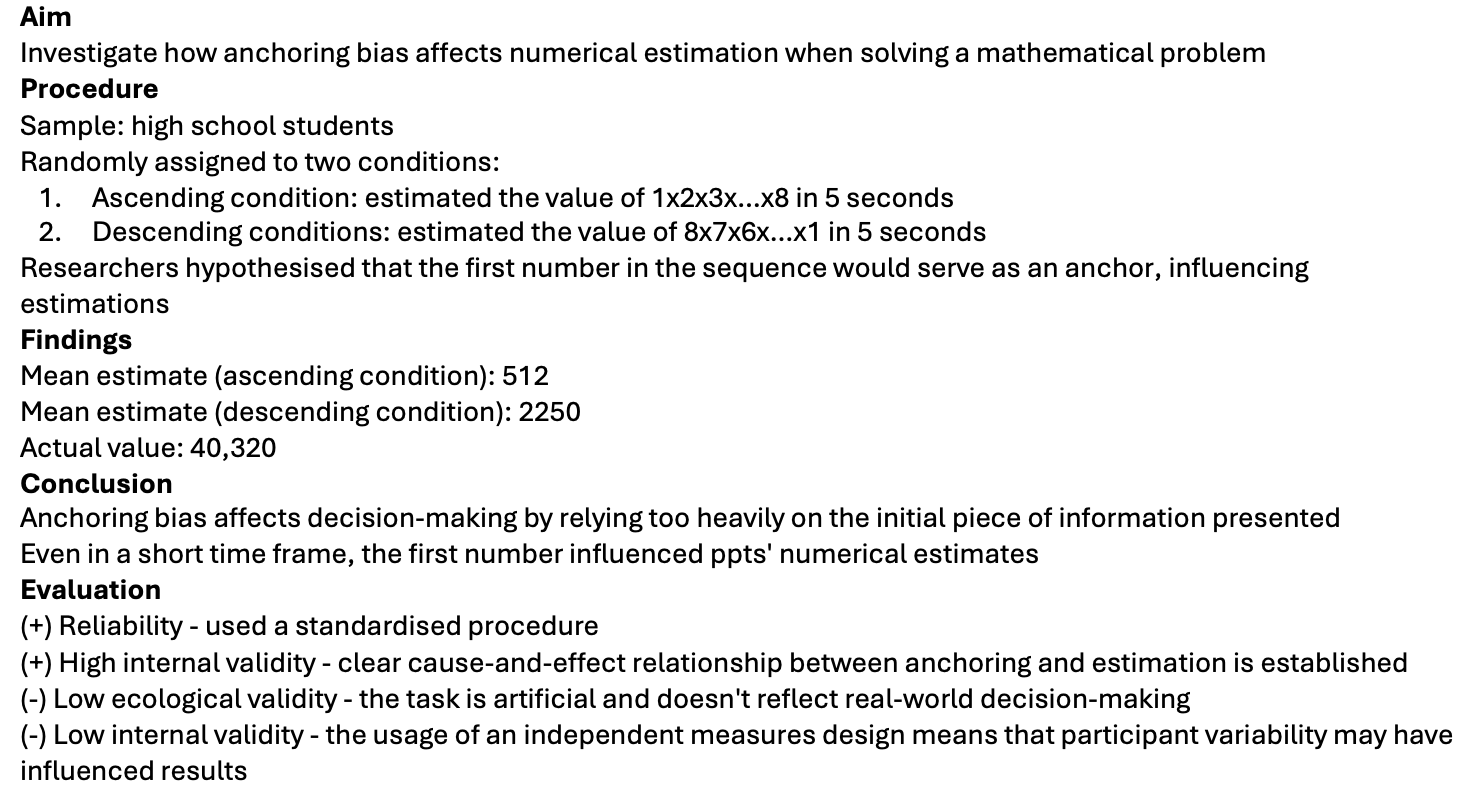
Tversky and Kahneman (1974) - Anchoring Bias
Aim
Investigate how anchoring bias affects numerical estimation when solving a mathematical problem
Procedure
Sample: high school students
Randomly assigned to two conditions:
Ascending condition: estimated the value of 1x2x3x…x8 in 5 seconds
Descending conditions: estimated the value of 8x7x6x…x1 in 5 seconds
Researchers hypothesised that the first number in the sequence would serve as an anchor, influencing estimations
Findings
Mean estimate (ascending condition): 512
Mean estimate (descending condition): 2250
Actual value: 40,320
Conclusion
Anchoring bias affects decision-making by relying too heavily on the initial piece of information presented
Even in a short time frame, the first number influenced ppts' numerical estimates
Evaluation
(+) Reliability - used a standardised procedure
(+) High internal validity - clear cause-and-effect relationship between anchoring and estimation is established
(-) Low ecological validity - the task is artificial and doesn't reflect real-world decision-making
(-) Low internal validity - the usage of an independent measures design means that participant variability may have influenced results