Unit 8 Review: Masterpieces of East and Southeast Asia
Chinese Art: Philosophy, Power, and Precision
Chinese art history spans thousands of years, primarily influenced by the philosophical interplay of Confucianism (social order, hierarchy, duty) and Daoism (harmony with nature, the flow of the universe or Qi). Additionally, the role of Buddhism and Imperial power structures shapes the visual culture.
Monumental Landscape Painting: Hanging Scrolls
Unlike Western art, which often uses a single vanishing point, Chinese landscape painting utilizes shifting perspectives, allowing the viewer to "wander" through the scene.
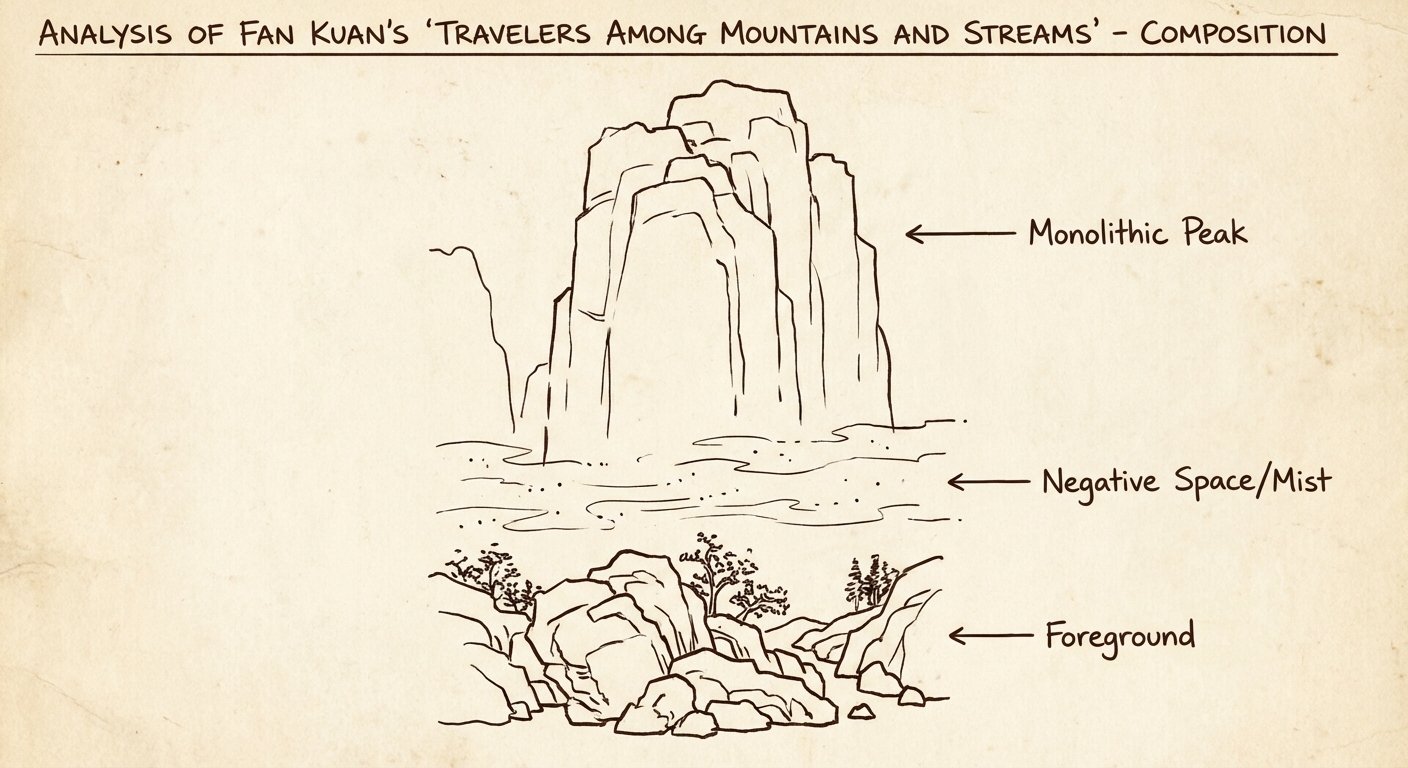
- Key Work: Travelers among Mountains and Streams (Fan Kuan, c. 1000 CE)
- Medium: Ink and colors on silk; Hanging Scroll.
- Philosophy: deeply Daoist. The mountains are massive and eternal, while the humans (mule train) are tiny, emphasizing the insignificance of man against the vastness of nature.
- Composition:
- Foreground: Large rocks detailed with "raindrop strokes."
- Middle ground: Travelers and trees.
- Background: Huge vertical mountains separated by a mist-filled void (negative space represents the spiritual breath or Qi).
The Art of Porcelain
Chinese ceramics reached a zenith during the Yuan and Ming dynasties. The key is the mastery of kaolin clay fired at high temperatures.
- Key Work: The David Vases (Yuan Dynasty, 1351 CE)
- Significance: These are the most important examples of blue-and-white porcelain in existence. They demonstrate global trade:
- Cobalt Blue: Imported from Iran (China did not have high-quality cobalt).
- Style:Modeled after bronzes.
- Motifs: Dragons (imperial power) and Phoenixes (empress/yin energy).
Imperial Architecture: The Forbidden City
Constructed during the Ming Dynasty and used through the Qing, this complex in Beijing was the political and ritual center of China for over 500 years.
- Layout: Based on Confucian principles of hierarchy. The entire city is built on a North-South axis.
- Symbolism:
- Isolation: The layout restricts access. Only the Emperor and immediate retinue could enter the inner sanctum.
- Hall of Supreme Harmony: The largest building, meant for grand ceremonies. It sits on a three-tiered marble platform.
- Colors: Yellow roof tiles symbolize the Emperor; Red walls symbolize good fortune.
Japanese Art: Nature, Zen, and the Floating World
Japanese art is characterized by an appreciation for natural materials, asymmetry, and the synthesis of indigenous Shinto (nature spirits/kami) with imported Buddhism.
Zen Buddhism and Dry Gardens
Zen Buddhism emphasizes meditation (zazen) and intuition over scripture. Art associated with Zen is often austere and encourages contemplation.
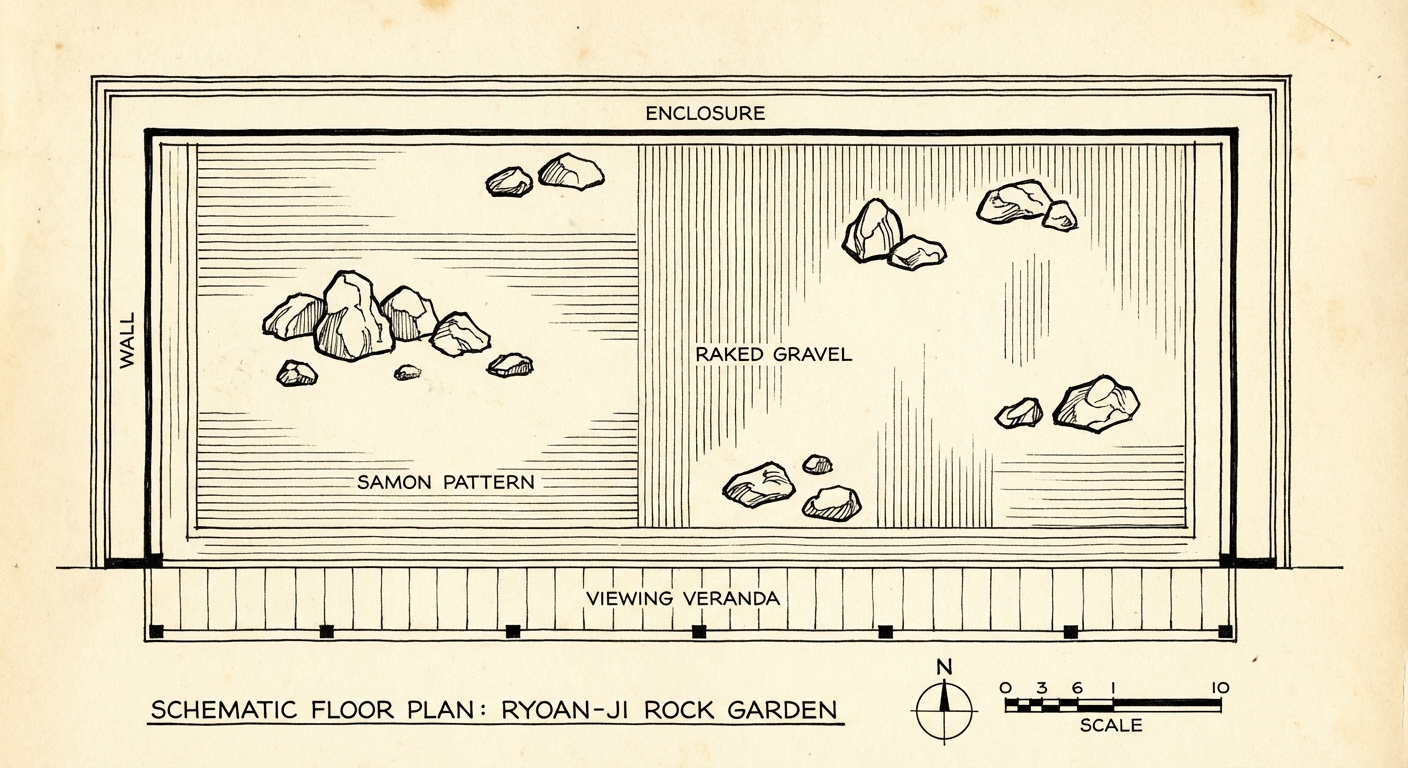
- Key Work: Ryoan-ji (Kyoto, c. 1480 CE)
- Type: Kare-sansui (Dry Landscape Garden).
- Components: 15 rocks arranged in gravel raked into patterns.
- The Conceptual Trick: No matter where you stand on the viewing veranda, you can typically only see 14 rocks clearly at once. The 15th rock creates a paradox, symbolizing that enlightenment is not easily attained by the physical eye.
- Wet Garden: The complex also includes a mirror pond, contrasting the dryness of the rock garden.
Monumental Wood Architecture
Japan is famous for its wood joinery techniques (using no nails), creating flexible structures that withstand earthquakes.
- Key Work: Todai-ji (Nara, originally 743 CE)
- Context: Commissioned by Emperor Shomu to unite various Japanese clans under Buddhism.
- The Daibutsu: Houses a colossal bronze Buddha (Vairocana). The project nearly bankrupted the Japanese economy.
- Style: Features the Great South Gate, which uses the Nandaimon style (massive wooden pillars and elaborate bracketing) and houses the Nio Guardian statues.
Ukiyo-e: Pictures of the Floating World
During the Edo period, art became accessible to the merchant class through woodblock prints. Ukiyo-e refers to the transient pleasures of life (theater, travel, beauty).
- Key Work: Under the Wave off Kanagawa (The Great Wave), from 36 Views of Mount Fuji by Katsushika Hokusai (1830–1833 CE).
- Innovation: Uses Prussian Blue (a synthetic European pigment), signaling Japan’s opening to the world.
- Composition: Low horizon line (Western influence). Mt. Fuji is small in the background, framed by the violence of the wave, highlighting the vulnerability of man (the fishermen) against nature.
Southeast Asian Art: The Cosmic Mountains
Art in this region is dominated by the interaction between Hinduism and Buddhism. Temple structures often mirror the cosmos.
Borobudur: The Buddhist Mandala
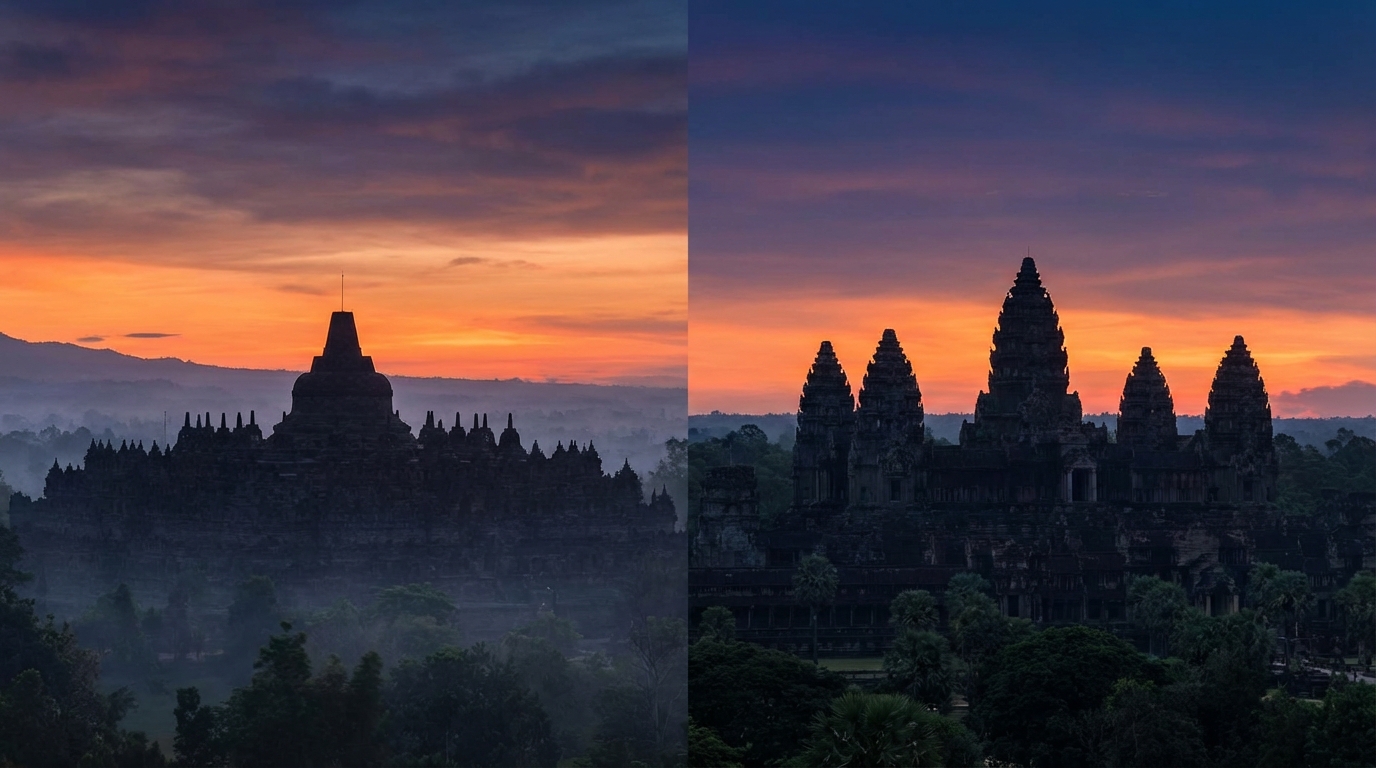
Located in Java, Indonesia, Borobudur (c. 750–842 CE) is the largest Buddhist temple in the world.
- Structure: It is a massive 3D Mandala (cosmic map) and a Stupa.
- The Journey (Circumambulation): Pilgrims walk clockwise up the levels, physically enacting the spiritual path to enlightenment.
- Kamadhatu (Sphere of Desire): The base (hidden reliefs showing earthly sins).
- Rupadhatu (Sphere of Form): Square terraces with reliefs of the Buddha’s life.
- Arupadhatu (Sphere of Formlessness): The top three circular terraces. No carvings, only 72 bell-shaped stupas containing Buddhas.
Angkor Wat: The Hindu Mountain
Located in Cambodia (Khmer Empire), built by Suryavarman II in the 12th century.
- Dedication: Originally dedicated to Vishnu (Hindu), though later converted to Buddhist use.
- Symbolism: Physical recreation of Mount Meru, the home of the gods.
- The five central towers represent the peaks of Meru.
- The massive moat represents the cosmic oceans.
- Bas-Relief: Famous for the Churning of the Ocean of Milk, a Hindu creation myth depicting gods (devas) and demons (juras) playing tug-of-war with a serpent king to release the nectar of immortality (amrita).
Common Mistakes & Pitfalls
Confusing Scroll Orientation:
- Hanging Scrolls (like Fan Kuan's) are displayed vertically and seen all at once.
- Handscrolls (like Night Attack on the Sanjo Palace) are held horizontally and unrolled section by section, viewing the narrative in time (right to left).
Hinduism vs. Buddhism at Angkor: Students often assume Angkor Wat is solely Buddhist because it is in Southeast Asia. It was built as a Hindu temple for Vishnu. (The nearby Angkor Thom/Bayon temple is Buddhist).
Porcelain Origins: The blue pigment in The David Vases is not Chinese in origin; the cobalt came from Iran. This is a critical point for essays on trade and cultural exchange.
Japanese "Empty" Space: In Zen art (like Ryoan-ji or Haboku painting), empty space is not "unfinished." It is ma—an active interval or void that is just as important as the solid objects.