PHYSICS II FINALS
End of an era.
Electric Potential Energy
Conservative Forces
A force is conservative if the work it does on an object moving between two points is independent of the path the objects between the points
The work depends only upon the initial and final positions of the objects.
Any conservative force can have a potential energy function.
Work-Energy Theorem
Sample 1
q = 3×10⁻⁹ C
m = 4
x1 = 1
x2 = 1.5 m
E = 5 N/C
a. W = qEd
= (3×10⁻⁹)(5 N/C)(0.5 m)
= 7.5×10⁻⁹ Nm or J
b.
c.
7.5×10⁻⁹ J =
v = 1.94×10⁻³ m/s
Sample 2
w = ?
E = 450 N/C
q = 3.4×10⁻⁶ C
d = 0.1 m
W = (450 N/C)(3.4×10-6)(0.10m) = 1.53×10⁻⁴ J
Sample 3
m = 3.25×10⁻³ kg
d = 0.12 m
vi = 0 m/s
vf = 25 m/s
a. W =
W =
W =
b. W = -
c. W =qEd → E =
E =
E =
E = 3.36×10⁹ N/C
Capacitors and Capacitance
Capacitors are devices for storing charges. In its most basic form, it consists of two metals plates and a dielectric inbetween.
Capacitance
Ratio of charge to voltage
SI Unit is Farad.
1 Farad = 1 C/ 1 V
Example:
If a 22 capacitor is connected to a 10 V source, the charge is 220 . 220×10-4 C
22 =
(10V)(22×10-6) = Q
220×10-4 C
Capacitance depends on three physical characteristics:
C is directly proportional to the distance (d) between the plates.
C is inversely proportional to the distance (d) between the plates.
C =
Find the capacitance of a 4 cm diameter sensor immersed in oil if the plates are 0.25mm.
(oil = 3.54×10⁻¹¹ C2/N2m)
c =
c = 1.78×10⁻¹⁰ F
2.
a. A = 0.0025 m2
$ = 4.8×10⁻¹¹ C2/Nm2
d = 0.0001 m
C =
C = 1.2×10⁻⁹ F
b. V =
E =
= 1.67×10⁵ V/m
A = 8.0×10⁻⁴ m2
mica= 4.8×10⁻¹¹ C2/Nm2
glass = 7.0×10⁻¹¹ C2/Nm2
d = 5 mm/0.005 m
The plate area is half of 8×10-4=4×10⁻⁴, since half of the space is filled with glass and mica.
C = Cglass + Cmica
=
= 9.44×10⁻¹² Farad
Series Capacitor Rules
Capacitance
a. CT =
Charge
b. qT = q1 = q2 = q3…
Voltage
VT = V1 + V2 + V3…
Parallel Capacitor Rules
Capacitance
CT = C1 + C2 + C3…
Charge
qT = q1 + q2 + q3…
Voltage
VT = V1 = V2 = V3…
Series Problems
If a 0.001 capacitor is connected in series with an 800 pF capacitor and subject to potential difference of 50 V. Find a. total capacitance, b. charge stored in each capacitor, and c. potential difference across each capacitor.
a. CT =
b. qT = CV
= (4.44×10 F)(50 V) = 2.22×10⁻⁸C
c. V1 =
=
V2 =
=
To capacitors with 2.0 F and 3.0 F capacitance are connected in series and subjected to a potential difference of 120 V. Find a) total capacitance, b) charge stored in each capacitor, and c) potential difference across each capacitor.
a. CT =
b. qT = CV = (1.2 F)(120 V) = 144 C
q1 = q2 = 144 C
c. V1 =
V2 =
Parallel Problems
A 10 F capacitor is connected in parallel with a 5 F capacitor and 4 F, and is subjected to a potential difference of 120 V. What is the total capacitance of the system? Find the individual charge and potential difference in each capacitor.
a. CT = 10 F + 5 F + 4 F = 19 F
b. qT = CTVT = (19 F)(120 V) = 2280 C
c. V1 = V2 = V3 = 120 V
Find
a. Total Capacitance
b. Individual Charge
c. Potential Difference in each capacitor
a. C1-2 =
CT = C1-2 + C3 = 4 F + 3.33 F = 7.33 F
b. qT = (7.33 F)(120 V) = 879.6 C
q1-2 = (3.33 F)(120 V) = 399.6 C
q3 = (4 F)(120 V) = 480 C
V1 =
V2 =
V3 =
W = U =
How much energy is stored by a 35 capacitor when the charge on each plate is 2500 ? What is the potential difference the plates of the capacitor?
C = 35×10-6F
q = 2500×10-6C
U =
U =
V =
Electric Current
Static Electricity vs. Electric Current
Static Electricity is a one-time event.
While Electric Currents are constantly flowing
Electric Current (I) is the rate at which charge passes a given point in an electric circuits.
SI - Ampere Formula I =
Andre Marie Ampere I = C/s Ampere (A)
An ammeter is a device used to measure current. It is always connected in series with the circuit.
Examples
A cross section of wire is isolated
20 C = q I =
40 s = t I = 0.5 A
Alternating Current vs Direct Current
AC - Electron flow in alternating directions. It is produced by proven plants.
DC - Electrons flow in one direction. It is caused by batteries.
Electrical Resistance
(R) Resistance is the opposition of a material to the flow of electric current .
The resistance is the ratio of the potential difference (v) and the current (I)
R =
Resistance are devices that limit current flow.
Factors that affect the resistance of a wire:
Length (L): Increasing the length (L) of the wire will increase the resistance. Decreasing the length will decrease the resistance.
R = L
Area (A): Increasing the cross-sectional area (A) of a wire will decrease the wires resistance.
R =
A =
Resistivity : This is a characteristic of a material that depends on it’s electronic structure. The higher the resistivity, the higher resistance and vice versa.
R =
Temperature - as temperature increases, resistance and resistivity increases for conductors, and decreases for insulators.
Full Equation
R =
Short, thick, & cold wires = low resistance.
Long, thin, & hot wires = high resistance.
Determine the resistance of a 4m copper wire with a diameter of 2 mm. Assume temperature is 20 Co
copper = 1.72×10⁻⁸
A =
= 3.14×10⁻⁶m2
R =
R = 0.022
An insulated wire 1.5 m long and made of copper with a diameter of 2.3 mm.
a. What is the resistance of the extension cord?
b. If an aluminum wire of the same length will be used instead of copper, what should be the diameter of the aluminum wire for the cord to have the same resistance.
a.
= 0.0062
b.
Determine the length of a copper wire that has a resistance of .172 and area of 1×10⁻⁴m2, The resistivity of copper is 1.72×10⁻⁸
R =
L = 10000 m
Ohm’s Law
R =
I = ; V = IR
V = 12 V
I = 0.10 A
R =
R = 120
V = (0.5 A)(20 A)
V = 110 V
I = 15 A
R =
= 7.3
Electromotive Force () is the potential difference across the terminals of a cell when no current is flowing. It is the voltage indicated on a battery.
Terminal Voltage (TV) is the potential difference across the terminals of a cell when current flows.
TV = - IR
TV = 1.5 V - 0.5 A
0.5r = 1.5 V - 1.35 V
r = 0.33
A cell has a terminal voltage of 50 V for a current of 10 A, and 54 V for a current of 6 A. Find the electromotive force and internal resistance of the cell.
TV =- IR
50 = 50 =
-54 = 50 =
r = 1
50 =
50 =
50 =
50 + 10 =
60 V =
Capacitor Rules
Series
Capacitance
CT =
Charge
qT = q1 = q2 = q3 …
Voltage
VT = V1 + V2 + V3 …
Parallel
Capacitance
CT = C1 + C2 + C3 …
Charge
qT = q1 = q2 = q3 …
Voltage
VT = V1 = V2 = V3 …
Resistors
Series
Resistance
RT = R1 + R2 + R3 …
Current
IT = I1 = I2 = I3…
Voltage
VT = V1 + V2 + V3…
Parallel
Resistance
RT =
Current
IT = I1 + I2 + I3
Voltage
VT = V1 = V2 = V3
Sample 1:
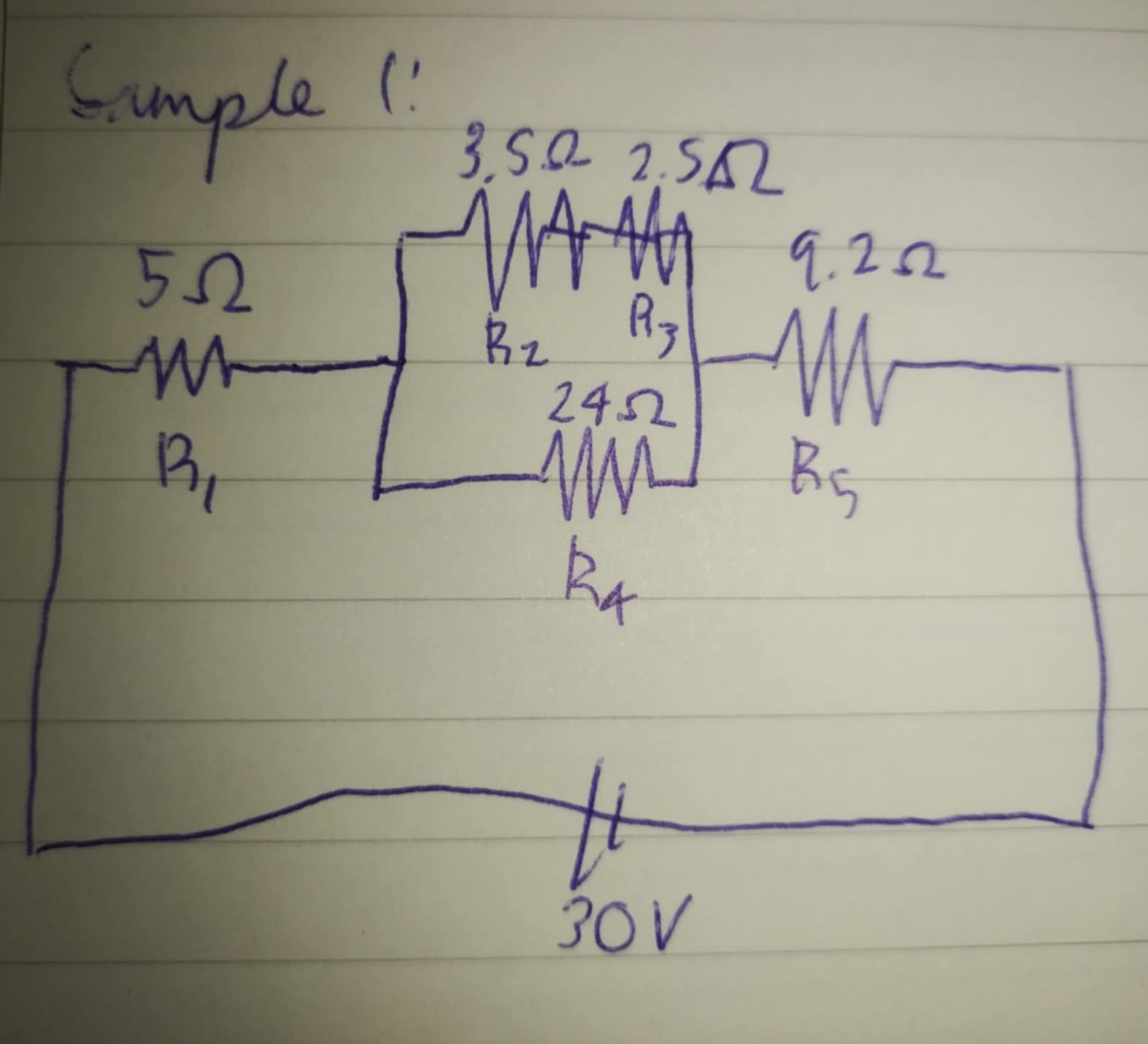
a.
R2-3 =
R2-4 =
R1-5 =
b.
IT = = 1.58A
I1 = 1.58 A
I2-4 = 1.58 A
I5 = 1.58 A
I4 =
I2-3 =
V = IR
V1 =
V2-4 =
V5 =
V4 = 7.58 V
V2 =
V3 =