Chap 15 Oligopolies and Antitrust law
Oligopolies and Game Theory
The following are characteristics of an oligopoly
Just a few firms
Each firm is mutually independent
Large barriers to entry (not huge, but large).
Unlike a monopoly (which has huge barriers to entry) or perfect competition (which has none), there are only some barriers to entry in oligopolistic markets.
The firms in an oligopolistic market demonstrate mutual interdependence. This means that the firm’s profits depend on its actions and also the actions of its competitors. An example of mutual interdependence is the market for computer chips. Intel and AMD are the two major computer chip producers. Intels profits and actions will be greatly influenced by AMD’s profits and actions.
Game theory and Oligopolies.
Game theory: was developed to take account of mutual interdependence between oligopolistic firms. Game theory was developed in the 1930s and 1940s by john van Neumann. It didn’t gain much attention until the 1940s and 1950s, when it was made popular by John Nash, who is featured in the Hollywood movie, a beautiful mind. (sadly, nash died in a car crash in 2015.)
A “game” is a situation in which one person’s actions significantly affect another person’s actions. There are a few defining characteristics of a game:
1. Games have rules ( antitrust laws, for example)
2. Games have strategies (like tit-for-tat)
3. Games have outcomes/payoffs (e.g. increased profits).
We will apply game theory to an oligopoly, specifically a duopoly, in the context of the prisoner’s dilemma. A DUOPOLY is an oligopoly in which there are only two firms. We do this for simplicity, bit the general lessons we learn from the two-firm model can be extended to an oligopoly in general.
Two players in a game may form a COLLUSIVE agreement. This is an agreement in which the two firms get together to cut output and raise prices. This is ILLEGAL in the US but there are always ways to circumvent the legal restrictions. Nash equilibrium is a situation in which each player takes his or her best action, given his or her opponent’s action.
A cartel is a group of producers that agree to jointly determine the price and quantity of their output. This is illegal in the US but not internationally. Probably the best example of a cartel is OPEC (the organization of petroleum exporting countries), which is a cartel among oil-producing countries.
Non-Cooperative equilibrium
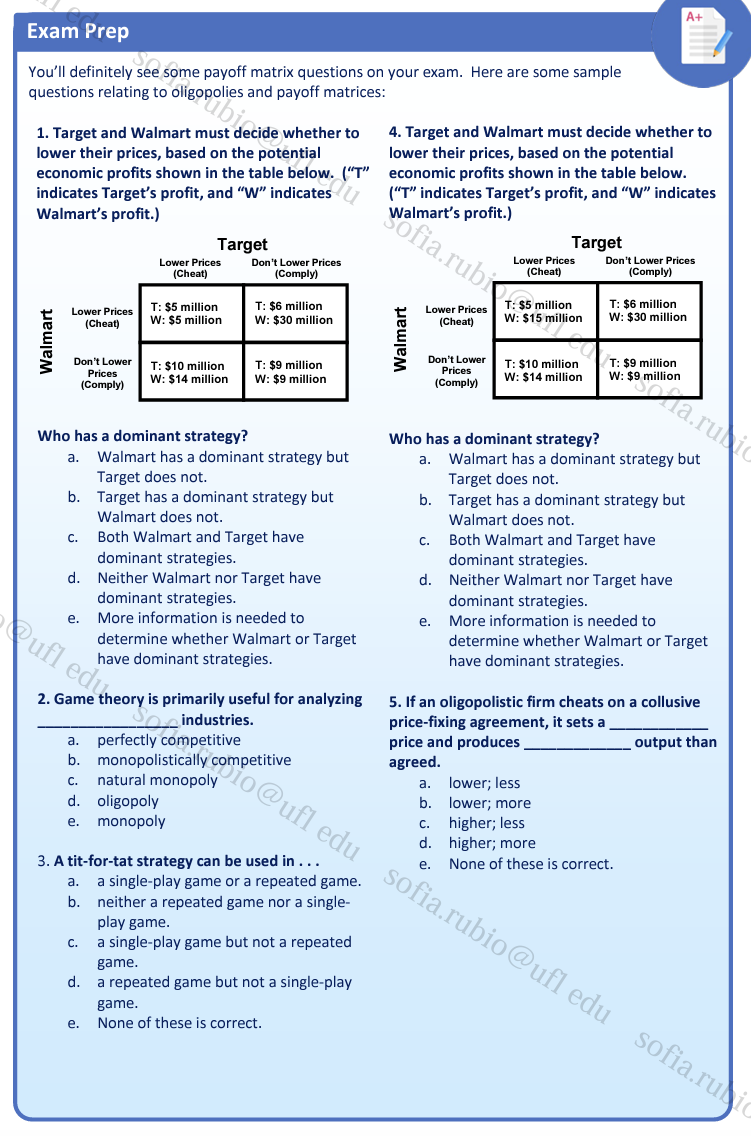
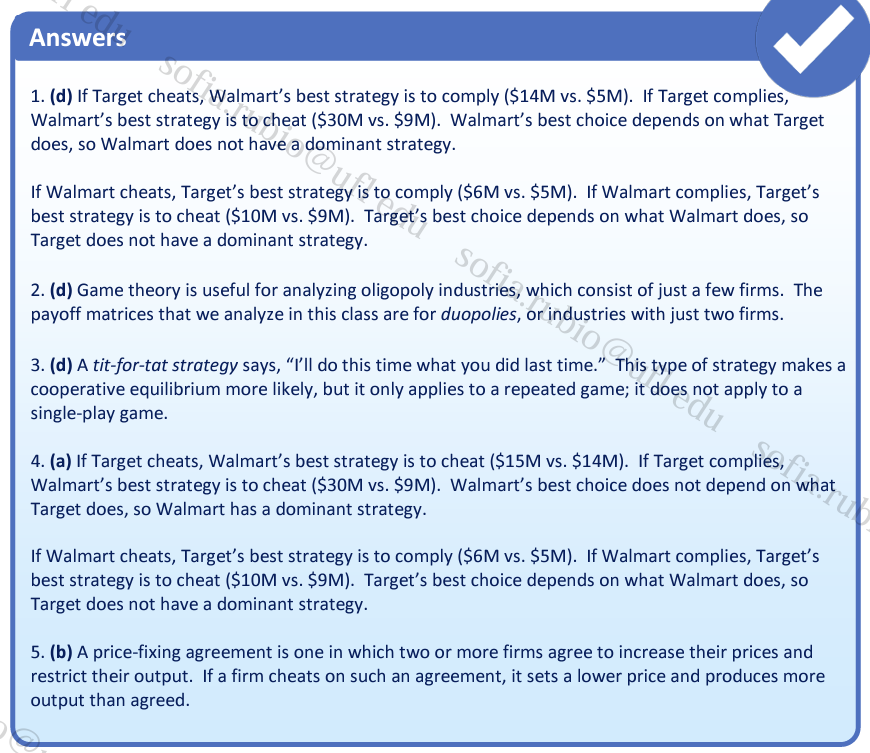
Lets say that firm A and Firm B get together and form a cartel. Once they agree to a certain price level, they can either comply with the agreement or cheat by lowering prices below the price they discussed. Here is a matrix of the possible economic profits of the two firms, if either complies with the agreement or cheats. (the payoff matrix).
A Dominant Strategy occurs when there is a “best strategy” that a firm should always adopt, independent of what the other firm does. In this case, the dominant strategy for both firms is. to cheat. Consider the following:
Firm A’s decision - if Firm B complies, its best move would be to cheat (300m vs 200m). If B cheats Firm A’s best move would STILL be to cheat (0 M vs - 50M)
Its the same for Firm B
In this case, we are in a state of Nash’s Equilibrium in which both firms are better off by cheating. This is also called non-cooperative equilibrium. In such an equilibrium, each player takes its best action, assuming he or she cannot affect the other player’s action.
Note that: for an industry standpoint, this is the WORST possible outcome. By not complying, the industry-wide profits are 0, whereas if the two firms had complied, the industry-wide profits would have been 400 million. This is, however, the most socially efficient option. By not complying the two firms are in essence competing against each other. The price to consumers will be the lowest if they both cheat.
Repeated Games and Cooperative equilibriu m
So far, we have seen that for a single game, the dominant strategy for our two firms was to cheat. However, there are some cases in which. itis more likely that a cooperative equilibrium would be established. Specifically, when we have been looking at a one-play game. Things change when you consider a REPEATED game, where you play the same game over and over.
One of the most widely used strategies in repeated games is a tit-for-tat strategy. A tit-for-tat strategy says: “ I’ll do this time what you did last time”. This can eventually lead to a cooperative equilibrium, where it is best for both firms to comply w the agreement.
Over the long run, if both firms use a tit-for-tat strategy, it may be more profitable for them to comply each time. This kind of equilibrium is called a Cooperative equilibrium: A situation in which each player cooperates with the other. Using a tit-for-tat strategy over the long term makes a cooperative equilibrium more likely, though it doesn’t guarantee that a cooperative equilibrium will be reached. Moreover, it doesn’t guarantee that a cartel will remain together indefinitely. The key thing to remember is this: in a repeated game, you’re more likely to get a cooperative equilibrium.
Antitrust Law
Antitrust laws are designed to keep an industry competitive. Back in the 1890s, the trust was the way that cartels were formed. There are two major laws that deal with antitrust issues:
Sherman Act (1890) - This was the first federal anti-monopoly law. This act has two sections. Section 1 focuses on firm conduct, and Section 2 deal with industry structure. This act covers legal restrictions on general attempts to monopolize or set prices.
Clayton Act (1914) - This legislation outlaws price discrimination, interlocking boards of directors, exclusive deals, trying contracts, and the acquisition of competing companies by purchasing the shares of the competitor only if those practices “substantially lessen competition or create a monopoly”.
In practice, price discrimination and exclusive dealings are usually upheld as legal practices that don’t substantially lessen competition or create a monopoly. Interlocking directorates and acquisition of a competitors shares are usually struck down as illegal practices that do substantially lessen competition or create a monopoly.
The Sherman Act (1890)
The sherman act has 2 major sections:
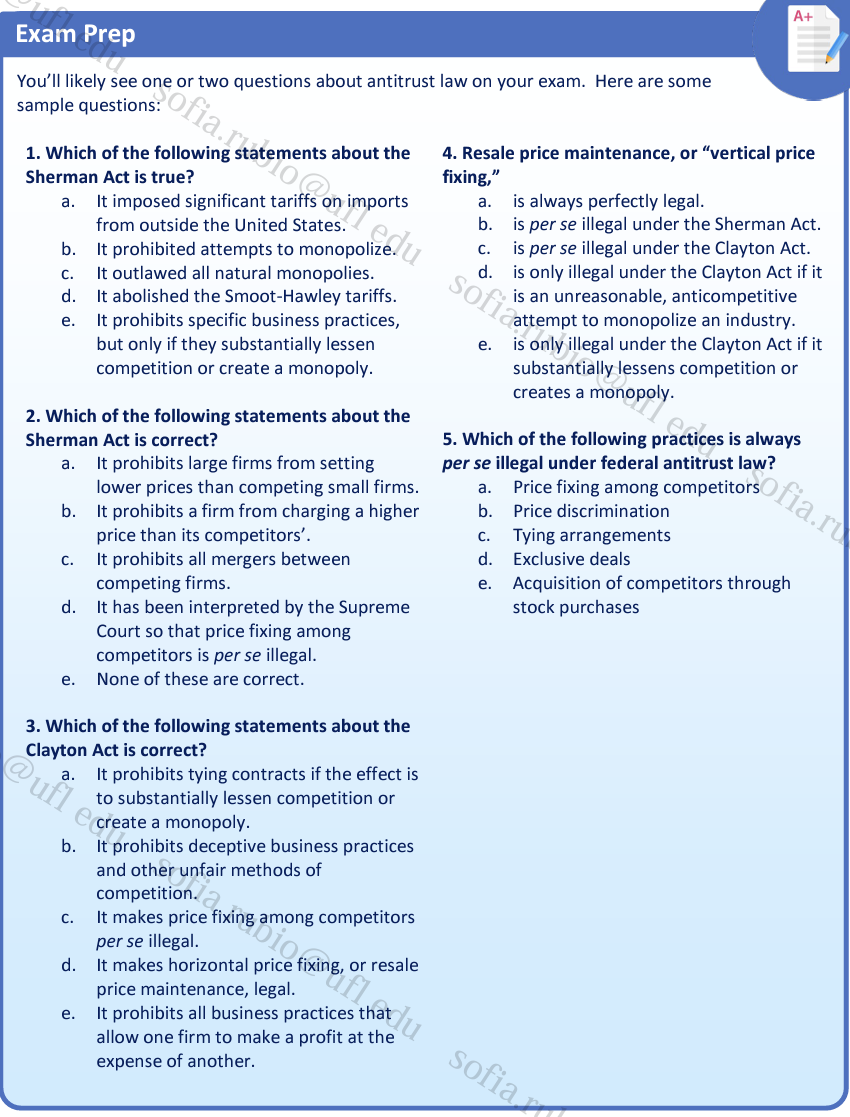
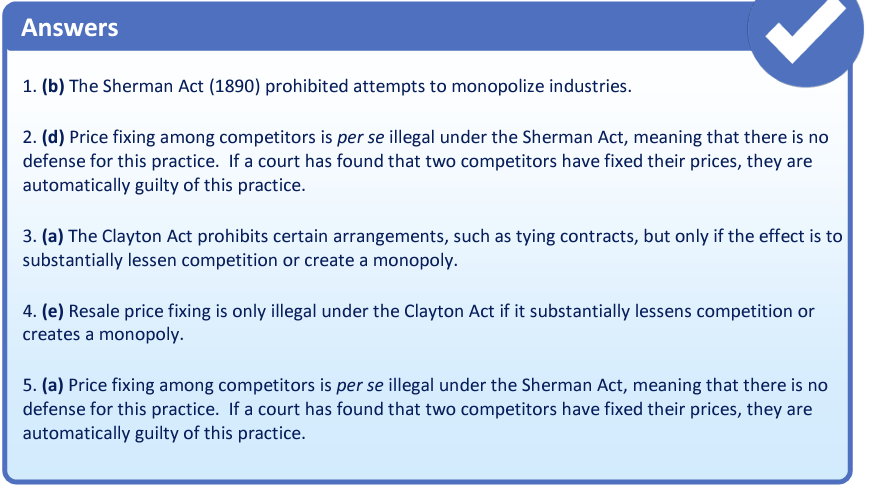
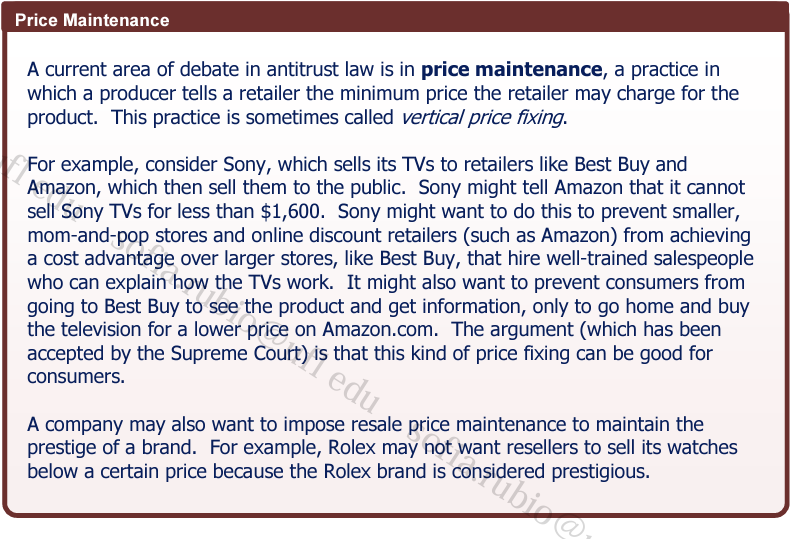
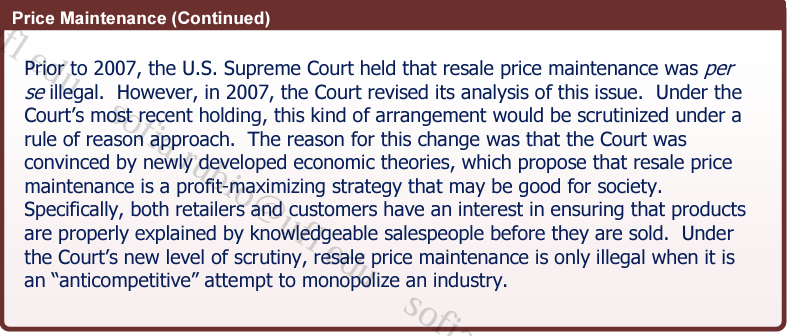
Section 1: Deals with firm conduct - This section outlaws “ever contract, combination in the form of a trust or otherwise, or conspiracy, in restrain of trade or commerce”. It has been interpreted very strictly by the US Supreme Court. The court has used this section to make any price fixing among competitors per se illegal. This means if you’re convicted of any price fixing, there is no defense for it.
Companies that are accused of price fixing under the Sherman Act often argue that they were merely involved in tacit collusion, which occurs when they both raise prices even though they never discussed it.
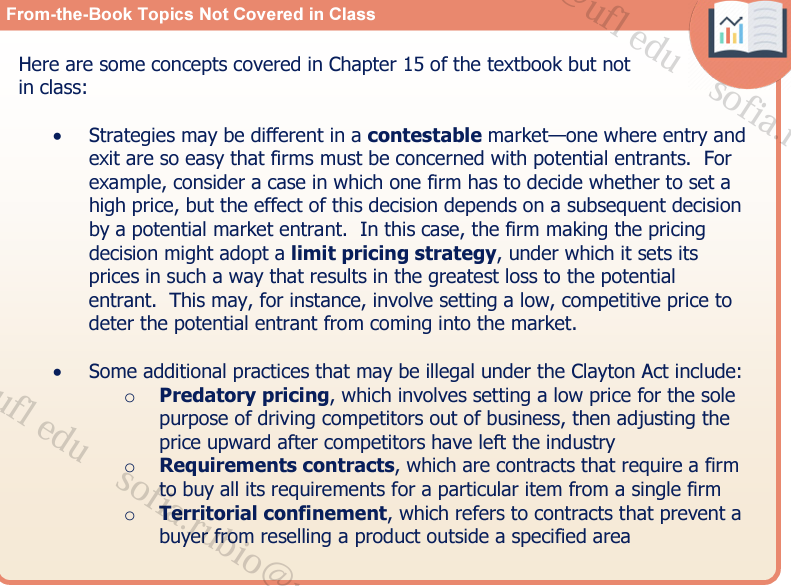
Section II: Deals with industry/market structure - This section made “every person who shall monopolize or attempt to monopolize … guilty of a felony”. In 1912, the Supreme Court enunciated the “ Rule of Reason”, saying that only “unreasonable” attempts to monopolize were illegal, and cases must be judged on. a case-by-case basis. For example, Gilead is a pharmaceutical company with patents on its superior pharmaceutical drugs. This is not an unreasonable attempt to monopolize.
The Clayton Act (1914)
The Clayton act prohibits the following practices, but only if they “substantially lessen competition or create a monopoly”.
Price discrimination - occurs when a firm charges different people diff prices for. the same product, or when a firm charges the same person different prices for different units of a product.
Its perfectly legal for a movie theater to use price discrimination (between mantinees and night-time shows, for example). This is because it has been found to not substantially limit competition or create a monopoly. An example of a price discrimination scheme that would run afoul of the Clayton Act is an agreement between a company and a supplier that requires the supplier to charge competitors a higher price. This occurred in the early 1900s when standard oil reached a deal with the railroad companies requiring them to charge Standard Oils competitors a higher price. This was found. to violate the Clayton act.
Price discrimination is rarely illegal in the US; it is much more likely to be found objectionable in Europe.
Excluse deals- these occur when the retailer of one product agrees to not sell any competing products. Currenlty, UF and Pepsi have an exclusive deal. No coke products are sold on campus. This is legal, however, because it does not “substantially limit competition or tend to create a monopoly”.
Interlocking boards of directors - An interlocking board of directors occurs when firms that are competitors have members of their boards of directors in common. The concern is that two companies may experience conflicts. of inter’interest hen are overseen by the same people on their boards of directors. The US supreme courts interpretation of this has been very strict- it is almost PER SE ILLEGAL. However, note that you can serve on boards of directors of non-competing companies- this restriction only applies to serving on the boards of competing companies.
note that businesses sometimes evolve, and businesses that do not compete with each other can become competitors. EX: CEO of Dunkin was once on Starbucks board. of directors, but he resigned after Dunkin' started to more directly compete with Starbucks by selling coffee in its stores.
Tying Contracts - this is when a seller agrees to sell one product only if the buyer agrees to also buy another product. Ex: Microsoft has been involved. in lawsuits in. theUS that claimed that bundling internet explorer with windows was an illegal trying contract.
Acquisition of competitors by purchasing either shares of their stock or their assets- For ex: walmart can’t just buy out Target by buying all the shares of Target. Until 1952, this was limited to just stock. Now, buying all the assets of competing firms is also deemed illegal.