Chapter 1-3 Notes
Chapter 1: The Policymaking System
Why study American Democracy?
Health
Economics (tariffs, inflation)
Rights (Roe v Wade)
Politics: deciding who benefits in society and who does not
American Efficacy
Bad at civic participation
Cynical and apathetic
Less trust in government = less efficacy
Low voter turnout
Efficacy: belief that one’s political participation really matters
Civic Duty: belief that people should always vote to support a democratic government
Benefits of civic engagement
More knowledge
More communication
More advocacy for one’s interests
Civic Engagement: individual and collective actions to identify and address issues of public concern
volunteering, group involvement, campaigning
Political engagement: citizen actions intended to solve problems through political means
What Government Does
Government: institution that creates and implements policies; makes and enforces laws
Types of government:
Monarchy: single leader with absolute monarchy
Oligarchy: elite few hold power
Democracy: citizens hold supreme power
Totalitarian: govt. controls every aspect of citizen life
Authoritarianism: govt. has strong power but is checked by others
Constitutionalism: govt. structured by law = limited
Key functions of government
protect soverign territory / national defense
preserve order and stability
establish and maintain a legal system
provide services
raise and sped money
socialize new generations
Many government services are public goods: cannot be limited and available to all
Citizens: members of political community; has rights, privileges, responsibilities
Naturalization: process of becoming a citizen
Governments perform on basis of legitimacy: citizens believe govt. power is right and proper
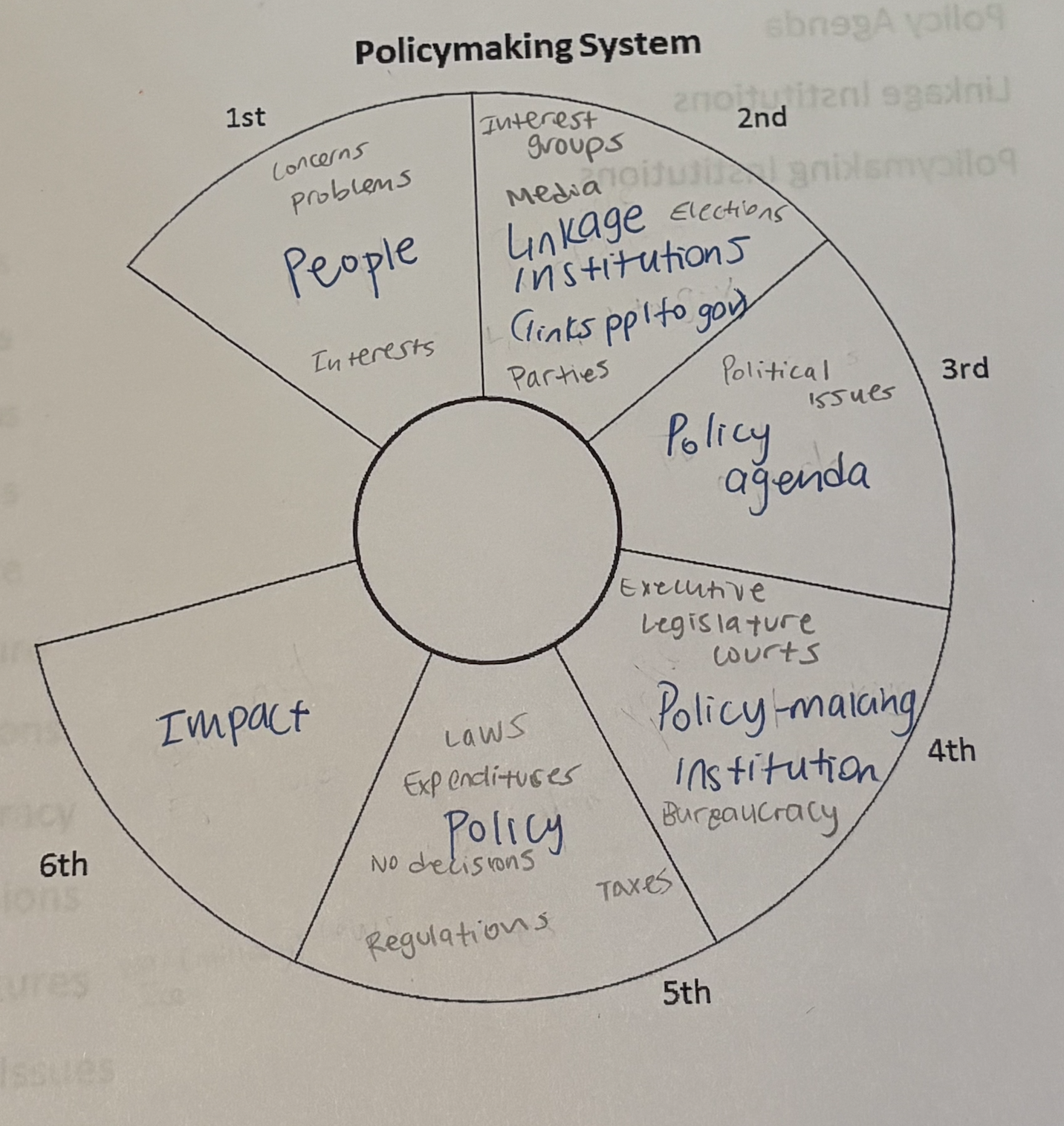
Policymaking System
Steps of Policymaking system:
People: interests, problems, concerns
Linkage Institutions: political parties, elections, media
Policy Agenda: Political issues (changes regularly)
Policymaking Institutions: executive, legislative, judicial branches
Public Policy: expenditures, taxes, laws, non-decisions, regulations
Congressional statute (law)
No Child Left behind Act: reform schools by emphasizing standards-based education, annual testing in reading and math, teacher qualifications, and accountability for schools and districts
Presidential action: decision by president
Court decision: opinion by Supreme Court
Budgetary choices: legislative enactment of taxes and expenditures
Regulation: agency adoption of regulation
FDA approves new drug
Impact
Origins of American Democracy
Vocabulary
Divine right of kings: monarchies rule absolutely, power given by God
Enlightenment: emphasize individuality, reason, scientific endeavor
Direct democracy: all citizens discuss and decide policy through majority rule
ex: Ancient Greece
Indirect democracy (also, representative democracy or republic): system where citizens elect representatives who vote on policies in govt. their behalf
The Modern Philosophy of Hobbes and Locke
Thomas Hobbes
Leviathan (1651)
State of nature: human beings are naturally uncivilized, brutish, and life is hard
Social contract: people in a society give up some of their rights to the government, in exchange for protection
John Locke
2 Treatises on Civil Government (1689)
Natural rights: life, liberty, property (God-given)
Consent of governed: govt. only has right to govern because they have the consent of those they govern - the citizens
Right to revolution: if govt. abuses power and does not protect citizens’ natural rights, citizens can revolt and put in place a new govt.
Contemporary Theories of Democracy
Participatory Democracy
Citizens have power to directly decide on policies and politicians
Pluralist Theory
Competition between groups (factions) leads to compromise and bargaining, ultimately representing public interest
See: Federalist #10
Elite and Class Theory
Society is divided by class; elites rule, so policies benefit those with money and power
Hyperpluralism Theory
There are too many groups, leading to a weak government because govt. is prevented from acting
Too many contradicting policies and interests
Policy gridlock: no policies passed bc opossing groups care more about stopping the competition
Government Ideology
Liberalism: Govt. protects social, political, and economic realms
should strive for equality of all groups
provide rights for all, like healthcare
Conservatism: govt. protects tradition by maintaining order and stability
emphasis on family values
free market by having less govt. regulation of economy
Chapter 2: The Constitution
What is a Constitution?
Constitution: nation’s basic law; creates political institutions, assigns or divides powers in govt, provides certain guarantees to citizens
Describes govt.
U.S. Constitution Articles 1-3 describes 3 branches’ responsibilities, relationships, and operative procedures
Legislative
Executive
Judicial
How to select national govt. officials, make laws, and amend and ratify Constitution
Creation of USA
History of USA
Taxation without Representation during English colonial times
Due to costs of French and Indian War (1756-1763), British govt. increasingly taxed colonies (1764-67)
Sugar Act
Stamp Act
Quartering Act
Declaratory Act
Townshend Act
Increasing conflict
Boston Massacre (1770)
Tea Act (1773)
Boston Tea Party - Colonists’ response
Coercive/Intolerable Acts - Parliament’s response
First Continental Congress (1774)
Lexington and Concord (1775)
Second Continental Congress (1775)
The Common Sense of Declaring Independence
Thomas Paine’s Common Sense (1776)
Thomas Jefferson’s Declaration of Independence (7/4/1776)
All men created equal
and have natural/unalienable rights (life, liberty, pursuit of happiness)
Consent of governed
Right to revolution
Articles of Confederation (1781-1788)
Confederation: a union of independent states in which each state retains its sovereignty, rights, and power
Weaknesses of Articles of Confederation
Unicameral legislature
Each state = one vote
Too hard to make laws = 9/13 votes for laws and treaties
Congress could not tax → financially weak
Amendments to AoC needed unanimous approval (13/13)
One branch of government - No executive nor judiciary
States were too powerful
could tax other states and foreign countries independently
each issued their own money
led to economic hardship
Shays Rebellion: highlighted weaknesses of AoC bc inability of govt.
to raise money (leading states to implement heavy taxes on citizens)
form a national army (could not aid MA in a timely manner)
Reforming govt:
First, Annapolis Convention
Failed bc only gathered by James Madison
Then, Philadelphia Convention
Worked bc A. Hamilton and G. Washington also helped! → Constitutional Convention
Crafting the US Constitution
Background
Structure of US Constitution
Preamble: introduction; states mission statement of govt.
Articles: 7
sections
clauses
Amendments: 27
Areas of consensus
Dual sovereignty: federalism aka power split between national and state and local governments
Supremacy clause (Article 5): constitution is supreme law of land
Separation of powers / checks and balances: power split among 3 branches, limit govt. from harming natural rights of citizens
See: Federalist # 51
Conflict and Compromise
Legislature
Virginia Plan: number of legislators dependent upon population; favored large states
New Jersey Plan: same number of legislators for each state; favored small states
Connecticut Plan (Great Compromise): bicameral legislature with Senate and House of Representatives
Limits on democracy
Electoral college: legislators vote for President
Senators chosen by state legislature: until change by 17th Amendment
Slavery
Postponed slave debate until 1808
Article 4: states deliver fugitive slaves back to original state
3/5 Compromise: each slave counts as 3/5 of a free man, to increase representation of Southern states in govt.
Articles
Article 1: Legislative Branch
Section 8 states all expressed (enumerated) powers of Congress; 1-18 clauses
Commerce clause: Congress can regulate commerce with foreign nations, between states, and Native tribes
Taxation clause: The government can tax people and use them to pay for public goods
Coinage clause: Congress can coin money and regulate the value of money
Copyright clause: The government protects authors’ and inventors’ rights to their creations for a certain duration of time
Elastic clause: final enumerated power; gives Congress right to make laws “necessary and proper” to carry out powers of other 17 clauses
Rights written in OG Constitution (Section 9)
Cannot suspend Writ of habeas corpus: citizens cannot be convicted without due process of law
No bills of attainder: citizens cannot be convicted just because they are a part of a group
No ex post facto laws: citizens cannot be charged with a crime that is now illegal but wasn’t before (when they did it)
No religious qualifications for holding office
Strict rules for treason
Article 2: Executive Branch
Vague powers
Veto: President rejects a bill (written by legislature)
Advice and consent: the Senate must approve President’s appointments and treaties
Article 3: Judicial Branch
Judicial Review: set by Marbury v. Madison (1803), ability of Supreme Court to declare an action by executive or legislative branch as constitutional or unconstitutional
Article 4: state-to-state relations
Article 5: amendment process
Article 6: supremacy of Constitution
Article 7: Constitutional ratification process (requires 9/13 original states)
Separation of Powers with Checks and Balances
Executive
Legislative - President can veto bills, VP is President of Senate
Judicial - President appoints judges, can give executive pardon
Legislative
Executive - Override vetoes (2/3 vote of both chambers), approval of appointments, treaties, and ambassadors, impeachment
Judicial - approval of federal judges, impeachment, initiation of constitutional amendments
Judicial
Executive - judicial review of executive orders, administrative regulations, and implementation of laws
Legislative - judicial review of statutes (laws)
Debate: The Ratification of the US Constitution
Federalists: supported the Constitution as presented
Federalist Papers: essays in support of Constitution
A. Hamiltion, J. Madison, J. Jay (Publius)
Federalist #10: defended pluralism theory of govt.
biggest threat to govt. are factions
To control factions, use a big republic = more factions = no majority
Representatives are best and brightest
Federalist #51:
Anti-Federalists: opposed the Constitution
Gave national govt. too much power
Erodes states’ authority and endanger individual freedoms
No Bill of Rights
Brutus #1: national govt. too strong and state govts. might as well not exist
Supremacy clause: national laws take precedence over state laws
Necessary and Proper Clause (Art. 1 Clause 18, Elastic Clause): Congress can make and justify ANY law
Supreme Court can strike down any state law
Ratified in 1788
Compromise = Bill of Rights (1791)
Constitutional Change (through Amendments and Informal measures)
Making Amendments
Propose Amendment
By Congress, 2/3 vote in BOTH houses (27x)
Called by 2/3 state legislatures at National Convention called by Congress (0x)
Ratify Amendment
By state legislatures, ¾ of states (38/50) (26x)
By conventions held in ¾ of states (38/50) (1x)
Informal amendment: over time, changes made in Constitutional but written word has not changed
Examples:
Passage of legislation by Congress (law)
Actions by President (executive orders)
Decisions of Supreme Court
Activities of political parties
Custom
Chapter 3: Federalism
An Overview of US Federal System
Unitary - a way of organizing a nation so that all power resides in the central government (majority of the world)
Confederation - National govt is weak and most or all the power is in the hands of its components
Federalism - way of organizing a nation so that two or more levels of govt have formal authority over the land and people
Unitary system - Authority is concentrated in the central govt.
National govt → states
UK, Japan, Sweden
Federation - Authority is divided between central and state govts, derived from the people
People →states and national govt.
Canada, India, US under Constitution
Confederation - Authority concentrated in states
States → national govt.
US under Articles of Confederation
Importance of federalism
Decentralizes politics → more opportunities to participate
Decentralizes policies
Fed. and state govt. handles different problems
states regulate drinking ages, marriage, and speed limits
States can solve same problem in different ways
Constitutional Distribution of Authority
A. The Division of Power
Supremacy Clause - national powers
Article VI states Constitution, Laws, and Treaties are SUPREME
National govt. cannot usurp state powers
10th Amendment - Powers not delegated to the national govt. nor denied to states are reserved for the states
Constitution’s Distribution of Powers
Powers denied to NATIONAL
Tax articles exported from one state to another
Violate Bill of Rights
Change state boundaries
Powers denied to STATE
tax imports or exports
coin money
enter into treaties
B. Establishing National Supremacy
McCulloch v. Maryland - Implied and enumerated powers
Gibbons v. Ogden - Commerce powers
Civil War - States can never leave
Brown v. Board of Education - Racial Equality
Overturned Plessy v. Ferguson
C. States’ Obligations to Each Other - Article 4
Full Faith and Credit - each state must recognize official documents and judgments rendered by other states
A CASE
Privileges and Immunities - citizens must be treated the same, regardless of which state they come from
Extradition - states must return a person charged with a crime in another state to that state for punishment
D. Concurrent Powers
national and state govt. exercise concurrent same powers independently and at the same time
Make and implement policy
Punish lawbreakers
Levy and collect taxes
Protect rights of citizens
Provide for public safety
Borrow money
Protect public health
National govt ONLY
Declare and engage in war
Print and coin money
Maintain army, navy, air force
Regulate interstate and foreign commerce
Negotiate treaties with foreign countries
Set up post offices
Set rules for immigration
State govt. ONLY
Govern marriage laws
Conduct elections
Regulate intrastate commerce
Determine qualifications of voters
Set traffic standards
Establish and maintain schools
Maintain state militia (National Guard)
E. National Sovereignty
Enumerated powers - listed powers in Article 1
LIST
Implied powers - powers not explicitly described but deemed necessary to fulfill enumerated powers
From elastic / necessary and proper clause (Article I)
F. State Sovereignty
Reserved powers - broad set of powers are reserved to the states (10th Amendment)
Police powers - protect the health, safety, lives, and property of citizens
Regulate land use
insurance laws
Education
Marriage and divorce
Banks and credit
Intrastate commerce
Property rights
Evolution of the Federal System
A. US evolved from dual federalism to intergovernmental relations (IGR) / cooperative federalism
Dual Federalism (Layered Cake)
system of govt. in which both states and national govt. remain supreme within their own spheres, independent, each responsible for some policies
narrowly interpreted powers of federal govt.
ended in 1930s
Cooperative Federalism (Marble Cake)
system of govt. in which powers and policy assignments are shared between states and national govt.
shared costs and administration →
GBI and FBI work together
state and federal highway
states follow federal guidelines
national govt. too strong?
devolution - return of policy responsibilities to state and local governments
Fiscal Federalism (next slide)
Intergovernmental Relations (IGR)
A. Tools of IGRs
Fiscal Federalism
pattern of spending, taxing, and providing grants in the federal system
grants of money given by national govt. to state and local govt.
grants-in-aid are 17% of federal annual spending, pays for 1/3 of total state budget
Medicaid is biggest expense
B. Grant-in-Aid system - main instrument of national govt. to aid and influence states
Categorical grant - federal grants with strings attached, state must do something or be something to get money
a. Project grant - based on merit (No Child…)
b. Formula grant - $ to state for a narrow purpose, defined by national govt.
amount varies based on formulas
matching funds requirement - obligates the states to match a specific percentage with its own money (Medicaid)
Block grants - federal grants given more or less automatically to support broad programs; states define the qualifications of program
TANF Temporary Assistance for Needy Families
Mandates - portions of LAWS that requires state/local govt. to do something
a. funded mandate - national govt. pays ALL cost
b. unfunded mandate - state/local govt. pays all or part of cost
Americans with Disabilities Act
Waivers - exemptions from particular conditions normally attached to grants
Preemption - constitutionally based principle that allows a national law to supersede state or local laws
a higher level of government's law (usually federal) overrides or cancels out a conflicting law of a lower level of government
Supremacy Clause (Article 6)
common in environmental policy
Nullification - legal theory that state govt. have authority to invalidate national actions they deem unconstitutional
True nullification - when a state law explicitly declares the national law unconstitutional
Non-acquiescence nullification - when state law claims the state will not cooperate with national law
Inconsistent legislation nullification - most common; when state law conflicts with or tries to alter rules in an existing law
C. Intergovernmental tensions
Immigration
Marijuana
Climate change
Pace of lawsuits filed by state attorneys general against the national govt. has increased
D. Advantages and disadvantages of today’s federalism
Advantages for democracy
increased access to government
local problems can be solved locally
hard for political parties or interest groups to dominate all politics
Disadvantages for democracy
states have different levels of service → education
local interest can counteract national interests
CASE marijuana
too many levels of government and costs too much money
SCOTUS Federalism Cases
McCulloch v. Maryland
Gonzales v. Raich (marijuana)
CA - Compassionate Use Act - you can use marijuana to ease pain and suffering
Controlled Substances Act - DEA raided her home and destroyed her plants
Marijuana is a black market drug, national
SC ruled NATIONAL Commerce clause power lets the national govt. regulate this even though CA made it legal
Gonzales v. Oregon (physician-assisted suicide)
OR - Death with Dignity Act - physician-assisted suicide for terminally ill
Controlled Substances Act - stopping trafficking / abuse of drugs did not want doctors from engaging in illicit drug dealing
SC ruled STATE, allowing the state to regulate its own medical practices bc CSA does not define general standards of medical practice
US v. Lopez (guns in schools)
Lopez sued Congress over federal Gun-Free School Zones Act - act unconstitutional bc argued not in power of national govt.
SC ruled STATE, carrying a gun in school is not an economic activity and doesn’t fall under Commerce Clause
Gibbons v. Ogden (interstate commerce)
Steamboats over power of New York
Ogden had state license, Gibbons had federal license
SC ruled NATIONAL bc Commerce clause allows Congress to regulate interstate commerce and Supremacy clause means fed > state
Baker v. Carr (state apportionment)
Apportionment - dividing HoR seats among states
TN - rural counties had more representatives than urban counties, even though urban had bigger population
Equal Protection Clause - no state can deny any person equal protection of the laws
Voting equality - one’s vote should not weigh more or less that another
SC ruled NATIONAL bc Equal Protection Clause, sets “one person one vote” standard (gerrymandering)
US v. Windsor
NY - recognized same sex marriage, federal did not recognize marriage. Spouse dies and leaves money to wife, but govt. taxes the estate
Defense of Marriage Act - defined marriage is between man and woman, does not tax estate (DOMA)
SC ruled STATE bc declared DOMA unconstitutional as violated Equal Protection Clause of 5th Amendment
Obergefell v. Hodges (marriage)
Legalized same-sex marriage across US
SC ruled NATIONAL bc Due Process Clause, right to marry is individual autonomy
Potential FRQs
FRQ 1
A. Supremacy clause is common in both cases.
B. In McCulloch v. Maryland, SC ruled states could not tax the national bank because taxing is the power to destroy. This violates the Supremacy Clause. In US Term Limits v. Thorton, SC ruled states could not alter the Constitutional requirements due to the Supremacy Clause. In the Supremacy Clause, the Constitution, the Laws of the US, and the treaties are supreme over the laws of the states.
C. Citizens can choose to not vote for the Representative again to artificially place a term limit on Congressmen. OR Citizens could demand Congress to enact an Constitutional Amendment for term limits by protesting.
FRQ 2
A. The most commonly used method to add an amendment is proposal by 2/3 both houses of Congress, then ratification by ¾ state legislatures
B. 2/3 majority to propose and ¾ majority to ratify. Proposing and ratifying are not simple majorities (51%), but require super-majorities. The framers wanted to make it difficult to make an amendment and that there was an overwhelming consensus to make the amendment.
C. Proposal is always done nationally, ratification is always by state. This shows federalism bc it shows the division of state and federal govt.
FRQ 3
A. The govt. could provide money (funded mandate) in the form of block grants or categorical grants. A funded mandate is a federal law that requires a state or local government to take action or meet a standard, with the federal govt helping cover the costs of compliance. A block grant is money given to support broad and flexible programs in which states define the qualifications of the program. A categorical grant is money given to states, with narrow and specific purpose and guidelines set by the federal govt.
B. The ADA was an unfunded mandate. An unfunded mandate is a federal law that requires a state or local government to take action or meet a standard, and the state/local govt must cover cost of compliance. Unfunded mandates create tension between state and federal govts since states have limited revenue. The Grant and Aid system is the main instrument the national govt uses to aid and influence the states. States feel compelled to do the federal govt wishes in order to get or keep federal money.
C. Federal system in its current form is cooperative federalism, which is when powers and policy assignments are shared between states and national govt. It establishes the supremacy of the national govt and causes the states to be reliant on federal govt for revenue through grants. States typically welcome the financial aid but not the rules and strings attached to the aid.
FRQ 4
A. Madison dislikes pure democracy because they cannot stop factions. Factions are groups of individuals with shared interest and common goals that will harm other groups and the overall public good to get what they desire. Governments must control the effects of these factions to make it hard for one to dominate, which required a large republic and checks and balances, which pure democracy did not lend itself to (but representative democracies did).
B. In the original Constitution, the framers placed limits on democracy through the electoral college and indirect senator election. The electoral college is when the election of the President through a congressional vote, in which each state’s number of electors equals its number of Reps in the House and Senate. Furthermore, senators were originally chosen by their respective state legislatures through the indirect election described in the original Constitution. The framers created these limitations because they were concerned about pure democracy and the tyranny of a majority faction, and they also believed a body of elites (the congressman) would make better, more informed decisions.
C. Increased voting happened through the following amendments:
15th Amendment: right to vote regardless of race, color, or previous slave status
17th Amendment: direct election of U.S. senators
19th Amendment: right to vote in all elections regardless of sex (gave women suffrage)