commerce notes 2023
Economic and business environment
investigate the role of consumers, businesses, government, financial institutions and the overseas sector in the five-sector circular flow model
Households: Households are the primary consumers of goods and services produced by businesses. They provide labor and other factors of production to businesses in exchange for wages, salaries, and other income. Households are also savers and investors, directing their savings to financial institutions. Their role is crucial in generating income, demand for goods and services, and savings for investment.
Businesses: Businesses are the producers of goods and services. They hire labor and purchase other inputs from households to produce the goods and services that households consume. In the circular flow, businesses receive revenue from selling their products to households. They also invest in capital and technology to improve productivity.
Government: The government sector includes all levels of government (local, regional, and national). Governments provide public goods and services (e.g., defense, education, healthcare) and engage in various economic activities. They collect taxes from households and businesses and spend those tax revenues on public services, transfers, and infrastructure. Government policies, such as fiscal and monetary measures, can influence economic growth and stability.
Financial Institutions: Financial institutions include banks, credit unions, and other financial intermediaries. They play a critical role in the circular flow by channeling savings from households into investments by businesses. They also provide credit to households and businesses, facilitating economic activity. Financial institutions enable the efficient allocation of capital in the economy.
Overseas Sector: The overseas sector represents international trade and financial transactions. It includes exports and imports of goods and services (balance of trade) and international capital flows. Households and businesses engage in international trade, importing and exporting products. Financial institutions facilitate international financial transactions. Government policies can also influence international trade and finance.
In the five-sector circular flow model, these sectors are interconnected. For example:
Households receive income from businesses and government in the form of wages, salaries, and transfers. They spend that income on goods and services produced by businesses and the government.
Businesses use revenues from sales to households and government for production and investment.
Governments collect taxes from households and businesses and spend on public goods and services. They may also borrow money from financial institutions or the overseas sector.
Financial institutions facilitate savings and investment for households and businesses. They also manage international financial transactions.
The overseas sector interacts with households and businesses through international trade and financial flows.
Investigate the business cycle and its impact on the economy
periods of high and low economic activity are referred to as the business cycle. After a period of prosperity, business activity gradually slows until a recession or depression is reached. A recession is where an economy gets smaller for a period of six months or longer. A depression is a long and severe recession. Eventually, business picks up again until prosperity is restored. This completes the cycle.
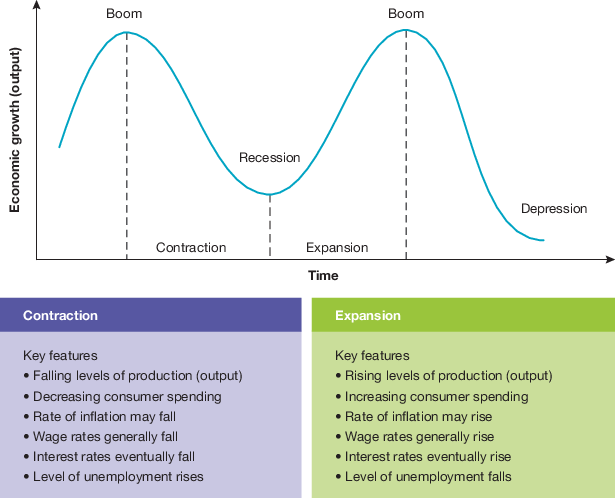
Recessions:
Recessions are caused by lack of spending, not the inability of the economy to produce goods and services. By choosing to spend some of your money, you send a signal to businesses to keep making the products you buy. If, however, some products are not bought, the business may cut back on production and some employees might lose their jobs and incomes. This causes total spending to fall even further as people’s confidence in the future is shaken. In this way, a recession spreads and economic growth is slowed. When a recession becomes widespread and long-lasting, it is called a depression.
The number of business closures increases during a recession.
The key features of a recession include the following:
Income and production are at their lowest level in the business cycle.
Unemployment is at a high level.
The inflation rate tends to stay low.
Wages and salaries either fall or grow very slowly.
Consumer demand and, consequently, business sales and profits reach their lowest levels.
Bankruptcies are everyday occurrences, and the business outlook is bleak.
Businesses have a lot of unused resources and no incentive to purchase new machinery.
Interest rates remain low, while investment opportunities are few and the number of creditworthy borrowers is reduced.
Booms:
Production, spending and employment rise. Businesses expand, employees are hired and incomes increase. Consequently, total spending increases even more. Consumer and business confidence are high. However, the economy cannot keep producing more goods and services indefinitely. There is a limit. When this happens, additional spending pushes up prices. Inflation, a general rise in prices, now becomes a major economic problem and will eventually bring an end to the continued growth.
The key features of a boom include the following:
Income and production are at their highest levels.
There is full employment of labour and all other resources.
Wages and salaries are relatively high. Employees are now in a strong bargaining position as businesses compete for scarce labour resources.
Businesses are operating at full capacity. Increases in consumer demand are met by increases in prices rather than by increases in production.
Interest rates are high because loanable funds are in relatively short supply.
The rate of inflation rises sharply.
investigate factors influencing business decisions
Technology - Technological advancements have revolutionized business operations, enhancing efficiency, product quality, and communication. Hi-tech robotics has automated manufacturing, reducing costs and tedious tasks. Information technology, like bar codes and EFTPOS, facilitates real-time interactions across distances. Technologies such as teleconferencing and smartphones have bridged geographical gaps, enabling flexible work arrangements and improving collaboration. These advancements create a more efficient, globally connected, and adaptable business landscape.
The business cycle - The business cycle significantly impacts business operations. During economic downturns, cautious consumer spending leads to falling profits and cost-cutting measures, sometimes including layoffs, exacerbating the recession. Conversely, in a growing economy, consumer confidence returns, leading to increased spending and improved business profits. Notably, not all businesses are equally affected by these cycles; those selling consumer or luxury goods suffer during recessions, while businesses offering essential goods, like grocery stores, tend to fare better. Clearance outlets may also perform well during economic downturns.
Globalization -
Positive Impacts:
1. Expanded Markets: Globalization, enabled by the internet, allows businesses of all sizes to access and sell products internationally.
2. Cheaper Materials: Businesses can source cost-effective materials and supplies from around the world.
3. Access to Talent: Globalization provides access to a diverse talent pool, reducing production costs and facilitating the hiring of skilled employees globally.
Negative Impacts:
1. Increased Competition: Businesses now face global competition as consumers can access goods and services from around the world.
2. Increased Unemployment: Industries unable to compete with cheaper imports may be forced to close, resulting in unemployment.
3. Environmental and Social Issues: Some transnational corporations (TNCs) may exploit workers and harm the environment in pursuit of cost reduction.
Investigate the contribution of entrepreneurship and innovation
Entrepreneurship - An entrepreneur is an individual who possesses the qualities and willingness to take risks, turning innovative ideas into thriving businesses. They actively seek opportunities, relish the challenge of establishing a successful venture, and derive profits from solving problems and selling their concepts. Entrepreneurs often initiate their businesses and, if successful, enjoy substantial financial rewards.
Innovation - Innovation typically involves enhancing or making significant contributions to existing products or services, while invention centers on creating entirely new concepts. Both innovation and invention result in the creation of unique offerings. Entrepreneurs and innovators play a crucial role in shaping our lives and work. Their ideas and creations have the potential to elevate living standards, generate employment, and boost economic activity.
Law soc and political involvement
The nature of law: For justice to be achieved three principles must apply, these principles are:
Fairness: The legal system must be free from bias, dishonesty, or injustice.
Equality: That all People are treated the same way, without unfair advantage or disadvantage.
Access: The right or opportunity to make use of something, particularly access to the legal system.
Reasons for laws:
Confusion and chaos would occur if not present. In extreme cases of conflict, a state of anarchy would develop.
Role of law:
Establish boundaries of acceptable behaviour and determine which actions will not be tolerated. For example, drink-driving laws reflect society’s attitude that placing other road users at risk through intoxication is unacceptable.
Protection from the actions of others as well as our own behaviour. It does this by telling society what people cannot do. For example, we cannot commit assault, murder or robbery. We cannot drive while drunk or ride a bike without a helmet. In this role, the law restricts our individual freedom but provides safety for all individuals in society.
Freedom to do many things by telling society what people can do. For example, the law allows us to own and operate a business, drive a car, get married or divorced, or leave school.
Resolving disputes in order to stop people taking the law into their own hands. The legal system provides a police force (or service), court system and correctional centres (jails and juvenile detention centres) to enforce and administer the law.
Values, morals and ethics:
Values: Fundamental beliefs held by an individual or group. They are usually based on what is considered important.
Morals: Standards of behavior. What is considered right and wrong.
Ethics: Just simple moral rules or principles and based on what is considered the right or wrong.
We develop a sense of what is right and wrong from the moral and ethical values of our society. For example, murder is considered a serious crime because our society believes human life is precious and should be protected. Usually, societies moral and ethical values reflect the beliefs, attitudes, and values of religious institutions.
Australia's court system:
Local court:
The Local Court deals with minor civil disputes; for instance, where people sue other people for damage to property or for injury claims of up to $100 000. This court also hears summary offences (minor criminal matters) such as stealing, drink-driving, assault, possession of drugs and indecent language.
A magistrate also presides over committal hearings dealing with indictable offences (major criminal matters) such as armed robbery, manslaughter and homicide to decide if there is enough evidence for the case to go to trial in a higher court. A magistrate also:
hears bail applications
issues arrest warrants and search warrants
hears applications for Apprehended Violence Orders (AVOs).
District court:
In the District Court of NSW, cases are heard by judges. District Court deals with more serious civil cases for claims over $100 000 up to $750 000 and all motor vehicle accident cases. Its criminal jurisdiction deals with serious criminal matters such as armed robbery and manslaughter. In some cases a jury will decide whether the accused is guilty or not. If the accused is found guilty, the judge will decide on an appropriate sentence. The District Court also hears appeals from the Local Court.
Supreme court:
The Supreme Court is the highest in NSW and deals with the most serious criminal cases such as murder, treason and serious sexual assault. As well, the most serious civil cases involving more than $750 000 are heard in this court. The Supreme Court is headed by the Chief Justice. The Supreme Court also deals with appeals from the two lower courts. The judgements of the Supreme Court are binding (compulsory) on all lower courts. The Supreme Court can impose a wide range of sentences.
High court:
the High Court deals with appeals from the state or territory Supreme Courts.
It also hears cases concerning the interpretation of the constitution; that is the laws of which Australia is governed by. It reads, interprets and applies the Constitution and, in reaching verdicts, it creates laws that then affect the powers of parliaments. The High Court, through its interpretation of the Constitution, has shifted the balance of power away from the states and towards the Commonwealth.
Because it is the highest court in Australia, its decisions are final. The High Court is a federal court, which means that any decision it makes applies to the whole country.
Specialised courts:
Childrens court:
The Children’s Court deals with cases involving the care and protection of children and young people. It also deals with criminal cases concerning children and young people who committed offences when under the age of 18. This court is closed to the public and the media. The Children’s Court has much the same personnel as the Local Court, but personnel in this court are specifically trained to deal with young people.
Coroners court:
The Coroner’s Court is a special Local Court that investigates deaths by unnatural causes in order to determine the identity of the deceased and the date, place, circumstances and medical cause of death. Coroners also investigate the cause and origin of fires or explosions.
Family court:
The Family Court is a specialised court that assists Australians to resolve more complex family law matters such as divorce, parenting disputes and the division of property when couples separate.
Drug court:
This court tries to provide long-term solutions for offenders who have been caught up in the cycle of drug use and crime by encouraging the person to become free of his or her substance abuse, gain employment and reduce the need to commit crimes to support the drug habit. To be referred to this court the offender must be eligible to the Drug Court Program.
Types of law:
The 2 types of law - There are two main ways of classifying the law: private and public law. Private law deals with how individuals interact with other individuals as well as the rights and duties people have towards each other. Public law is concerned with regulating people’s behaviour within society as a whole and protects the freedom of individuals. It also deals with the conduct society expects from its government (the state).
Administrative law
Administrative law deals with the decisions and powers of these government departments. This law allows courts to review and change the decisions of government if necessary.
Constitutional law
This set of laws deals with the rules by which a country is governed. It is concerned with the powers and authority of parliament; the rights of each citizen; the powers between the federal and state governments.
Contract law
This set of laws is concerned with legal agreements between two or more people. If one party fails to carry out his or her side of the agreement, that person can be sued for breach of contract.
Family law
This law regulates family relationships. It sets out rules about the process of getting married; who can get married; de facto relationships; divorce; custody and other aspects involving family members.
Criminal law
Criminal laws are needed to keep the community safe from harm, to provide for an orderly society and to provide a way of dealing with a crime when it occurs. Offenders will be punished if they choose to put people and property at risk.
Industrial law
This law is concerned with the rights and obligations of employers and employees. Much of the law deals with the legal way of resolving industrial disputes, workers’ compensation, occupational health and safety, and discrimination in the workforce.
Property law
This law recognises two broad types of property: real property (land and buildings) and personal property (goods and services we purchase). Specifically, property law provides regulations about the sale, leasing and hiring of property.
Tort law
The law of tort deals with situations when one person infringes the rights of another, resulting in distress or injury; for example, the mental distress caused by being bullied. The person injured may claim financial compensation from the other party for any loss suffered.
Civil law
Civil law, is part of private law, deals with non-criminal matters. It allows an individual to bring actions against other members of the public for a civil wrong done to them. It plays an important role in the creation and protection of our individual rights.
The two main areas of civil law are the law of tort and contract law. The law of tort includes:
negligence — where a person fails to take reasonable care and, as a result, injures another person
defamation — where a person injures another person’s reputation
nuisance — where a person causes unreasonable interference with another person’s right to quiet enjoyment of their property
trespass — where a person interferes with another person, or that person’s property rights.
civil law gives the person whose rights have been infringed (the plaintiff) the ability to initiate action to sue the wrongdoer (the defendant). Where a civil wrong is successfully proven in court, the wronged party will seek money as compensation.
Sometimes the judge decides that the plaintiff is in the wrong and can order him or her to pay the defendant’s costs. Alternatively, the judge can look at contributory factors in the case. For example, it might be determined that the plaintiff was held partly responsible, say 40 per cent, and the defendant 60 per cent responsible for the injury that has occurred. In such a situation the damages are reduced accordingly. In civil cases juries are optional, but if one is used, it is their role to determine both the outcome and the amount of damages. Not all civil cases end up in court. Often the parties reach an out-of-court settlement.
Criminal law
a crime involves behaviour that is considered by the state to be unacceptable, deserving of prosecution, conviction and punishment. From ten years of age, a person can be prosecuted for committing an offence. This is considered the ‘age of criminal responsibility’ when the offender knows the difference between right and wrong.
Serious crimes, such as armed robbery, homicide, child abuse, murder and sexual assault, are called indictable offences. These offences are heard in the District and Supreme Courts. For these offences, the guilt of the defendant is determined by a judge and jury.
Less serious crimes, such as minor assaults, petty theft, vandalism and traffic infringements, are called summary offences. They are dealt with relatively quickly and cheaply by a magistrate in a Local Court.
The purpose of criminal law, which is part of public law, is to protect individuals from others doing the wrong thing; to make the community feel safe from harm. If, for example, a person went around killing other people or stealing their property, and was not punished, people would live in fear.
Under our system of criminal law, if a person commits a crime, the police force and the judiciary are the way in which the state (society) deals with criminal behaviour. During the court case the accused will have the opportunity to tell their side of the story. If they are found guilty, they will be punished with either a fine, court order/or imprisonment. accused will have the opportunity to tell their side of the story. If they are found guilty, they will be punished with either a fine, court order/or imprisonment.
Domestic versus international law
We are members of our local community, the state we live in and the country we live in. As members of these communities, we are expected to abide by the laws that apply to those communities — the parking laws at our local shopping centres, the speed limits when driving on the roads and the laws governing taxation when completing our tax return for the Australian government. If you break a domestic law you will be dealt with by the country’s legal system.
International law
International law is concerned with setting standards of acceptable behaviour for nations and their citizens when dealing with issues that cross borders, or issues of concern to society in general, as a way to foster good relationships and avoid conflict. International law is mainly developed from treaties and conventions between countries.
investigate a current issue relating to australia's ecosystem or political process for example access to the law and why some individuals or groups have a difficulty in doing so due to factors such as cost distance time procedures and language difficulties:
One current issue in Australia's political process pertains to access to justice and the barriers faced by certain individuals or groups in seeking legal remedies. Despite Australia's commitment to the rule of law, access to the legal system can be hindered by factors such as cost, distance, time, procedural complexity, and language barriers. Many Australians, particularly those in remote or disadvantaged areas, struggle to access legal assistance and representation. High legal fees and limited availability of legal aid services create significant financial barriers. The geographic vastness of the country can make it difficult for individuals to access legal services, particularly in remote communities. Additionally, navigating complex legal procedures and court processes can be daunting for those without legal expertise. Language barriers are another challenge, with culturally and linguistically diverse communities often facing difficulties in understanding and participating in the legal system. These barriers underscore the need for continued efforts to improve access to justice and legal support for all Australians.
Running a business
Characteristics of an entrepeneur:
Vision: Entrepreneurs typically have a clear vision of what they want to achieve. They can see opportunities and possibilities where others might not. This vision serves as their guiding star, motivating them to work towards their goals.
Risk-taking: Entrepreneurship often involves taking calculated risks. Entrepreneurs are willing to invest time, money, and effort into their ventures, even when success is not guaranteed. They understand that some level of risk is inherent in business.
Innovation: Entrepreneurs are often associated with innovation. They seek to create new products, services, or solutions, or they find unique ways to improve existing ones. Innovation is a key driver of their success.
Adaptability: The business landscape is ever-changing, and entrepreneurs must be adaptable. They can pivot and adjust their strategies in response to market shifts, competition, or changing circumstances.
Key considerations involved when planning and organising a small business
Market Research: Market research is the process of gathering and analyzing information about customers and business opportunities. It helps entrepreneurs make informed decisions by understanding consumer behavior and needs. This data allows for the development of effective marketing plans, reducing the risk of business failure. Loyalty cards and customer data collection are common methods for gathering market research.
Location: Location is a critical factor, especially for retail businesses. A well-chosen location can significantly impact a business's success, affecting factors like total sales and operational costs. Entrepreneurs must consider whether a physical presence (e.g., in a shopping center or on a main street) or an online presence suits their business model. The choice of location should maximize revenue and minimize costs.
Demographics: Demographic factors, such as age, ethnicity, gender, marital status, family size, and income, influence customer spending patterns. Understanding the changing demographics of the population in a particular region can help entrepreneurs identify their potential customer base and tailor their products and marketing accordingly.
Competition: Competition involves rivalry among businesses trying to meet market needs. Businesses must be aware of existing competitors and monitor the market for potential newcomers. They should adapt to changes in competitor strategies and aim to establish a sustainable competitive advantage, ensuring they stand out in the market over the long term.
Target Markets: Identifying the target market is crucial for business success. The target market is the specific group of customers to whom the business intends to sell its products or services. Entrepreneurs should focus their marketing efforts on this group to maximize sales. Understanding the characteristics and preferences of the target market helps in tailoring products and marketing strategies to meet their needs effectively.
Key features of organizational structures:
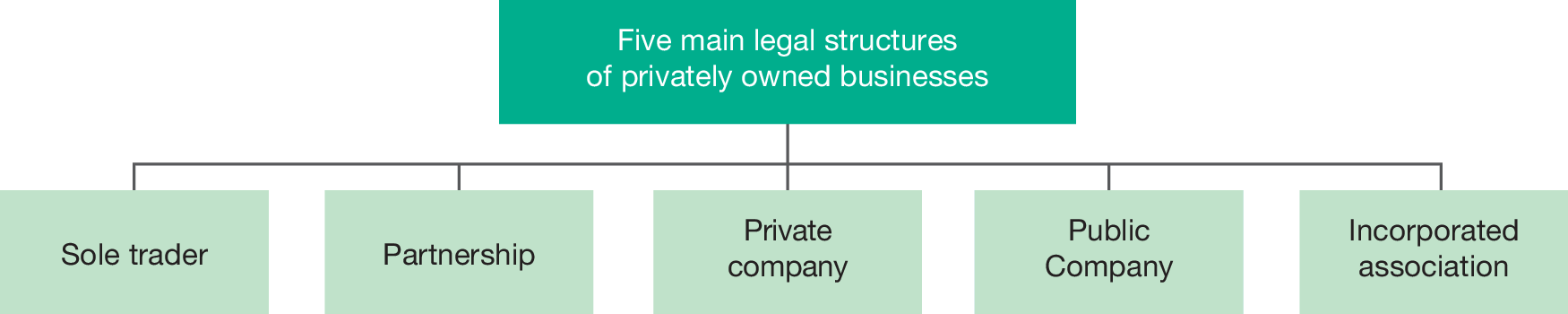
these five entities can be divided into:
incorporated business entities, in the case of sole traders and partnerships
unincorporated business entities, in the case of private companies, public companies and incorporated associations.
The term incorporated refers to the process companies go through to become a separate legal entity from the owner/s. This means the business exists in its own right, its own legal entity. Regardless of what happens to individual owners (shareholders) of the company, the business continues to operate. The business has taken on a life of its own. Consequently, the company can sue and be sued, can own and sell property, and has perpetual succession – it will continue to exist even when the owners change.
An unincorporated business has no separate legal existence from its owner(s) and will be either a sole trader or partnership. This means the business entity and the owner(s) are one and the same. When the owner dies then so too does the business entity.
Sole trader – a sole trader is a business that is owned and operated by one person and it is the most common type of business in Australia. A sole trader is the simplest and cheapest structure to establish. The Sole trailer receives all the profit and suffers all the losses. He or she has unlimited liability. This means he or she can be forced. To sell personal assets such as the house or car to pay for business debts.
Partnership - The partnership is a business usually owned and operated by between 2 and 20 people called partners. The partners share their profits and losses. It is common for people with similar skills, such as doctors and solicitors, to form a partnership. Partnerships also have unlimited liability, meaning that the owners. Are personally responsible for the business' debts.
Private company - A private company usually has between 2 and 50 private owners called shareholders. These businesses tend to be small to medium in size of then they are family owned. Shares in private companies are offered only to those the business wants as part owners. This is why it is called a private company. Just have the words Proprietary Limited, abbreviated to PY Ltd after its name. The main advantage of a private company is that the shareholders have limited liability. This means if the business cannot pay its debts, A shareholder generally loses only the money he or she. Had invested in the business.
Public company - The company can have an unlimited number of shareholders. The shares for public companies are listed on the Australian Securities Exchange and the public may buy and sell shares in those companies. Most public companies are large shareholders and public companies. A public company must have the word limited abbreviated to Ltd After its name.
inCorporated association - People may form an incorporated association in NSW by registering with the NSW fair trading. Incorporated associations are small scale, nonprofit and non-commercial in nature. They can only conduct business in the state in which they are registered. An incorporated business has its Legal identity, separate from its members, which provide protection to members. Small community groups such as sports clubs and art groups usually choose to each start as incorporated associations. Incorporated association structure can be more effective for these types of organization as they are generally simpler, more affordable than a company structure.
Range of options for financing a business:
two main types of sources are available to a business, as can be seen in the diagram. The business owner can contribute their own funds (equity) or they can obtain a loan (debt) from external sources.
The two main types of finance available to small business owners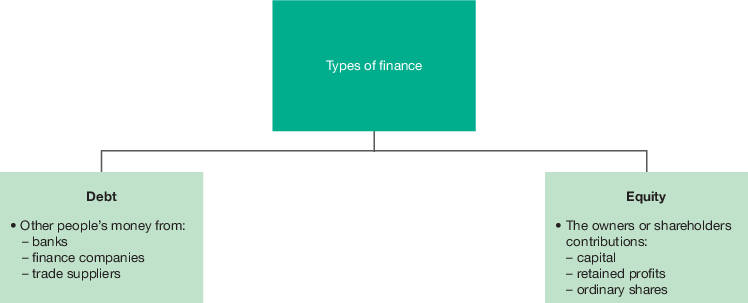
There are advantages and disadvantages associated with each source of finance. For instance, the main advantage of debt financing is that the owner does not have to sell any ownership in the business to raise funds. Also, debt financing has certain taxation advantages. For these two reasons, debt financing is the most popular source of finance used by business people when starting a new business.
Equity has an advantage over debt because it does not have to be repaid unless the owners leave the business. It is also cheaper than debt finance because there are no interest payments.
A loan may be secured or unsecured. A secured loan is where the borrower offers an asset as security, such as a car or a house, for the loan. If they don’t repay the loan, the lender may sell that asset to get their money back. Secured loans offer a lower interest rate but run the risk that the lender may have the right to sell the security if the borrower can’t pay.
With an unsecured loan, the borrower does not need to have an asset to offer as security, but the interest rate is usually higher. A person wishing to get a loan will need to consider carefully which type of loan best suits their needs.
Prospectus
A prospectus is a legal document issued by companies that are offering securities for sale.
The role of the prospectus is to make investors aware of the risks of an investment. Without this information, they would basically have to make investments ‘sight unseen’. This disclosure also protects the company from future accusations that it did not fully disclose enough information about itself or the securities in question.
Establishing a new business or purchasing an existing business
setting up a new business from scratch:
Advantages and disadvantages
Advantages of starting a business from scratch | Disadvantages of starting a business from scratch |
The owner has the freedom to set up the business exactly as he or she wishes. The owner’s objectives can be matched more closely to the business. The owner is able to determine the pace of growth and change. The owner has more flexibility to select the location, target market, range of products and level of customer service. There is no goodwill for which the owner has to pay. If funds are limited, it is possible to begin on a smaller scale. | There is a high risk and a measure of uncertainty. Without a previous business reputation, it may prove difficult to secure finance. Time is needed to develop a customer base, employ staff and develop lines of credit from suppliers. If the start-up period is slow, then profits may not be generated for some time. Potential customers may be more difficult to attract than initially expected or unforeseen competition may appear, especially if the level of planning was inadequate. |
8.6.2 Purchasing an existing business
When an existing business is purchased, the business is already operating and everything associated with the business is included in the purchase — for example, stock and equipment, premises, existing customer base, staff, reputation and goodwill.
Advantages and disadvantages
Advantages of purchasing an established business | Disadvantages of purchasing an established business |
Sales to existing customers will generate instant income. A good business history increases the likelihood of business success. Stock has already been acquired and is ready for sale. Equipment is available for immediate use. Existing employees can provide valuable assistance. | The existing image of the business may be difficult to change, especially if the business had a poor reputation. The success of the business may have been due to the previous owner’s personality and contacts which may be lost when the business is sold. It may be difficult to assess the value of goodwill with the likelihood of paying more than the business is worth. Some employees may resent any change to the business operation. |
8.6.3 Franchising
462Under a franchise agreement a person (franchisee) buys the right to use the business name and distribute the goods or services of an existing business (franchisor). People choose to start a franchise in the hope of avoiding many of the problems associated with starting a new business. For a set fee, the small business owner receives the benefits of a successful business formula, a well-recognised name and established trademarks.
Advantages and disadvantages
Advantages of purchasing a franchise | Disadvantages of purchasing a franchise |
Products, equipment, premises design and marketing are usually established. The franchisor often provides training. There is less need for the franchisee to have previous business experience. The investment risk may be lower. There is immediate benefit from the franchisor’s goodwill. | The franchisor usually controls everything to do with price, suppliers and health regulations. Profits must be shared with the franchisor. The franchisor often charges a service fee for advice. Contracts may be biased in favour of the franchisor. The franchisee may merely feel like an employee, but without the benefits and security. The franchisee has to deal with day-to-day operations and they are legally accountable. |
Important planning considerations
Staffing – businesses rely on staff to achieve their aims of improved profit growth and increased market share, therefore developing good working relationships with staff and motivating them to do their best in the workplace is a Priority for the business owner. good staff provide the business with a competitive advantage, especially if the business offers a service where the customers come into direct contact with the employees.
Identifying an appropriate location
Factors to consider when choosing a location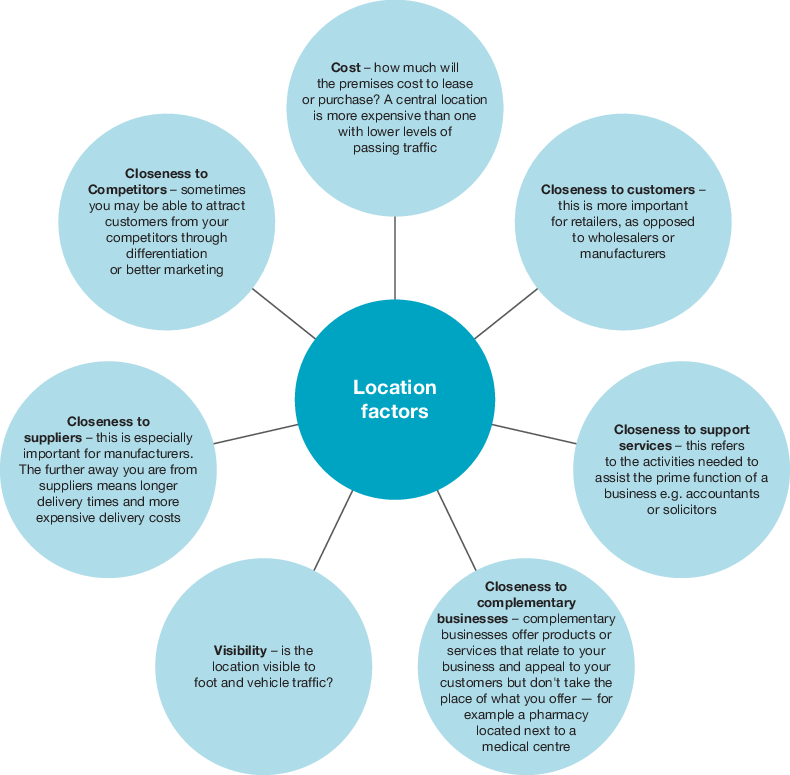
Equipping premises - Business owners Need to ensure they have the right equipment, fittings, furniture, and technologies at the employees can work efficiently. Some of the main things kept in mind when equipping premises is how much money is required and where to source those funds. Where to purchase the equipment and how to maintain the equipment and how to train staff.
Obtaining realistic valuations - If you plan on purchasing an existing business, it's important that you determine the current worth of the business and its future prospects. One should consider estimating a businesses value including sales costs, profits, assets, liabilities, tax and legal issues. Information needed when purchasing an existing business. Includes financial statements for the past few years. Details of. Any assets the business owns. Details about goodwill. Legal information, including legal documents such as leases and insurance policies. As well as any registration papers. Sales information, staff, Supplier and customer information. This allows the owner To calculate tHe suspected profits and losses.
Key considerations involved in running a small business
Marketing strategies for promoting a business and selling products or services -
Many small business owners have failed despite having an excellent product. They lacked customers — and, in business, ‘no customers’ equals ‘no profit’!
Consequently, you will have to promote your business. Promotion refers to methods used by a business to inform, persuade and remind customers about its products.
Personal selling: involves the activities of a sales representative directed to a customer in an attempt to make a sale.
Relationship marketing: refers to the development of long-term, cost-effective and strong relationships with individual customers.
Sales promotion: refers to activities or materials used by the business to attract interest and support for the good or service — e.g. free samples, coupons and point-of-purchase displays.
Publicity: refers to any free news story about a business’s products.
472Public relations: those activities aimed at creating and maintaining favourable relations between a business and its customers.
Advertising: where print or electronic mass media are used to communicate a message about the product.
Ethical decision-making and corporate social responsibility
Ethics is not concerned with legal obligations, but with what is morally right or wrong
organizations are frequently confronted with ethical decisions. For example, what should a business do:
with a loyal, long-serving employee who cannot adapt to new technology
with confidential information about a competitor’s pricing policy that a disgruntled employee leaked
when deciding who to offer a promotion to between two equally competent employees — should they hire a women with two young children or the male employee with two older children?
Corporate social responsibility (CSR) refers to the way that a business considers the financial, environmental and social impacts of its decisions. A socially responsible business will attempt to achieve two goals simultaneously: increasing profit as well as providing for the greater good of society.
The benefits of ethical decision-making and corporate social responsibility include:
improvement in staff turnover and absenteeism rates as staff feel more valued and motivated
lower business costs (such as recruitment and training costs)
increase in employee productivity
increase in sales as customers reward socially responsible businesses by purchasing more of their products
improved business reputation
marketing opportunities if the business receives publicity in the media
attracting better employees who want to work for organisations that are socially responsible
helping business achieve a sustainable competitive advantage.
The ways businesses respond to changing economic conditions
The Australian economy experiences economic ‘boom’ and ‘bust’ cycles. These periods of high and low economic activity are referred to as the business cycle. After a period of prosperity, business activity gradually slows until a recession or depression is reached. Eventually, business picks up again until prosperity is restored. This completes the cycle.
Economic forces have an enormous impact on both business and customers. They influence a business’s ability to compete and a customer’s willingness and ability to spend.
Phases of the economic cycle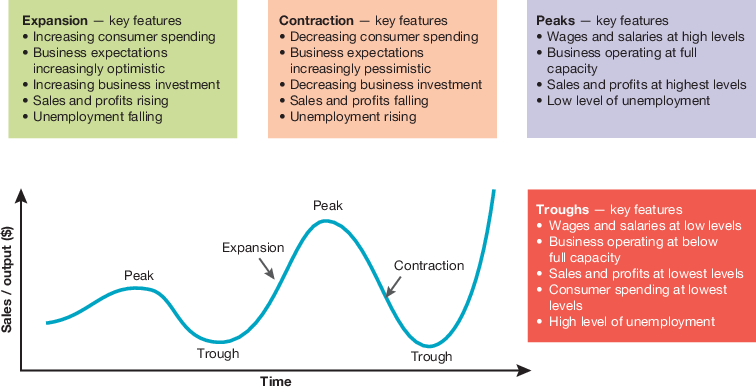
The ways businesses respond to changing economic conditions is summarised in the table below:
Business responses to peaks | Business responses to troughs |
Increase employees’ wages and salaries Increase production to take advantage of an increase in sales Hire more staff Increase prices Expand business Invest in new equipment, technology or assets | Keep employees’ wages and salaries at current levels Decrease or maintain production at current levels Decrease the size of the workforce Keep prices at the same level Put a stop to expansion or possibly close some locations Maintain current equipment, technology or assets |
The selling process
Product differentiation - This occurs in products that are the same or similar. Are made to be different from and or better than those of their competitors. By highlighting differences between one product and another, a business simply trying to make its product more desirable to customers.
Factors for differentiation:
Service: But the old service provided for every tale outlet. After sales service for ongoing maintenance like a motor car, how well the product does the job is designed for.
Convenience. Consumers are inclined to buy the product that is readily available. Consumers may be unwilling to wait for product to be ordered and delivered.
Value. choices include the cheapest product, the band on sale or offered as a special. The band presenting good value be cause it last longer is of higher quality with more features in similar products.
Social. People may buy a particular brand because it is seen as cool or worn by friends. Paper may also buy a label because of the status it represents and the link it has to wealth and success.
Ethical. Ethical Consumerism provides businesses with opportunities to satisfy the demands of the growing number of consumers, for example. In response to the dislikes of genetically modified foods by some consumers. Various products are labelling their products as GM free.
Environmental. People might choose environmentally friendly products to reduce the impact that consumption practises have on the environment.
The nature of product promotion
The role of gender in product promotion
Advertising often uses stereotypes.
Two major criticisms of some promotion stategies, particularly advertising, relate to gender. First is the use of stereotypical images of male and female roles. For example, in most advertisements it tends to be the male who uses the power tools, or who watches sport with his mates. Females, on the other hand, are portrayed preparing meals, cleaning the house or caring for the children.
The second major criticism refers to the overuse of sexual themes and connotations to sell products. Some advertisers target certain groups and appeal to personal desires such as physical and sexual attractiveness. Unrealistic images are portrayed as attainable.
Advertisers use sex appeal to suggest to consumers that the product will increase the attractiveness or charm of the user. Consumers need to be critical of such advertisements and realize they do not represent reality but are using an attribute — sex appeal — to sell a product.
The rise of the ethical consumer means some businesses try to address ALL consumer needs by focusing on gender inclusive advertising rather than traditional gender stereotypes.