CLASSICS 1000 UWO — Greeks & Romans
Test II Notes
Peloponnesian wars —
Conflicts between Athenians and Spartans goes back to Persian wars.
• Disagreements and frictions between them immediately after the wars
• Athenians built alliances and thus built an empire (aka Delian League) whereas Spartans were internally focused
• Athens becomes more and more militarily successful
• Active hostilities began in the 460's and continued until 404 BCE when Athenians were defeated..
○ Thirty years of peace for 446 BCE divides conflict into phases…
○ The great Peloponnesian war was fought from 431-404 BCE
• People fled from frontiers into Athens1
• Athenian literature leading up to 404 BCE , sense that Athenians feared their own destructions
Thucydides
• Author of incomplete history of the war between Athens and Sparta (431- 404 BCE)
• One of the most important political texts
• Unfinished, died before he could finish it
• Born ca 460 BCE maybe earlier, general in 424 BCE, was minimum 30 yrs old
• Came from an aristocratic family
• Broke family tradition, enthusiast for Pericles
• Strong ties to Cimon and those opposed to Pericles - but Thucydides followed him
• Caught the plague but recovered… detailed and puzzling account
• Failed to save Amphipolis from Spartans, thus was exiled.. Returned 20 yrs later but then died soon
• On the outside looking in…
Herodotus loved to tell a long story, Thucydides is more analytical and aware of methodological reasons
The 10 yrs war is the first phase of the great Sicilian war.
Incomplete history falls into 5 parts:
Intro, (ii) ten years war, (iii) uneasy peace, (iv) Sicilian Expedition, (v) Decelean War
• In addition to the narrative of events, Thucydides uses extended speeches.
• The speeches in Thucydides constitute a fascinating series of texts.
• In particular the epitaphios (funeral oration) delivered by Pericles (winter of 430/31 BCE) is an extraordinary statement of the Athenian sense of their own greatness.
• There are other versions of this speech, and Thucydides’ speech is quite distinct.
Thucydides importance:
Seen as the model of history in its modern sense:
Unlike herodotus
History vs. Poetry
Poetry is a philosophy and tends to speak of universals, history of particulars
Democracy at Athens —
Wars
Retreat
Types of govt. :
Kingship : reality in the Bronze Age (wanax), true kingship is a myth by the classical period.. Heredity -conflict over succession is kept in check
Tyranny : tyrannos - does not rule by heredity - seizes control of an existing government. Not necessarily bad, Plato and Aristotle’s writings did associate some negative connotations were attached to it
Oligarchy : broadens the base, ruled by the few, most common in the Archaic period. Aristotle considered it as ‘ruling by the rich’... Aristotle read the constitutions of each govt…
Democracy : rule by the people, direct vs. representational or parliamentary democracy. Aristotle considered it ‘ruling by the poor’ but wasn’t too fond of it
No
Aristocrat - rule by the best!!
The Ideology:
Rule (Kratos) of the people (demos) “It seemed good to the people
Demokratia: hotly debated form of constitution
Criticised by the oligarchs
Who were they?
Demos was a class i.e – the ordinary people or city poor
Athenian democrats believed that democracy was intimately connected with liberty
Democratic ideals
Eleutheria - liberty
Political liberty to participate in democratic institutions
Private liberty to live as one pleased
freedom of speech (parrhesia)
Public: to address fellow citizens in political assemblies
Private: a person’s right to speak his mind
Isonomia - equality to participate in politics… largely dependant on social class though
The concept of equality was strictly political, and was not transferred to the social and economic aspects of society
Helmsman - ship man steering a ship because our society resembles one
Cleisthenes
Divided Attica into 139 municipalities (demo or demes)
Institutions
Bringing Attica together:
city, inland coast
Institutions:
Political rights granted to adult males
Excluded:
women slaves and foreigners, as well as children
(coming of age was 18, full rights were granted at 30)
Assembly (ekklesia)
Normally attended by 6,000 citizens
Passed decrees
Adults male citizens over the age of 30
Legislators (nomothetai)
passed laws (nomoi)
Largest decision-making body
Rules punishment is transgressed, formal laws
Solon was a figure in history who wanted to formalise the system of Athenians; they referred to their laws as ‘laws of Solon’ then.
dealt with amendments to ‘Solon’s laws’ (594/3 BCE)
Courts (dikasteria)
Dealt with the administration of laws
Means ‘Places for Justice’
‘Dikae means judgements, judges were called Cretai
Magistracies (archai)
various administrative functions
The year was named after Chief magistrates
10 Generals (strategoi)
Elected offices, people voted for generals.
“Law, the king of all,
of mortals and immortals,
guides them as it justified the utmost violence
with sovereign hand.”
— Pindar
Legislation:
Vocab - meanings of words
Nomos means both LAW and CUSTOM
Thesmos is an older word.
Accent on last word could mean pasture
Law was originally custom - the legal system was defined by traditions, normal everyday life.
Law is when you formalise tradition.
Beginnings of laws are hard to define
Two distinct views:
Unwritten law (oral and conventional views)
Only written rules are really laws
So long as Greece had oral culture, they would have oral laws one can assume
First written laws in any Greek city were said to have been drawn up by Zaleucus for Locri Epizephyrii (southern Italy)
In Athens the first written law are attributed to Draco (circa 621 BCE) — harsh laws thus Draconian Laws
Homicide laws remained in force, but Solon’s laws replaced
Unwritten ordinances (of gods)
Clash of culture and politics ; laws of the city are coherent with the ‘larger sense of laws’
Human laws reflect divine law.
After democracy… laws could be passed by a majority of the assembly
In 5th century BCE, no firm distinction between ‘permanent’ law aka nomos, and a ‘decree’ for a particular occasion aka psephisma
Legislation was not systematic; confusion
…
After 410 BCE … serious attempt to clean up legislative system:
Existing laws were revised
All were inscribed in stone
No uninscribed laws were enforced
No decrees could override a law
Decrees continued to be passed by the Assembly
New laws were made by the nomothetai
Judicature:
How were these laws administered?
“And look, this is a map of the entire world. See? That’s Athens right there.”
“What do you mean? I don’t believe it: I don’t see any juries in session”
Administration of justice through courts and judges.
Until early 6th century BCE all verdicts were given by
9 magistrates called archontes aka archons
Court of the Areopagus: most ancient council at Athens
The Ephetai: a jury of 51 members.
Solon instituted a system of trial by the elaia to hear appeals of the verdicts of the archons, etc. l
Jury system founded since elaia was inadequate:
Volunteers were called up each year, 6,000 people were drawn up
Continued to modify their jury
Population:
From 425,00 in 431 BCE decreased to 185,000 in 317 BCE
Women and children were around 3 to 4x the size of male citizens
Number of slaves was around double that of Male citizens
Century of sustained conflict affected population
Public v. Private Actions:
Law on any subject generally
Public actions were considered more important
private public |
Injury or wrong suffered by an individual Could be raised only by the person who claimed to have been wronged. No penalties were imposed. Offence that concerned the community as a whole Could be raised by a magistrate or official acting on behalf of the state or ‘he who wishes’ Penalties were imposed for those who failed to win ⅕ of the jury’s votes or abandoned prosecution. |
Litigant had to speak for himself but could use the work of a speech writer (aka logografos)
Lysias
Demosthenes
Classical Athens had a massive focus on rhetoric and oratory
Litigant could call on friends to speak in support
Documents (eg. laws) could be read & witnesses could also be called.
Testimonies from slaves could only be introduced if obtained under torture.
Speeches were limited by time and water clocks were used.
When the speeches were over the Jury voted immediately
No impartial summing up or discussion
They voted by casting pebbles or shells in an urn(later, bronze votes were used)... Majority vote won.
Punishment was then proposed by the prosecutor and litigant
Second vote on punishment
Punishments:
Monetary penalty
Partial/temporary or Total disenfranchisement - taking away citizen’s rights,
Confiscation of property, forced to give it away.
Confinement in the stocks — a device that will immobilise a person — long terms of imprisonment were not common
Public Humiliation — culture and community that was really preoccupied with the idea of honour and shame
Deluxe disenfranchisement LOL — exile — return would be possible but after many years
Death - executions
Athenian Judicial System:
The chief weakness of this system was that the Juries could be swayed by skilful speakers
Advantages:
Large juries were difficult to bribe or bully
The courts and the people were nearly identical so that the accused felt that he was being judged by the Athenian people and not some govt. Official
Family in Greek Society —
Thucydides poster boy
The Word family comes from Latin familia, but this word usually refers to the slave within a household.
Greek counterpart, oikos, refers to the house in a larger sense whereas oikia, the physical house itself
Senior male was called kyrios : took charge of relations with outside world
Held legal authority (esp. women of the oikos)
Women never severed ties with their natal home… Women lived their lives in two oikoi and men lived in one
Households could include non - kin members
People, property, animals
Houses:
Oikia not oikos
Private houses were basically same throughout the classical and hellenistic periods
Recent works reflected organisation of domestic space; windows were few and small
Second story (common), reached with ladder
Archaeological evidence is rare to none — exiguous
Mud-brick on stone foundation
Walls plastered and painted simply
Floor of beaten earth
One or two rooms on ground floor
Simple hearth and portable braziers
Fixed hearths and domestic altars were not common ; literary evidence attaches special importance to the hearth (Hestia)
Roofs were pitched with rush and terra
Andron has
Euphiletus:
His wife moved downstairs after having their child, he himself moved upstairs and since his wife was downstairs, Erastonhenes, who is an adulterer, to gain access to his wife.
Women in Greek Society:
Leaving fathers home is a sort of betrayal - leaving your father for another man.
Roles: wives mothers daughters and betrayers
Mainly stories of Heros - being helped by the daughter of an adversary
Hesiod contemporary with Horic poems
First woman created punishment for all humans, as the result of the crime of prometheus
Theogany: rant about woman
Early greek misogyny
Arrival of women in greek myth brings birth, and birth brings death
Pandora was an earth goddess
Hope trapped under the rim of the jar
Semonides of Amorgos
Iambos on women
"The Types of Women," where he divided women into different categories based on their behaviour and characteristics. In this poem, he used iambic verse to satirise and critique various aspects of female nature.
He talks about how in the beginning women’s minds were made differently and how they were made from different types of animals
Says a lot about the values of early Greek society and what’s appropriate to women and their values
Early greek misogyny 🤝 early greek pessimism
How serious? What is its function
“A word or two on the duties of women to those among you who are now widowed. I can say all I have to say in a short word of advice. Your great glory is not to be inferior to your essential nature, and the greatest glory of a woman is the be least talked about by men, whether they are praising you or criticising you” — Thucydides 2.45 (Pericles Funeral Oration)
Women should not dominate male space.
Media - euripides and his plays - he thought misogyny and segregation was bad.. His plays did cause awareness but also ig commodified the struggle
Dionysus & Maenadism:
Maenad - mad woman
Occultish behaviour and vigorous worship:
Sustained by women - exclusively women
Fluid makes us live -
Celebrating the gods by having orgies
Modern day ‘orgy’ has been corrupted from the original meaning, (orgia)
Maenadic worship:
Occurs
Everything is structured around the oikos but at this point
Ecstasy - ekstasia - out of self experience
Fantasies of sparagmos or omophagia
Reaffirmation of the normal order… myth is not about changing the world but affirming it.
Maenadism is a powerful release.
Myths
Black figure dionysus - in his youth, he was kidnapped on the beach, he filled the ship of the pirates with vines and animals
Hera produces a handicapped god - Hephasteus whereas Zeus births Athena…
Hephastus makes hera a chair
Satyrs :
Goats outside of athens - horsey within athens
Bulbous nose, receding forehead
Women are Ritually free - loose women
Slavery :
Definition of a slave:
“a person who is, in the eyes of the law and of public opinion and with respect to all parties, a possession, a chattel, of another person”
Can be used and abused at will - slaves were flexible to the definition
Barbarians aka non greeks were appropriate slaves
Chauvinism - non greeks fere ‘naturally’ slaves since greeks were superior
Terminology bleaches or normalises the word of slave -
Servant v. slave
Dmos : disappears after homeric poems, meaning ‘house’ (latin famolos - household slave)
Doulos (douleia): standard word
Andrapoda: ‘man footed’ dehumanising terms that equates them to animals
Oiketes: household slave , from oikos (house)
Athenian slaves - some argue that the Athenian economy was entirely slave based.
Their legal states was consistent - with considerable gradation in other areas:
Publicly owned slaves(demosioi)
Few hundred in number
Token police force
Serving as minor functionaries in the agora and courts.
Privately owned slave
Household slaves - f and m, males worked in fields
Agricultural slaves
Mine slaves - silver mines of Laurium
Douloi
Not all labelled slaves (douloi) were chattel slaves:
Sometimes people would get enslaved for their debt (debt bondage )
ca 600 BCE, political unrest led to Solon becoming
Sexuality —
Issues of hierarchy:
Hermes - phallic imagery - not fertility imagery .. How do we know this? It is never located in areas where it should be expected..
Phallic display — threatening — aspect of aggression
Maleness - Latin term connected with the male to courage to excellence
The herm is a depiction of maleness
Mutilation of hermes — deep mark on the community’s integrity
Maenad and Satyr black vase painting:
Satyr is aroused as they mostly are. He is harassing the Maenad
Male perspective of paintings etc.
Heterosexuality:
Dominant (men) v. subordinate position (women)
Hermaphrodites in myth
Most women depicted on vases are clearly prostitutes (pornai, hetairai, auletrides) and not wives
Romans faced a lot of anxiety around sexuality - Usurpation of men when women have WLW relations.
The absence of opinion to WLW relationship in ancient Greece implies indifference.
(the vases we have seen are 2% of the vases that existed – not as abundant of evidence)
Married couple, eyes locked.
Homosexuality:
The lioness on the cheese grater LMAO
Dialogue of Plato Show
Homoerotic behaviour was particularly among the elite.
Remains controversial
With the emergence of the Polis, forming heterosexual
The popular pairing of a mature male and young boy -
Paederasty is more accurate than homosexuality.
Persia: Herotodus considers mingling with young boys in a homosexual relationship to be ‘one of the pleasures of life’ that they learnt from persians.
Greek homoseuxlaity is a complex social phenomenon
Dober approach:
Phenomenon of the polis
No early (especially in Epic) evidence for overt homosexual behaviour.
It is the result of segregation of women among the elite
Substitute for courtship - pursuing boys “if they had women, this wouldn't have happened”
Avg. Athenian males were open to a large sexual experience, sex with anyone or anything
Absence of overt homosexuality is a result of conventional reticence (cf. to prepon)
Cross Cultural evidence –
Cultures differ, we cannot always draw observations
Symposium:
Reclining on couches
Feature of commensality
Related to warriors feast — conspicuous feature of Homeric society
Anthropology of the evening meal
Libation - liquid offering
As an aristocratic institution
Activity based on the warrior group — the spartan reclining, syssition (shared mess), which remained the basis of Spartan military organisation
Centre for transmission of cultural values
Homoerotic behaviour
Political activity (hetaireia aka priv club)
Place of pleasure (games — kottabos, entertainment — hetairai)
Serious poetic performance
Greek Myth —
Siren - partially woman partially bird
Carrying a child — grave marker … myths of harpees carrying off children
What is a myth?
Traditional tale
Not bound to any text or reality
Is the product of language
MYTH exists independent of the tellers though…
When the story is not connected to a text it can be shaped and moulded when needed ; thus
Genuine myth is shaped over time.
Mythos — can refer to a speech, tale/story
Traditional comes from ‘handing down’ generation to generation
Functionalist definition of myth:
Series of devices that the ancients used to develop their view of the world.
Some argue the myth does something more straightforward
Six Monolithic theories:
All myths are nature myths
Explains meteorological or cosmological phenomena
The assumption is that they used myth to describe instances which they observed but were unable to explain.
Explaining it through the excuse that ancients knew about certain concrete physical laws.
Works for SOME, but clearly not for others
Myths are Aetiological
Aviation – reason or cause
Myth is proto science
They seek to explain some aspect of the world
Similar to first, but broader in application
Myths are Charters
Serve as charters for customs institutions or beliefs
Explain and legitimise social practises
Structuralism
Primitive computer running this program on contemporary
Claude Strauss
Binary opposite that seek mediation
Shows structure but now oft myth
Psychological theories
Freud influential
Discussed the myth of Oedipus – repression in early childhood, of sexual feelings for the parent of the opposite sex, accompanied by desire to suppress parent of the same sex
Saw folktales, myths, sagas, even jokes and popular tales as related to dreams in form and content
Ritual theory of Myth
.Currently in fashion — associated with Walter Burkert
Important connection between myth and religious ritual.
Often some link between the narrative structure of the narrative and the pattern of action in ritual.
Ritual was a sequence of actions or, ‘the things being done’ (ta dromena)
Theseus and the Minotaur – Minos – palace at Knossos
THE MINOTAUR
Offspring of Pasiphae and a bull
Lived in the labyrinth
Athenians were supposed to give a regular tribute to king Minos
Became a problem for Athens because Athenians would be sent to be fed to the bull.
Theseus sails to Crete as part of the tribute
Minos’s daughter Ariadne falls in love with Theseus and aids him in his quest.
Gave him a luminous garland and a thread of goal (to find his way out of the labyrinth)
The Heroic Cycle:
Theseus was adopted as a national hero
He fought many monstrous villains in and around Athens
Minotaur of Crete was his most famous adversary
Never ONE canonical version of the myth
Theseus is the Athenian answer to Heracles
Athens does not have a deep bronze age, so no deep stories
Religion:
Did not have a simple word for what we call religion
Spoke of ta theia , theon therapeia and eusebeia
Religion is a state of mind, a complex of beliefs and feelings about the forces which govern a man's life and situate it in the world.
Polytheism and Anthropomorphism
nature / the world is not merely a reflection of a single transcendent deity
What is a Greek god?
Immortality
Gods are deathless — athanatoi : those that are not subject to death
They are born, have a beginning but no end
Anthropomorphism
Portrayed in human form — cannot be everywhere at once
Epiphany — manifestation for a day?
Cult iconography — characteristic representation … you see them and you know which god it is
Mythic and literary representations – can be part of literature and narrative
Mythic
Greek conception of power
The Olympians:
Zeus
Hera
Poseidon
Demeter
[Hades] - non one worships death
Athena
Apollo
Artemis
Aphrodite - 2 birth myths .. one relates her to this ‘legacy of Zeus’ Iliad - one says that she was much older than Zeus, of a diff generation.
Hermes
Dionysus - replaces Hestia
Hephaestus
Ares
Greek Drama —
Theatre of Dionysus sdjldd
Athens
Odd but purposeful design
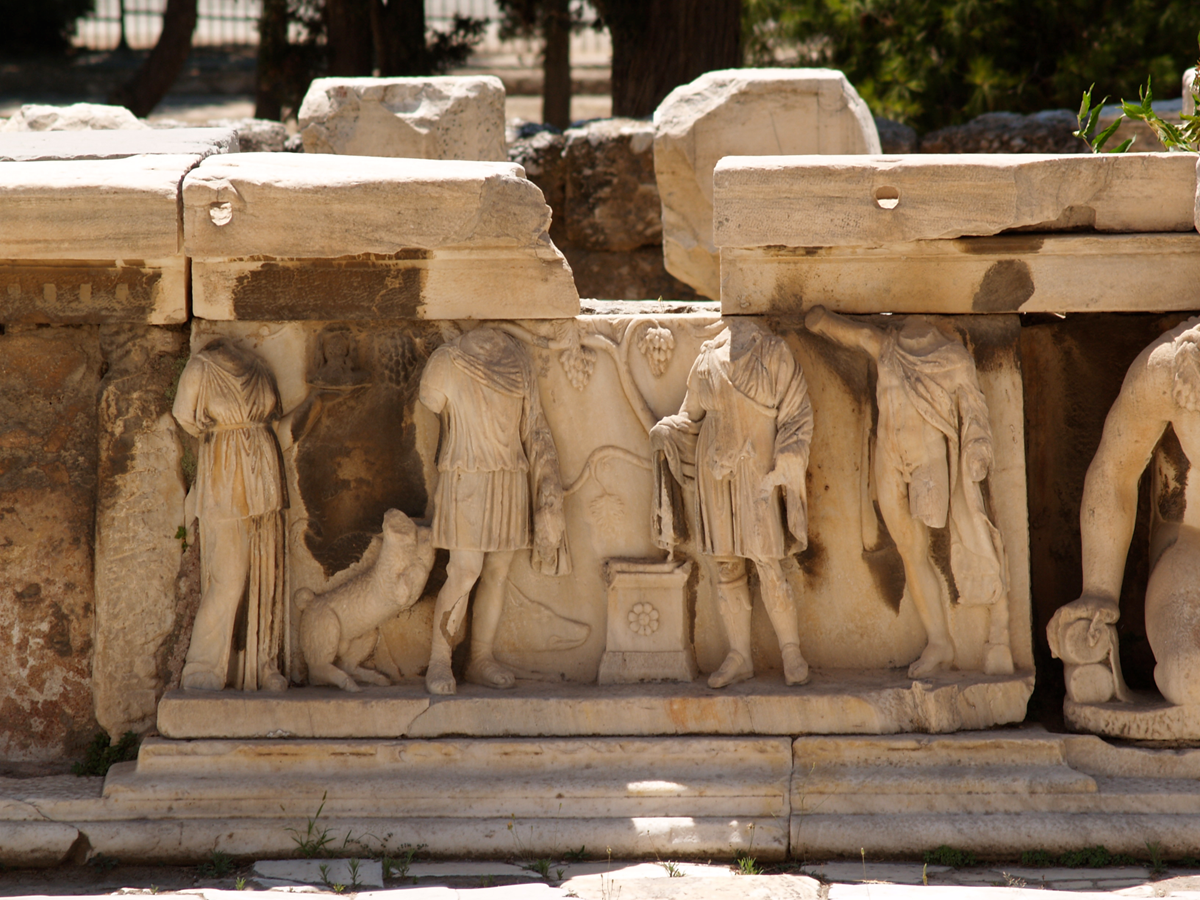
Once an orchestra – Greek word orchestra means dancing place.
Elevated stage to make the actors more prominent
Reflecting changing space and time
Similar style theatres began to pop up across Greece cuz everyone wanted to be like Athens ofc
Best preserved theatre fig 1.1
Dramatis Personae
Three great Athenian playwrights:
Aeschylus
524/525 - 456/455 BCE
Sophocles
495 - 406 BCE
Around 120 plays - only 7 known - due to their usage as school texts in the Byzantine period
Euripides
485 - 406 BCE
Thespis - Thespians (after one of the first playwrights)
Chronology:
Basic Features:
— Dramatised as the play demands
— of considerable importance; may have been even more important in pre-Aeschylean tragedy
Limited number of speaking actors
— two in early period and three in later - sophocles
Stichomythia
— highly stylized and formal
— dialogue 2 lines, very grammatical
Length
— moderate
— ca 1,000 to 1,500 lines
Masks
— alien to modern notions of theatre
— remnant of tragedy’s ritual past
— gesture inflection of voice etc.
— very different onte
Contributory Influences:
Taken from mythology
–
Dozens of tragedies, only one is fictional.
Lots of tra
First – persians
Second is by Francis (toadman LOL)
Oedipus as the victim of unavoidable doom
Why does he blind himself
Cutting himself offihUE
Test III Notes
Greek Comedy —
Ambiguity of laughter
Analysing humour is like dissecting a frog, the frog dies of it.
Three phases
Old (5th to 4th)
Middle (first part of 4th) - no major names of this phase
New (after)
Important comic poets:
Aristophanes
Old comedy – 11 plays survive
Menander
Ancient poet did not survive antiquity but fragments of papyrus
Scattered quotations
1958 — large papyrus finds
Origins
Tragedy and comedy come from similar but different places. Emphasis on tragic events..
Tragedy : goat song… developed within culture of Dionysus, satyrs are goatlike
Athenian satyrs are horsey… tragedy as goat song may be the idea that its rooted in competition and sacrifice. You win something and you sacrifice something…
Komodia – song of komos , song of the village (kome)
Aristotle in poetics wrote that comedy arose “from the leaders of the phallic songs, which remain customary even now in many Greek cities”
There are funny tragedies..one is not entirely serious while the other unserious. The two forms of art differ in the way in which the two forms of drama relate to the audience.
Tragedy (universal) objectifying distance of the mythic past. Ancient myth, set in a time of kings and heroes (Thesues talking like a modern democrat while being a hero)
World of comedy is the particular world of classical athens. Directly reflective of the audience
Old Comedy
Aristotle’s observations .. phallic song referencing Greek ideas about potency, strength etc.
Characteristics:
Costumes
padded, elaborate costumes – to be a bit grotesque
Masks - like tragedy
leather phalloi - used in strategic ways????
Chorus
24 in number -
of primary importance in early plays
Language
elaborate and varied
much sexual and scatological humour - lot of shit jokes
Plots
often fantastic – loose in plausibility.. Disrupted for jokes
indifferent to reality
Bolaraphon flew to Olympus on a pegasus.
emphasis on a comic ‘hero’
Opportunist, lazy, sexual, anti-hero
strong connection with the world of contemporary Athens
‘real’ Athenians portrayed on stage (e.g. Socrates in Clouds)
citizens are seeing their own reflection on stage.. Socrates sits and watches himself be made fun of.
elements of social and political satire
a fundamentally conservative outlook
Middle Comedy
ca 404 - 321 BCE
follows the defeat of Athens in 404 BCE
A time of experiment and transition
Little political criticism
Popularity of mythic burlesque
No complete play survives (only scattered ‘fragments’)
Alexis and Eubulus were significant figures
New Comedy
Punctuating the drama, radical change in ancient drama.
Originated with choral song and performance, but by the time we get to new comedy, its dance routines between acts
Increasing importance of the actor and acting profession.
ca 320 - 250 BCE
Until recently New Comedy was known almost exclusively through Roman adaptation (Plautus and Terence)
Papyrus-finds have increased our knowledge of Menander significantly
Characteristics:
5-act structure emerged from structural changes in Old Comedy
This became the standard structure for all drama until recently
Emphasis on social comedy and social tensions
rich and poor ; town and country ; citizens and non-citizens ; free and slave ; men and women ; parents and children
No topical comedy, obscenity, no phalloi, etc.
The language is closer to tragedy
Menander’s strength was the sympathetic portrayal of many kinds of personal relationship and the problems that arise from ignorance, misunderstanding, and prejudice
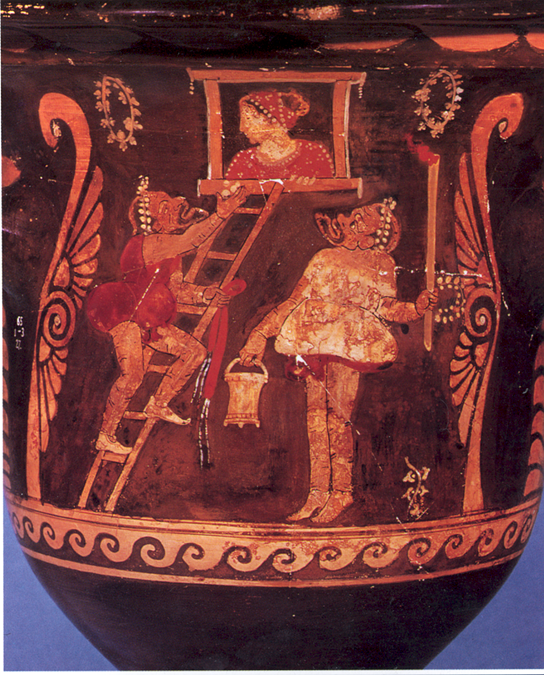
Grotesque faces suggest comedy, old men were funny to greeks
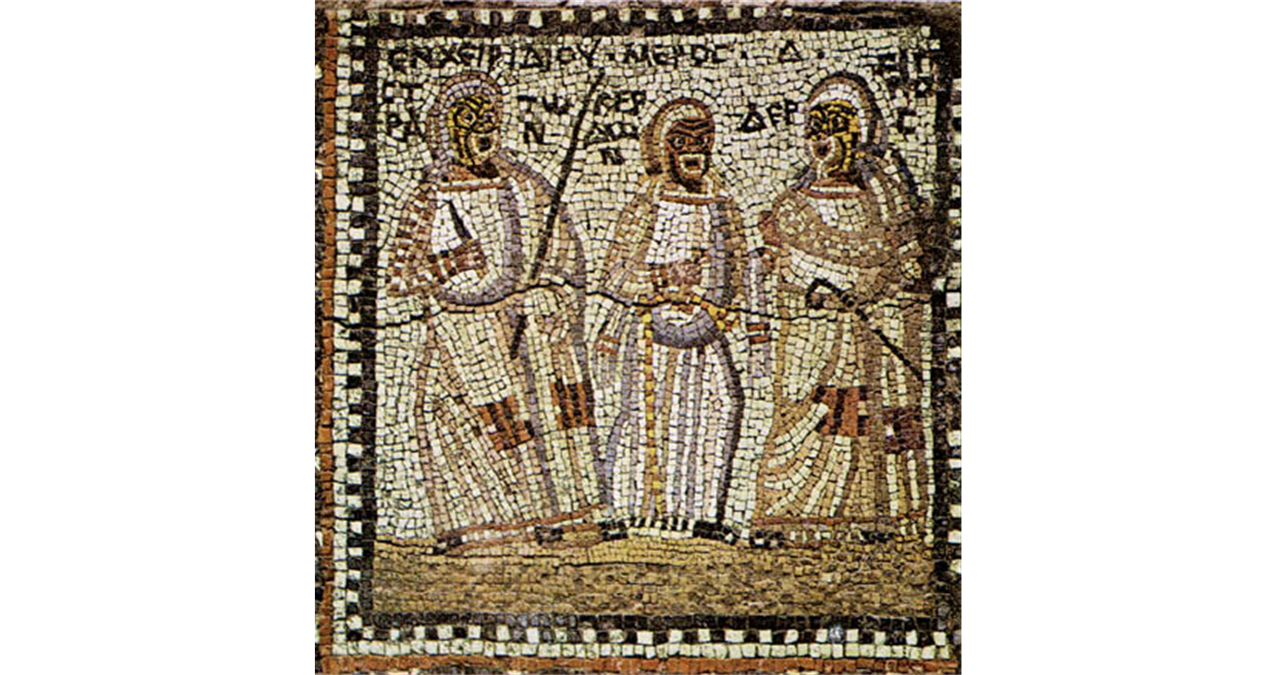
House of menander in Mytilene
super fan from the island of lesbos, was a reader of Menander
Muses don't have consistent function Thalia is the Muse of Comedy
Reference to very particular moments in the plays
“Encheiridion” – act (4, 2 or 3)
Shows progression on literacy (image mosaics with footnotes)
Greek Philosophy —
Overview
Talking and thinking about things, these approaches were mostly defined by these philosophers who preceded us.
Before philosophy they told epic with myth…
Rise in 5th CE Athens; the analytical tools we use for contemplating the world
Asia Minor and then southern Italy
Xenophon vs. Plato’s writings
Socrates seems like this idealised figure, literary construct, shifting prescience, develops as Plato develops
Myth often focused on cosmology – ex. Hesiod's Theogony
Myth offered a narrative account of reality
Pre-socratic philosophers were not entirely diff from those like Hesiod.
Philosophy offer a coherent system vs. a story
Pre-Socratics
Evidence is lacking, no works survive completely
Poetry has a system, prose does not, so it's tricky to know whether the quotes referenced by some philosophers were truly the words the other philosopher spoke.
Quotations in later writings but only in fragments
Doxographic Tradition: later philosophers writing about their predecessors.
Aristotle’s Metaphysics
Gives an overview of early philosophy, however, his bias and theoretical preoccupations offers a tainted account (people trying to grab round in the dark for some sort of truth he has himself reached)
We see Pre-Socratic philosophy through the filtre of later thought
The Milesians
Active in the 6th BCE
Often called physical or natural philosophers
Lived around the city of Miletes
Interested in a material understanding of the world
They developed the idea of the arche (‘first principles’)
Thales
CB thinks he's largely a legendary figure
Was seen as the typical scientist or intellectual (Einstein)
Water was the arche… primal substance, all things originated from water
May have been influence of non-greek traditions
Anaximander
Born circa 485 BCE ?
First Greek to write in standard prose.
Quotation marks don't exist, but writing style and dialect shifts, turns to Ionic… ‘’
His arche was to apeiron
That which is unlimited, the infinite?
The process which has not been subject to limits, the process by which matter comes to be, process of definition
To define something would mean to put limits around it, define it so that you are able to observe it from that which is not
Anaximenes
Active until ca 500 BC
Pupil to Anaximander
Principle substance is air
Anaximander
Ca. 504 BC
Fire is the principle substance
Parmenides
Fl. ca 540 BC
Philosophical poem
How art is manifested, framed truth in a mythic form.
Emphasis on being
True world is the world of unchanging beings.
To say that something is makes sense, to say something is not, does not make sense… difference insinuates that this something is not something other than itself.
‘Is’ in Greek can be ‘true’ or ‘exists’.. is by itself has a deeper sense.
Existing is the only thing that's true and logically possible.
If the universe unfolds according to time, how does time change, what is the true concept of time.
Plato constructed a dialogue between a very old Parminedes and a very young Socrates and Socrates lost, this was fundamental to Plato’s own ideology due to his devotion to Socrates.
His true account denies motion, change, difference, etc.
Posed a major logical challenge for subsequent philosophers
The Strasbourg Papyrus
Purchased in 1904, but not published until 1998.
Papyrus shaped into a stand-up collar and decorated with copper leaves.
In the early ’90s scholars realised that the papyrus was from a text of Empedocles
Overlap with known fragments as well as new material.
Gives us 69 continuous lines.
Empedocles
Rich biographical tradition
Ardent democrat (Aristotle)
Healing powers and wea
Said to have died by leaping into Mt. Etna.
Credited with two main poems:
On Nature
Purifications (Katharmoi)
Response to Eleatics… taking Parmenides on.. Until Plato (in Sophist)
Empedocles responded to the points of
Generation and destruction
Motion and change
Plurality
Argues that the world is made up from the interaction of the Four Roots
Irreducible elements
Zeus ; fire
Hera ; air
Aidoneus ; earth
Nestis ; Water
Principle of Love is of attraction, the opposite is Strife, polarity
Things change radically and we are in the middle of this cycle.
Philotes
Love is a cosmic force for early Greeks
Neikos
Strife recalls Heraclits’ use of strife and war as cosmic principles.
Cycle of change
A twofold tale I shall tell: at one time they [i.e., the roots] grew to be one
alone out of many, at another again the grew apart to be many out of one.
(fr. 8.1-2 = B 17.1-2)
An implicit rejection of Parmenides, but he supports a Parmenidean notion of ‘unchanging change’.
Constant cosmic cycle, as the elements are influenced
A complex zoogony, details biology, attempt to reconcile the notions of birth death and general change with Parmenides’ view that being is unchanging and eternal
Underlying unity, of all elements
Empedoclean Scholarship
Can Katharmoi be reconciled with the Physika?
Were they composed at different periods in the poet’s life?
Empedocles’ view is comprehensive…
Gold leaves with poems inscribed upon them
The Purifications - Katharmoi:
Complete break from cultural tradition
Precursor to philosophical writings that questioned
The Decree (fr. 107 = B 115):
Much in the text is obscure
Wretched conditions of mortal incarnations is described
If we are in exile, that harsh world is not nice for us, mystical Greek beliefs…
Human life was unpleasant, life of the gods wasn't.. Everything gods do is without toil
Hope of release and return to the company of the blessed (gods)
Account of the underworld?? Descent to the underworld or a Katabasis… very controversial
An account of early history of race
Ritual injunctions – how to live a proper life
Concluding remarks:
Empedocles offers a glimpse into the world of mystical religions of Greek Italy in the Classical period
Empedocles sets out two complementary cycles: cosmic and the exile and incarnations of the daimon
Plato & Aristotle:
Renaissance - period of creativity… Raphael’s fresco in the Vatican
5th CE Athens:
Sophistic revolution
Greek enlightenment – concentration of thinkers in Athens..
Sophistes = sophist aka a practitioner of sophia (wisdom)
Emphasis on practical use of sophia —> rhetoric
Socrates
469 - 399 BC
Well known public figure
Wrote nothing – highly influential
Plato wasn't his only disciple
Xenophon's Socratic works survive but all others are lost.
Inquiry of the divine mission
In 399 BC put on trial for impiety – introducing new gods and corrupting the youth
Improvising religion.. Introducing new gods OR corrupting the youth
Homeboy was so annoying he rly said ride or die… wanted to be kept at states expense because he wished to be a philosopher (so pretentious but i still love you bae)
Plato:
Athens ca 429 - 347 BC
Folk hero for philosophical setting
We've got everything from Plato. He became the fundamental philosopher… great literary artist
Importance in education
He lied to us.. His name was Aristocles, from a wealthy family background.
Major influence of his life was Socrates.. Diff from Socrates in three respects
Rejected marriage
Founded a philosophical school - academy
Produced a great deal of written works
Dialogues:
Himself does not appear, reflection of the world: well known Athenians we are aware of through other sources.
Historical moment in which a discussion can take place…
Unique among philosophers in his refusal to present own ideas.
Varied and open dialogues – much debate beginning in antiquity
Earlier dialogue are shorter and more accessible
E.g., Apology, Laches, Euthyphro
Apology – speech that Socrates gave. Consistent with the way the earlier dialogues are written
Often ‘aporetic’
Middle
E.g., Symposium, Republic, Phaedo
Socrates is still a central figure, but develops positive views of his own
Symposium – hierarchical structure … king should be a philosopher
Late
E.g., Cratylus, Laws, Timaeus, Parmenides
Socrates is less important
Plato develops views of his own at length
Difficult – less influence on Western thinking.
Laws takes up ideas of the state, Timaeus - cosmology
Plato’s idiosyncratic views are not reflective of Greek values. Aristotle was more aligned in that sense yet he had his own issues.
Aristotle:
384 - 322 BC
Born in Stagira to a physician
#orphan at a very young age
Lyceum area surrounding Gymnasium, called place of Lucias – Apollo?
At 17 he travelled to Athens and entered Plato’s Academy, where he remained until Plato’s death in 347 BC
Aristotle’s relationship with Plato was complex
a mixture of admiration and criticism
may have prompted Plato to be critical of himself
After Plato’s death, Aristotle left Athens
stayed in the court of Hermeias, ruler of Assos and Atarneus (in the Troad) until 345
married Hermeias’ adopted daughter Pythias
began his biological research
In 342 BC Aristotle was invited by Philip II of Macedon to become the tutor of Alexander (the Great)
Returned to Athens in 335 BC
He founded his own school called the Lyceum
the school was later named after the peripatos, and so there are references to Peripatetic philosophers
Left Athens after the death of Alexander and died in Chalcis in 322.
Classification system — biological writings and elsewhere
Teleology – study of ends
Fundamental thinker of western philosophical tradition.
Works remained challenging
Writings:
Esoteric works survive
Exoteric works are lost
Extant works can be classified in three broad categories:
Logic and Metaphysics
Nature, Life, and Mind
Ethics, Politics, and Art
The nature of the Aristotelian corpus remains controversial
Written lectures?
Notes are selective and can be abstract…. Forgetting context can be challenging
Early Greek Medicine —
Achilles was considered a hero
Connection of rise and philosophy and formalised sense of medical practise, as well as ritual religious
Hippocrates of Cos
First real physician… born ono Island of Cos
Influence of Plato's writings
Practise:
One cannot understand the body without understanding the whole world
How things fit into the cosmic structure of things.
Earlier descendants saw themselves as the successors of the healing god Asclepius
Hippocratic Corpus
Numerous writings on the subject of ancient medicine and medical practice
Large body of texts, designed to combine the teachings (?)
Does not cohere as a system of medical practise – rather different texts on a variety of things
Health and disease – balance –
None of the works is likely to be by Hippocrates himself
Does not offer a consistent view
emphasis on balance and morbid imbalance
Much controversy surrounds Hippocrates' precise understanding of the nature of the body and disease
Hippocrates was the ideal physician
Galen
Galenic school was more influential in the ‘modern world’ basically second century – greeks and romans
A.D. 129 – ca 190
Galen started out as a gladiator
Spent a lot of time on Plato and aristotles works
Rose from gladiator-physician to court physician of Marcus Aurelius
Important for writings on anatomy and pathology
Central for Galen was the four-humour system (chymoi ‘juices’; L. (h)umores):
yellow bile (chole)
black bile (melaina chole)
phlegm
blood
Three organic systems: heart, brain, liver
Anatomy, Physiology & Consciousness
They did not dissect people
Most obvious way they got to know about it was through sacrifice
Battlefield – fighting with swords etc. – physicians while inspecting battle wounds.
Desecrating a corpse was a religious offence
Extispicy was an important source of knowledge about inner organs
Examining entrails
Physicians made observations on the field of battle, but they did not practise dissection
Dissection was believed to be an act of desecration
It was only after the conquests of Alexander that Greeks in Egypt first made a formal study of anatomy
Boy presents sacrificial animal to a warrior for inspection with a Scythian looking on
Ancient Egypt – mummification
Herophilus of Chalcedon
ca 330-260 BC
Systematically explored the inner body…. Weird
Opened ppl up for exploratory purposes……. Boy
Active in Alexandria in Egypt
Performed vivisectory experiments on convicted criminals
His writings were very important
Also important is Erasistratus (315-240 BC), who formulated general principles for discussing anatomy
Unusual Ideas
The wandering womb caused illnesses in women
Called hysteria from hystera in greek
Womb wandering around the body and causing problems. Bruh what were these Greeks on
Why is she being so weird.. Must be her womb talking a stroll
The brain (enkephalos, myelos) is in fact semen
Thinking through your chest? Liver = emotions!!! Can’t be anything else
Enkephalos, grey stuff in the head… cum in head oh lawd
Brain that sits on our head, full of semen, spinal column connects your semen to your genitalia
If semen can only belong to men.. What about women.
ATHENA AND THE HEAD OF ZEUS
Where is consciousness located?
Where did the Greeks locate consciousness
Psychic Organs
Modes of mental actions — varying words (mind – lungs? Spirit? Sensibilities? Heart, soul and spirit)
Heart seems more intellectual in nature – liver is the seat of deep passion
Valentine livers
Prometheus’ Immortal Liver
Criminal – deceives Zeus
Titan; divine figure
Punished for stealing fire.. Tied to a rock in the middle of nowhere (fettered and nailed to a pillar)
Suggest ancient practise of crucifixion
Eagle eats out is liver for it tor degenerate and be eaten by the beast again
Ancient Greek application of the myth: Crucified slaves – vultures
Vulture is replaced by eagle since it is a bird sacred to Zeus
Hesiod’s Theogony,
Saviour – suffers terribly on our behalf
Why the liver? This punishment is reminiscent of the fate suffered by Tityos who tried to rape Leto, the mother of Apollo and Artemis
Liver is the seat of deep and intense feeling
Later it is increasingly associated with sexual passion… Eros fire at Polyphemus and shoots it at his liver
Plagues in Athens
Homer, Iliad
“And the pyres of the dad were always burning without pause.”
World of myth and epic… begins with a plague
Silver arrows of Apollo – he is the healer of the plague but can also be the bringer of it.
Greek attitude towards disease:
Ancient medicine was not population based, but the treatment of singular people, physicians would treat on a case by case basis.
Disease is an external force – it is an affliction. Can be sent by God supernatural power or even magic
Never mentioned contagious diseases — 19th century recognition of contagion
Thucydides on the plague (430 BC)
Plague was at its worst in 429 BCE
Athenians moved in to the city during the Peloponnesian wars
Starving people and plague breaks out…
“I shall describe its actual course, explaining the symptoms, from the study of which a person should be best able, having knowledge of it beforehand, to recognize it if it should ever break out again. For I had the disease myself and saw other sick of it.” (2.48.3)
Social consequences identified by Thucydides.. Pericles died, the weakness and breakdown of Athens.
Failing traditional values – people refusing to treat the sick out of fear.
“No ostensible cause”
Attacked – external force “redness and inflammation in the eyes, the inward parts, such as the throat or tongue, becoming bloody and emitting an unnatural and fetid breath”
Neglected sick – disturbing phrase.. People putting themselves in cold bodies of water to somehow ease the burning and the pain :/
Contagion proof — “the mortality among them being greatest because they were most exposed to it.” (2.47.4)
Acquired Immunity —- “”
The medical world was entirely focused on the patient – did thucydides find something the others could not? Yes and no.
Greek Athletics —
Training of the body was crucial to Greek and Roman ideas of education
Mousike kai gymnastike — (music: poetry speaking etc, and athletics: training the body)
Mens sana in corpore sano — Roman ideas about sane/stable mind and stable body
Warriors and Athletes — statues
Everything was about competition – winning in war, in poetry and drama etc.,Athletics were about hard physical struggle to gain victory over the opponent
Athlon as in prize – reward for competition
Sport derives from hunting rituals
Ritual sacrifice of energy
Origins of Sport
Two prominent theories:
Ethologists sport derives from a primitive hunting ritual as a kind of sacrifice of energy.
Rooted in the more violent form of food collecting
Pastoralism was dominant form of agriculture in prehistoric Greece
Games originated in Death ritual
D
Involved games;
chariot-racing, boxing, wrestling, running, javelin, fencing, throwing the weight (discus?), archery
Greeks began putting up statues a lot, statutes placed… inscriptions on statues
Sociology of games: Poems (Pindar) on bases of statues
Crown games
Major competitions
Olympic Games (Olympia): Zeus
Women competed in separate games at Olympia: the Heraea in honour of Hera
Pythian Games (Delphi): Apollo, Pythian was a priest of Apollo
Nemean Games (Neamea, NW Argolid): Zeus
Isthmian Games (Isthmia near Corinth): Poseidon
Events
Running races
stadion at Olympia (192 m.)
diaulos (there and back)
dolichos (12 laps at Olympia)
A race in armour
Pentathlon
long-jump, stadion, discus, javelin, wrestling
Pankration (boxing + wrestling)
Sociology of Sport
Athletics were part of everyday life, but competition was part of elite society
prestige of chariot racing
horses were a significant expression of elite status
N.B. names in Hipp- and -ipp-
Victory commemorated in monuments and poetry
Pindar and Bacchylides
Olympia:
Casual Competition – carnival like atmosphere
Reconstructed areas for competitions – entranceways
Transition
Greece was ready to fall
Period after peloponnesian war brought time of transition and crisis
Central poleis were in a precarious position
The 4th Century —
Macedon
End of 5th CE
Wandering poets
Euripides
Eoscoles
Philip II
Got aristotle to be his son’s tutor
Architect of Macedonian greatness — world is driven by conquest
Remains – speculated to be those of Philip the II… experiment in reconstruction, put bones together and attempt to work with software
Alexander
356-323 BC
Alexander ‘the Great’
Expanded Macedonian control to the East by subjugating the former Persian Empire
Also conquered Egypt and most of India
Became the monarch of most of the known world
Was much romanticised by the later tradition
Hellenistic Greece successors to Alexander
The successors to Alexander
The officers who partitioned Alexander’s empire
Antigonus (Persia, Phrygia, etc.)
Antipater
Cassander
Lysimachus (Thrace)
Ptolemy (Egypt)
Seleucus (Babylon)
Cleopatra is the first one from the family that is
Public inscriptions in Greek
Greekness becomes increasingly assimilated into one culture
Hellenistic Literature and Culture
Cultural Patronage of the Ptolemies
Library of Alexandria
Founded by Ptolemy I in early 3 century BC
Ambitious collection of all Greek literature
Catalogued by Callimachus
Museum (Mouseion)
Home for scholar-poetry
Phlius – writing about literary culture “bird cage of the muses”
Ptolemaic rulers — controlling narratives? Modern versions of Homer are most def altered/aligned by them
Alexandrian poetry
Critical hostilities:
Egypt has best conditions to sustain papyrus texts
Critical hostility to Alexandrian Poetry
Tendency to see hellenistic literature as a transition from Classical Greece to Augustan Rome
The distaste of poetry that appears to be the product of royal patronage
The lack of appreciation of the poetry’s self conscious ‘intertextuality’
Preference for aristotelian unity and consistency, which many Alexandrian works do not possess
They wanted variety and diversity
Obscure mythical subjective
Most texts that have disappeared — myth was proportional to history
Rise of local historians
Scholar poets 1
Feitshizing originality – romantic ideas of poetry dismiss it as derivative
Poets had one eye on homer and one eye on each other
Song culture — poetry art music is reliant on other forms of art to sustain themselves
Alexandrians – critics claim are unoriginal
Obsessive engagement with micro aspects of texts — editing and stabilising text of Homer, promoted a different attitude about thinking about texts.
Greeks did become more literate but that's not why they started to synthesise Homer's works into confirmed works.
Propertius:
Said that the subject matter in itself would not be talked about if it weren't for Homer..
Concerned with the Alexandrians
Troy by two different names — ilion, and you to troy
Oetaei – hill, god there is Heracles. Betrayed by wife suffering from poisonous garment, wanted to be burned alive
Heracles’ bow is needed
Poetry is only intelligible with long answers
Major Alexandrians:
Callimachus
Fl. ca 260
Credited with 800 books – scholar poets, produced catalogue for library of Alexandria
Aetia — series of interconnected poems
Hecale —papyrus finds, takes place night before theseus has to fight the bull
Hymns — 6 hymns, paired with homeric Hymns
Epigrams — recited at symposiums
Apollonius of Rhodes
Fl. 3rd cent. BC
Librarians at Alexandria
Argonautica – in 4 books ; Jason's quest of the golden fleece
Great hero is reconsidered and passive
Theocritus
Fl. early 3rd cent. BC
Syracuse
Best known for being the first person to write Idylls (pastoral poetry) – between savage nature and civilised society
Model for the Roman poet – Vergil (Eclogues)
Early Rome & the Etruscans —
Romans synthesised greek ideas into their own
Treytons column? Scenes of roman life and conquests – carved in antiquity
Greek world as
Main evidence for Early Romans:
Archaeology
Indo-european
Phases into which its divided
Later ancient historians
Became aware of their own history and legacy
Latial I (1000-875 BC)
Little evidence
A few burial urns
No habitation sites
Latial II (875-750 BC)
Division of this phase into two is the result of the archaeological evidence, suggesting two population groups
Excavation of ancient Gabii
Low economic development (a subsistence economy)
Population approx. 100
no social stratification (two extended families)
Latial IV (700 - 580 BC)
Goods from east – greece (hence ‘Orientalizing’ Period)
Great increase in wealth
Evident in burials
Tombs exhibit
increase in disposable wealth
Celebration of military prowess
Rise of wealthy landowning class
Owning land – essential to Roman notions of wealth
Tribal society – chieftains and head of gentes
Rise of centralised authority
Rome – dominated by the elite in Rome, making it a central focus and centralised authority – in comparison to Greek city states
Who is related to whom?
Large political structure into which this is fitted
Literary Tradition
Not really significant tradition of myth
Earliest phase before contact with Greek Culture – roman gods were not anthropomorphic
Latin filter to greek myth
5 books Auc
Two strands of foundations
Foundation of Rome was connected with the Trojan Hero Aeneas
Attempt to link Rome with Greek tradition and chronology
Minor hero in Iliad – Aeneas ; foundation of rome
Romulus and Remus
Derived from IRomaI
Foundation of rome itself – foundation myth
Need to anchor the history of the state in mythic history
Rome’s view through a dominant perspective — roman rule covered
Numitor was driven into exile by Amulius, his younger brother. Made Rhea Silva, his daughter, a Vestal virgin… unmarried ritually pure girls – done to prevent heir
Central cult of goddess Vesta
Being buried alive for being raped … i want to kill myself
Rhea is raped by god Mars – has twins and Amulius orders them to be thrown into Tiber
Avoid shedding of kindred blood – river = no killing technically
Greeks practised exogamy – marriage as a phenomenon in ancient world
Establishing ties of marriage between families to bring together disparate groups
Death of Romulus
Murdered and dismembered – or disappeared
Quirinus was independent god – assimilation of romulus to Quirinus
Quirinius as Mars? Not a precise equivalent but an adaptation
Ares and Mars cannot be the same cuz Mars is the main god for Romans
Jupiter - equivalent to Zeus
The Early Kingdom
Republication evidence – early regal period
Rex Sacrorum – king of sacrifices
Religious building in the Forum called Regia
An archaic inscription mentions a rex
Names of early kings are unusual and so may be authentic
Other evidence suggests that a rex was a priestly office
Nothing in archaeological record that talks about oligarchy
History suggests king
The seven Kings
Romulus ; Numa Pompilius ; Tullius Hostilius ; Ancus Marcius ; Tarquinas
Etruscans
Chief competitors of Rome?
Highly developed civilization — earlier Roman view was more biassed they saw they as a primitive and mysterious precursor to Rome
Language
Believed to be obscure and mysterious
Gaps in understanding of grammar and lexicon
9,000 epigraphic texts
A Liber linteus (linen book - fabric with writing)
40-50 glosses (ancient texts – etruscan words in latin, early dictionary?)
Civilization
Two accounts of origins
arrived from the east (Herodotus [1.94])
autochthonous (Dion. Hal.)
The story of Tyrrhenus’ leading of an exodus from Lydia to Italy now seems to be a political fabrication
They seem to have occupied an Iron Age settlement in Italy
Archaeological evidence – development in culture and society during 7th & 8th Cent. BC
Recognizable artistic tradition
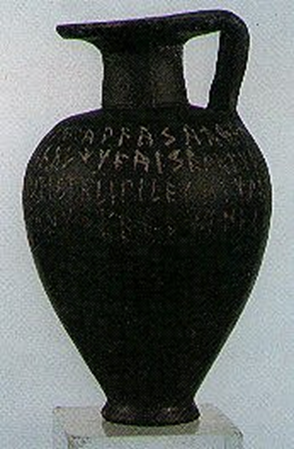
Painted pottery
Buccero – distinctive style of pottery
Vase painting – greek influence - dancing and competition
Gold work
Statues – Distinctive features pointy beards and stylized features
Society
Regal style society to system reminiscent of Greek polis
Distinct and hellenized society
Imperial expansion
Presence in Early Rome
Tarquin dynasty at Rome
Lucius Tarquinius Priscus
General depiction is negative due to hostilities – described as pirates
Theopompus of Chios
“ Sharing wives ” – Etruscan men are looked down upon
Goes against Greek custom : legitimacy of offspring fidelity and sexual consciousness
Misogyny in Greek society was mostly centred around maintaining ‘purity’ of heritage
“ It is not a disgrace for them to be seen naked ” – Exposing one’s body – slaves prostitutes etc could be exposed at the expense of whoever wherever – women, respectable ones need to cover up — clothes = sense of shame
Issues with the historical accuracy – Theopompus is clearly biassed in some accounts
Etruscan women did recline with men during dinner and did sit with men while watching sporting events.
Funerary inscriptions identify the deceased by both patronymics and matronymics
Etruscan woman had greater legal and social status than the majority of Greek women
Mommys boy - as a term carries heavy social implications
Death = partytime
Greeks Attitudes Towards the Etruscans
Commercial and military rivals (Carthiginians in NA)
Once Greek defeated Etruscan fleet off Cumae in 474 BC, Greeks could afford to disparage defeated enemy
Wanted to account for the decline of Etruscan Naval and land power in 5th and 4th cent. BC
Luxury
Softness that comes with being overripe
Herotodus - “soft lands breed soft men”
Monarchy to Republic
Last of the kings – Tarquinius Superbus – Etruscan origin
Superbus conveys arrogance – haughty – tyrannical populist (manipulated the masses)
Expelled – 6th century BC.
Monarchy was replaced by elected republic system
Magistrates senate etc. remained the same – change may have been gradual or instant
Basic Principles:
The pomerium
= the sacred boundary of the city
Within the pomerium was ‘home’ (domus)
Outside was militia (i.e., the area of military service
Implicit in this distinction is a basic view of the world
Imperium
= ‘command’
Gentes
family or clan groups
Populus
= ‘people’
but the word’s basic sense suggests the army
res publica populi Romani
= ‘communal affairs of the Roman people’
Basic Elements of Republican Government
Collegiality
Magistrates were part of boards called ‘colleges’
Popular Election
Roman magistrates were always elected by the Roman People in their various assembles
Annual term for office
This proved to be problematic with respect to military campaigns
Prohibition of direct election from one office to another’
Consuls:
Absolute power for their
Ptrologing consuls – consolidation of power
Wars and victories – got filthy rich
Armies became more loyal to them and to Rome
End of republic – civil wars compounding
The Struggle of the Orders
Patrician families
Connected with rank of pater
Magistrates - elected from small number of elite families
Ruling few
The plebs
Adj. : plebeian
Non-patrician members of populus Romanus
Mob crowd throng
Contrasts and struggle of the two – central aspect of the Republic
Roman Expansion
Make plebs happier by exploiting them!
Conquest time
Hadrian's column
Italian tribes – etruscan like people – brought them under Rome's control
Towards the end of 5th cent. BC, Romans began campaign of conquest and colonisation
Alexander’s territory turned into small states and individual territories
Romans had Rome. Political expansion – imposition of roman culture/
Latin became the standard language. ‘
Other languages:
Iscan-Umbrian, Greek, etruscan, Gallic
Roman Imperialism
Modern term — growth of colonial empire 19th and early 20th cent.
Used to describe growth of roman power
5th to 2nd cent. BC Rome was a profoundly military society
Public figures – minimum 10 yrs in military
Imperium was essentially military power
Troops and wagon and captured loyalty, a general being celebrate for being the leader of all this… triumph over conquest
Any aspiring magistrate had to have performed 10 yrs of military service
Roman expansion was rooted in military success – they thought it lifted you up to the level of gods
Alliances - on Roman terms, resistance was met with conquest.
Character of Europe and Roman society.
Moving outside of Italy
Political unity – long term control by establishing provinces.
WHy?
Origin was defensive and only incidentally expansionist
Economic motives and desire for territorial acquisition
Political classes believed other states should do what Rome wants
Pax Romana
Aeneas
The Punic Wars
Carthage
Phoenician colony on coast of NE Tuci
Important trading centre
Sought naval control of important trade routes,’
Carthage and Rome
Rome and Carthage were close
Intentionally not initiated
Rome won
Could be explained by following factors – determination s
RepublicAtilius Regulus was captured
250 BC — carthaginians - sent Regulus to Rome to negotiate exchange of prisoners
Corvus
Technological innovation in naval building.
Rotatable boarding
Sea battle into land battle..
2nd war was provoked by Carthi
Hannibal
Can only perceive through a roman lens.. A
Considered by both ancient and modern historians to be one of the greatest generals in history
Combining infantry and cavalry , importance of military intelligence, loyalty from his troops
Third and final punic war
Provoked by Carthage
Defeated by a Roman expeditionary force
One side’s account, defeated
The republic maki
Effect of Roman Conquest
Constitutional anomalies from Hannibalic War – second punic ads
Imperium and growing empire
Repredal
Increase in personal wealth
By procuu;
Slavery in war
Wealth acquisition – wars of conquest
Family farms and lands —
Mom and pop farms worked upon by hundreds of slaves
Male head of family was important figure in political roles etc. usually they were in the army – small holders were often soldiers
They could not compete in markets with large estates
Growing urban port in rome
You have to have some sort of property to be a soldier — strategy of them having a stake in the roman empire.
Vast wealth & power of senatorial class led to arrogance
Treatment of Antiochus IV of Syria by Gaius Popillius Laenas (refused to shake his hand)
Resentment among italian allies – who were largely excluded from power
First Century BCE
Collapse of the Republic
Collapse was not the end of the empire
Oligarchic republic to a dictatorship
Conquest of mediterranean basin created number of problem
The Gracchi
Tibersius Sempronius Gracchus
Elite family – re
Tibirius practised holding office
As tribune of the pleds, scipios absences Gracchus propeda
Gracchus ignored senates will on foreign policy
Tyrant in the making – alienated supporters by seeking immediate re election to avoid prosecution fo
Marius
‘New man’
Popular support
Cornelius Sulla Felix
Prominent patrician family
Used army to seize Rome
Significant reforms – divesting power
Tribunate was weakened
Caesar
100 – 15 March 44 BCE
Born into patrician family – claimed descent from Venus and Aeneas
Conquest in Gaul
Capable general – easy defeat of Pharnaces at Zela (crimean territories)
Cleopatra
Ptolemy Caesar
Civil War
Bloody struggle ended with Caesar in control of Roman State
Author of two surviving Commentari
Monarchs would place themselves on a pedestal – on the level of gods
Assassinated hastily
Instituted a divine cult
Dressed in manner of early kinds but did not assume the title rex
Murdered at steps of the senate
Why was he assassinated?
Caesar was a threat to the return of the republic
Civil unrest resumed after his death however
Ptolemaic rules of Egypt lived in a Greek bubble
Cleopatra
Relations with high profile Romans
Became Queen 51 BCE
First alone, later with younger brothers
Children with Marc Anthony and Caesar
Romanticized — more powerful irl than historical record
Said to be author of treatises on hairdressing and cosmetics
Octavian’s Propaganda →
Interesting impressions of her
Monster and a wicked woman
Horatius’ Poem on the Death of Cleopatra
Sacrilegious to bring out Caecuban – insinuating her religious and cultural opposition to their own?
Not only a threat to those loyal to caesar but also a threat to the whole empire
“Contaminated flock of men diseased by vice” — eunuchs
Out of control, drunk.
Augustus
Statue –
Upper attire is militaristic
Draped toga – warriors didn't fight with the toga, but it's a symbol of civilised conduct
Roman culture – religion, roman civilization and their way of life
Barefoot – direct contact with the earth, connected with the land (Augustan Ideology)
Baby – aligning to the Julian lan, and close association with the god venus – Cupid is the son of Venus
Children who represent the future – referencing Augustan Ideology again
Painted and richly decorated – not white marble
Series of Civil wars after Caesar dies
The Battle of Actium stabilised the situation a great deal.
Forces under Octavian had a victory – and they wanted to stop civil wars
“August” – make big
Maintaining control – challenge was to create a permanent system to govern Rome.
Army has to be repurposed to traditional roles against foreign enemies – outwardly facing army
Restoration from civil wars’ inward focusing army
Augustus as Princeps
Not an official title but reflected pre
Restoration of the Republic
Jupiter increasing
He was interested in Control
Test IV Notes
Augustan age was high point of Roman culture
Roman Art —
Warm up slide – colossal statue
Constantine – converted on deathbed, Christianization of Roman empire
Greek Art – public & private
private : decorative intended for personal use ; public : decorative but regularly commemorative (sometimes symbolic function)
Scholar relation to leisure since you have time to contemplate
Art and artistic style influenced by numerous cultures
Spoils from campaigns ; Greek artists migrating to Rome
Romans were more interested than the Greeks in commemorating historical events in public and priv art.
Admiration of Greek but air of superiority
First Europeans to produce art gallery?
Private Patronage
Sources
Discoveries from all points of the Roman Empire
Digs and black market in antiquities
Pompeii and Herculaneum
Eruption of Mt Vesuvius (79 CE)
Eyewitness account – Pliny the Younger (Gaius Piniuis)
Important for understanding of ancient art and domestic life
Roman Painting
Range of subjects - traditional myth to military conquests
Migration ot Rome (Greek artists)
Wall painting
Portable panels to wall painting shift … Elder Pliny said “this is deplorable”
Pompeii & Herculaneum had extensive paintings in residences
Simple designs to complex polychrome chemes and scenes
Pompeii
House of the Vettii ; north and southeast oecus
“Punishment of Dirce” painting
Daedaius showing Pasiphae the wooden cow
Ixion bound to the wheel by Hephaestus
Trompe l’oeil decor architectural motifs and picture in house near Farnesina
Trompe l’oeil decor in ‘Room of Masks’ from house on Palatine
Scenes from landscape of the Odyessey
Tomb on the Via Latina
“Chiron and Achilles” painting from the basilica of Herculaneum
Roman Minor Arts & Crafts
Astrology
Serpent design ring
Engravings
Metals like Sardonyx Chacledonyx
Augustus the transvestite????
Focus on Portraits:
portrayal of people as they are – individuated by iconography
Mercury god of commerce – merchandise
Optical Illusions
Effeminate clothing on men?
Achilles hidden, dressed up as a girl – puberty initiation
Decor - silver plates
Statues Dionisiac scenes
Lamps
Roman Mosaics
opus tessellatum
stone or marble cut into cubic shape and fitted closely together in mortar
opus uermiculatum
tiny pieces fitted together without any spaces ; imitates painting
opus sectile
larger pieces
emblemata
panels made in artists’ studios
Greek myth and literature
Roman Sculptures
Bronze marble other stones, precious metals terracotta
Typically mabrle
Used for extensively Commemorative purposes:
Funerary, decorative art or state propaganda, religion
Varieties:
Statues, busts, relief Friezes and panels, architectural embellishments
Roman Architecture
Colosseum –
Marble decorations
Stolen and sent to Vatican for homes of the elite etc.
Absence of casingsrinthian columns – all orders are there
Psnk
Pantheon
Hellenistic & Roman Philosophy —
Best sources from hellenistic philosophy are from romans
Important in order to become a sophisticated leader.. Someone who can lead an army, wage a case at court
Who they wanted to be –
Philosophy narrowed – less comprehensive than intellectual initiatives of Plato and Aristotle
Non-greek influences
More schools were established
It became more systematic
Plato and Aristotle’s attempts at making or producing systems is still uncertain
Philosophy became an integrated system for a complete understanding of the world’s structure and our place in it.
Principal Schools
Stoicism
Zeno of Citium, Athens 313 BCE
Stoa Poikile — Painted Porch
Almost failed after Zeno – divergent positions unified by Chrysippus
Appeal to Romans: Duty – what you must do not what you wish to do
WritingsCicero
Stoic doctrine
Stoics made important contributions in the areas of logic, physics, and ethics
Stoic Physics
materialist
appeal to exceptionless laws — fate
Fire basic substrate through which things are produced
Cf. Heraclitus: emphasis on fire
Stoic Ethics
Virtue is sufficient for happiness
Virtue? And maleness?
Nothing except virtue is good
Emotions are always bad
Epicurus
341-270 BCE
Best known through Lucretius’ Latin poem De rerum natura
Titus Lucretius Carus c. 94-55 BCE
Doctrine
Pleasure
Atomic theory
Freedom from fear of the gods
Cynics
Founded by Diogenes ‘the dog’
so called because of his shamelessness
c. 412-324 BCE
Not really a philosophy, but a way of life
Extreme primitivism: ‘live according to nature’
Opposition to material possession
Very influential on later Greek and Roman thought
No writings survive complete
Roman Religion
Focus on hearth
Myth is Greek myth disguised as Roman gods
Goddess Vesta – cult of Vesta
Roman temples have similarity to Greek temples, just different origins
Abstract Divine forces pervaded the world - numina
Greeks were profoundly anthropomorphic → Roman religion was originally not; gods didn't have form
Talked not only of Gods, but numina as well
Agrarian – agriculture deities have big presence
Farms and divinities:
Flora - growth, Pomona - edible grown products, Consus - storing of agricultural produce, Robigus - croplite , Ceres - comprehensive goddess ; cereal ; demeter
Range of minor agricultural deities are not present in greek religion
The door connected to god Janus
Janus Clusivius - closing the door
Threshold – limentinus
Cardea - goddess of hinges
Forculus - fulcrum? Manipulating door leaf
Twelve gods → dii consentes
Twelve olympians cf.
Iuppiter ; Iuno ; Minerva ; Vesta ; Ceres ; Diana ; Venus ; Mars ; Mercurius ; Neptunus ; Volcanus ; Apollo
Gilt statues were originally stoof in the forum
Janus
God who presides over beginnings
Water-ways and crossings
War – temple of Janus was closed by Octavian in 29 BC
Hestia - Vesta
Connected with fire
Vulcna nature fire
State cult
Mars - Ares
Agricultural deity
War god is a later development
Jupiter
Product of hellenization
Great temples on the Capitoline
Cult developed and promoted by Augustus - divine patriarch
Magic in the Ancient World
Worshippers of superstition
Curses written, folded up and nailed through - binding spells
Definitions? What is magic
“a manipulative strategy to influence the course of nature by supernatural (‘occult’) means” (Versnel)
Considerable overlap of religion and magic
Coercion – vs in religion you have to pray and hope
Concrete goals and performative strategies (spells, incantations etc.)
The distinction between magic and religion is difficult to maintain
In our sources prayers, magical formulae, magical ritual all occur
Secret knowledge and emphasis on the Secrets of the world – arcana mundi
Reason why magic became increasingly associated with evilness
“Agamemnon spoke, and cut the lambs’ throats with the pitiless bronze and laid them on the ground gasping, as the life left them, their strength robbed by the bronze. Then they drew wine from the bowl into the cups, and poured it on the ground, making their prayers to the ever-living gods. And this is what any one of the Achaeans and Trojans would say: “Zeus, greatest and most glorious, and you other immortal gods: whichever side first offends against these oaths, may their brains spill on the ground as this wine is spilled, their own and their children’s, and may their wives be other men’s conquest.”
— Homer, Illiad
Sources
Literary texts
Classical period – more explicit and detailed
Allusions to magical practise in Homer
Magical papyri
Handbooks for magical practitioners: spell recipes
Inscriptions curse tablets
Very private rituals and often buried
History
Main approaches:
Long tradition and an ancient feature of the Mediterranean world
Or that magic came into the Greek world from the East - esp. Persia
The Greek words magos, mageia (= Lat. magus, magia, magicus) are derived from Persian
the magi
Plato speaks of ‘the magian lore of Zoroaster’
Evidence for magic is more abundant and explicit after the Archaic Period
an orientalizing period
Early Evidence for Magic
Homeric poems
Circe in Odyssey - book 10
Autolycus’ treatment of odysseus wound in Od. 18 —
“They bound the wound of blameless, godlike Odysseus with skill, and checked the black blood with a spell (epaoide)”
Why is Homer reticent about magic?
Was magic a basic feature of Homer’s World
Objectives
Harmful — black magic
Curse tablets - defixiones katadesmoi, incantations, potions and positions - pharmakon, pharmaka, sympathetic magic, contagious magic
Beneficial — white magic
Magical techniques:
Uncanny utterances: onomata asema or upces magicae.. foreign words? Prayer formulae and form
Any objects can be used
Special gestures.. performance is a very integral aspect of it.
Notable Witches:
Circe
Homer – powerful sorceress
Medea
Most famous ancient witch – great literary figure. Euripedes – play about a woman who is wronged
Canidia (Horace)
Roman society – she has a bunch of followers and they kidnap an elite boy
Erictho (Lucan)
Realm of the dead early routine in epic.. Deluxe witch.. Charming the moon down ; involved necromancy – occult behaviour
Social Setting
Magic was highly valued — religious ceremonies would often contain magical elements
However secretiveness promoted suspicion
Magic as bad religion or praua religio .. and superstitio
Five ‘Recipes’
All purpose spell
Protection against Hecate
Associated with Artemis ; becomes separate from her and becomes a mysterious dark goddess, worshipped at crossroads
Invocation of Hecate’s aid in divination and against a death penalty
Invokes Hecate against an enemy
A counter-spell against an enemy’s spell
Roman Literature
Prose
History
Titus Livius (Livy) 59 BCE – 17 CE
P. (?) Cornelius Tacitus ca 56 - 118 CE
Philosophy
M. Tullius Cicero 106 - 43 BCE
Lucius Annaeus Seneca ca 4 BC E- 65 CE
Oratory
Cicero
Novel
Petronius Arbiter d. 66 CE: Satyricon
Apuleius ca 125 -170 CE: Metamorphoses or Golden Ass
Roman Drama
Characteristics:
Adaptations of Greek originals
Greek New Comedy
Euripidean tragedy
Some influence of native Roman traditions
Esp. for comedy
mime
farce
Seneca’s tragedies are much later and very different in character
10 plays survive (2 are spurious)
influenced by Greek drama, not adapted
strong Stoic colouring
Major Figures:
Tragedy
Quintus Ennius
239-169 BCE
only fragments survive
Comedy
Publius Terentius Afer (Terence)
d. 159 BCE
6 plays survive
Titus Maccius Plautus
ca 205-184 BCE
21 plays survive
Name Maccius suggests ties with sub-literary popular entertainment
Free in his adaptations of Greek Comedy
Substantial musical element: exuberant and virtuoso cantica (arias and duets)
His humor is broader than New Comedy generally
New comedy tends to have humor found in the situation
In some ways feminist of old comedy – aristophenes – word play and puns
Fondness for elaborate comical names like artorogus
His plots are varied
Character study aulularia
Transvestite camp casina
Mistaken identity
Roman Satire
satura quidem tota nostra est (“satire, at any rate, is all our own”), according to Quintilian (10.1.93)
But an important debt to Cynic diatribe
Enshrined a Roman tradition of freedom of speech, although the reality is more cautious
Poems detail the foibles of Roman society
The major writers of satire:
(Gaius Lucilius ca. 180 BCE – ca. 102/1 BCE)
Quintus Horatius Flaccus (Horace) 65 - 8 BCE
Aules Persius Flaccus 34 – 62 CE
Decimus Iunius Iuuenalis (Juvenal) 67- ca 127 CE
Prose satire:
Seneca, Apocolcyntosis (‘Pumpkinification’)
written on the death of Claudius and the ascension of Nero in 54 CE
Roman Epic
No evidence for Roman oral epic tradition – started from contact with Greeks
Livius Andronicus’ Latin translation of Odyssey as one fo teh defining events in 3rd cent. BCE
21+ fragments of Livius’ Odyssey are rpeserved
Kept close to the actual wording
Adapted the text witha view of Roman sensibilities and idea of storytelling
Then Naevius’ Bellum Poenicum (late 3rd cent. BCE)
Quintus Ennius’ Annales (finished before 169 BCE)
Andronicus as a Translator
Names of gods and heroes are given Roman counterparts
Mousa = Camena
Odysseus = Ulixes
Morta (a Roman goddess of prophecy) replaces fate
Conceptions shocking to Roman ears were toned down
e.g. Patroclus described as ‘counsellor equal to the gods’ (Od. 3.110) becomes uir summus adprimus (‘first-rate leading man’)
Vergil’s Aeneid
Publius Vergilius Maro (Vergil / Virgil) 70-19 BCE
The Aeneid is the great epic of Augustan Rome
Skilfully combines the Homeric tradition with Ennian tradition of historical epic
In 12 books it narrates the adventures of Aeneas, and looks forward to the founding of Rome and its imperial mission
It is not merely propaganda: it presents a highly complex view of the human condition
Other Epics
Ovid’s Metamorphoses (P. Ovidius Naso, 43 BCE – 17 CE)
Lucan’s Pharsalia or Bellum Ciuile (M. Annaeus Lucanus, 39-65 CE)
The tradition continues with minor figures who continue the Vergilian (and Ovidian) tradition
Personal Poetry
Neoterics (poetae nouui)
Gaius Valerius Catullus – most accessible poetry
Best known for cycle of poems that he wrote about an affair
116 poems ; survival was almost a fluke
Lyric Poetry
Quintus Horatius Flaccus (Horace) 65 - 8 BCE
Four books of odes
Love Elegy
Propertius, Tibullus, Ovid
Catullus poetry
Roman Law
Sources:
Statutes: laws passed by roman people in assembly - comitia.. decrees of senate, legal pronouncements of emperors
Injunctions of magistrates:
Annual edict of urban Praetor
Romes chief judicial magistrate
Important for private law
Other magistrates especially provincial governers had edicts of their own
Long standing custom
Jurists
Like modern lawyers
although they had no formal training
few in number (about 20 in the early period)
Dispensed legal advice to clients
clients were expected to provide political support
close interrelationship between law and politics
Jurists developed a rule-based form of judicial decision-making
Legal processes became more formal and ‘professional’
The Digest
Classical Roman jurisprudence is preserved in the Digest
a collection of excerpts from the writings of jurists
over 800,000 words in length
was assembled and published on the order of he Byzantine emperor Justinian in 533 CE
The most influential source in the western legal tradition.
Roman Lawcourts and Judicature
Two basic models:
arbitrator acceptable to both parties
paterfamilias calling upon friends to advise him on crimes committed within the familia
Chief exceptions:
assembles used to try cases with political implications
esp. perduellio (can include violence threatened against the state)
concilium plebis (more democratic)
monetary penalties
comitia centuriata (favoured the wealthy)
penalties often serious (capital, exile)
In 63 BCE a simpler system was implemented:
7 permanent criminal courts (quaestiones perpetuae)
extorsion in the provinces (repetundae)
misuse of public funds (peculatus)
electoral corruption (ambitus)
forging of coinage and wills, treason (maiestas)
murder with a weapon or by poisoning (uis)
Augustus added an eighth for adultery
Pompeii
Shrines – prominence of pillars, places of worship
Remains of statues, shegs, storage rooms
Ceilings with artwork
Herculaneum – women’s bath decorated shrines of marine imagery
Villa of the Papyri – notable figures at the end of the republic
Found papyri,
Culture
Roman Empereors – imperator aka successful general, wiedling imperium
Augustus settled on a bundle of powers > govt power
Julio-Claudian Emperors
Augustus
16 January 27 BC to 19 August 14 CE
Tiberius
19 August 14 to 16 March 37
Both died of natural causes
Caligula (also known as Gaius)
18 March 37 to 24 January 41
assassinated by the Praetorian Guard
Little boot — military campaigns w his dad Germanicus
Claudius
24 January 41 to 13 October 54
poisoned by Agrippina
stammered and was limp
Uncle of Caligula
Nero
13 October 54 to 11 June 68
committed suicide
Year of Four Emperors
Galba
8 June 68 to 15 January 69
assassinated in favour of Otho
Otho
15 January 69 to 16 April 69
Committed suicide
Vitellius
2 January 69 to 20 December 69
assassinated in favour of Vespasian
Flavians
Vespasian
1 July 69 to 24 June 79
Titus
24 June 79 to 13 September 81
assassinated by Domitian?
Domitian
14 September 81 to 18 September 96
Assassinated
Nervan-Antonian
Nerva
18 September 96 to 27 January 98
Proclaimed emperor by senate
Trajan
28 January 98 to 7 August 117
Hadrian
11 August 117 to 10 July 138
Antoninus Pius
10 July 138 to 7 March 161
Marcus Aurelius
7 March 161 to 17 March 180
Lucius Verus
7 March 161 to March 169
Co-emperor with Marcus Aurelius
[Avidius Cassius
175
Usurper
Ruled only in Egypt and Syria – assassinated by his own army]
Commodus
177 to 31 December 192
His accession brought prosperity.. But then boy got assassinated
Year of the Five Emperors (193CE)
Five claimants, each supported by different constituencies
Really a period of civil war
Severan Dynasty
Septimius Severus (193–211)
restored peace
Caracalla (198–217)
Geta (209–211)
[Macrinus (217–218)]
Elagabalus (218–222)
Alexander Severus (222–235)
Dynasty was unstable: political turmoil and problematic family relationships.. The Severan emperors are the last of the lineage of the Principate founded by Augustus.. The Crisis of The Third Century followed
Case Study: Elagabalus
c. 203-222 CE
born Varius Avitus Bassianus ; brought ot Rome at 15
related to the Julian clan through his mother, Julia Soaemias
Accession was orchestrated by his mother, who claimed that he was the son of Caracalla
Renamed Marcus Aurelius Antoninus
Priest in Emesa of the sun-god Heliogabalus, to whom he built two temples in Rome
Notable for outrageous behaviour
left the affairs of state to be run by women
even let his mother sit on the Consul’s bench
Earned the hostility of Rome
planned to have the Sun-god named the supreme deity of Rome
divorced his wife to marry a Vestal Virgin
Assassinated by the Praetorian Guard
Remains an enigmatic figure
principal account in the Historia Augusta is suspect
Popular Entertainment in Roman Culture
Gladiators:
Combat introduced to Rome from Etruria in 264 BCE
Originally held at Etruscan funerals for dead warriors
Expensive for sponsors – scale of combat would be large
5000 pairs fought in 8 diff games given by Augustus
4 types of Gladiators
Murmillo – fish crest on helmet
Samnite – heavily armed, oblong shield and visored helmet
Retiarius – lightly clad fighting with a net and trident
Thracian – round shield and curved scimitar
Prisoners of war and slaves – fighting as gladiators
Professional fighters were either slaves who were bought for that purpose or a free volunteer bound to an owner by an oath
Valuable investment
They were trained in schools under a lanista (retired gladiator)
Elite romans were attracted to a gladatorial career because of its glamour and sex appeal
Augustus and Tiberius → wanted to manage popularity so they passed legislation forbidding members of the senatorial class from becoming gladiators
Restrictions on games seem to have had more to do with expenditure than distaste
There were objections to the idea of bloodshed for fun
Cicero and Pliny approved if the combatants were condemned criminals
Gladiatorial combats were first banned by Constantine I in 325 CE
too bloody a peacetime activity
Funerary inscriptions for dead gladiators
‘Fatal Charades’
You must believe that Pasiphae did couple with the bull of Dicte: we have seen it happen, the age-old myth has been vindicated. Don’t let ancient Tradition vaunt herself, Caesar: whatever Legend sings, the amphitheatre (harena) offers you.
Martial, Liber Spectaculorum 6
Horse and Chariot races
Originated in Cult
Sacrifice to Mars of the equus October
The popular chariot races held in the Circus Maximus (and provincial counterparts) were managed by factions
characterised by colours (white, red, blue, green)
= seasons (Tertullian)?
Circus factions
blue and green eventually predominated
“Bread and Circuses”
popular entertainment for the masses
Individual charioteers became celebrities in Roman society
Martial – nasty poems
Women & Family in Roman Society
Almost all of the information we have about Roman women derives from elite Roman males
Usually women were portrayed stereotypically
Chaste wives, mothers and daughters
Evil seductresses, scheming power-mongers
Evidence had resulted in scholarship tending to treat women more narrowly in relation to men
The reality was almost certainly more complex
Women played many roles
The focus has often been on what they could not do rather than what they really did
Recent work has attempted to redress the balance
Their Public Life
No political rights, could not vote or be elected or hold office
They could however, exemplify an ideal – embodying the values of the state, self-sacrifice to preserve ideals
Some women did play ia role in political life
Through men in their lives – Cornelia mother of Gracchi
in their own right (e.g. Servilla, lover and friend of Julius Caesar and mother of Brutus, who chaired political meetings in a time of crisis)
Livia (Augustus’ wife) combined virtuous and old-fashioned behaviour with a very active political agenda
Roman men considered women frail and weak of mind, and so could not participate in business
the required a legal guardian (tutor)
Cf. the kyrios in Greece
The reality was that they worked independently of their tutores
Cicero’s wife Terentia managed the household finances
his daughter Tullia was a keen student of philosophy
Marriage and ideals
Typically married in their teens – 10-15 yrs older with 6 children on avg
Married to one man and after his death remain devoted to his memory – uniuira
The Chaste casta or pudica uniuira is a highly praised ideal – opposite criticized
Divorces and remarriages were common though
To remain unmarried was not an option until the influence of Christianity grew around 400 CE
Sexual renunciation and ascetcism
Taking the veil – virgins of the church OR vow of Chastity after death of husband
Oppressive culture for pagan women
Most significant way of creating alliances – elite & political alliance .. lower class alliance was often more practical
Emphasis on children
Matrimonium – institution for making mothers
Women played a prominent role (as in Greece)
this has often been underestimated by modern scholars
Were believed to be important in securing divine favour in war
Could also be held responsible for a crisis
E.g., Vestal Virgins
Two Imperial Women
Livia Drussila
58 BCE –29 CE
Married to Tiberius Claudius Nero in 43 BCE
son Tiberius (b. 42 BCE)
Divorced and married Octavian (later Augustus) in 39 BCE
scandalous because she was expecting her second son Drusus
Along with Augustus’ sister Octavia, Livia was consider a model of womanly virtue
Received important public honours during Augustus’ lifetime
After his death and the accession of Tiberius she became even more prominent
Received title Augusta (in Augustus’ will)
Became the chief priest of Augustus’ cult
Remained popular with the masses
Rumours of murder seem to be false (Robert Graves)
Deified after her death by Claudius on his accession in 41 CE
Agrippina The Younger
15 – 59 CE
Born to an illustrious family (with two earlier distinguished Agrippinae)
Exiled after the death of her husband Lepidus
Recalled and married by Claudius (48 CE)
she was his neice
Received honours as Augusta
Claudius adopted her son Nero by Lepidus
Highly honoured but sought greater power and influence
May have poisoned Claudius
Nero had her murdered
She wrote a memoir that was used by Tacitus (now lost)
Funerary Epitaphs
A very important source for information about women’s lives are epitaphs
funerary inscriptions set up by husbands and/or family
often celebrate the virtues of the deceased
“To the dead spirits of Claudia Lachne, freedwoman of Antonia, Philippus Rustianus, public freedman from the Sacrarium of the Divine Augustus, made [this tablet] for his dearest wife and for himself.”
CIL VI 2329
Slavery
Played an important part in society
Performed domestic and agricultural tasks within the household of their masters
Warfare and debt slavery were the most common sources for slaves
Terminology: seruus (f. serua) as opposed to ingenuus (f. ingenua)
also minister (f. ministra)
The wars of conquest generated large numbers of slaves
Worked on the estates owned by aristocratic families for large-scale agricultural production
Slaves were desirable because they were cheap and easy to control
But the large concentrations of slaves on estates created the threat of revolt
Revolts
The most serious was in 136 BCE
took 6 years to suppress
resulted in the crucifixion of thousands of slaves
The most famous was led by the gladiator Spartacus in 73 BCE
numbers grew to ca 70,000 (120,000 in some accounts)
took the Romans two years and 10 legions to put down
revolt put down by Lucinius Crassus in 71 BCE
Slave Families
Increase in aristocratic wealth led to huge slave families (often numbering in the 100s)
Early emperors had slaves and freed slaves to carry out routine administrative tasks
called familia Caesaris
were more trustworthy than the senatorial class
some of these slaves became very wealthy
(many slaves were allowed to keep part of their peculium)
Nuanced picture
There were many types of slaves
Literate slaves could occupy important positions within the household
Ambitious slaves were often set up in business
Obedient slaves could set up their own families
Dissident slaves often endured harsh conditions
hard labour, etc.
Punishment
It was a master’s right to punish slaves
corporal punishment (i.e., beatings)
executions
The harsh treatment emphasized the difference in status been slave and freeborn person
Torture was routinely used in law-courts
Manumission
Slaves could be freed
Occupied a recognized position in society
Remained bound to their masters
Terminology: libertus (f. liberta)
In special cases the freed slave could be granted citizenship
Horace was the son of a libertus
Early Christianity
Flourished among lower-class Greeks in cities of the empire
Official ‘persecution’ strengthened the sense of community among Christians and reinforced their identity
Christian communities were extremely hierarchal
Structure of the Early Church
Each community had:
a church (ekklesia)
senior priests call ‘overseers’ (episkopoi)
the English word ‘bishop’ is ultimately derived from episkopos
‘elders’ (presbyteroi)
There was a strong concern for maintaining the ‘correctness’ of the beliefs of the faithful
an important difference from pagan religion, which was more concerned with practice than doctrine
New Testament and Sacred Books
A collection of 27 writings, mostly composed at the end of the 1st century CE
A diverse body of texts, but focused on the life, death, and resurrection of Jesus of Nazareth
Four different accounts of the life of Jesus accepted as canonical
All the books of the NT were written in koine Greek – various assigned authors real authors unkown
not very accomplished as literary texts in terms of style – but highly influential
Although ascribed to named individuals, the authors are unknown
the Pauline books appear to have been written about a generation after the death of the Apostle
Many other holy books were circulating in late antiquity
Persecution of Christians
Roman Govt. began ot make effort to stamp out christianity
Efforts were inadequate and inconsistent and could not deal with a well organized institution with clear beliefs
Govt.s perspective → Traditional religion is good, social organization!
Christian view of their God being the only god → reinforcement of Pagan gods being evil demons..
Exclusivit claims of Christians were seen as misanthropic
Christians were people who had abandoned their beliefs – criminal organization
Romans were also not great with Jews but they found it justified that Jew adhered to traditional ancestral beliefs
political problems (e.g., Jewish revolt of 66-70 CE in Egypt), a number of Jewish groups existed in the Roman Empire (e.g. Pharisees, Sadducees, and Essenes)
Cf. Josephus: a strong supporter of the Roman state, while proudly affirming his status as a Jew
Two main elements misunderstood:
The Eucharist (re-enactment of the Last Supper), in which worshippers symbolically drank Christ’s blood and ate his flesh
non-Christians associated this with the cannibalistic activities that were supposedly practised in certain disreputable magic rites
Cannibalism and occult rites
The Eucharist formed part of a ceremony called a ‘love feast’ (Agape) celebrating their love of God, and referring to their fellow Christians as “brothers and sisters”
non-Christians saw this as promiscuity and incest
Roman Conquest of Britain
Provinces under the Principate
Augustan Settlement of 27 BCE
Provinces – either public or imperial
Provinces – garrisoned with legions made up of roman citizens
CASE STUDY: Conquest of Britain
43 CE Claudius invades Britain – first major conquest
82 CE the Romans reach Inverness – north towards Sctoland
122 CE – Hadrians wall – were prevalent due to their control of traffic, control of access and regularization of movement of people – boundaries of Romanness were
142 CE The Antonine Wall
Vindolanda
Finds:
Anaerobic conditions have allowed us to find materials that normally would have decomposed very quickly
Examples:
Wattle and daub houses
Writing tablets
thin sheets of wood, latin cursive text written in ink
Recording lists of supplied and letters
The small holes on either side allowed for multiple tablets to be tied together.
Ex. Birthday Invitation
Leather (including shoes)
Who wore them? Materials – Lepidina Slipper. Not exclusively roman soldiers but women children and much more
Organic materials like seeds, nuts and even flower petals
Timber Forts
The first 5 forts were constructed from turf and timber with a technique called wattle and daub
Materials from the early layers which normally decompose quickly are preserved due to anaerobic conditions
Oxygen is blocked from reaching these layers, stopping decomposition
Garbage
Crisis of the Third Century
History of roman principate – increasingly becoming problematic because administratve structure was fragile
Severus Alexander died 3rd CE – accession of Diocletian in 284 CE
Reliance on imperial expansion – fringe of the empire do not want Roman rule ,
Taking back conquered land
A large number of short-lived emperors
Incursions across all fronts of the Empire
Civil war
Economic Decline
By and large – silver currency became devalued and collapsed
Desertion of agricultural land
++ Plague famine and population decline
Drinking lead – fertility rates?
Roman Army
Expanding empire and increasing wealth of the elites…
In this period tho they become an issue
Increased army was an economic burden
Cycle of inflation – pressure ot pay led to debasement of coinage
Armies felt their importance – proclaiming emperor of their choice and thus decline of senatorial influence
External threats
Sassanians in the east captured the emperor Valerian (253-260 CE)
Valerian died in captivity and his flayed skin decorated a Persian temple
Germanic tribes (e.g. Franks) in the north and west
The reason for these incursions is not clear
Periodic
did not involve large numbers
They required the deployment of military resources to the frontiers of the Empire
Crisis was not Universal
Accelerated processes of decline begun under the Severans
A flowering of local culture in some places
Short-lived independent kingdoms
Palmyra in the Syrian desert (267-273 CE)
Gaul
Continued urban growth and prosperity in North Africa
oil trade
Tetrarchy
Too big to be controlled centrally – division into eastern and western empire – rome and Constantinople
A response to the Crisis by Diocletian
The empire was divided in two, each presided over by an Augustus, aided by a Caesar in the late 3rd CE
Augustus Iovius and Augustus Herculius
Rise of powerful ‘warlords’
e.g. Stilchio (ca. 359–408 CE) “the last of the Roman generals” (Gibbon)
Claudian
Last of the Roman generals – stronger cultural ties to local area than to Rome – overlying sense of Romannes is undermined
Fall of the Empire
Divison of empire was a band aid solution
476 CE: Romulus Austuslus deposed
Within a generation Western empire got divided into a series of Germanic kingdoms
Eastern Empire – Byzantine empire continued (1000 yrs) and fell in 1453 CE